You're halfway through the walk when a beagle appears across the street. Your Lab mix freezes, locks onto the dog, then launches forward with both front feet off the ground. You brace your knees, shorten the leash, and pull back while saying, “No, leave it.” By the time the beagle disappears, your dog is still scanning the pavement and you're wondering how the next walk became a problem to survive.
The fastest way to change this pattern isn't to overpower the lunge. It's to understand what drives it, prevent unnecessary rehearsals, and train only at a distance where your dog can still think. How to stop dog lunging at other dogs starts with management, then becomes a training problem.
Why Dogs Lunge on Leash
A dog that lunges can look dominant, stubborn, or aggressive. Those labels usually hide the useful question: what is the dog trying to accomplish emotionally? A leash blocks the option to move away, and some dogs respond to that restriction by escalating toward the approaching dog.
Fear is a common driver. The dog sees another dog, feels trapped, and uses barking, stiffening, pulling, and lunging to create space. Frustration produces a different pattern. The dog wants to approach, but the leash prevents the greeting, so excitement builds until the dog explodes. High arousal can intensify either response.
Practical rule: Treat the lunge as information about the dog's emotional state, not as evidence that the dog has chosen to disobey.
The leash itself can amplify the reaction. A worried dog may first freeze, stare, and shift weight forward. If the trigger keeps approaching and escape remains unavailable, that quiet tension can turn into a frantic burst. A tight leash, a handler pulling backward, or a narrow path can add still more physical pressure.
A lunge isn't always a friendly pull
A friendly pull generally comes with a loose body, soft movement, and a dog that can disengage when called. Reactive lunging tends to include sustained eye contact, a stiff body, closed or tense mouth, intense leash pressure, and slow recovery after the other dog has gone.
The recovery period matters. A dog that keeps scanning, panting heavily, whining, or reacting to the next small movement hasn't returned to a workable state. Training during that period usually creates another failure rather than useful learning.
Leash reactivity is also common after adoption, and the peer-reviewed shelter dog study on leash reactivity links poorer socialization and higher arousal during assessment with stronger leash reactions. That finding supports early, careful intervention instead of waiting for the behavior to become a fixed walking routine.
Identifying the Trigger Behind the Behavior
Before choosing an exercise, identify the emotional pattern. Fear, frustration, and general arousal can all produce barking and lunging, but they require different distances, pacing, and expectations.
Fear-based reactions
A fearful dog often lowers its body, tucks its tail, pulls away between outbursts, or shows the whites of its eyes. The barking may stop or soften when the other dog increases distance. Some dogs look “tough” only because the threat is close enough to overwhelm their ability to retreat.
Frustration-based reactions
A frustrated greeter may carry its tail high and wag rapidly, whine before the other dog is nearby, bounce at the end of the leash, or spin while trying to get closer. These dogs may quiet quickly when greeting is permitted, though that doesn't mean every greeting is safe or appropriate. The leash has created an access problem, not necessarily a fear problem.
Arousal overflow
Arousal-driven lunging often looks loose and chaotic at first. The dog may bounce, vocalize, and switch rapidly between looking at the trigger and looking at the handler. Once arousal passes the dog's coping capacity, the body can become stiff and the behavior can include snapping or redirected biting. Adolescent and under-exercised dogs commonly struggle here, but any dog can overflow.
Record short videos from a safe distance, then compare what you see at 30 feet, 15 feet, and 5 feet without deliberately forcing a reaction. The distance where the body first changes tells you more than the loudest moment.
| Driver | Tail Position | Eyes & Ears | Vocalization | Post-Lunge Recovery |
|---|---|---|---|---|
| Fear | Tucked, low, or still | Whale eye, ears back, fixed or darting gaze | Sharp barking, growling, frantic vocalization | Often improves as distance increases |
| Frustration | High, fast wag, or flagging | Forward ears, intense focus | Whining, barking, excited pulling | May settle when access ends or greeting occurs |
| Arousal | Loose at first, then stiff or inconsistent | Rapid scanning, forward focus | Whining, barking, escalating noise | Can remain elevated and trigger easily again |
For a clearer read on signals such as posture, facial tension, and gaze, use this guide to understanding dog body language. If pain, sudden behavior change, or unusual sensitivity appears, involve a veterinarian before treating the issue as a simple training gap.
Finding Your Dog's Threshold Distance
Threshold distance is measurable. It's the closest point where your dog can notice another dog, remain physically functional, and still eat, move, and respond to you. Don't define it by the first bark. The earlier sign is usually a quiet orientation, a stiffened walk, or a locked gaze.
Choose a low-traffic location with room to move, such as an open parking lot or a fenced school area when it's empty. A helper with a calm dog makes the assessment easier. Start far away, then reduce distance in small increments while watching your dog's body rather than waiting for a dramatic reaction.
Useful starting reference points include:
- Across a four-lane street
- Behind two parked cars
- About 40 feet away on a quiet path
These distances aren't universal thresholds. They're practical places to begin looking for the first change in posture or attention.
Use orient, mark, reset
The instant your dog notices the other dog, mark the moment with a clicker or a clear “yes.” Feed several rapid treats, then move laterally or create an angle that breaks the sightline. The sequence is simple:
- Orient: Your dog notices the trigger.
- Mark: You identify the calm observation.
- Reset: You feed, move, and allow attention to return to the environment.
Your initial success criterion is not a close pass. It's a dog that notices the other dog, accepts food, and reorients to you within two seconds. If your dog won't eat, leans hard into the leash, or stares without blinking, increase distance immediately.
A narrow sidewalk is a poor testing ground because your dog has no retreat route. Start somewhere that lets you move sideways, turn away, or use parked cars and corners as visual barriers.
For a veterinary behavior perspective on safe distance, reinforcement, and avoiding overwhelming exposure, review Cornell's guidance on managing reactive behavior.
Building a Training Progression That Works
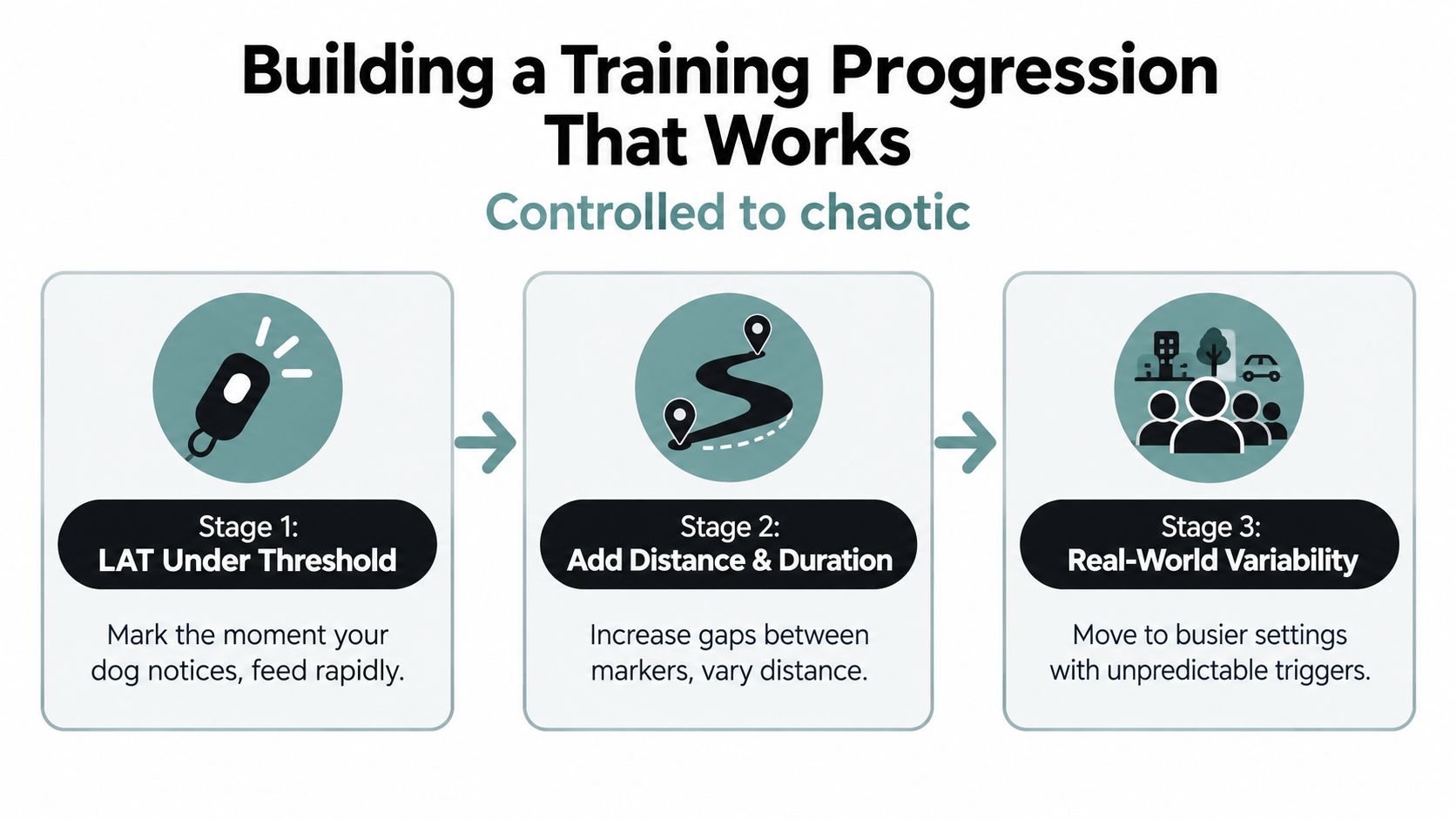
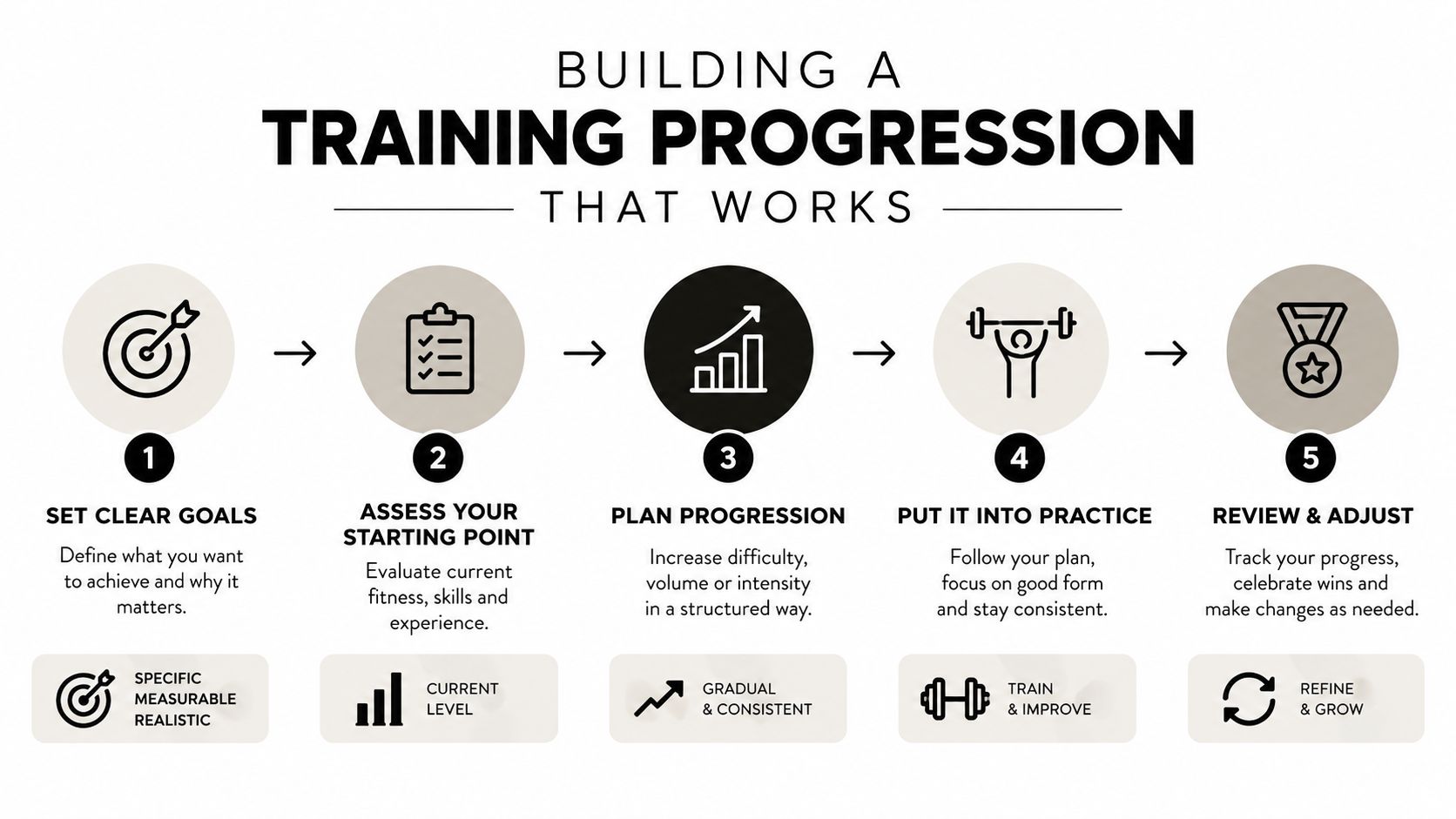
A reliable progression moves from controlled observation to unpredictable daily life. The mistake I see most often is advancing because the dog succeeded once. One clean repetition shows what's possible. It doesn't prove the dog is ready for a harder environment.
Stage one uses LAT under threshold
With Look at That, or LAT, mark the moment your dog notices another dog and immediately begin feeding. During the trigger's visibility, aim for one treat per second. When the dog disappears or you've created enough distance, stop feeding and let your dog reset.
Keep the session short enough that your dog never rehearses the lunge. Move back if the dog starts pulling, barking, or hard staring. Advance only after three consecutive sessions with none of those behaviors.
Stage two adds controlled movement
At the same starting distance, use a calm helper dog for parallel walking. Behavior Adjustment Training, often called BAT 2.0, gives the reactive dog opportunities to notice the trigger, make a choice, and move away without being dragged into a greeting.
Reward check-ins and voluntary disengagement. A long line or dragline can provide freedom in a safe, controlled area, but it must be handled carefully and never used to force contact. Progress with three different helper dogs, not just one predictable partner.
Impulse control can support this stage, especially exercises that teach the dog to pause before gaining access. These dog impulse control exercises are most useful when they build a real alternative response, not when they're used to suppress rising fear.
Stage three brings in real-world variability
Use the same observation and disengagement skills on your normal route. Add busier settings gradually, reduce food only when the dog can remain responsive, and vary the distance rather than marching steadily closer.
A practical starting rate is one treat every three to five seconds during a clean pass. Once the other dog has gone by, say “free” and allow sniffing or forward movement as a release. The goal isn't a dog that never notices another dog. It's a dog that can notice, stay functional, and recover.
Punishment may interrupt sound or movement, but it doesn't change the underlying association and can increase anxiety in fear-driven cases. The technical evidence summarized by AVSAB's controlled intervention review favors desensitization, counterconditioning, and caregiver-delivered reinforcement for leash aggression.
Breed and Age Pitfalls to Watch For
Breed and age can help you form a hypothesis, but they shouldn't determine your diagnosis. Individual history, social experience, health, and the exact trigger still matter more than a breed label.
Herding dogs often turn visual attention into movement control. A Border Collie, Australian Cattle Dog, or Australian Shepherd may stare, whine, and surge toward another dog, then recover quickly between repetitions. The trap is assuming that quick recovery means the dog can handle a longer session. These dogs often need more brief repetitions and less total duration.
Guardian breeds may show a more defensive pattern. A Rottweiler, Akita, or livestock guardian can need substantially more room to observe a trigger without feeling pressured. For these dogs, reducing distance too quickly may produce shutdown, freezing, or a sharper reaction rather than useful engagement.
Sporting dogs and hounds frequently overflow with excitement. Their bodies may stay loose until the stimulation stacks too high, at which point the dog can no longer respond cleanly. Doorway pauses, leave-it games, and controlled access to sniffing can build the foundation before difficult dog encounters are added.
| Group | Lunging Pattern | Likely Pitfall |
|---|---|---|
| Herding breeds | Stare, whine, chase-like pulling, rapid repetition | Mistaking fast recovery for readiness to increase difficulty |
| Guardian breeds | Defensive posture, strong distance-increasing response | Moving closer before the dog feels secure |
| Sporting breeds | Excited pulling, bouncing, vocal overflow | Treating high arousal as deliberate aggression |
| Hounds | Trigger fixation, forward drive, slow response to handler | Expecting food or cues to compete once scent and visual arousal peak |
| Adolescents | Uneven attention and frequent relapses | Raising difficulty after a good run of walks |
Adolescence is especially inconsistent. Dogs between six months and two years can appear improved for a period, then lose access to previously reliable skills as their attention and emotional regulation shift. Keep the environment easy enough for success and resist the urge to “test” a good week.
Managing Lunging in Busy Real-World Settings
A training plan collapses if every walk exposes the dog to more triggers than it can process. Route design is not avoidance forever. It's how you stop paying for unwanted rehearsals while the dog learns a better response.
Audit your neighborhood before you take the dog through it. Select three quiet blocks where dogs can appear at a generous distance, two moderate routes for later-stage work, and one unavoidable high-pressure area, such as an apartment lobby or veterinary parking lot. Enter the difficult area only with an exit plan.
Build walks around visibility
During the first month, choose off-peak periods when the route is quieter. Early morning before 7 a.m. or after 9 p.m. on weekdays may reduce trigger density, but the correct schedule depends on your location and safety. The point is to create repeated opportunities for calm observation, not to force a crowded walk because it feels more like “real life.”
See the trigger before your dog does. Step behind a parked car, hedge, tree, or building corner. A visual barrier can prevent the locked gaze that makes food irrelevant.
A tree trunk can be more useful than a pocket full of treats if it prevents the reaction from starting.
Load a high-value interrupter before leaving home. A nose target or hand touch works well when the dog has practiced it in quiet rooms, hallways, and empty outdoor spaces. Reward the instant your dog turns away from the other dog, then keep moving to safety.
When the trigger appears too close
At ten feet, there may be no time for a polished cue. Cross the street, turn a corner, step into a doorway, or place a parked car between the dogs. If none of those options exists, use your body to block the sightline, feed rapidly while backing away, and keep the leash as steady as safety allows.
A reactive dog doesn't need more courage in that moment. It needs distance. Each avoided explosion protects the next training session.
Your 30-Day Starting Plan and When to Get Help
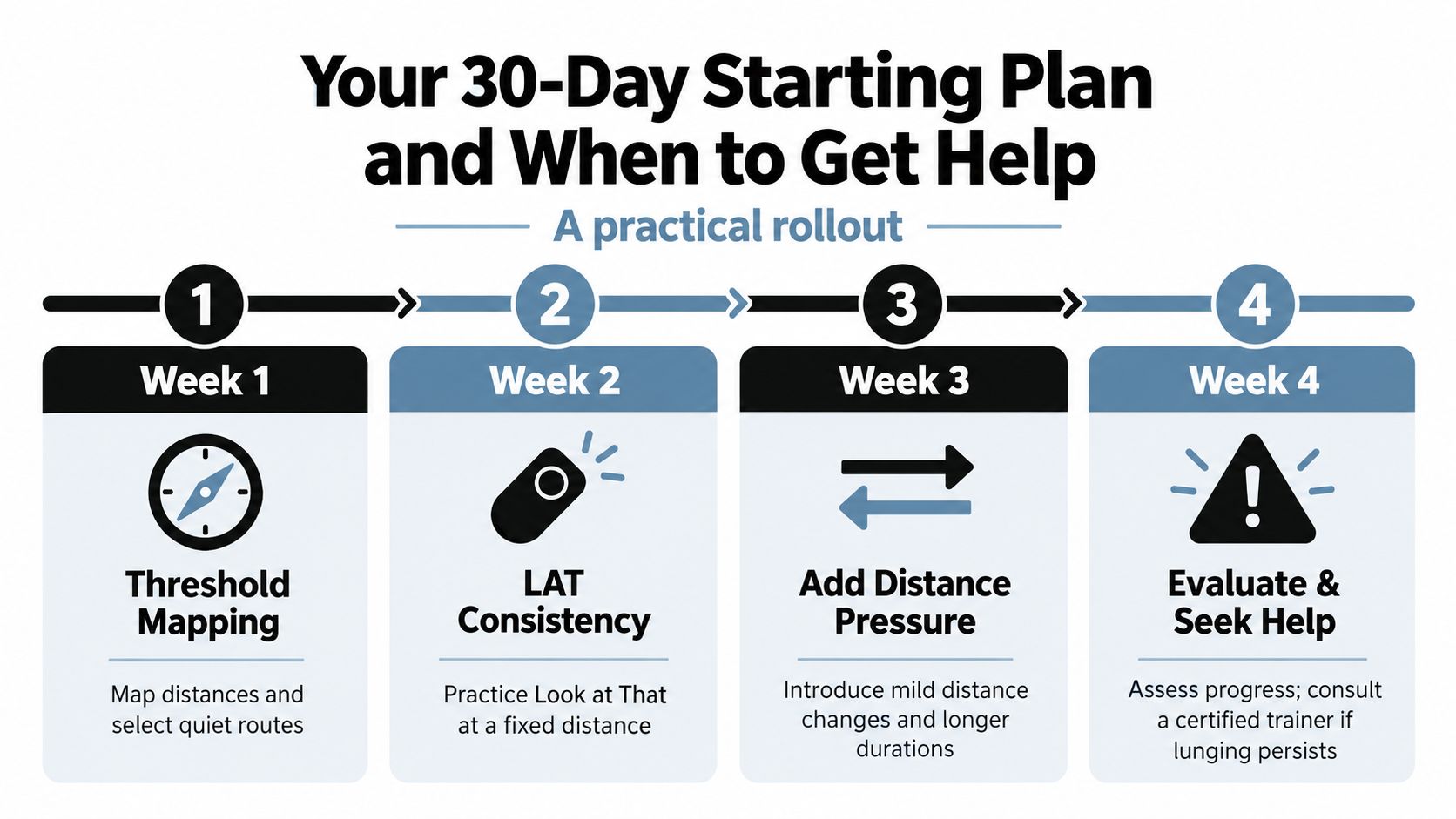
Use the first month to build information and consistency, not to prove that your dog can walk through the busiest part of town. Keep a simple record after each session: location, approximate distance, trigger intensity, whether your dog ate, and recovery time.
Week one maps the problem
Choose quiet routes and identify the first distance where your dog can notice another dog without escalating. Practice your hand touch or nose target away from triggers. Your benchmark is a usable map, not closer contact.
Week two makes LAT predictable
Work at one consistent distance. Mark the instant your dog notices, feed rapidly, and leave before the dog becomes tense. Look for repeated observations followed by quick reorientation to you.
Week three introduces mild pressure
Vary distance slightly, add controlled movement, and work with calm helper dogs when possible. Keep the trigger predictable enough that your dog can make successful choices. If barking or hard staring returns, increase distance instead of repeating the setup.
Week four tests real walks
Use a familiar route with modest environmental distractions. Track clean passes, recovery, and whether your dog can respond without continuous prompting. A good result is functional behavior at a workable distance, not an invitation to greet every dog.
A professional dog leash training class may suit a dog with manageable trigger density and no bite history, provided the instructor can keep reactive dogs separated. Choose private support when your routes are crowded, your dog reacts at long distances, or you need the plan adapted to your home and schedule. A force-free reactive-dog specialist or veterinary behaviorist is the safer choice after a bite, escalating intensity despite careful adherence, or repeated freeze and shutdown responses.
PawCraft creates a personalized 30-day dog training program based on your dog's breed, age, environment, and behavior challenges, with daily exercises, progression criteria, and weekly checklists. Use PawCraft to turn threshold mapping and route management into a structured plan you can follow on your next walk.