Starting at about 8 weeks, when your puppy comes home, gives you the strongest opportunity to build good habits during the primary socialization window of roughly 8 to 16 weeks. The first month should focus on short, repeatable routines rather than waiting for your puppy to “mature,” because early structure shapes what your dog learns to expect from daily life.
The first few days often feel less like training and more like crisis management. Your puppy wakes, wees on the rug, bites your trouser leg, cries in the crate, then falls asleep beside the water bowl. You wonder whether you should begin teaching commands or let the puppy settle in.
Start now, but keep the work small. Step by step puppy training isn't about drilling a baby dog until they perform perfectly. It's about arranging easy wins around meals, naps, toilet breaks, play, handling, and brief exposure to the world.
When to Start Step by Step Puppy Training and Why Timing Matters
Your puppy may freeze when the vacuum starts, bite at your hands, or soil the rug within the same hour. Those moments are not signs that training should wait. They show where the first lessons belong: calm exposure, clear routines, and rewards for choices you want repeated.
The primary socialization window falls roughly between 8 and 16 weeks. Several major training guides recommend beginning when the puppy comes home at about 8 weeks, rather than postponing all teaching until later (Petful's puppy training guide). Early goals should remain modest: responding to a name, resting in a crate, toileting in the chosen place, accepting gentle handling, and meeting new sights and sounds without becoming overwhelmed.
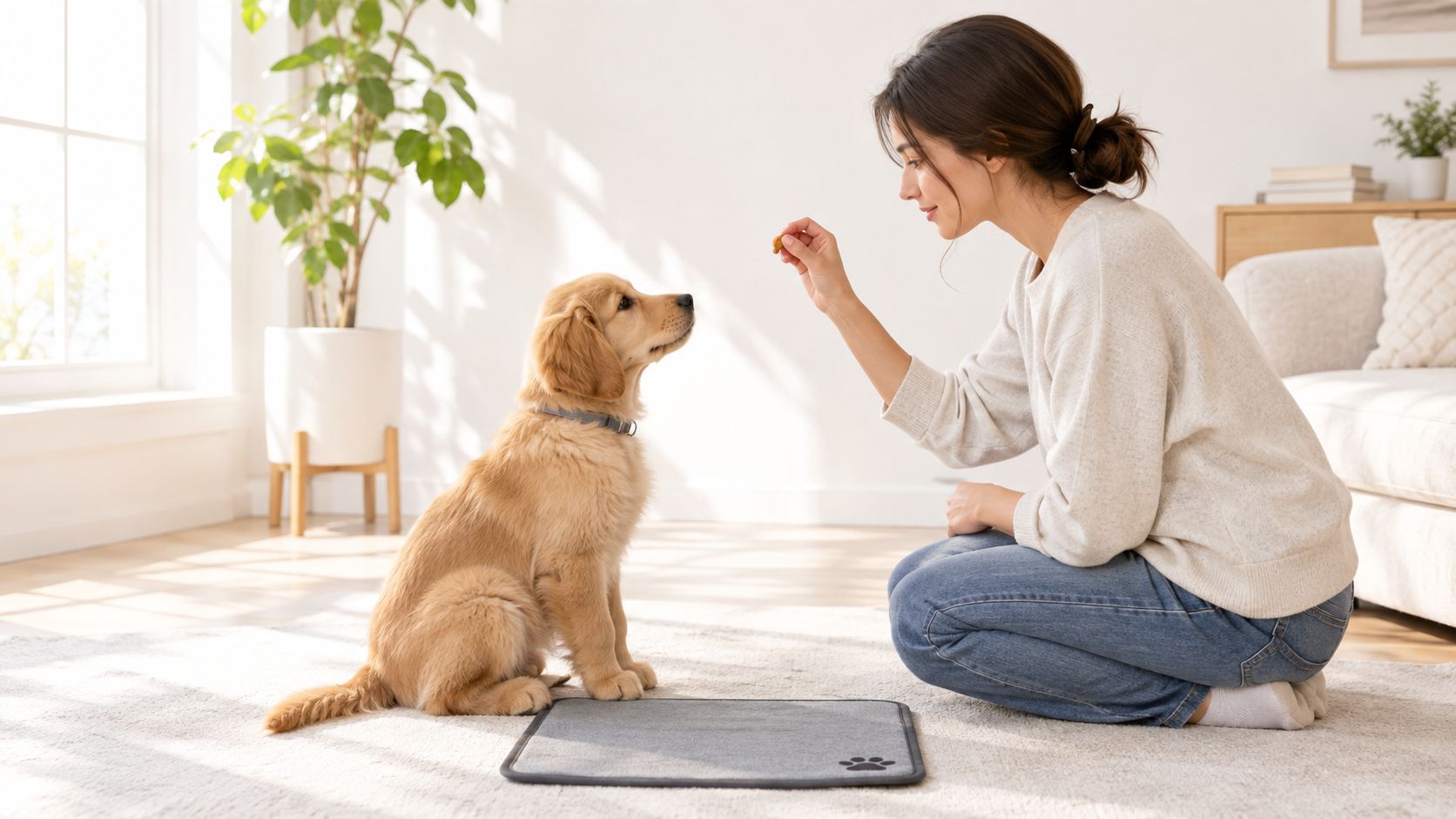
What the first window looks like at home
If your puppy freezes when the vacuum starts, switch it off, create more distance, and reward calm observation. Resume only at a level the puppy can handle, then stop before fear escalates. Apply the same approach to visitors, collars, car rides, unfamiliar surfaces, household noises, and touch around the paws or ears. Exposure should build information and confidence, not force endurance.
Some controlled in-home training can begin as early as 5 to 6 weeks while the mother and litter remain together. Permanent separation before 8 weeks is discouraged (Petful's puppy training guide). After the puppy arrives, replace broad novelty with a predictable rhythm. Consistent responses teach that rest is safe, toileting follows a pattern, and unfamiliar experiences can end before they become too intense.
Practical rule: Confidence grows from manageable exposure, not from forcing a puppy to endure whatever scares them.
Breed and temperament affect the pace. A bold retriever may investigate a new surface after one reward, while a cautious herding breed may need several short sessions at greater distance. Your 30-day plan should adjust the exercise, not abandon the goal. Note normal regressions too. A puppy that performed well yesterday may lose focus after a growth spurt, poor sleep, or an exciting outing.
Delaying all guidance allows accidental habits to receive practice. Launching at hands, pulling toward every smell, and toileting wherever the urge arrives become harder to change after repeated rehearsal. Prevention, management, and gentle redirection preserve more options.
Use the first week to establish household rules, then build toward sit, stay, recall, leash introduction, and controlled social exposure. Around 3 months, training roadmaps commonly introduce these skills more directly, so the 30-day progression should move from easy routines to greater distraction rather than demand instant obedience. If you are weighing an earlier start against waiting for vaccinations, the decision depends on your household risk level as much as the calendar. This guide to training timing for puppies can help you compare that choice with your puppy's temperament and daily environment.
Foundational Skills Your Puppy Needs in the First Week
The first week should feel repetitive. Repetition is useful because it reduces decision-making for both of you. Feed, toilet, rest, play, handle, and repeat the same small lessons in calm places.
Name recognition
Say your puppy's name once in a cheerful voice, then immediately deliver a tiny food reward when they turn toward you. Practise around meals, after waking, and during quiet play. Start in a low-distraction room and stop after a handful of successful responses.
Don't repeat the name several times while the puppy ignores you. That teaches the sound has no consequence. If the puppy doesn't turn, make the environment easier, move closer, or use a gentle sound to attract attention, then reward the response.
Crate comfort
The crate should predict food, rest, and safe downtime, never angry isolation. Toss a treat inside and let the puppy walk in and out. Feed part of a meal near the entrance, then farther inside, leaving the door open until the puppy is relaxed.
Close the door briefly while you remain nearby. Open it before the puppy becomes distressed, then build duration in small increments. A puppy that paws, pants, cries continuously, or repeatedly tries to escape needs an easier step, not a longer test. This puppy crate training guide can help you structure the routine.
House-training basics
Take the puppy to the chosen toilet area after waking, eating, drinking, playing, and exciting interaction. Wait patiently, reward immediately after they finish, and clean accidents thoroughly so the smell doesn't keep inviting repeat visits.
Supervision matters more than correction. Use a gate, pen, leash, or nearby crate when you can't watch closely. If you find an accident later, clean it up. The puppy can't connect a delayed reprimand to what happened.
Gentle handling
Touch one body area, feed, and stop. You might briefly hold a paw, lift an ear flap, touch the collar, or stroke along the shoulders. Keep your movements slow and watch the puppy's response. Turning away, licking the lips, yawning, tucking the tail, or moving away can indicate discomfort, so pause and give space.
Breed and temperament affect the pace. A confident retriever may approach new objects readily, while a cautious toy breed may need more distance and shorter exposure. High-drive herding puppies often benefit from quiet thinking games as much as physical play. The standard stays the same, but the difficulty, reward, and recovery time should fit the individual dog.
A workable daily rhythm looks like this:
- After waking: Toilet, name game, breakfast.
- After breakfast: Calm handling, then rest.
- Midday: Toilet, short play, crate practice, and one new household sound.
- Afternoon: Name response and gentle exploration of a safe surface.
- Evening: Toilet, quiet interaction, and a calm settle before sleep.
Keep sessions brief enough that your puppy wants another turn. The first week isn't about obedience fluency. It's about making cooperation easy and safe.
Your 30-Day Puppy Training Roadmap with Weekly Milestones
A useful month-long plan increases difficulty one variable at a time. Don't add distance, duration, distractions, and unfamiliar places simultaneously. If your puppy fails, lower one element and make the next repetition easier.
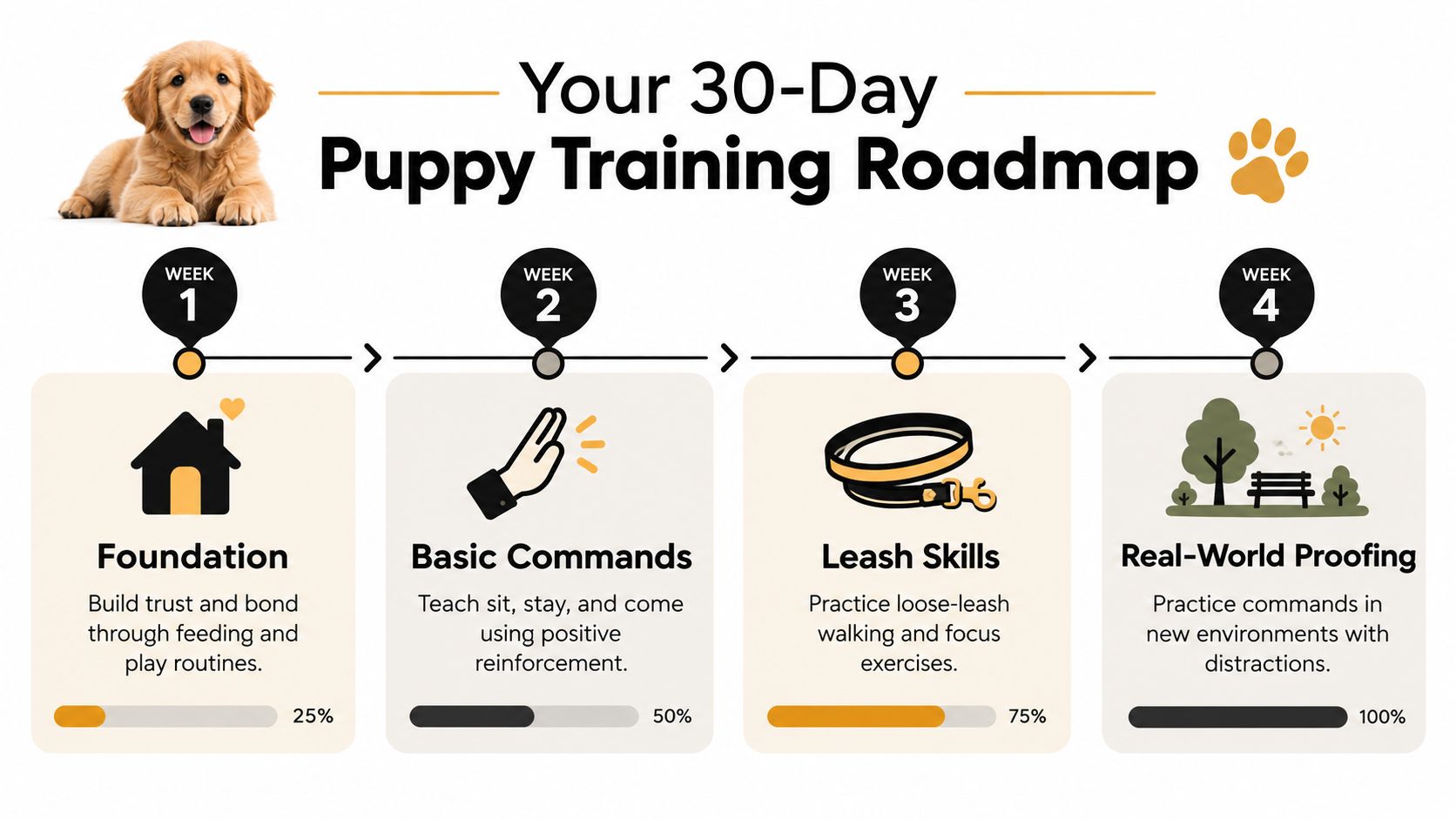
Days 1 to 7, foundation
Keep the first week focused on the routines already described. Each day, reinforce the name, reward voluntary crate entry, take the puppy to the toilet area at predictable transition points, and handle one body area gently.
Add a simple check beside each skill:
| Skill | Move forward when |
|---|---|
| Name | Your puppy regularly turns toward you in a quiet room |
| Crate | Your puppy enters willingly and settles briefly |
| Toilet routine | You can predict several successful toilet trips |
| Handling | Your puppy remains loose and accepts brief touches |
If your puppy becomes frantic, stops eating, or can't settle, the exercise is too difficult or the puppy needs rest. For a herding breed, add quiet scent searches or food puzzles. For a toy breed, prioritise safe, gradual exposure and avoid turning every interaction into a physically demanding game.
Days 8 to 14, first cues
Introduce sit by moving a treat slowly from the puppy's nose upward and rewarding when the bottom reaches the floor. Add a release word so the puppy understands when the exercise ends. Practise recall indoors by moving a short distance away, saying the puppy's recall cue once, and rewarding enthusiastically when they follow.
Introduce stay by rewarding the puppy for remaining still while you stand close. Build duration before distance. A puppy that rises after a moment hasn't failed, they've shown you the current limit.
Days 15 to 21, leash skills
Let the puppy wear a well-fitted harness indoors for brief periods while supervised. Reward looking toward you, walking beside you, and choosing slack in the leash. Begin in a quiet room, then a hallway, yard, or similarly controlled space.
Practise a few steps, pause, reward, and finish while the puppy is still engaged. High-energy puppies may need a sniffing activity before leash work. A cautious puppy may need the leash introduced without leaving the house until the equipment feels ordinary.
Days 22 to 30, real-world proofing
Change one context at a time. Practise the name and recall in a different room, then near mild household movement, then outdoors in a secure area. Ask for a sit before food, a door opening, or greeting only when the puppy can succeed.
By the end of the month, success doesn't mean a finished dog. It means your puppy can recover from small distractions, return to you in easy settings, accept handling, settle with support, and repeat familiar routines. Keep a weekly note of what worked, what triggered mistakes, and which reward your puppy valued most. If progress stalls, return to the last easy version instead of abandoning the skill.
Common Puppy Training Mistakes That Slow Progress
Training often stalls because the plan changes before the puppy has had time to understand it. The cue shifts, difficulty rises too quickly, rewards become unpredictable, or a behaviour learned in the kitchen is tested beside traffic and dogs. A 30-day plan works better when it treats these setbacks as information and adjusts the next exercise instead of labelling the puppy stubborn.
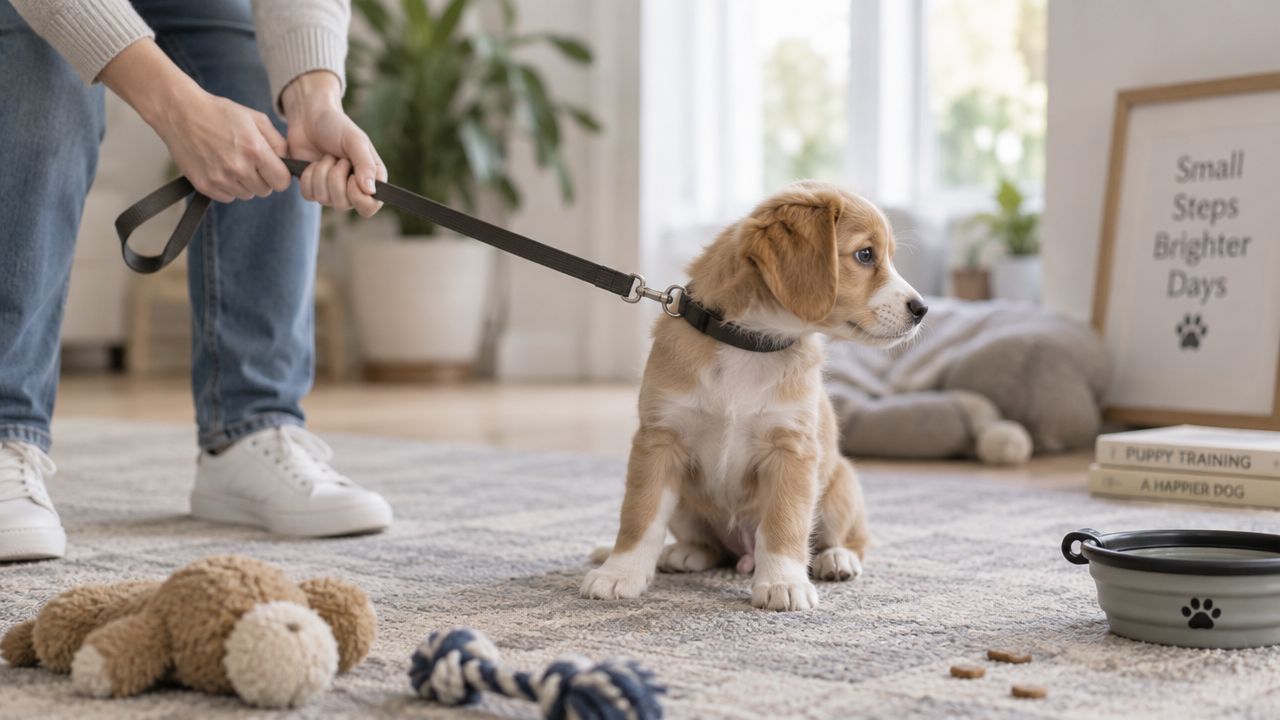
Mistake one, training only when something goes wrong
If you say your puppy's name mainly when they steal a sock, the name can predict interruption. Use it during quiet moments and reward the turn toward you. Give the crate positive practice when nobody is leaving, and introduce the leash indoors before asking for a difficult walk. These small repetitions make the equipment and cues ordinary rather than warning signs.
Mistake two, confusing exposure with flooding
Socialisation is not a schedule of forced greetings. Your puppy does not need every stranger to touch them or every dog to approach. Let them watch from a comfortable distance, provide an exit, and reward calm choices. A stiff body, hiding, refusal of food, or repeated attempts to leave means the situation is too difficult. Increase distance and end the interaction before fear becomes the main lesson.
Mistake three, adding difficulty too fast
A puppy that sits in a quiet room may not sit beside moving dogs, traffic, children, and strong smells. Dogs learn a behaviour in a context, then need practice to transfer it. Repeat the same skill in several easy locations, changing one factor at a time. Breed tendencies and individual temperament affect the pace. A highly social puppy may handle movement sooner, while a cautious puppy needs more distance and shorter sessions.
Mistake four, treating regression as defiance
Adolescent progress can wobble. A puppy behaviour study identified barking, jumping up, lead pulling, and recall issues as common undesirable behaviours across age checkpoints. It reported lead pulling by 3.8% to 6.6% of owners, depending on age, with recall issues peaking in the 9 to 15 month range. The same findings reported more pulling among 9- and 12-month-old dogs than among 15- and 18-month-old dogs (puppy behaviour study).
A temporary dip does not erase earlier learning. Lower the difficulty, reinforce the response again, and expect progress to return unevenly as excitement and independence change.
Early training gives you a foundation. It doesn't remove the need to teach the skill again in harder situations.
Mistake five, switching to punishment when progress slows
Aversive corrections may stop a visible response briefly, but they do not teach the replacement behaviour. If the puppy is worried, frustrated, overexcited, or physically uncomfortable, added pressure can intensify the problem.
Manage the setup first. Prevent rehearsal, reduce distraction, reward a workable alternative, and seek qualified help when behaviour is intense, escalating, or fear-related. Reviews of early socialisation programs report improved outcomes involving separation-related behaviour and general anxiety, with reported benefits at 6 weeks and 8 months (systematic review summary). Use that evidence cautiously, and judge your puppy by observable recovery, comfort, and repeated behaviour rather than by a rigid calendar.
Troubleshooting High-Friction Behaviors in Your Puppy
Generic milestones don't always match the behaviours that make daily life difficult. One 2026 UK dataset reported leash pulling in 67% of owners and poor recall in 52%, alongside barking and jumping as common frustrations (UK puppy training statistics). Treat those figures as a reminder to build a plan around your actual household, not just a list of commands.
Leash pulling
Start where your puppy can think. Reward a glance at you, then a step with slack in the leash. If the leash tightens, stop or calmly change direction. Don't drag the puppy forward and don't keep walking while they pull, because forward movement can reinforce the pulling.
For an energetic breed, give the puppy a chance to sniff before asking for focused walking. In an apartment, practise in the corridor or lobby before tackling a busy pavement. For a worried puppy, distance from triggers matters more than covering ground.
Use this decision path:
- Pulling begins immediately: Check harness fit, reduce stimulation, and return to a quieter location.
- Puppy can walk but loses focus: Reward more often and shorten the route.
- Puppy lunges, freezes, or can't eat: Stop training in that context and contact a qualified force-free trainer.
- Progress is steady: Add mild distractions while keeping the leash expectations unchanged.
Poor recall
Never spend the recall cue on a situation where you already know the puppy won't respond. Begin indoors, move away playfully, call once, and reward generously when the puppy reaches you. Sometimes release the puppy back to play so coming to you doesn't always end the fun.
Use a secure area or long line outdoors. Don't chase a puppy who runs away, and don't punish them when they finally return. A reliable recall is built through a history of safe, rewarding returns, not through louder repetition.
Barking
First identify the trigger. Barking at a window, barking for attention, barking during play, and barking from fear need different solutions. Block the view, add distance, offer a chew or food search, and reward the quiet pause rather than shouting over the barking.
If barking is sudden, intense, accompanied by defensive body language, or difficult to interrupt, involve your veterinarian and a qualified behaviour professional. Health, fear, environment, and breed tendencies can all change the right response.
The same logic applies to related puppy problems, including mouthy play. Use this guide to stopping puppy biting for practical redirection and management rather than turning hands into part of the game.
Keep a weekly record with three columns: trigger, response, adjustment. If the response improves after you lower the difficulty, continue that path. If it worsens despite careful management, stop experimenting alone and get individual support.
A personalised plan can be useful when breed drives, age, environment, and behaviour challenges interact. PawCraft creates a 30-day programme with daily exercises, timing, progression, success criteria, breed and temperament considerations, and weekly checklists after a short questionnaire, offering one structured option alongside group classes or private training.
If your puppy's leash pulling, barking, recall, or settling problems keep changing with context, visit PawCraft for a personalised 30-day plan built around your dog's profile. Use the daily exercises and progress checks to replace guesswork with a routine you can follow.