Many are told to enroll in a leash training class and wait for the pulling to disappear. That advice is incomplete. A class can teach you useful mechanics, but attendance alone doesn't create reliable leash manners. Your dog still has to learn around the smells, movement, dogs, people, and surprises that make your normal walk difficult.
I've watched hundreds of owners move through group classes with the same pattern. Their dogs perform beautifully in a quiet training room, then drag them toward a squirrel outside or erupt when another dog appears. The problem usually isn't that the owner failed to attend. It's that the curriculum never matched the dog's real trigger level, motivation, or environment.
Why Most Leash Training Classes Fall Short
The popular promise is simple: sign up, practice the exercises, and your dog will stop pulling. In reality, a class is a learning environment, not a magic reset button. Many dogs understand loose-leash walking during a structured exercise and still pull on ordinary walks because the owner hasn't transferred that skill into harder situations.
Research from the University of Edinburgh makes the gap difficult to ignore. A 2021 study found that 63% of dogs that pulled on lead had attended training classes, and 85.3% of those classes included loose-lead exercises (Edinburgh research on owner approaches and lead pulling). The breakdown included puppy classes, other classes, and dogs that had attended multiple classes. In other words, leash work is already common in formal instruction, yet exposure to the exercise doesn't guarantee lasting behavior change.
Exposure isn't the same as fluency
Generic classes usually teach attention, walking beside the handler, turns, stops, and gradual exposure to distractions. Those are sensible foundations. The trouble starts when every dog receives the same progression, even though one dog is mildly enthusiastic and another is already over threshold before the leash goes tight.
A reactive dog needs a plan for specific triggers, workable distance, intensity, and recovery time. A high-energy adolescent may need shorter repetitions, more movement, and carefully managed reinforcement. A fearful dog may need an environment where distance can increase immediately. A crowded class often can't provide enough space or individual coaching for those needs.
Practical rule: If your dog can't eat, look at you, or respond to a familiar cue, the exercise is too difficult at that moment.
The strongest classes teach owners to notice those signals and adjust. Weak classes keep marching through the lesson while dogs rehearse pulling, barking, staring, or lunging. That rehearsal matters. Your dog practices the behavior that gets repeated, even when the instructor calls it “just excitement.”
What a useful class should change
Look for instructors who ask what your dog reacts to, how close the trigger can be before behavior changes, and how long your dog takes to recover. The program should include practice outside the classroom, clear criteria for moving closer to distractions, and feedback on your handling rather than only demonstrations.
Leash manners have been part of formal obedience for a long time. The American Kennel Club's history of obedience records the first American obedience trial in October 1933, with exercises including heeling both on and off leash. That history reinforces the value of the skill, but it also highlights the core issue: leash walking is foundational, not automatically easy.
What a Typical Leash Training Curriculum Covers
Most dog leash training classes follow a predictable progression. The instructor starts with skills your dog can perform in a controlled setting, then adds movement, distance, and distractions. That order makes sense because a dog can't respond reliably outdoors if they haven't learned what the leash, handler, and reinforcement are supposed to mean.
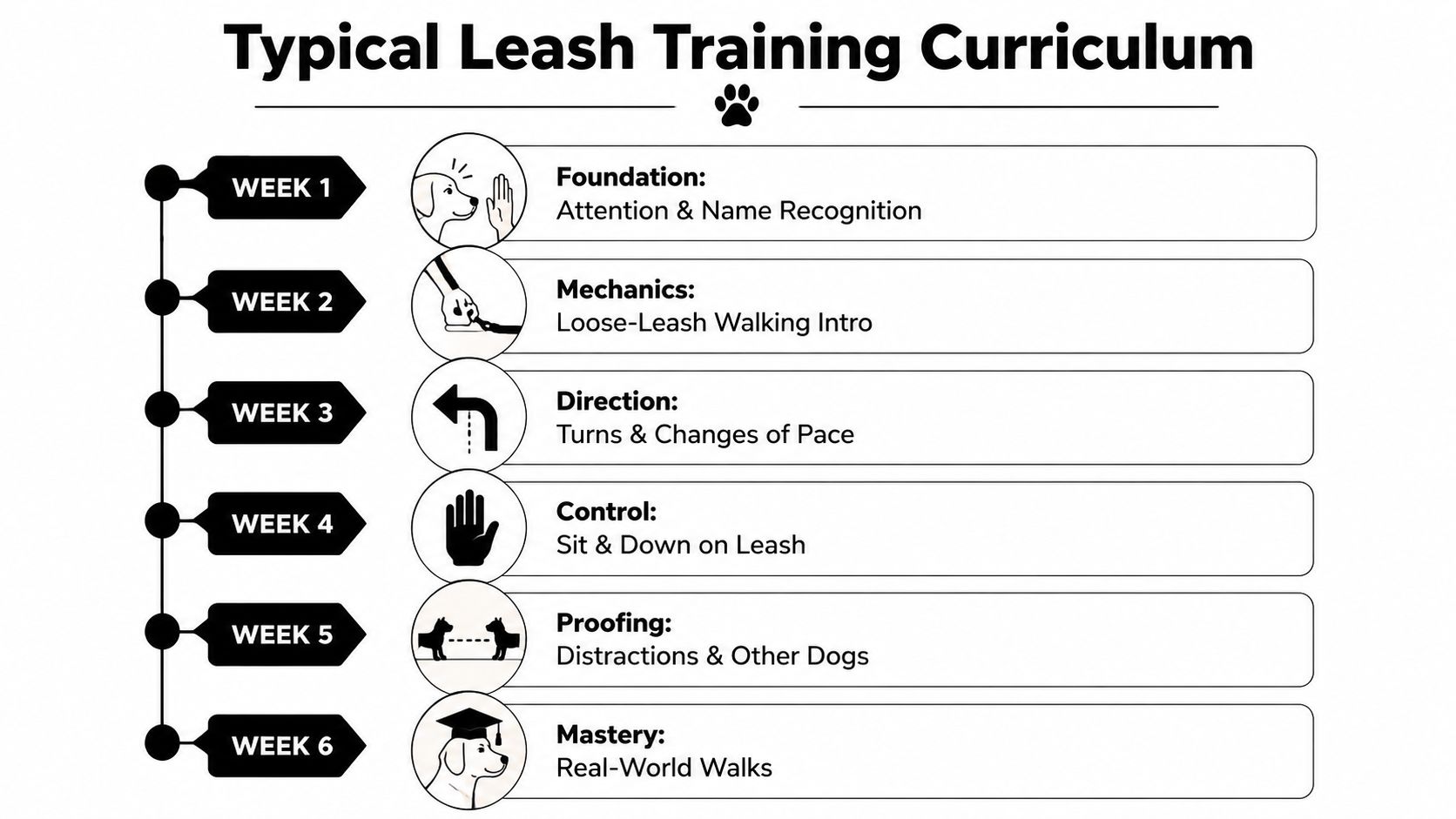
The exact schedule varies, but a six-week format often resembles the sequence below.
Weeks one and two build the walking language
Week one usually focuses on attention and name recognition. You'll reward your dog for orienting toward you, following a hand target, checking in voluntarily, and responding to a simple cue. The goal isn't a formal heel. It's creating a reason for your dog to notice the person holding the leash.
Week two introduces loose-leash mechanics. Your instructor may reward a slack leash, reinforce a position near your side, and teach you to stop or change direction before pulling becomes a full-body habit. Timing matters. If you wait until your dog has already reached the end of the leash, you're addressing the aftermath instead of reinforcing the choice you want.
Owners of older dogs often benefit from reviewing these fundamentals rather than assuming age makes them irrelevant. The guidance in this resource on training adult dogs can help you approach foundation work without treating an adult dog like a blank slate.
Weeks three and four add control under movement
Week three commonly introduces turns and changes of pace. Left turns, right turns, halts, and slow or fast walking teach your dog to follow changes in your movement instead of choosing the route independently. Keep the turns clean and reward early orientation toward you.
Week four often adds sit and down on leash, especially at curbs, doorways, or pauses. These behaviors can give owners something useful to reinforce during a walk, but they shouldn't replace movement management. A dog that can sit while staring at another dog may still be highly aroused and ready to explode when released.
Weeks five and six test whether the skill transfers
Week five introduces distractions and other dogs, usually with controlled spacing. A competent instructor won't force close greetings or use another dog as a moving target without watching body language. The aim is to keep your dog able to learn while gradually increasing difficulty.
Week six should resemble real-world walking. That may mean working near an entrance, navigating mild traffic, passing people, or practicing recovery after a distraction. Ask what happens if your dog fails. A good curriculum includes an easier version of the task, not pressure to repeat the same mistake.
Comparing Group Classes and Private Sessions and Online Programs
There's no universally correct delivery format. The right choice depends on your dog's behavior, your ability to practice, and how much live coaching you need. Group classes are not automatically inferior, and private training isn't automatically effective. The instructor's methods and the fit between the program and your dog matter more than the label.
| Format | Cost Range | Best For | Limitations |
|---|---|---|---|
| Group classes | Usually lower than private instruction | Owners who want a structured schedule and controlled exposure to mild distractions | Limited individual attention, fixed pace, and too much stimulation for some reactive dogs |
| Private sessions | Premium pricing that varies by trainer and location | Trigger-specific problems, complex households, and owners who need hands-on coaching | Higher cost, travel demands, and quality varies between providers |
| Online programs | Often flexible and less expensive than live private work | Busy owners who can record practice, follow written plans, and work independently | No immediate physical coaching or real-time adjustment during a difficult walk |
Group classes
Choose a group class when your dog can remain under threshold around other dogs and people, and you want accountability. The social setting lets you practice handler attention while mild distractions are present. It can also expose you to common mistakes made by other owners, which is useful if the instructor explains why a technique works.
The weakness is built into the format. The trainer must divide attention among several teams, so your dog may progress faster or slower than the lesson. A dog that barks continuously, lunges, or cannot take food may need a quieter setup before a group environment becomes productive.
Private sessions
Private instruction shines when the problem is highly specific. A trainer can watch your dog on the route where pulling happens, identify the moment your dog loses focus, and adjust distance or reinforcement immediately. This format is especially useful for dogs with intense reactivity, fear, or handling concerns.
Don't pay for private sessions just because they sound more professional. Ask whether the trainer will teach you a repeatable protocol and provide homework. If the owner remains dependent on the trainer's physical presence, the dog's improvement may disappear between appointments.
Online programs
Online instruction works best for owners who value flexibility and can follow directions precisely. Video demonstrations, written exercises, and progress tracking can make home practice easier, especially for apartment owners who need to build skills in small spaces before facing a busy sidewalk.
The tradeoff is feedback. You must recognize when your dog is too aroused, choose the right equipment, and adjust the exercise without someone standing beside you. Online programs are a sensible middle option when a group class is too generic and private coaching is outside your budget, but they aren't ideal for serious safety concerns that require professional assessment.
Understanding Costs and Realistic Timelines
Budgeting for leash training means looking beyond the enrollment fee. Group classes are commonly presented as a short course, private instruction is usually billed by session, and board-and-train programs charge for intensive care while the dog is away. The numbers in promotional material can look attractive until you add equipment, transport, missed practice, and the cost of repeating a program that never addressed the problem.
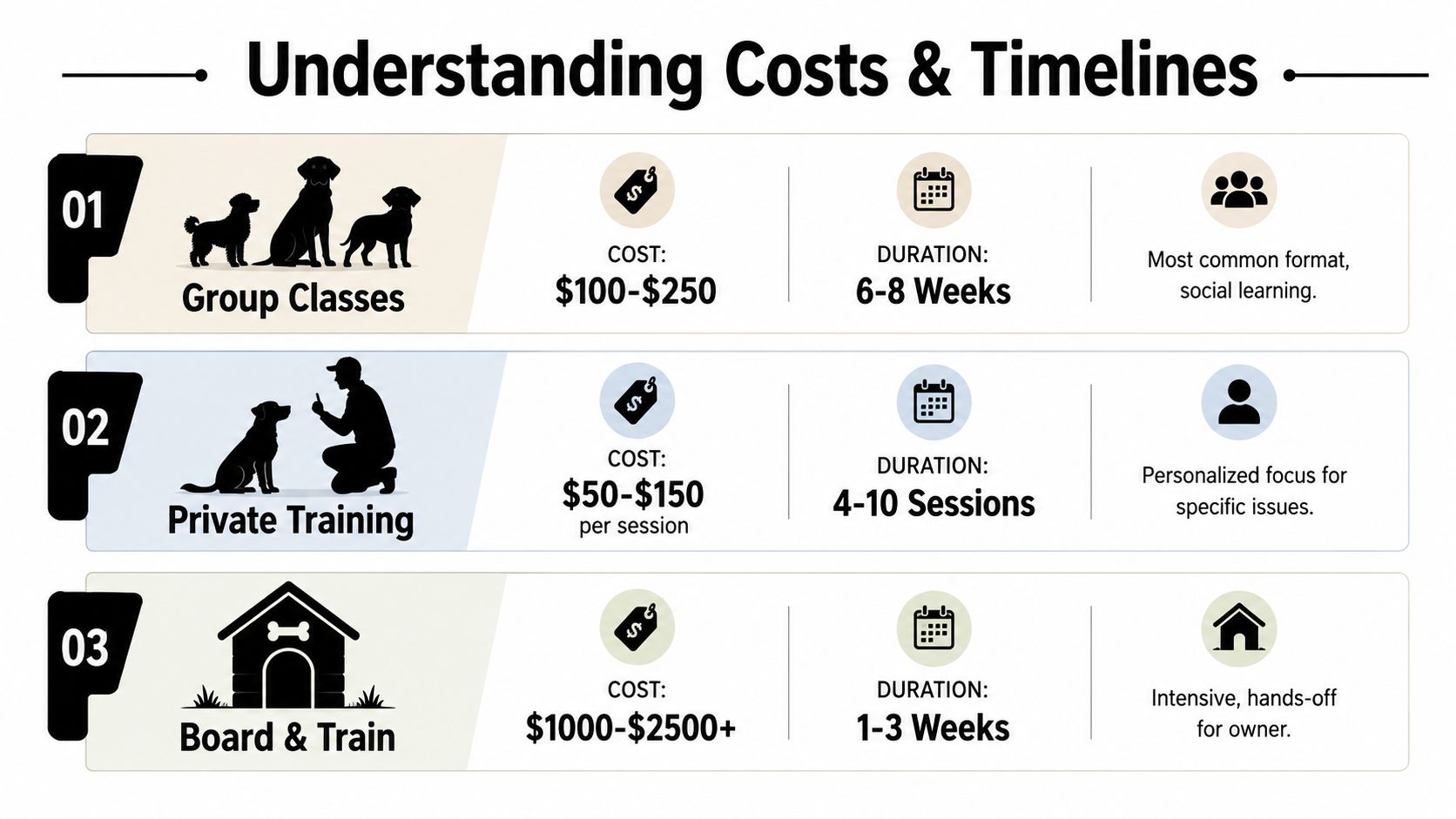
The supplied comparison visual lists these formats as follows:
What the common price structures include
Group classes are shown at $100 to $250 for a typical 6 to 8 week format. You're paying for scheduled instruction, a shared venue, and a curriculum that serves multiple dogs. Ask whether the fee includes written homework, make-up sessions, equipment guidance, and a plan for dogs that can't cope with the group.
Private training is shown at $50 to $150 per session, with a typical duration of 4 to 10 sessions. The total cost depends on the trainer's rate, travel, session length, and whether follow-up support is included. A cheaper single appointment isn't valuable if you leave without a clear progression plan.
Board-and-train is shown at $1,000 to $2,500 or more for 1 to 3 weeks. This can provide intensive handling, but the owner still has to learn how to maintain the behavior at home. A dog may walk politely for a professional and pull again when returned to familiar routines.
Time is part of the price
Behavior change rarely follows the calendar printed on a class flyer. A six-week course can introduce the skills, but reliability depends on practice in the environments where the problem occurs. Your dog may need a gradual return to busy sidewalks, parks, elevators, or dog-heavy routes rather than immediate full exposure.
A short course can teach the exercise. Repetition in real life teaches your dog that the exercise still applies.
Plan your budget around instruction plus daily implementation, not the number of lessons alone. Include a suitable leash, rewards your dog can eat quickly, a secure walking setup, travel, and time for calm repetitions. If pulling creates physical risk, delaying effective help can cost more in stress and failed appointments than choosing a better-matched format at the beginning.
Your Pre-Class Preparation Checklist
A group class cannot rescue a dog who arrives unprepared. Your dog should not encounter a leash for the first time at the door, and you should already know which situations make walking difficult. You do not need a polished performer. You do need enough preparation to keep the session focused and safe.
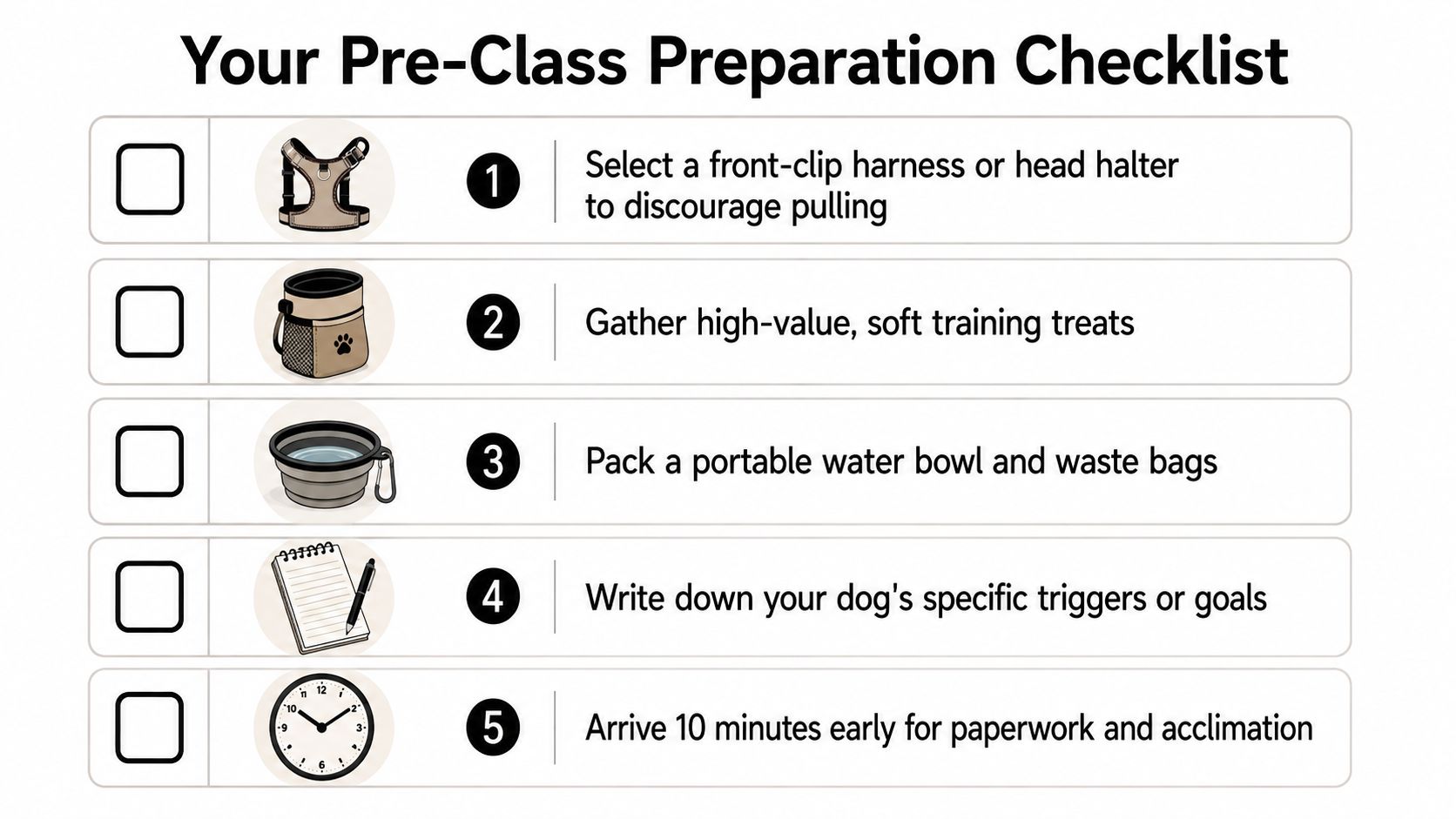
Start with the walking setup. Equipment changes how pulling feels and how much force reaches your dog, so a collar or harness is not a universal solution. Comparative research found statistically significant differences in pulling impulse across leash equipment types, with dogs pulling most on a martingale collar. A back-connection harness could also increase pulling force in food-motivated tests (comparative research on leash equipment and welfare). Choose a secure setup with your instructor, then train the behavior. Hardware does not teach loose-leash walking by itself.
Pack for learning
Bring soft, high-value treats your dog can swallow quickly, a treat pouch, water, waste bags, and the leash and harness you plan to use at home. A mat or towel can help if your dog settles better on a familiar surface. Leave retractable leads and oversized treats at home. Rewards should support the exercise, not interrupt it.
Write down the behavior you want to change before class. “Pulling” gives an instructor too little information. Note whether your dog pulls toward dogs, people, scents, vehicles, or the end of the route. Record the trigger, the distance at which your dog reacts, the behavior that follows, and the recovery time. A reactive-dog questionnaire built around these details shows why trigger information is more useful than a broad label such as “bad on leash” (reactive-dog intake questionnaire).
Practice before arrival
At home, reward your dog for looking at you, following a hand target, walking beside you for a few steps, and stopping when you stop. Keep each repetition easy. You are building a communication system, not measuring endurance.
Give your dog time to sniff and toilet before class. Do not arrive with a dog who is exhausted or overstimulated. Arrive early for paperwork and acclimation, and keep distance from other dogs if your dog needs it. These first-time dog owner tips provide broader preparation guidance.
Your role continues throughout the lesson. Research on adolescent dogs found that owner interaction during leash-walking exercises was associated with increased owner attention and decreases in vocalization, leash pulling, and attention toward the target dog compared with a no-interaction condition (study of owner interaction during adolescent dog obedience classes). Stay engaged instead of waiting at the end of the leash for the instructor to fix everything.
When Personalized Training Plans Outperform Traditional Classes
Some dogs don't need more access to a generic class. They need a plan that starts with the reason they pull and builds around the situations where pulling happens. That's the missing middle between a crowded group lesson and the expense of ongoing private instruction.
A personalized program should ask better questions than “Does your dog pull?” It should examine breed tendencies, age, energy, environment, reinforcement preferences, trigger patterns, and the owner's daily routine. A scent-driven dog in a rural area won't need the same progression as a fearful dog navigating an apartment hallway. Treating both as identical loose-leash cases wastes practice time.
Why the middle ground matters
Private trainers can observe details that generic lessons miss, but not every owner needs or can maintain frequent one-to-one appointments. A personalized plan gives the owner a structured sequence to follow at home, while leaving room to adjust the environment and difficulty. It's most useful when the owner is willing to practice consistently but needs clear direction rather than another collection of disconnected tips.
PawCraft is one example of this format. It uses a brief questionnaire to generate a personalized 30-day dog training plan created for a dog's breed, age, environment, and behavior challenges. The service includes a breed and temperament diagnostic, day-by-day exercises, progression guidance, common mistakes, weekly checklists, and plain-English explanations, at a one-time $17 fee with a 30-day money-back guarantee. Those product details come from the publisher's supplied information, so evaluate the plan as structured guidance, not as a substitute for professional behavior assessment when safety is involved.
What a real plan should contain
A useful plan tells you what to do today, how long to practice, what success looks like, and what to change when the dog struggles. It should separate foundation work from trigger exposure and make the next step harder only after the current step is stable.
Use this guide to dog behavior modification plans as a standard for judging structure. If a program offers only general advice such as “be consistent” or “use treats,” it hasn't done enough diagnostic work to guide a difficult leash case.
Controlled research on leash-training methods also supports the importance of design. One comparison found the Major-Minor Walking Program outperformed two alternative approaches, while the Penalty Yards Walking Program ranked second (controlled comparison of leash-training methods). The practical lesson is straightforward: reward timing, repetition structure, and feedback matter. Personalized plans can make those decisions explicit instead of leaving owners to improvise.
How to Choose the Right Training Path for Your Dog
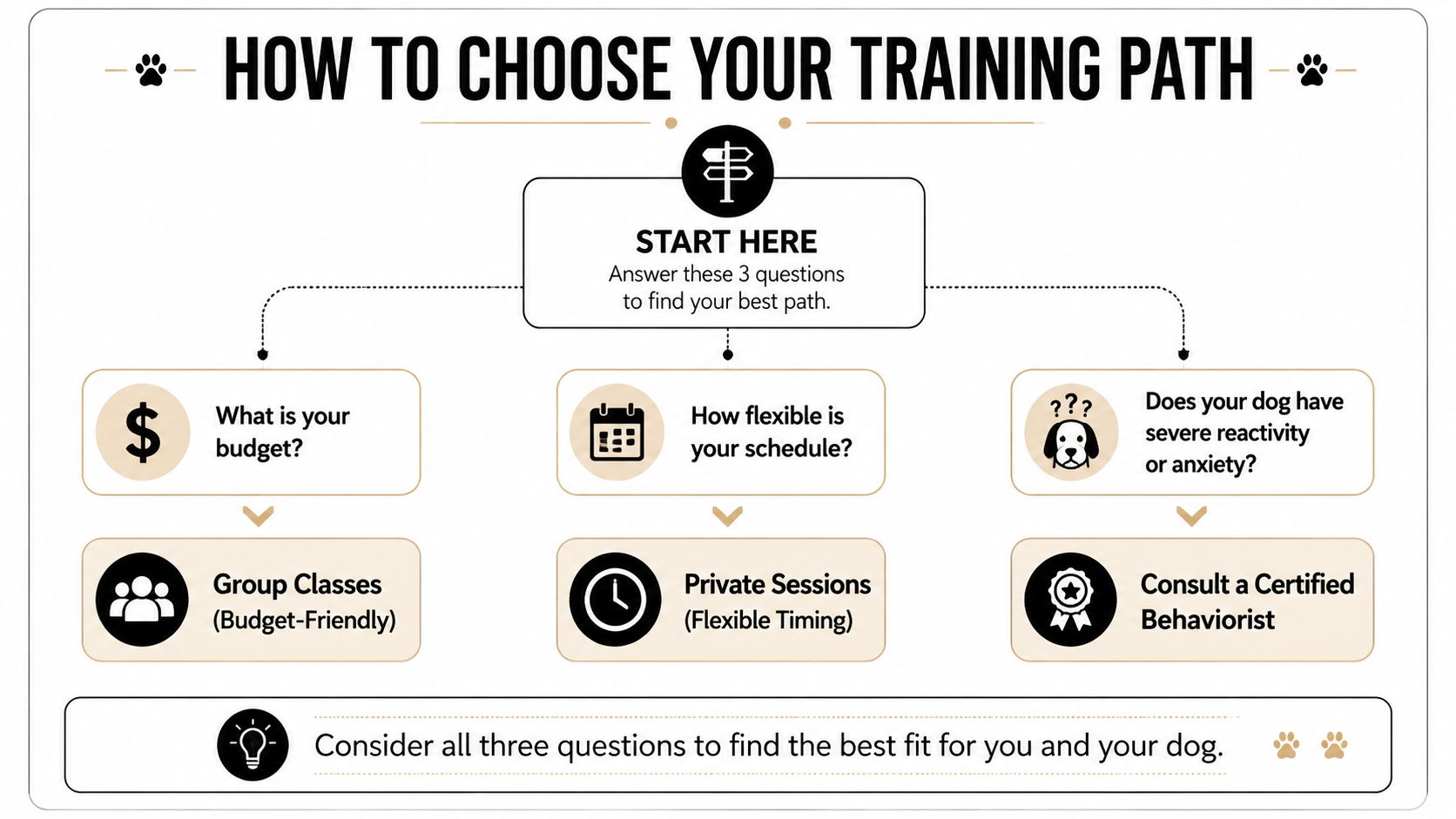
Choose training by your dog's behavior, not by polished program marketing. Ask three questions: Can my dog learn around other dogs? Can I practice on the required schedule? Do I need live professional intervention, or can I follow a structured plan independently?
Match the problem to the environment
A group class suits mild pulling, reliable food motivation, and enough self-control to work near other teams. It is a poor match for a dog that barks, lunges, freezes, or becomes too distracted to eat. Those dogs need more distance, slower progression, and decisions built around their specific triggers.
Choose private instruction for intense reactivity, fear, handling concerns, or a household problem that a class cannot recreate. A skilled trainer can adjust setup and timing in real time. If your dog poses a bite risk, has severe anxiety, or cannot remain safe around triggers, contact a qualified behavior professional instead of relying on a standard class or self-guided plan.
A personalized online plan fits owners whose main obstacle is structure. It can guide gradual home practice, provide a clear daily sequence, and fill the gap between expensive private training and a generic group curriculum. It cannot replace live assessment when safety or serious behavior concerns are involved.
Screen the provider before paying
Ask how the instructor handles barking and lunging, whether dogs can work at a distance, which equipment they recommend, and how they measure progress. Good answers include management, reinforcement, gradual difficulty, and coaching for the owner.
Leave programs that promise instant results, force close contact, punish pulling without teaching an alternative, or refuse to explain their methods. Lead pulling can create welfare concerns, including physical injury, so equipment and technique deserve direct discussion, not vague reassurance. Apply the same standard to the trainer's safety practices.
Track behavior, not attendance
Record whether your dog can notice a trigger and still eat, how quickly they reorient to you, whether the leash stays slack for longer stretches, and how rapidly they recover after difficulty. These measures reveal progress better than class attendance.
My recommendation is direct. Start with group lessons for manageable pulling and a dog who can learn near others. Choose private instruction for serious reactivity, fear, or safety concerns. Choose a personalized program when you need customized daily guidance and can practice consistently, then add professional help if progress stalls.
PawCraft creates a personalized 30-day training plan around your dog's breed, age, environment, and leash-related behavior challenges, with daily exercises and progress checklists for home practice. Visit PawCraft to answer the questionnaire and get a structured plan for your next walk.