Leash reactivity is a stress response that appears only when a dog is restrained. Your dog may be perfectly fine off-leash but becomes tense, vocal, lunges, or pulls when on a leash because restraint blocks their natural ability to keep distance from triggers.
You might know the scene well. The leash clicks onto your dog's collar or harness, and your relaxed companion suddenly scans the pavement, stiffens at the sight of another dog, then erupts into barking and pulling. At an enclosed park, the same dog may sniff politely, play normally, or walk away from something uncomfortable.
That contrast is confusing, but it doesn't mean your dog is pretending to be friendly or trying to control you. Leash reactivity is context-specific behavior, shaped by restraint, arousal, fear, frustration, and the loss of choice. Understanding that “why” is the first step toward safer, calmer walks.
Your Dog Pulls and Barks On-Leash But Is Fine Off-Leash
You leave the house with an ordinary plan for a short walk. Your dog is affectionate inside, responsive in the yard, and sociable with familiar dogs. Then a dog appears across the street, the leash tightens, and your companion freezes, whines, lunges, or barks as though the trigger is an immediate threat.
Later, off-leash, that same dog may greet calmly or move away without an incident. This split is the hallmark of leash reactivity, a pattern Cornell's Riney Canine Health Center describes as behavior that appears on leash even when the dog may be calm or sociable off leash. The visible responses can include tension, vocalizing, lunging, and pulling. Cornell's guidance on managing reactive behavior makes the context distinction clear.
Why the leash changes the picture
Off leash, a dog has more ways to cope. They can arc away, pause, sniff, increase distance, or choose whether to approach. On leash, those options narrow. A dog that feels uneasy may pull toward the trigger, bark to make it retreat, or thrash because the leash prevents a comfortable exit.
That doesn't make the behavior acceptable or harmless, but it does make it understandable. Your dog isn't necessarily choosing bad manners or displaying dominance. They're showing that the situation has pushed their arousal beyond what they can manage.
Shelter research also supports the idea that this is connected to emotional regulation rather than a fixed moral flaw. In observations of 370 human-dog leash walks, dogs rated as more relaxed during behavioral assessment later showed less leash tension and lower pulling frequency. The shelter-dog study links observable on-leash behavior with a dog's ability to remain settled.
If you're building foundational skills with an adult dog, PawCraft's adult dog training guidance can complement the work described here. The important shift is simple: stop asking, “How do I punish this reaction?” and start asking, “What is my dog experiencing, and how can I make the next walk easier?”
What Leash Reactivity Is
A dog may walk calmly in one setting, then bark, lunge, or pull when attached to a leash. This pattern is best understood as a behavioral state created by a specific context, not a permanent personality label. The leash limits movement and can prevent the dog from controlling distance from something worrying, exciting, or frustrating.
Restraint removes choices
Off leash, a dog can often leave, arc away, pause, sniff, or decide whether to approach. A restrained dog may lose those options when a person, dog, cyclist, or vehicle comes directly closer. As the trigger approaches, arousal can build until barking, lunging, or pulling becomes the response the dog can access.
The same outward reaction can come from different emotions. A dog may fear unfamiliar dogs, feel frustrated because greeting is impossible, or learn that barking makes the other dog move away. The behavior looks similar from the outside, but the dog's experience is different.
A walk-behavior study found that dog-to-dog encounters were about half as likely to become interactions when the subject dog was on leash rather than off leash. When both dogs were leashed, an off-leash dog was almost four times more likely to interact than the leashed dog. The study of dog walking interactions shows that restraint can change social behavior itself. The leash becomes a physical barrier between the dog and the choices they would normally use.
Practical rule: Treat the leash as a major variable in the situation, not as proof that your dog has a bad character.
A dog's general ability to settle also affects leash behavior. During 370 observed leash walks, dogs that appeared more relaxed in behavioral assessments showed lower tension and pulled less often. Read the research on behavioral assessment and leash walking examines the connection between relaxed assessment scores and later on-leash outcomes.
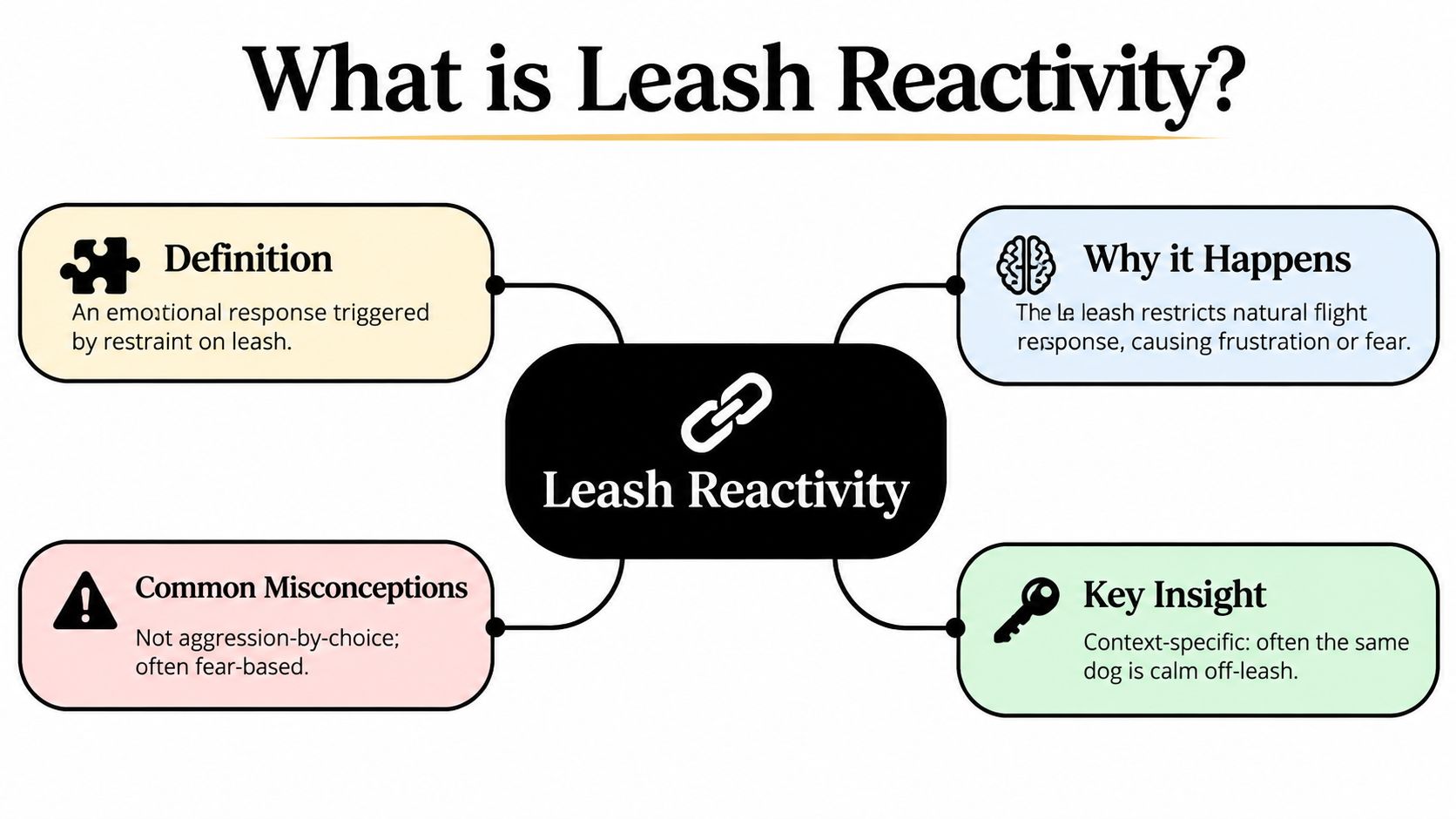
Punishment may quiet the barking briefly while leaving fear, frustration, or overload unchanged. Training works better when it changes what the dog experiences: more distance, greater predictability, and enough support to regain emotional control. Your dog is responding to stress under restraint, not proving dominance or choosing bad character.
Common Triggers and Warning Signs
A trigger is anything that reliably shifts your dog's emotional state while they are on leash. Other dogs are common triggers, yet some dogs respond to strangers, children, runners, cyclists, scooters, motorcycles, cars, wildlife, or people wearing unusual clothing. The approach also matters. A dog may cope when another person or dog passes from the side, then react when that trigger comes directly toward them or appears suddenly around a corner.
Your dog's response can change from one walk to the next. Poor sleep, a crowded route, an earlier startling event, or an exciting morning can reduce the emotional space available for a routine encounter. The trigger is only part of the picture. Restraint, surprise, and accumulated stress can push a dog closer to reacting, so the behavior reflects a stress response rather than stubbornness or dominance.
Notice the early signals
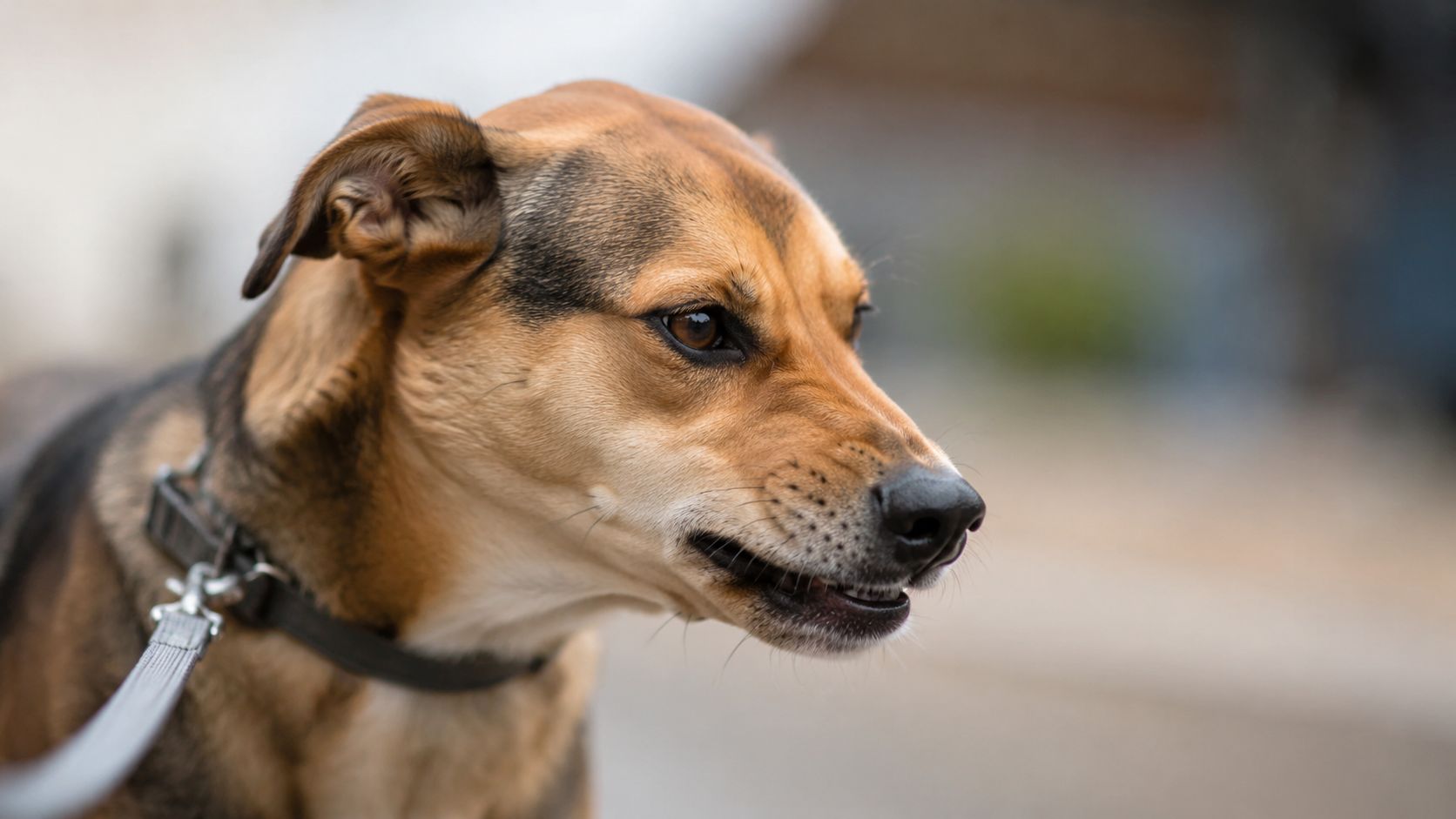
Barking and lunging usually appear late in the escalation. Earlier signs may be quiet: loose movement becoming stiff, a closed mouth, rapid breathing, lip licking, yawning, a turned head, a tucked or very high tail, pinned ears, or visible whites of the eyes.
A casual glance can become a fixed stare. Your dog may stop sniffing, refuse food, lean forward, or shift weight toward the trigger. These changes show that attention is moving from exploring and learning toward managing discomfort. Spotting them early gives you time to create space before the leash becomes a source of greater pressure.
Find your dog's threshold
Your dog is below threshold when they can notice a trigger and still eat a treat, respond to their name, or move with you. Threshold is not a fixed distance. It changes with the trigger, setting, emotional state, and speed of approach.
Use this decision rule:
- Can take food: You may be far enough away to begin a calm exercise.
- Can look and disengage: Mark the sight of the trigger, offer a high-value treat, and increase distance if your dog's attention locks on.
- Refuses food or can't respond: Stop training and leave without scolding.
Animal-welfare guidance recommends finding the distance at which a dog can notice a trigger and still take treats, then using controlled exposure and counterconditioning. ASPCApro's guidance for managing and training leash-reactive dogs also emphasizes that distance, environment, and arousal control matter more than equipment alone.
Leash Reactivity vs Aggression
The word “aggressive” often gets used for any dog that barks, growls, or lunges. That label can frighten owners and lead them toward punishment, even though the same outward display may come from fear or frustration. Research on canine behavioral assessments and leash walking supports treating leash reactivity as distinct from a dog's off-leash behavior and recognizing fear or frustration as possible sources.
Body language provides clues, but it doesn't replace an individual assessment. A fearful dog may try to increase distance, while a frustrated dog may pull toward the thing they want. A dog with serious aggression risk may show sustained, intense focus and fail to de-escalate when the trigger moves away.
| Behavior | Fear Reactivity | Frustration Reactivity | True Aggression |
|---|---|---|---|
| Body language | May lean away, lower the body, pin the ears, tuck the tail, or attempt to retreat | Often leans forward, pulls toward the trigger, and appears highly aroused | May show hard focus, marked stiffness, and an escalating display |
| Likely trigger pattern | Unfamiliar dogs, people, objects, or approaches that feel threatening | A desired greeting, blocked movement, or inability to reach a trigger | A perceived threat, conflict, guarding context, or other situation requiring careful assessment |
| What may happen when distance increases | The dog may recover once they feel safer | The dog may settle when access or movement is no longer blocked | The dog may remain intensely focused or continue escalating |
| Helpful response | Increase distance, reduce pressure, and pair safe exposure with positive reinforcement | Prevent rushed greetings, provide distance, and teach alternative behaviors | Use strict safety management and seek qualified professional guidance |
The categories can overlap. Fear can produce forward lunging, and frustration can become anxiety after repeated overwhelming encounters. Don't diagnose your dog from one walk or from the volume of their bark.
If you need help addressing dangerous behavior around other dogs, PawCraft's guide to aggressive behavior toward other dogs may help you organize the problem, but a bite history or serious safety concern deserves direct professional support.
Managing and Training Reactive Dogs
Start with management, because every explosive encounter is hard on the dog and difficult for the handler. Choose quieter routes, walk when fewer triggers are likely, cross the street early, and use parked cars, hedges, or open spaces to create a visual buffer. A well-fitted front-clip harness may improve handling, but equipment should support safety rather than replace behavior work.

Build a below-threshold routine
Find the distance where your dog can see a trigger and still eat. The moment your dog notices it, feed a high-value treat, then move away before the stare becomes rigid. You're not bribing the dog to ignore the trigger. You're pairing the trigger with safety and helping the dog remain able to think.
Practice the mechanics away from triggers first. Teach a cheerful U-turn, hand target, name response, and treat delivery in the home or yard. Then rehearse them in an easy outdoor space before asking your dog to use them near another dog or cyclist.
Progress should be gradual. If your dog stops eating, stiffens, vocalizes, or repeatedly loses focus, increase distance and allow recovery. Don't measure success by how close you can get. Measure it by whether your dog can notice, process, and return attention to you.
Distance is training equipment. More space often gives your dog the ability to learn, while less space can turn practice into another overwhelming event.
Management alone won't change the emotional response. It prevents unnecessary rehearsal while desensitization and counterconditioning teach new associations. The environment, distance, and arousal level determine whether your dog is in a state where learning can happen.
A personalized routine can make that process easier to organize. PawCraft offers a breed-, age-, environment-, and behavior-specific 30-day training plan with daily exercises, progression guidance, success criteria, and plain-English explanations. You can review PawCraft's dog behavior modification plan as one structured option alongside help from a qualified trainer.
Use the video below as a visual supplement, not as a substitute for observing your own dog's threshold and safety needs.
Keep sessions short enough that your dog finishes capable of relaxing. A calm retreat, a sniffing break, or an easy indoor exercise can help bring arousal back down after a difficult sighting.
When to Seek Professional Help
Self-guided training is appropriate only when you can keep everyone safe and your dog can still learn. Bring in qualified help if your dog has bitten and broken skin, repeatedly redirects onto you, or becomes impossible to handle around triggers. Walks shouldn't leave you afraid of losing control.
Professional support is also important when distance management doesn't prevent extreme panic, when your dog's reactions are spreading to more triggers, or when leash reactivity appears alongside resource guarding. A sudden behavior change deserves a veterinary conversation because pain, illness, or another medical issue can affect behavior.
Choose the right professional
A certified dog trainer can help with handling skills, reinforcement-based training, and practical management. A certified applied animal behaviorist focuses more on behavior assessment and modification. A veterinary behaviorist can evaluate behavior alongside medical factors and may discuss treatment options when anxiety or fear is severe.
Ask prospective professionals how they handle fear and frustration. Look for methods based on management, reinforcement, gradual exposure, and careful observation. Be cautious of anyone who promises an instant cure, frames the problem as dominance, or recommends punishment as the central solution.
Asking for help isn't admitting defeat. It's choosing a safer plan before the behavior becomes harder for both of you.
Bring notes or video captured from a safe distance, describe the triggers and early body-language changes, and mention what happens off leash. That context helps a professional distinguish fear, frustration, social conflict, and possible medical contributors.
Key Takeaways and Frequently Asked Questions
Leash reactivity is a context-specific stress response, not proof that your dog is disobedient or dominant. Restraint can block distance-increasing choices, while fear, frustration, and arousal determine how the dog responds. Watch for early stiffness, fixed staring, changes in breathing, and refusal of food, then create space before the reaction peaks.
Can leash reactivity get worse with age? It can become more established when a dog repeatedly rehearses barking, lunging, or pulling without a change in management or training. Early support is useful.
Should I use a choke chain or shock collar? Aversive tools can add fear and conflict to an already stressful situation. Use humane management and reinforcement-based training, and consult a qualified behavior professional for difficult cases.
How long will training take? Progress varies with the dog, trigger, environment, history, and consistency. Look for small changes in recovery, attention, and ability to work at a safe distance rather than demanding a fixed timetable.
Can a social dog suddenly become reactive? Yes. A medical issue, frightening event, or developmental change can alter behavior. Sudden reactivity deserves a veterinary assessment as well as a training plan.
If walks feel unpredictable, visit PawCraft for a personalized 30-day plan built around your dog's breed, age, environment, and behavior challenges. Use the daily exercises and progression guidance to create calmer practice sessions while you continue prioritizing distance, safety, and professional support when needed.