The doorbell rings, and your dog launches off the bed before you've even reached the hallway. Claws scrape across the floor, the barking gets faster and sharper, and you're left trying to hold the leash, quiet the dog, and greet the visitor at the same time. By the time the door opens, everyone is tense.
That scene doesn't mean you have a stubborn or disobedient dog. Door barking is usually a cue-driven arousal pattern that has been practiced through repeated entry events. The reliable solution is to rebuild the sequence, from bell or knock to greeting, with a calm alternative behavior and carefully controlled exposure.
Why Dogs Lose It When the Door Moves
The first bark often starts before anyone appears. Your dog hears the bell, springs up, charges toward the door, and discovers that barking changes the scene. The door opens, footsteps come closer, and a person enters. From the dog's perspective, the barking has been part of a successful chain, even if you dislike the result.
The situation becomes harder when you respond with raised volume or physical restraint. Saying “quiet” while the dog is already frantic rarely teaches what to do instead. Grabbing the collar can add more pressure to an already crowded moment, and the dog may interpret your movement as another exciting part of the event.
Practical rule: Train the door routine before your dog reaches the point where food, cues, and thinking disappear.
A classic study recorded barking from 10 adult dogs in different contexts. Disturbance barks caused by a stranger ringing the doorbell had a lower average frequency and longer duration than isolation or play barks, with average frequencies of 686 Hz in disturbance contexts, 860 Hz in isolation, and 840 Hz in play (classic research on context-dependent dog barking). The useful takeaway isn't the sound measurement itself. It's that barking changes with context, so training should target the specific door sequence rather than treat every bark as the same behavior.
A practiced pattern needs a replacement
Your dog needs a job that can compete with rushing to the entrance. That job might be going to a mat, touching your hand, or sitting behind a distance marker. You'll teach it away from the door, then attach it gradually to the bell, knock, handle, opening door, and visitor.
The rest of this guide uses desensitization and counterconditioning, not punishment. You'll work below threshold, pair mild door cues with valuable rewards, and follow a practical two-week routine that gives you clear reasons to advance, pause, or step back.
What Your Dog Is Actually Reacting To
The door isn't one trigger. It's a cluster of cues that arrive close together:
- Sound: A knock, bell, footsteps, voices, or keys can start the response.
- Movement: The handle turns, the door swings, and a person suddenly appears.
- Access: Your dog may expect to rush toward the visitor or outside.
- Social pressure: The person enters the dog's space and may look, speak, or reach toward them.
Each piece can raise arousal. When they stack together, a dog that could calmly respond to a quiet recording may bark intensely at the actual event.
Read the type of barking
Alert barking often has an investigative quality. The dog notices something unfamiliar, vocalizes, looks toward the source, and may settle after receiving information. Arousal barking keeps building. The dog may pace, jump, spin, strain at the leash, ignore food, or continue barking after the visitor is inside.
That distinction matters because a dog over threshold can't perform a calm alternative reliably. If your dog won't eat, can't orient toward you, or keeps escalating, the trigger is too intense for learning at that moment.
Barking can also be part of a wider sensitivity to household noise. Research involving 386 owners and video analysis found stress-related responses to ordinary household sounds, supporting the possibility that some door barkers are reacting to abrupt noise more broadly rather than only to strangers (research on canine responses to household noises).
Past consequences shape the pattern too. If barking is followed by the door opening, a person entering, or your dog gaining access to the hallway, the behavior has produced a meaningful result. That doesn't mean your dog is manipulating you. It means the sequence is predictable enough to retrain.
Setting Up for Training Success
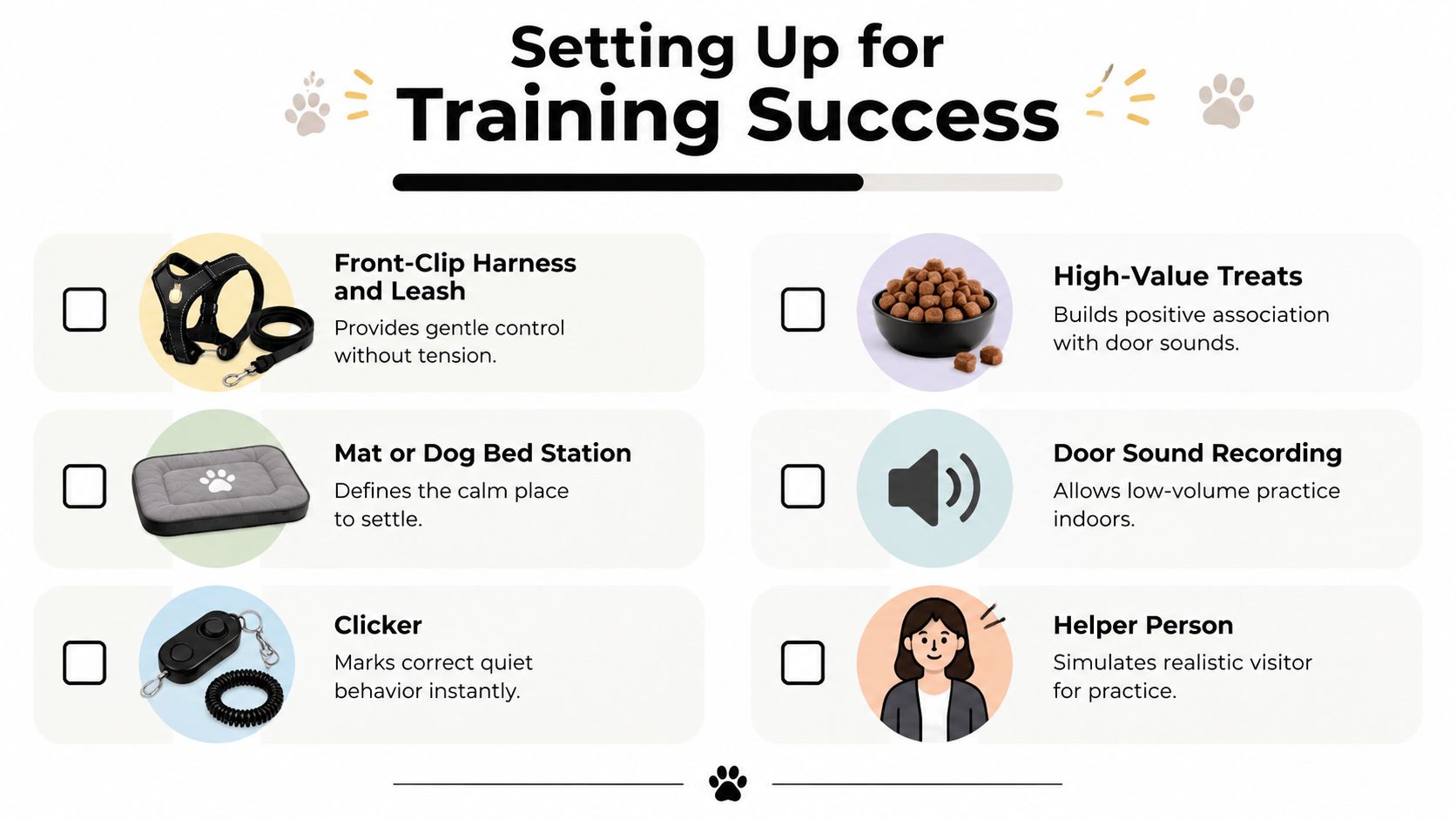
Preparation determines whether the first practice session teaches calm behavior or rehearses another explosion. Choose a quiet training area, place the mat away from the entrance, and keep the equipment ready before you create any door sound.
Use a front-clip harness or head harness with a standard leash for gentle control. The leash isn't there to drag your dog into position. It gives you a safe way to prevent a rush while you guide the dog toward the chosen station. If you're comparing equipment, this guide to dog training collars can help you think through control and handling choices.
You'll also need:
- A mat or dog bed: This becomes the dog's station during the entry routine.
- A marker: Use a clicker or one consistent word such as “yes” to identify the exact calm behavior you want.
- High-value food: Cut soft treats into tiny pieces and reserve them for door practice. At this arousal level, ordinary kibble may not compete with a visitor cue.
- A sound source: A doorbell recording played from a phone or speaker lets you control volume and distance.
- A helper: Recruit someone who can follow instructions, repeat the same approach, and avoid exciting greetings.
Teach the station first
Start in a low-distraction room. Lure your dog onto the mat, mark the moment all four paws are on it, and feed directly on the mat. Repeat until your dog moves there readily, then add the cue “mat” or “place.”
Next, reward a down on the mat. Build duration slowly, adding only a few seconds at a time while you remain nearby. Step away briefly, return, mark calm staying, and feed. Your first success criterion is not a long stay. It's a dog that understands the mat predicts steady rewards.
Add mild distractions only after the basic behavior is comfortable. Scrape a chair lightly, walk across the room, or open a door elsewhere in the house. If your dog gets up, lower the distraction and reward an easier version.
The mat should become the best-paying job in the house before it's asked to compete with a real visitor.
Use the video below as a visual supplement for the training setup and handling sequence.
The Desensitization and Counterconditioning Plan
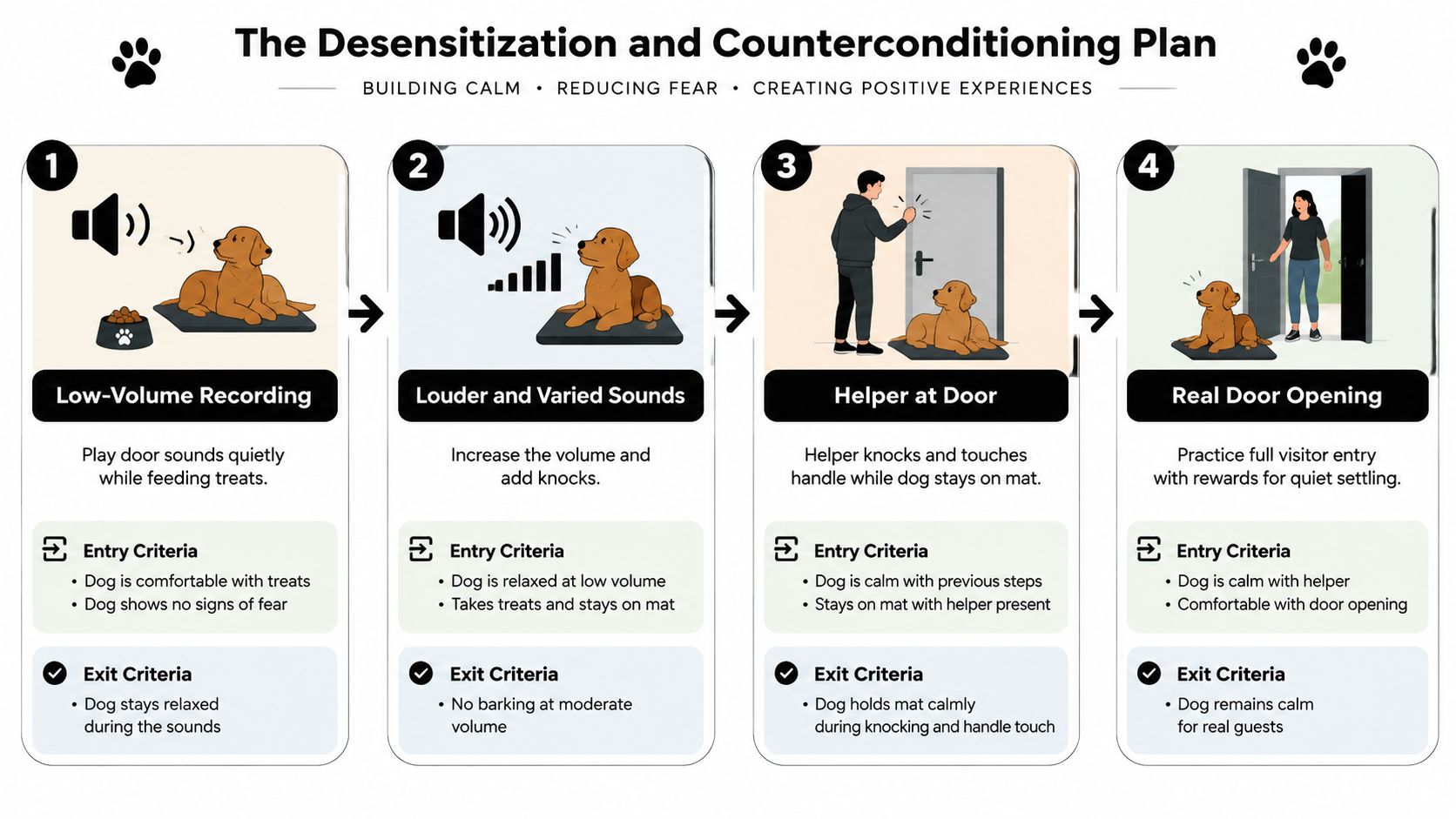
The central rule is simple: present the trigger at a level your dog can handle, then pair it with something valuable. The dog should notice the sound or movement and still be able to eat, orient toward you, and perform the chosen alternative behavior.
A structured behavior plan can help you organize the same logic around your home, schedule, and dog's response. For owners who want that kind of customized framework, a dog behavior modification plan can be used alongside hands-on training.
Work through the stages
Stage 1, quiet recording. Put your dog on the mat. Play a very low-volume doorbell recording from another room, then immediately mark calm orientation and deliver food on the mat. Entry criterion: your dog can hear the sound and remain relaxed. Exit criterion: your dog consistently looks to you or returns attention to the mat without barking.
Stage 2, stronger and varied sounds. Increase volume gradually and add quiet knocks. Don't raise volume and add a new sound in the same repetition if your dog is struggling. Entry criterion: the previous sound level produces calm responses. Exit criterion: your dog can handle moderate variations while eating and staying engaged.
Stage 3, helper outside. Have the helper stand at a distance from the door, then knock or ring while your dog remains on the mat. The helper should stay still and quiet. Entry criterion: the sound recording is easy. Exit criterion: the dog holds the station through the actual sound without barking.
Stage 4, door movement. Touch the handle, pause, and reward. Then move the handle, pause, and reward. Open the door a crack, close it, and reward. Increase the opening only when the dog remains settled.
Stage 5, visitor entry. The helper steps inside slowly and avoids eye contact or reaching. Feed while the dog remains on the mat, then release the dog only if the greeting is calm. If the dog barks, the visitor freezes or exits, and you return to the last reliable stage.
Keep sessions short, usually 5 to 10 minutes, and stop while your dog is still successful. Deliver treats frequently at first, then gradually space them as the dog maintains the station. A bark isn't a moral failure, but it is information that the current setup is too difficult.
A worked practice session
- Minute 0 to 1: Cue the mat, reward several calm downs, and confirm the leash is loose.
- Minute 1 to 3: Play the quiet recording. Mark the dog's calm look toward you and feed on the mat after each sound.
- Minute 3 to 4: Pause the recording and let the dog relax. Don't use the pause to add a harder cue.
- Minute 4 to 6: Repeat the sound at the same level. If the dog remains loose and accepts food, add a brief hand touch or sit if that's the chosen alternative.
- Minute 6 to 8: End with several easy mat rewards, then release the dog away from the door.
If barking starts, don't repeat the same difficult trial to see whether the dog can “get through it.” Reset completely, reduce intensity or increase distance, and return to the previous successful stage. The desensitization and counterconditioning guidance from East Bay SPCA similarly recommends beginning with a low-intensity trigger and advancing through sound, distance, people, and door-opening variables only as the dog stays under threshold.
A Realistic Two-Week Daily Schedule
A useful schedule fits around ordinary life. Three short sessions are easier for most households than one exhausting drill, and each session should end before the dog becomes frantic or mentally flat.
| Day | Morning Session | Midday Session | Evening Session | Notes |
|---|---|---|---|---|
| 1 | Mat practice | Quiet recording | Mat practice | Find the level that keeps the dog relaxed |
| 2 | Quiet recording | Mat practice | Quiet recording | Keep the sound at the easiest successful level |
| 3 | Recording with small volume increase | Mat and settle | Recording | Step back if food refusal appears |
| 4 | Recording | Recording with brief pause | Mat practice | Reward calm orientation |
| 5 | Varied recording sounds | Quiet recording | Mat with mild room distraction | Finish with an easy repetition |
| 6 | Recording | Helper session | Mat practice | Add a helper only if recording work is stable |
| 7 | No door trigger | Mat work | Enrichment | Use this as a rest day |
| 8 | Recording | Helper at distance | Mat practice | Keep the helper outside and still |
| 9 | Recording | Helper knocks | Recording | Maintain distance from the entrance |
| 10 | Mat work | Helper knocks and touches handle | Recording | Return to easier knocks if needed |
| 11 | Recording | Helper moves handle | Mat practice | Reward before the door moves further |
| 12 | Recording | Door opens slightly | Mat practice | Keep the visitor quiet and still |
| 13 | Mat work | Door opens wider | Helper entry rehearsal | Release only after calm settling |
| 14 | Easy recording | Full rehearsal | Mat and enrichment | Test one realistic but controlled entry |
Sessions can be 5 to 10 minutes each. During the first five days, use recordings only. From day six onward, add one helper session per day if the dog is coping well.
Use a written reset rule
If your dog barks twice in one session, drop back one full stage and remain there for two days before trying the harder stage again. This rule prevents optimism from pushing the dog into repeated failure.
Track the work in a simple log:
- Stage: Which trigger level or door action you practiced.
- Session count: How many repetitions you completed.
- Barks observed: Record the actual number without judgment.
- Notes: Food intake, body tension, recovery time, and what changed.
By day fourteen, success doesn't mean your dog will never bark again. It means your dog can hear a controlled door cue, move to the station, accept food, hold the behavior through basic door movement, and recover without a prolonged outburst.
Adjusting the Plan for Age, Breed, and Environment
The progression stays the same, but the starting point and recovery time can change.
Puppies under six months usually benefit from very brief sessions, often 2 to 3 minutes, with gentle food and calm exposure rather than intense repetition. Pair door sounds with ordinary socialization experiences, such as hearing visitors move through the home, without making every person a greeting opportunity.
Adolescents may understand the mat but lose impulse control when the door sequence begins. Give them more decompression before practice, reduce the trigger intensity, and reward the first pause rather than waiting for a perfect down. Older dogs may recover more slowly from arousal, so begin at a lower trigger level, increase distance, and allow longer pauses between repetitions. Broader guidance on training adult dogs can help you adjust expectations without abandoning consistency.
Breed tendencies can influence pacing, but they don't determine the outcome. Herding and terrier types may react quickly to movement and sound, so early sessions should emphasize quiet recordings and distance. Scent hounds may orient more strongly through the nose, making food trails and station work useful. Guardian breeds may need slower visitor exposure because unfamiliar people carry more significance.
Environment changes the management plan. In an apartment, hallway footsteps and shared doors may be impossible to control, so use white noise, sightline blocking, and a station positioned well away from the entrance. In a house, create distance with a gate or another room and practice around predictable delivery periods. Management isn't avoidance forever. It stops your dog from rehearsing the unwanted response while training catches up.
Troubleshooting and When to Get Extra Help
Persistent barking usually points to a mismatch somewhere in the setup. Diagnose the training conditions before blaming the dog.
If arousal is already high at the start, drop back two stages, move farther from the door, lower the recording volume, and shorten the session to under 90 seconds. Increase treat value and reward the first moment of orientation, not only a complete down-stay.
If the helper keeps moving, talking, staring, or opening the door too soon, the helper is breaking the criteria. Use written instructions and add a physical barrier, such as a gate, so the dog can't rush the entrance while you reset.
If the alternative behavior is weak, stop practicing door triggers and rebuild the mat routine in easier rooms. Your dog must find the station rewarding without the door competing for attention.
A regression after a successful week is data, not proof that training failed. Return to the last reliable stage, reduce visitor unpredictability, and restore the household routine. Door barking is a common nuisance issue. It accounted for 35.5% of annual dog complaints in Auckland, with 2,452 barking complaints out of 6,905 total dog complaints, while almost 30% of noise complaints in England were about dog barking (reported barking complaint data). The behavior deserves a practical plan, not embarrassment.
Get professional help if bark intensity keeps increasing despite three weeks of consistent work, if your dog redirects toward household members, or if you see freezing followed by snapping near the door. Look for a CPDT-KA or CDBC professional who uses force-free methods and provides a supervised behavior-modification plan. Ask your veterinarian about anxiety, sensory decline, or pain when the reaction has changed suddenly or your dog struggles to recover.
PawCraft creates personalized 30-day dog training programs that account for your dog's breed, age, environment, and specific behavior challenges, including barking and reactivity. If you want a structured plan with daily exercises, progression steps, and success criteria for your home, visit PawCraft and complete the brief questionnaire.