You're halfway down the sidewalk when another dog appears around the corner. Your dog spots it first, stiffens, and starts barking before you've found room to move. The leash goes tight, your hand closes around it, and both dogs leave the encounter more wound up than before.
That scene is common, but barking isn't automatically defiance or aggression. Often, it's your dog trying to create distance from something worrying, or protesting because the leash prevents access. How to stop dog barking at other dogs starts with identifying that emotional response, then changing the distance, timing, and consequences around it.
Why Your Dog Barks at Other Dogs on Walks
A quiet street can change in seconds. Another dog appears, your dog locks on, and barking starts before you can cross the road. The sound may be alarming, but it is communication, not a diagnosis. A 2010 ethological study found that dog barks vary with context, including play, isolation, and reactions to strangers or other dogs. Human listeners could identify aggressive, fearful, and playful barks above chance levels, yet the bark alone still cannot reveal the full emotional picture. The research summary on dog-barking context shows why training should address the situation behind the noise.
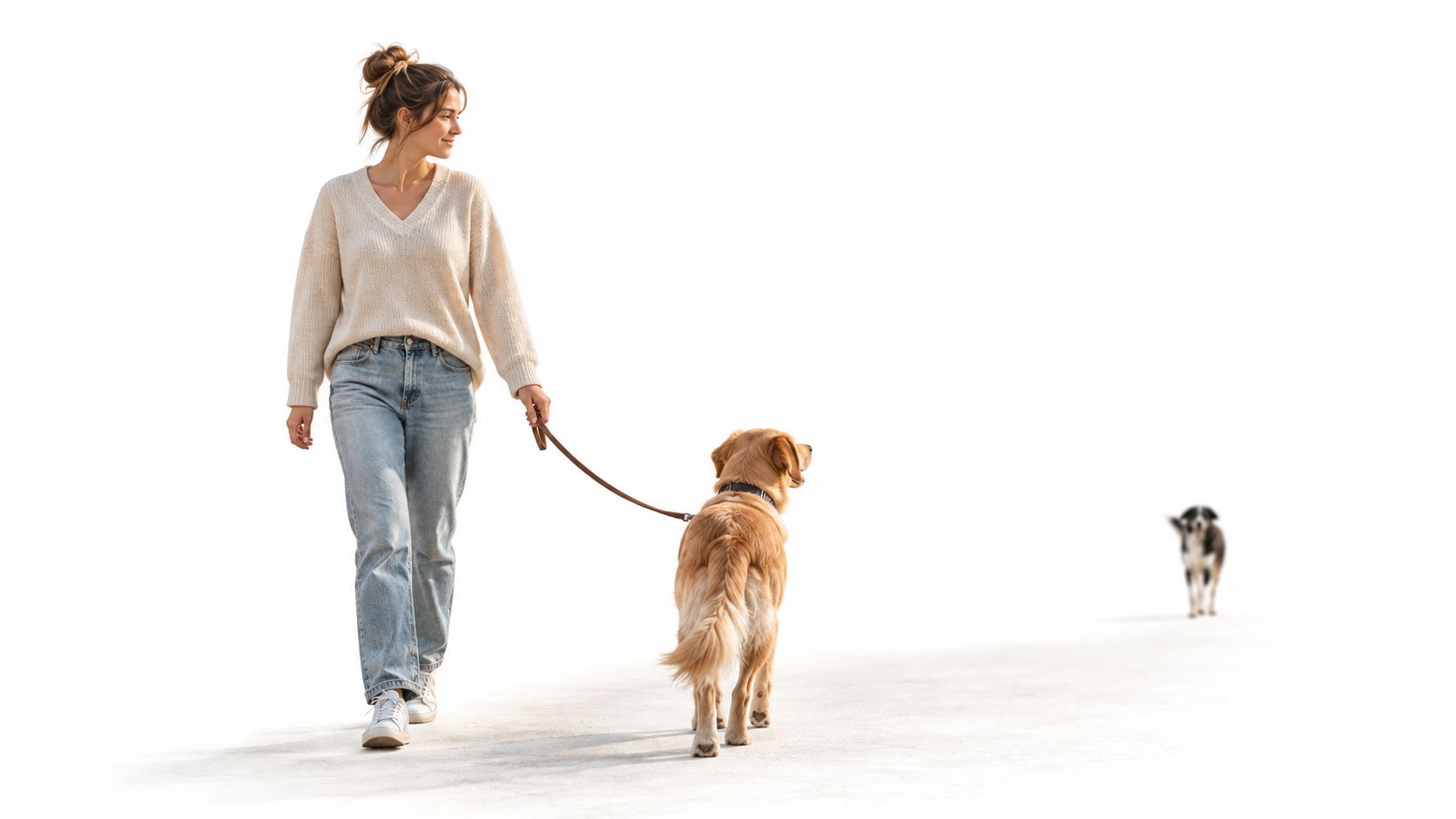
A dog that feels unsafe may bark, growl, lunge, or pull toward the trigger. If those actions have previously made another dog pass or move away, barking can become a distance-seeking strategy. A frustrated dog may show the same outward behavior because the leash blocks a greeting. The behavior overlaps, while the emotional cause does not.
Fear, frustration, and restraint
Leash restraint changes an encounter. Your dog cannot arc away, pause freely, or choose whether to approach, so a narrow sidewalk can make a routine sighting feel inescapable. A tight leash can add physical tension, and a sudden correction can make the approaching dog seem even more important. Read this leash reactivity explained before treating every outburst as disobedience.
Punishment may interrupt the bark without changing the underlying feeling. For a fearful dog, yelling or jerking the leash adds another unpleasant event to the appearance of dogs. For a frustrated dog, punishment can raise arousal and conflict instead of teaching a workable alternative. Distance, recovery, sleep, and the dog's overall stress load affect how much learning is possible on a given day.
Survey evidence supports a measured response. A 2013 UK owner survey found that 22% of owners reported aggression toward unfamiliar dogs, defined as barking, lunging, growling, or biting, while aggression toward dogs in the same household was reported by 8%. In the larger Dog Aging Project sample of 50,188 dogs, responses after an unfamiliar dog barked, growled, or lunged ranged from no aggression to snaps or bites, as reported in the Dog Aging Project behavior data. Barking sits within a wider reactivity spectrum, so prevention and careful observation matter.
Practical rule: Ask, “What distance lets my dog notice another dog and still make a good choice?”
Progress may begin with looking at a dog without exploding, recovering sooner, or turning back toward you. Those small responses are useful training targets. The plan that follows builds them while reducing repeated rehearsals of barking.
What Your Dog's Bark Is Really Telling You
Watch the whole dog before deciding what the bark means. A fearful dog often tries to look larger or more forceful, but you may also see weight shifted backward, a low or tucked tail, flattened ears, lip-licking, scanning, or a quick retreat once the other dog passes. Recovery time matters. A dog that remains tense long after the trigger has gone may have been overwhelmed, even if the encounter looked noisy rather than frightened.
A frustrated dog tends to lean forward into the leash. The tail may stay high or move rapidly, the body may bounce, and the dog may keep trying to reach the other animal. In a hallway or on a narrow sidewalk, the barrier is obvious: your dog wants access but can't get it. A dog that settles quickly once the other dog is gone may be dealing more with blocked social access than with a desire to create distance.
Overexcitement can look similar again. The dog may whine, bark in bursts, spin, jump, or lose the ability to take food. The trigger might be a dog running near a fence, a familiar playmate, or the moment the leash comes out. Context gives you useful evidence, but it doesn't replace a professional assessment when safety is uncertain. The guide to understanding dog body language can help you read posture, movement, and recovery together.
Use context to separate the possibilities
Ask yourself these questions after each encounter:
- Does your dog move backward or forward? Backward movement, freezing, hiding, or turning away supports a distance-seeking interpretation. Forward pulling and repeated attempts to reach the dog point more toward frustration or high arousal.
- What happens when the leash disappears? If the behavior occurs only behind a leash, fence, window, or gate, barrier reactivity may be involved. Don't test this by forcing an off-leash meeting.
- Can your dog eat and respond? A dog that can take food, orient toward you, and move away is still within a workable learning range. Refusing food, staring, or ignoring familiar cues means you're too close or the trigger is too intense.
- How long does recovery take? A quick return to sniffing is different from continued pacing, panting, scanning, or explosive reactions to the next dog.
The same dog can show different motives in different places. Your dog might fear an unfamiliar animal on a tight sidewalk, then bark from frustration at a familiar dog behind a park fence. Record the setting, distance, body posture, and recovery rather than assigning one permanent label.
Setting Up for Success Before Training Starts
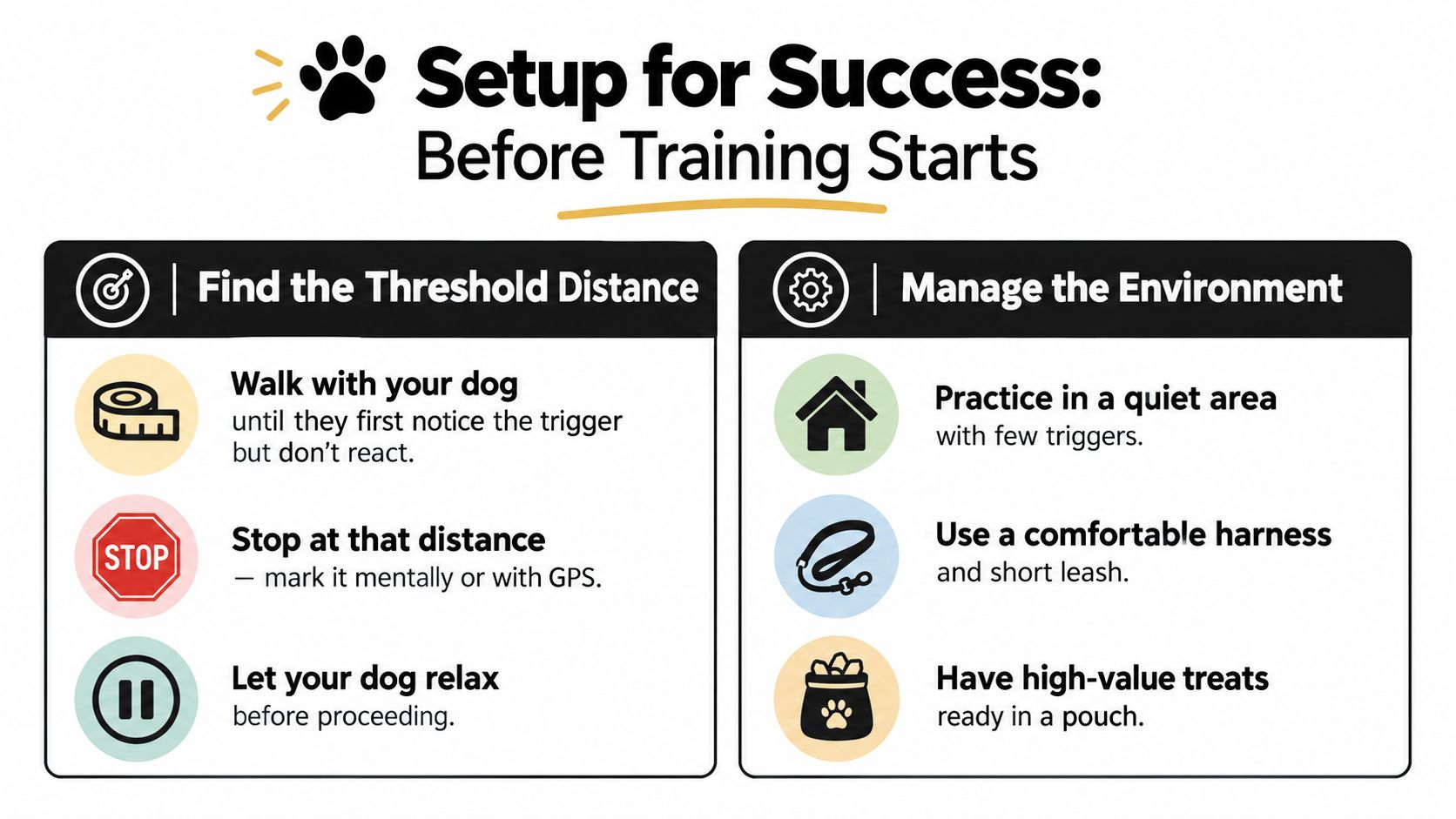
Training can't work reliably if every walk becomes a close-range confrontation. Start by managing the environment so your dog has fewer chances to practise the full barking sequence. Choose quieter streets, walk when foot traffic is lighter, and identify escape routes before you need them.
In an apartment, that may mean checking the lobby before leaving, using a side exit, or waiting while another dog clears the elevator area. On a busy urban route, parked cars, hedges, driveways, and building entrances can provide visual cover. A comfortable harness, a secure leash, and a treat pouch keep your handling practical. A longline can help in open, legal spaces, but it isn't suitable where other dogs, cyclists, or traffic can become entangled.
Find the threshold distance
Threshold distance is the space at which your dog notices another dog but can still think, eat, and respond. It isn't a fixed measurement. It changes with sleep, weather, location, leash tension, the other dog's movement, and your dog's accumulated stress.
Walk toward a low-intensity setup until your dog first notices the other dog. Stop there or move farther away. If your dog barks, growls, lunges, stares hard, or refuses food, increase distance immediately. You're looking for the earliest workable point, not the closest point your dog can tolerate.
Use a simple management checklist:
- Create an exit: Know where you'll turn, cross, or step behind a barrier.
- Protect space: Ask other handlers to pause or give room when needed.
- Reward calm observation: Feed while your dog notices the trigger and remains loose enough to eat.
- Allow retreat: Moving away is a useful coping choice, not a failure.
- Skip forced greetings: Your dog doesn't need to meet every dog on the route.
- Avoid corrections: Punishment may suppress communication while leaving fear or frustration unchanged.
Reward-based work is most useful when it starts before the reaction. The reward-based dog training guidance provides the broader foundation, but the key handling decision is simple: create enough room for your dog to succeed, then reinforce the behavior you want repeated.
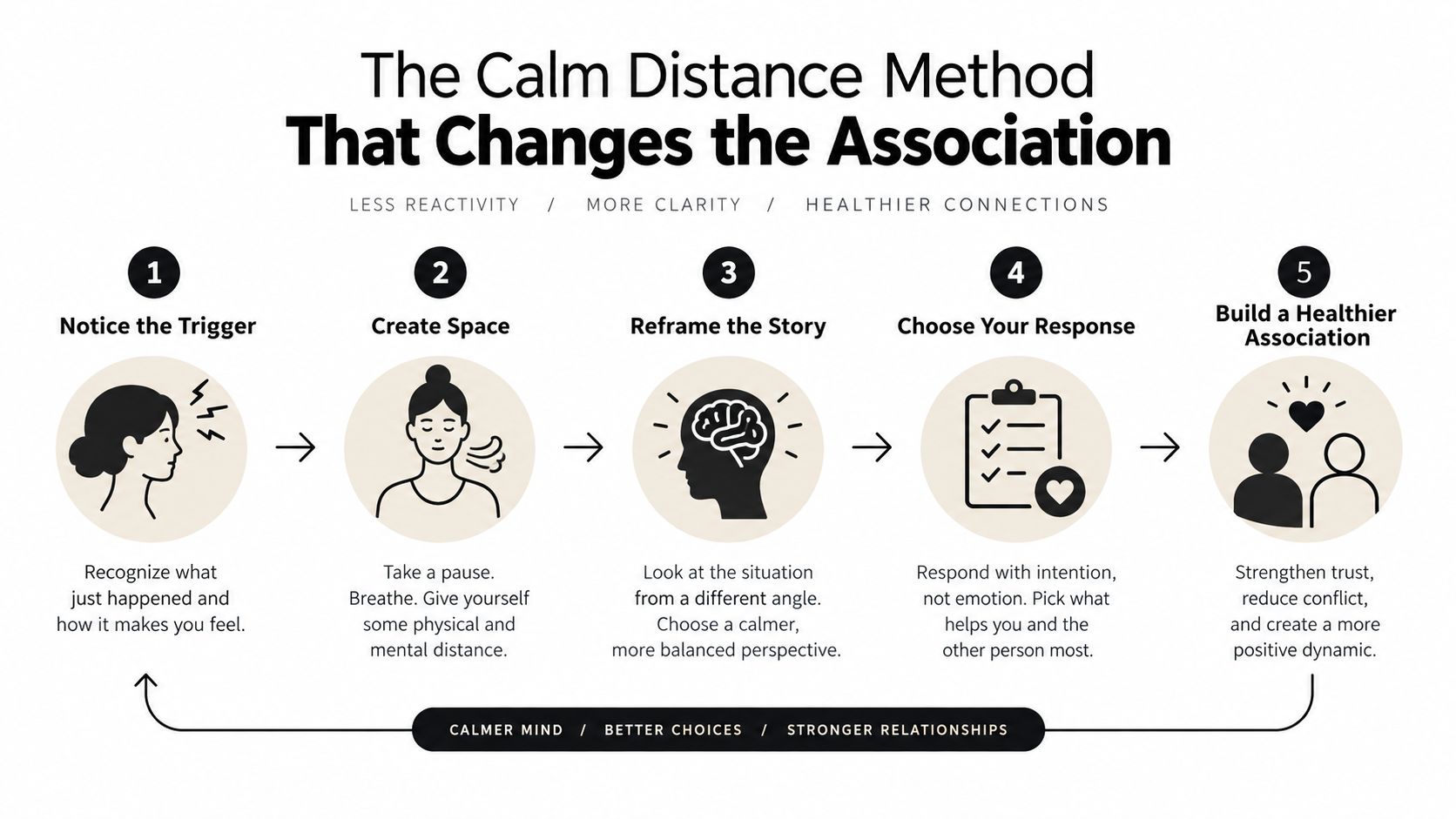
The Calm Distance Method That Changes the Association
The active exercise is desensitization paired with counterconditioning. You present another dog at a manageable distance, then immediately provide something valuable. Over repeated, controlled exposures, the sight of a dog can begin to predict food, movement away, and safety rather than panic or blocked access.
Start with a helper dog if possible. Choose a calm dog and a handler who can follow instructions. The helper should appear briefly, remain far enough away for your dog to stay under threshold, and then disappear. A moving stranger on a crowded sidewalk is a poor first training partner because you can't control speed, distance, direction, or duration.
Run one clean repetition
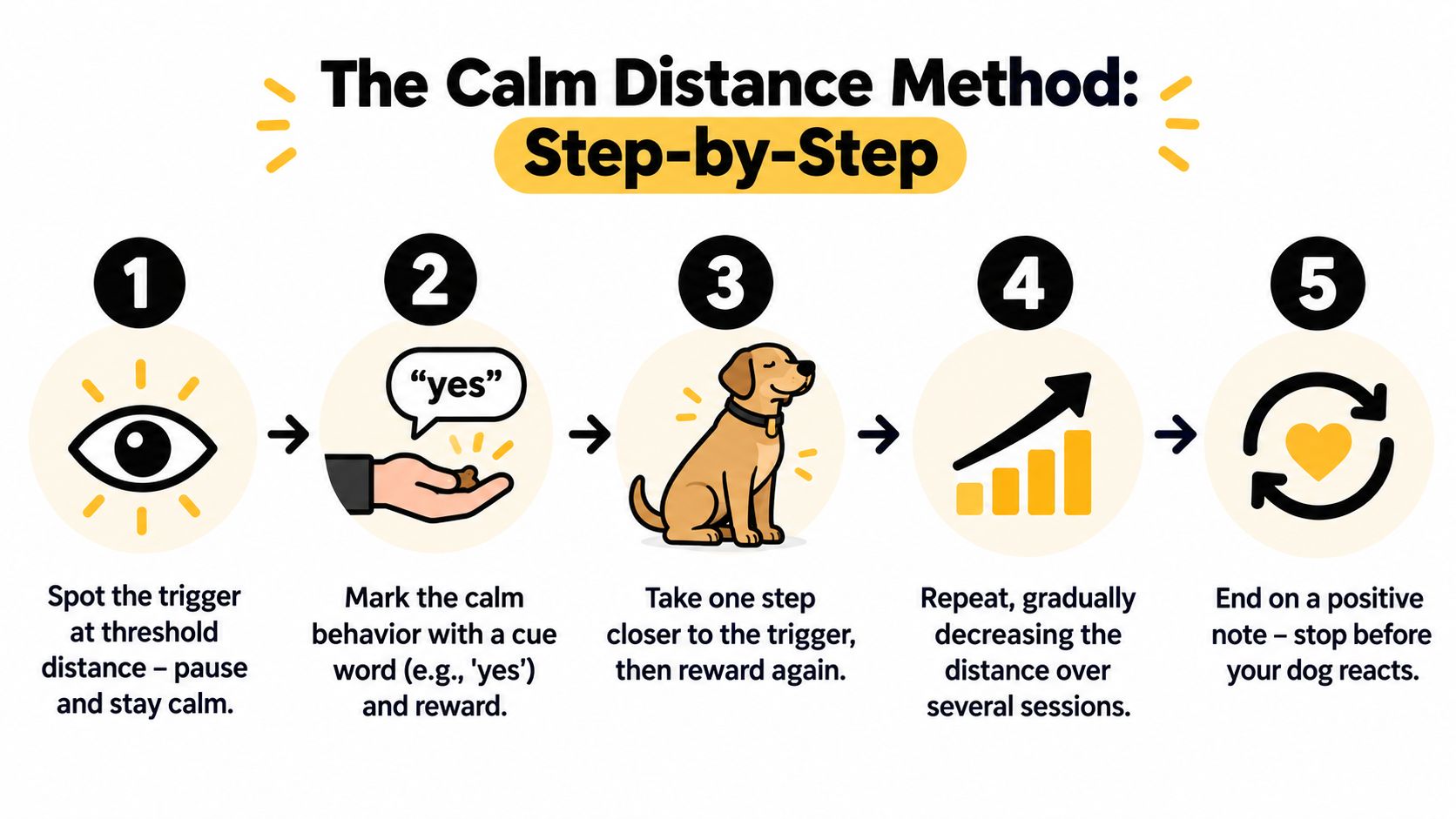
- Begin beyond threshold. Your dog notices the helper dog but can still eat and orient toward you. Keep the leash as loose as the situation safely allows.
- Mark the sighting. Use a calm cue such as “yes” as soon as your dog sees the other dog. Don't wait for eye contact if the first glance is still relaxed.
- Feed rapidly. Deliver 10 to 20 treats in a row, as recommended in the ASPCA-style look-and-treat protocol. Use small, high-value pieces so the food lasts through the brief exposure.
- End the exposure. Have the helper dog move away or disappear after a few seconds. Stop feeding when the trigger is gone, then let your dog sniff and decompress.
- Repeat only while quality stays high. Several calm repetitions teach more than one long encounter that ends in barking.
The order matters. The dog appears, food starts. The dog disappears, the repetition ends. You're not bribing your dog to ignore a threat. You're pairing the trigger with a consequence that changes the emotional prediction.
Timing mistakes that undermine the exercise
Moving closer because your dog succeeded once is the most common error. Keep the same distance until your dog can repeat the pattern calmly across separate sessions. Then change only one variable, such as distance, movement, or duration.
Rewarding after the bark also creates confusion. If you miss the first glance and your dog is already lunging, don't push food toward the trigger or wait for a perfect sit. Increase distance, help your dog recover, and make the next repetition easier.
Avoid continuous exposure. Keeping the helper dog in view until your dog “gets used to it” can flood the dog with more intensity than they can process. Desensitization depends on manageable exposure, not endurance.
Tightening the leash is another predictable trap. Safety comes first, but a rigid leash can add pressure and remove your dog's ability to create space. Turn away, use a visual barrier, or cross the road before the reaction builds.
For dogs that can't eat outside, start farther away or use a quieter location. Food isn't the only reinforcer, but refusal often tells you that the setup is too difficult. Lower the intensity before changing the reward.
A short demonstration can help you see the timing and body-language details:
Building Progress Week by Week Without Rushing
A successful session doesn't earn an immediate closer walk. It gives you information about what your dog can handle today. Keep a simple record after each practice: location, approximate distance, whether your dog ate, number of calm repetitions, and recovery quality.
Use the 80% success rule as a brake on ambition. Increase difficulty only when your dog is succeeding about 80% of the time. If barking appears in more than a small minority of repetitions, return to the previous easier version rather than trying to push through.
Change one difficulty dial
Distance is usually the first dial. Reduce it gradually, then hold the new distance until it feels ordinary. After that, introduce movement, because a stationary dog is easier to process than one approaching directly.
Duration comes later. A brief glance followed by food is different from watching another dog walk past. Keep the trigger visible for only as long as your dog remains able to respond, and finish before arousal rises.
Busier locations should come after the skill works in quiet settings. A dog that succeeds on an empty field may still struggle on a narrow pavement with sudden appearances. Add urban complexity in small pieces, not all at once.
| Signal | What It Means | Next Step |
|---|---|---|
| Your dog notices, eats, and turns back easily | The current setup is workable | Repeat at the same difficulty |
| Your dog stares, stops eating, or stiffens | You're close to the edge | Increase distance or reduce movement |
| Your dog barks once, then recovers quickly | The exposure was slightly too hard | Make the next repetition easier |
| Your dog lunges or stays aroused after the dog leaves | The session exceeded capacity | End training and schedule more decompression |
| Your dog succeeds about 80% of the time | The skill is becoming reliable at that level | Change one variable gradually |
Daily life can provide practice without turning every walk into a lesson. On ordinary outings, manage distance and reward calm sightings. Reserve deliberate repetitions for locations where you can control the setup.
Timelines vary. Mild cases may show useful change over weeks, while severe reactivity can require months or even years, according to behavior guidance summarized by Dog Trust's advice on barking and lunging. Consistency and below-threshold work matter more than forcing a dramatic breakthrough.
Age, breed tendencies, and experience change the starting point, not the basic principle. An adolescent dog may need shorter sessions around exciting movement. A senior dog may need a veterinary check if behavior changes suddenly, especially when pain could affect tolerance. High-drive dogs often need more movement and sniffing away from triggers before they can learn.
Troubleshooting When Barking Stalls or Slides Back
A setback doesn't mean the training failed. It often means the dog's total arousal load exceeded what the walk could support. Poor sleep, repeated trigger sightings, noisy housing, intense exercise, pain, and long periods of restraint can all reduce the margin you thought you had.
The 2024 Dogs Trust report found that 17% of dogs were reactive to other dogs while out walking. The same report recorded other common behavior concerns, including barking at the door or outside noises, fireworks distress, and jumping up. These issues shouldn't be treated as proof that one training failure caused everything, but they do support a broader view of arousal and welfare.
Fix the conditions, not just the leash skill
If barking returns on tight sidewalks, stop testing that route for now. Use wider streets, parked cars as visual screens, planned U-turns, and quieter times while you rebuild success.
If one bad encounter causes a slide backward, give your dog lower-pressure outings. A decompression walk in a quiet area, gentle sniffing, and extra rest can be more productive than repeated exposure the next day.
Sleep deserves attention too. UK welfare data has linked insufficient sleep with more intra-household aggression-related behavior toward other dogs, as noted in the Dogs Trust national survey material. That doesn't make sleep a standalone cure, but it makes rest, predictable routines, and reduced overstimulation sensible parts of a reactivity plan.
Change the budget: If your dog has spent the day reacting at windows, hearing hallway dogs, and navigating crowded streets, don't expect a polished training repetition at the end of it.
Breed and age can influence trigger intensity. Guardian-type dogs may respond strongly to movement or approach, while high-energy dogs may struggle after long periods without appropriate outlets. Adjust the environment and session length rather than blaming the breed.
Seek veterinary behavior support if your dog's reactions are escalating, include snaps or bites, create a genuine handling risk, appear suddenly, or don't improve despite careful distance management. A qualified professional can assess medical contributors, safety, equipment, and whether your plan matches the dog in front of you.
You don't need every walk to be perfect. You need fewer explosive rehearsals, more recoverable sightings, and a plan that fits your actual streets, schedule, and dog.
PawCraft creates a personalized 30-day dog training plan based on your dog's breed, age, environment, and behavior challenges, including daily exercises, progression points, and troubleshooting for barking and leash reactivity. Answer the short questionnaire and visit PawCraft to receive a structured plan designed around your dog's real starting point.