Your dog spots another dog at the far end of the sidewalk. The leash goes tight, the stare locks on, and within seconds you're holding back barking, lunging, and a body that seems determined to drag you into the street. Then someone says, “He's fine off leash,” as if that settles the matter.
It doesn't. Leash reactivity is an emotional response expressed through movement, noise, and tension, not a simple refusal to obey. The useful question isn't only how to stop the explosion. It's what your dog is trying to accomplish, how close the trigger can be before learning shuts down, and how to make city walks predictable enough for better choices.
Why Your Dog Explodes on Leash and What It Really Means
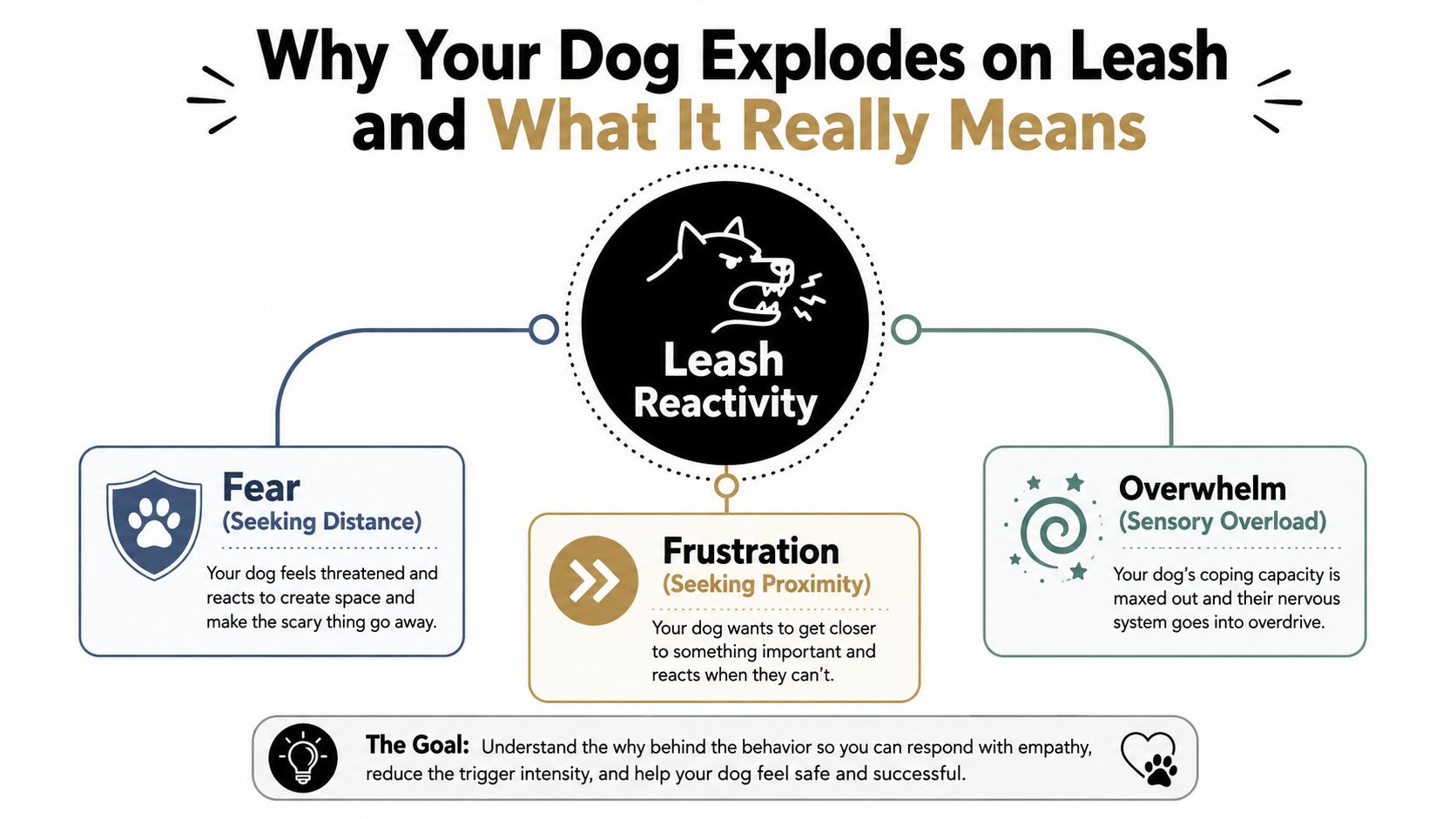
A dog that reacts on leash may be trying to create distance, gain access, or cope with too much sensory pressure. Those motives can produce similar barking and lunging, but they call for different handling.
Fear-based reactivity usually has a distancing purpose. The dog may lean backward while barking, keep the body low, tuck the tail, lick the lips, or scan for an escape route. The outburst says, in effect, “Move away from me.” A dog with this pattern often becomes more distressed when the handler tightens the leash or insists on moving closer.
Frustration-based reactivity points in the opposite direction. The dog may pull forward, whine, bounce, wag with a rigid body, or keep trying to approach the other dog, person, or moving object. The barrier prevents access, and the leash turns an ordinary desire to greet, chase, or investigate into a physical struggle.
A third pattern involves barrier stress and sensory overwhelm. The trigger may be the leash, a narrow hallway, a crowded elevator, traffic noise, scooters, or several moving people arriving at once. Some dogs cope well in open spaces but lose flexibility when restraint and stimulation combine.
Why off-leash behavior can mislead you
A dog may behave normally in a secure off-leash area because it can arc away, pause, sniff, or leave an interaction. A leash removes those choices. The dog can also learn that barking makes the handler retreat, or that pulling eventually produces access to the interesting thing. Either outcome can strengthen the pattern without making the dog generally aggressive.
A large peer-reviewed shelter-behavior study found measurable links between general temperament and leash behavior. Dogs that were more relaxed during assessment showed less leash reactivity, lower tension, and less frequent pulling, including statistically significant associations for lower maximal net leash tension and lower pulling frequency in the study's reported results. The same research found behavioral differences connected with dogs' backgrounds, which supports treating reactivity as more than a basic manners problem.
Find the threshold before you train
Threshold distance is the closest point at which your dog can still notice a trigger and respond to you. Below that point, your dog may stare, stiffen, vocalize, or lunge. Learning becomes unreliable because the emotional response has taken over.
Arousal also stacks. A tense elevator ride, a barking dog behind a fence, a missed nap, and a crowded pavement can leave your dog closer to threshold before the main trigger appears. For the next walk, don't correct or rehearse exercises yet. Observe one trigger from a safe distance and write down what your dog does first, whether the body moves toward or away, and how long it takes to recover after the trigger disappears.
How to Diagnose Your Dog's Trigger Type and Threshold
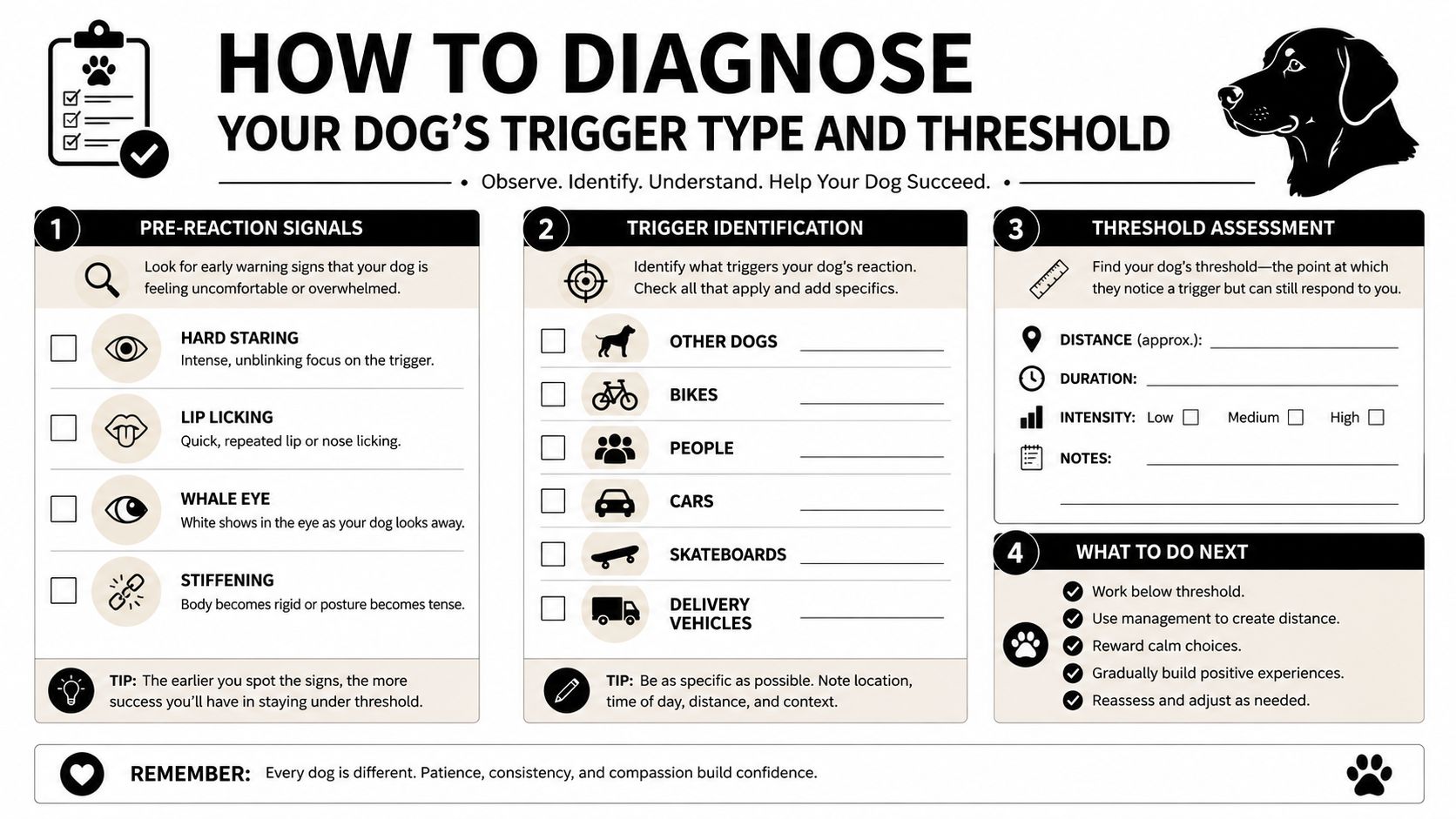
Diagnosis starts before the bark. The first useful signal might be a pause in sniffing, a closed mouth, a hard stare, or a sudden change in walking rhythm. If you wait for the lunge, you've waited too long to make the easy training choice.
Read the sequence, not one isolated gesture
Watch for clusters of signals:
- Early tension: Your dog stops sniffing, closes the mouth, raises the head, or fixes on the trigger.
- Rising arousal: The body stiffens, weight shifts forward or backward, the eyes widen, or the tail changes position.
- Loss of flexibility: Your dog ignores familiar food, stops responding to their name, or keeps staring despite your movement.
- Full reaction: Barking, growling, whining, lunging, spinning, or repeated leash bites appear.
Fear and frustration can overlap, so don't diagnose from barking alone. A dog moving backward while vocalizing is giving you a different clue from a dog straining forward with a loose, wiggly body. A dog that scans, startles, and struggles to recover may be overwhelmed even when no single trigger seems especially close.
Use a field test without forcing contact
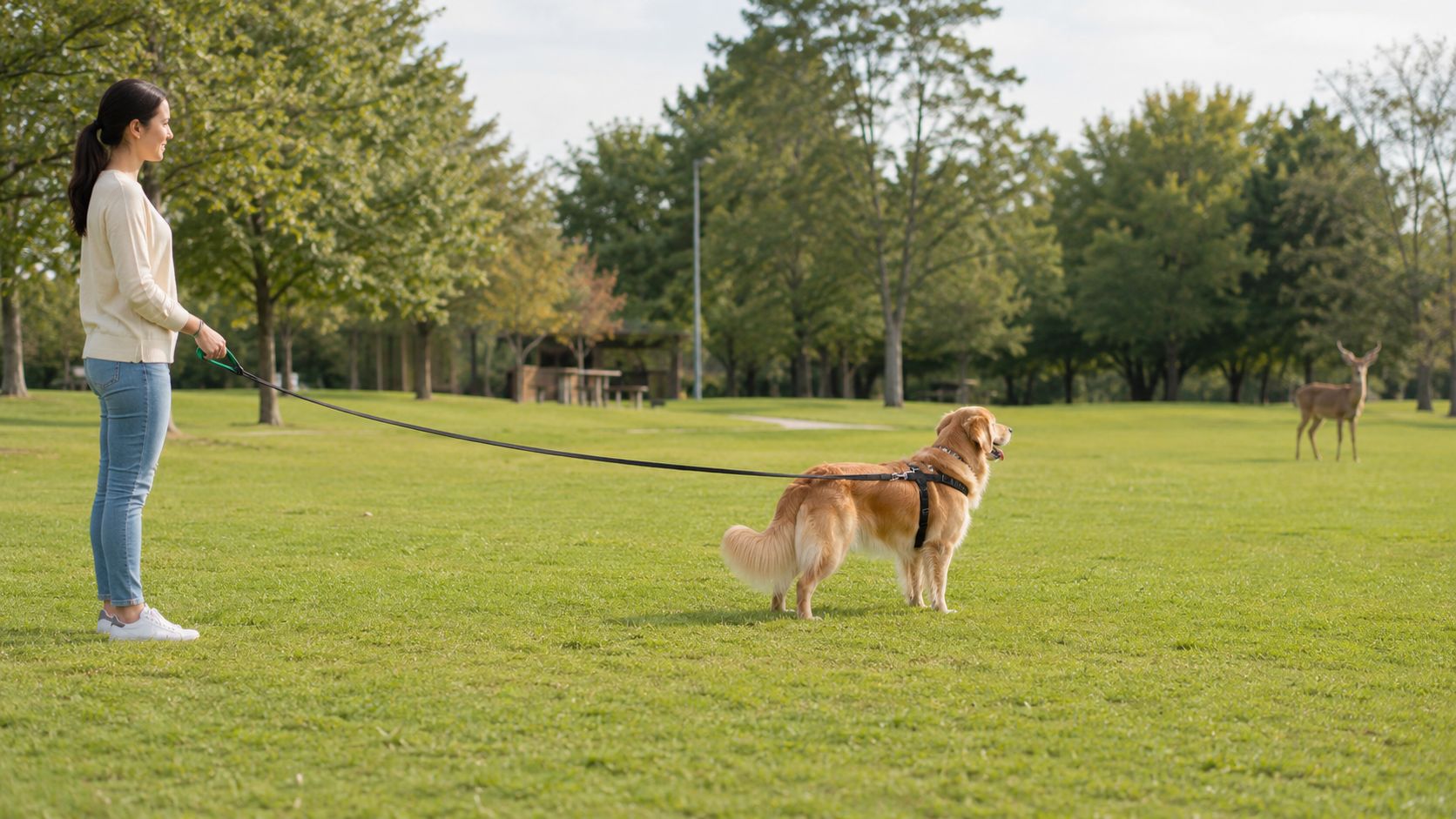
Choose a location where you can see likely triggers early, such as the edge of a quiet park or a wide parking area. Keep your dog far enough away that they can eat and orient back to you. When the trigger appears, note whether your dog notices it, takes food, and can turn away without physical pressure.
If your dog reacts, don't wait for silence while holding position. Turn away, cross the street, or use a parked vehicle as a visual screen. The distance that restores eating, sniffing, or eye contact is more useful than the distance that produces a dramatic reaction.
Fear often shows as an attempt to retreat, hide behind the handler, or make the trigger leave. Frustration more often includes forward pulling, repeated whining, bouncing, and renewed efforts to approach after the handler blocks access. Barrier stress becomes more likely when the reaction is strongest in tight spaces or when the leash tightens, even though the same trigger is manageable in an open area.
Keep a simple trigger profile
Record each meaningful encounter in plain language:
- Trigger: Note the object, movement, location, and whether it was approaching or stationary.
- Starting distance: Estimate where your dog first noticed it and where the body changed.
- Driver clues: Mark retreat, forward pressure, scanning, freezing, or sensory overload.
- Response: Record the first signal, the full reaction if it happened, and what helped.
- Recovery: Note when your dog could eat, sniff, or respond normally again.
This profile determines your first exercise. A fearful dog needs a reliable exit and carefully controlled distance. A frustrated dog needs calm engagement and alternative access patterns. An overwhelmed dog may need quieter routes, shorter outings, and protection from stacked stimulation before formal trigger work begins.
Management Setup That Stops Rehearsal Before Training Starts
Training can't gain traction if every walk gives your dog repeated opportunities to practise barking and lunging. Management isn't surrender. It's how you reduce the number of emotional blowups while your dog learns a replacement response.
Build the walking kit
Use equipment that gives you control without adding pain. A well-fitted front-clip or supportive Y-shaped harness can help distribute pressure, while a standard fixed leash gives clearer handling than a retractable line in crowded spaces. Check that the harness doesn't restrict shoulder movement, rub behind the elbows, or allow the dog to back out.
Keep the leash short enough for urban navigation but loose enough that your dog can move naturally. Hold the handle with both hands when needed, keep your elbows close, and avoid shortening the leash the instant a trigger appears. Sudden tension can become part of the trigger picture and can increase the dog's sense of confinement.
A painful collar correction, leash pop, or choke-based response may interrupt movement without changing the underlying emotion. It can also make the approaching dog, cyclist, or person predict discomfort. If you're reviewing equipment, compare the pressure and fit carefully, including options described in this guide to a metal dog training collar, rather than choosing a tool as a substitute for distance and timing.
Use movement before the crisis
Before leaving, prepare food in an easy-to-reach pouch, choose the quieter side of the building, and scan the route before stepping into a blind corner. Cross early when you see a trigger. A parked car, hedge, doorway, or building entrance can create enough visual relief for your dog to keep functioning.
For narrow sidewalks, teach a cheerful U-turn away from the trigger before you need it. Say the cue, turn your shoulders first, and feed as your dog follows. In an elevator or hallway, wait for space instead of squeezing past another dog. If a surprise trigger appears at close range, move behind a barrier, step into a doorway, or calmly retreat. Don't demand a sit while your dog is already losing control.
A short sniffing period before the main walk can help some dogs settle, but it won't compensate for an impossible route. On high-stimulation days, choose decompression, indoor enrichment, or a secure exercise area instead of testing progress on the busiest pavement.
The Staged Training Plan for Calm Leash Walking
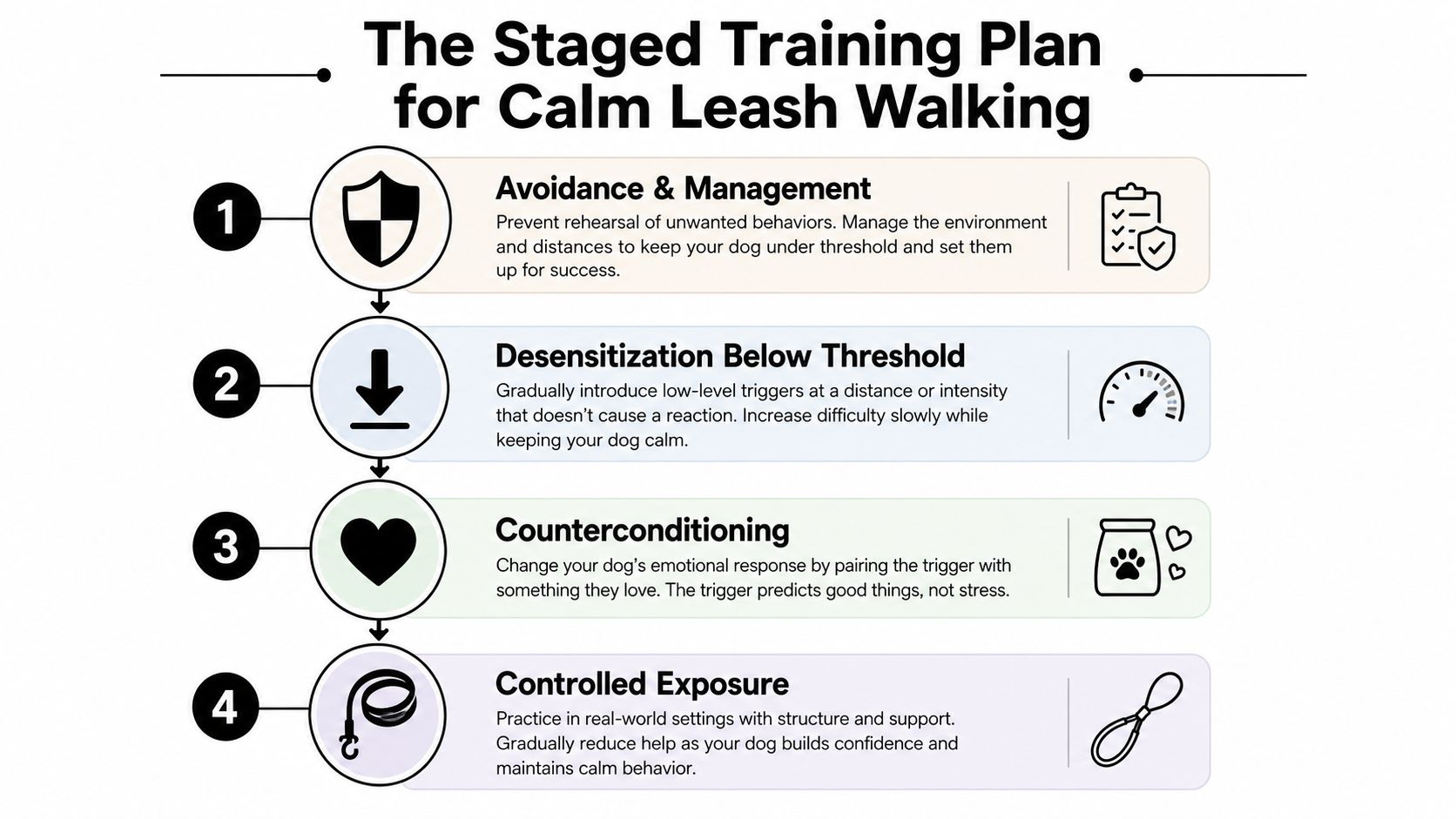
The training objective is not to make your dog stare at a trigger until they stop reacting. It's to change what happens after noticing the trigger. Your dog sees it, stays capable of thinking, engages with you, and chooses to disengage.
A controlled dog-training study found that an Owner Interaction phase significantly reduced vocalization, leash pulling, and attention toward the target dog compared with a no-interaction period. Owner attention increased during that phase, which supports active, structured engagement rather than passive exposure alone in the study's reported comparison.
Stage one creates workable distance
Start where your dog can notice the trigger without escalating. That might mean the opposite side of a broad street, the far edge of a park, or a quiet area near a café rather than the pavement immediately outside your home.
The moment your dog sees the trigger, mark the observation with a calm word and deliver high-value food. Chicken, cheese, or a soft training treat often works better than ordinary kibble when the environment is difficult. Feed while the trigger remains at a safe distance, then stop when it leaves or when you turn away.
Don't lure your dog toward the trigger. Don't wait for a reaction and then try to negotiate. If your dog freezes, refuses food, or locks on, increase distance immediately.
Stage two pairs noticing with disengagement
Once your dog can notice the trigger and eat, wait for a small head turn, blink, sniff, or glance back toward you. Reward that voluntary disengagement generously. If the dog doesn't look away, use your practiced U-turn rather than repeating their name until the cue loses meaning.
Keep sessions brief and end while your dog still has flexible behavior. Repetition quality matters more than covering a long route. A dog that succeeds with a distant dog, then walks home calmly, has completed more useful learning than a dog that crosses the street repeatedly while already over threshold.
Stage three reduces distance in tiny decisions
Move closer only when the current distance produces relaxed body language, food acceptance, and voluntary orientation back to you across repeated easy encounters. Reduce distance in small increments, not in one dramatic jump from across the street to the same sidewalk.
If the dog reacts, return to the last successful distance on the next repetition. Don't punish the setback or keep drilling. The dog training guide for adult dogs can help you keep the general training plan aligned with age and learning history while this trigger-specific work develops.
| Stage | Distance Goal | Success Criteria Before Advancing |
|---|---|---|
| Avoidance and management | Create enough space for recovery | Your dog can move away and regain normal behavior |
| Desensitization | Stay below the reaction point | Your dog notices the trigger without escalating |
| Counterconditioning | Build a positive response to observation | Your dog accepts high-value food and disengages |
| Controlled exposure | Handle realistic movement with support | Your dog can pass, turn away, or reorient without a full reaction |
Stage four handles real urban passes
For a narrow sidewalk, spot the other dog early and decide whether you can create space. If yes, cross or step behind a parked car. If no, turn away before your dog locks on and feed continuously while moving. The purpose isn't to force a close pass. It's to get through safely while preserving the next training opportunity.
At a café patio, begin at the perimeter rather than beside the busiest table. Reward your dog for looking at a person or dog and then returning attention to you. If the body stiffens, leave the area. A successful session may end with only a few calm observations.
Keep loose-leash walking separate from trigger training at first. Practise ordinary walking in low-distraction areas, then use the trigger protocol when the emotional work is needed. Asking for a perfect heel, a prolonged sit, and calm eye contact during a difficult encounter creates too many jobs at once.
Systematic review evidence summarized by the Pet Professional Guild's discussion of desensitization and counterconditioning reported clinically significant improvement in 73% of cases, with gains maintained at six-month follow-up in 68% of dogs. Those figures support a realistic definition of progress: reactions become less frequent, less intense, and shorter, rather than disappearing on every walk.
Breed Age and Energy Adjustments That Prevent Common Mistakes
The same trigger plan can feel completely different across dogs. A herding breed may notice movement early and become intensely focused on bikes, runners, or erratic dogs. A terrier may escalate quickly around motion and resist long periods of stillness. A brachycephalic dog may need closer attention to heat, breathing, and physical fatigue before you interpret a difficult walk as a training failure.
Match the session to the dog in front of you
High-drive dogs often need an outlet before trigger work, but hard exercise immediately beforehand can also leave some dogs more aroused. Use controlled sniffing, food searches, pattern games, or calm movement rather than trying to exhaust the dog through frantic play.
Adolescent dogs can show uneven regulation. They may succeed on a quiet morning and struggle after a busy day, so lower your expectations when sleep, novelty, or accumulated stimulation changes. Fearful young dogs need slower distance changes and more escape options, not repeated exposure designed to “get it over with.”
Senior dogs deserve a physical check when reactivity appears suddenly or worsens. Pain, reduced vision, hearing changes, and slower recovery can alter how a dog experiences close approaches. A dog that can't comfortably turn, brake, or move away may need route and equipment changes before behavior exercises begin.
Adjust reinforcement and environment
Some dogs work for tiny soft treats, while others need a toy, permission to sniff, or access to a quiet patch of grass. Frustration-based dogs may benefit from short movement patterns and a clear release to investigate when calm. Fearful dogs usually need predictable retreat cues and food delivered without pulling them toward the trigger.
Apartment dogs may need indoor practice around hallway sounds, doors, and elevators before they train outdoors. Suburban dogs may have more space but face fences, driveways, and sudden vehicles. Herding, terrier, brachycephalic, adolescent, and senior profiles all change the correct pace, even when the basic principle remains the same: keep the dog able to learn.
Practical rule: Increase difficulty only when the dog's body and recovery support it, not because the calendar says the next step should happen.
Tracking Progress and Troubleshooting When Reactivity Returns
Progress becomes easier to trust when you track behavior instead of judging one hard walk. Each week, record the trigger, the distance at first notice, whether your dog could eat, the intensity of the response, and the time needed to recover. Look for a pattern across frequency, intensity, and duration.
A setback usually has a practical cause. You may have started too close, tightened the leash before your dog saw the trigger, used food after the reaction instead of before it, or taken a route where several triggers arrived together. Trigger stacking can make a familiar distance suddenly impossible, so treat the next outing as a recovery walk rather than proof that training has failed.
Make decisions from the dog's response
- If your dog eats and disengages: Keep the same distance and repeat the setup.
- If your dog stares but can still move: Increase distance slightly and use the practiced turn-away cue.
- If your dog refuses food or lunges: End the exposure, create space, and lower difficulty next time.
- If recovery takes a long time: Shorten the outing and reduce other stimulation that day.
- If progress stalls: Return to easier locations and rebuild the mechanics without a trigger.
The dog behavior modification plan should fit the emotional driver, environment, and recovery pattern you've observed. Some dogs will retain mild reactivity even after substantial improvement, so maintenance means continuing to manage distance and reinforce flexible choices when the city gets difficult.
For owners who want daily structure, PawCraft creates a personalized 30-day training program from your dog's breed, age, environment, and behavior challenges, with exercises, progression guidance, and weekly checklists delivered after a brief questionnaire.
PawCraft can turn your trigger profile into a day-by-day plan for leash pulling, barking, and urban distractions, so you know what to practise and when to lower the difficulty. Visit PawCraft to create a personalized program and start with a clearer next walk.