You're halfway down the sidewalk when your dog spots a squirrel. The leash goes tight, your dog stops hearing their name, and the treat you were holding suddenly has no value. At home, that same dog can sit, touch your hand, and come when called. Outside, it seems like the training disappeared.
It didn't. Your dog hasn't learned how to perform the behavior while aroused, moving, and surrounded by competing sights and sounds. Distraction training for dogs works when you build that skill gradually, using distance, carefully chosen rewards, and a clear success standard instead of repeatedly waving food in front of an overwhelmed dog.
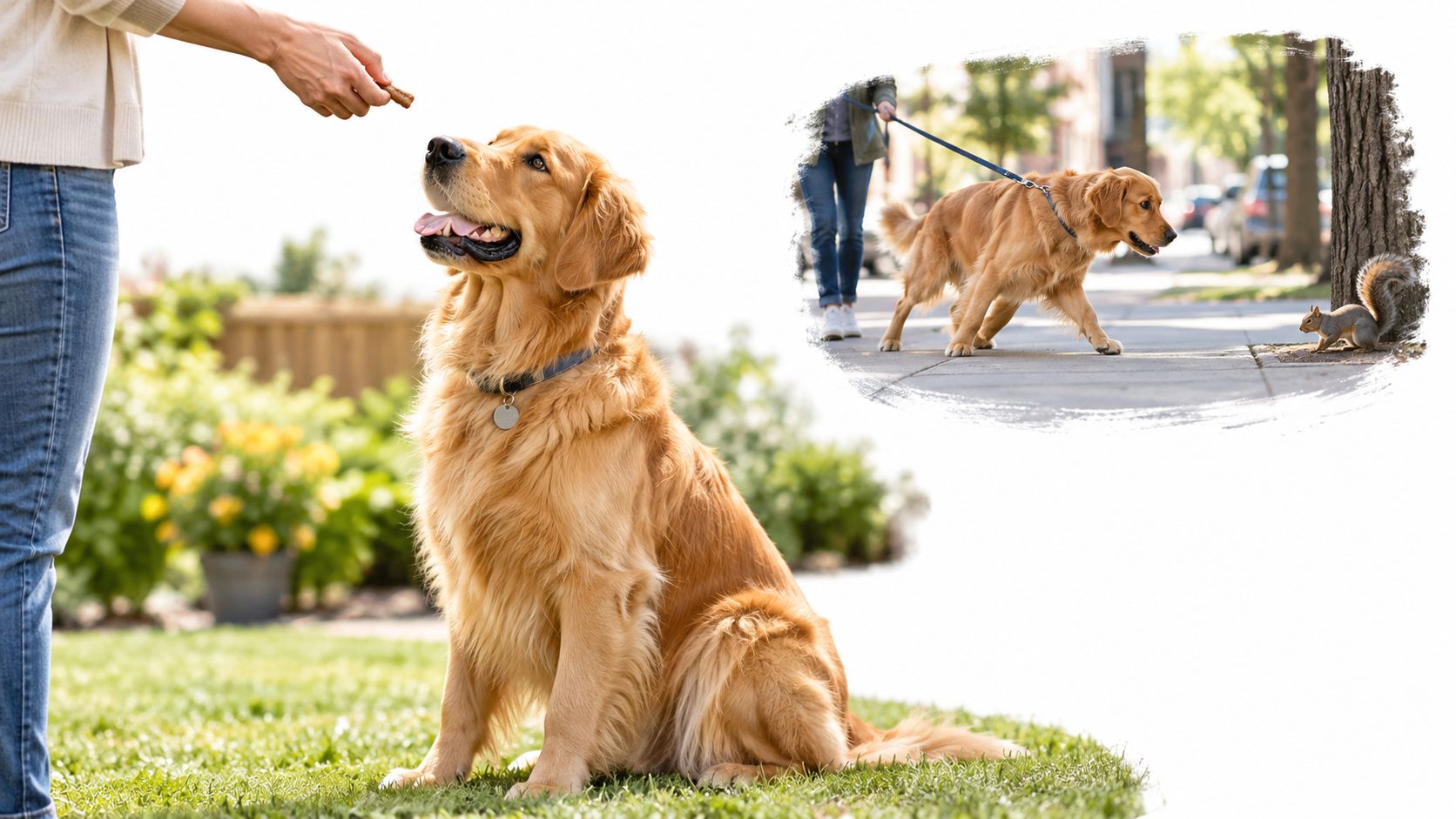
Why Your Dog Listens at Home But Not Outside
Your dog responds in the kitchen, then ignores the same cue beside a busy road. A cyclist passes, a gate bangs, another dog appears, or a scent trail changes direction. Each event competes with your request, and a cue learned only in quiet conditions may not hold up under that pressure.
This is a training gap, not stubbornness. Dogs do not automatically generalize a behavior from one room to a park, or from a quiet park to a crowded pavement. Every new setting tests the behavior around unfamiliar movement, sound, smells, and social pressure. If your dog ignores you outside, this guide to why dogs ignore their owners can help distinguish a motivation problem from a skill that has not been proofed.
A default response beats emergency bribery
The working goal is a default check-in. Your dog notices something interesting, then turns toward you, touches your hand, walks with you, or settles into a familiar position.
Build that response in layers:
- Your dog notices the distraction without lunging, barking, or pulling hard.
- You mark the calm moment immediately.
- Your dog turns back to you or follows a simple cue.
- You reinforce the choice, then release your dog to sniff or continue walking.
The release matters. If every distraction requires your dog to stare at you and abandon the environment, the exercise becomes frustrating. A calm dog should sometimes earn permission to investigate when the situation is safe.
Practical rule: Use food to reinforce a decision your dog has made, not to pull an already overloaded dog through a trigger.
Use distance as part of the lesson
Distance changes the difficulty of the task. It is a training variable, not automatic avoidance. A dog that responds to their name from far away may be ready for a slightly closer repetition. A dog that freezes, stares, vocalizes, or stops eating needs more space before you add distraction.
A 2023 distraction-learning study found that dogs trained with an acoustic distractor learned less efficiently than dogs trained in silence, and they did not later perform better when novel distractions appeared. The same study reported that a similar auditory distraction impaired performance more than a dissimilar light distraction. A new sound may therefore require a slower progression than a mild visual change. (Study data on distraction learning in dogs)
Measure the lesson instead of guessing. Record the distraction, approximate distance, response latency, whether your dog ate, and what happened after the repetition. Advance when your dog succeeds consistently at the current level, then change one variable at a time. If success drops, increase distance before adding better food or more prompting. That choice tells you whether the problem is difficulty or motivation, and keeps distraction training focused on proofing rather than treat luring.
What You Need Before You Start Training
Good equipment should give you control without creating a struggle. For most outdoor practice, use a well-fitted harness, a long line in an open safe area, a treat pouch, and rewards your dog can work for. A collar may be appropriate for some dogs and activities, but distraction work shouldn't depend on leash pressure to force attention.
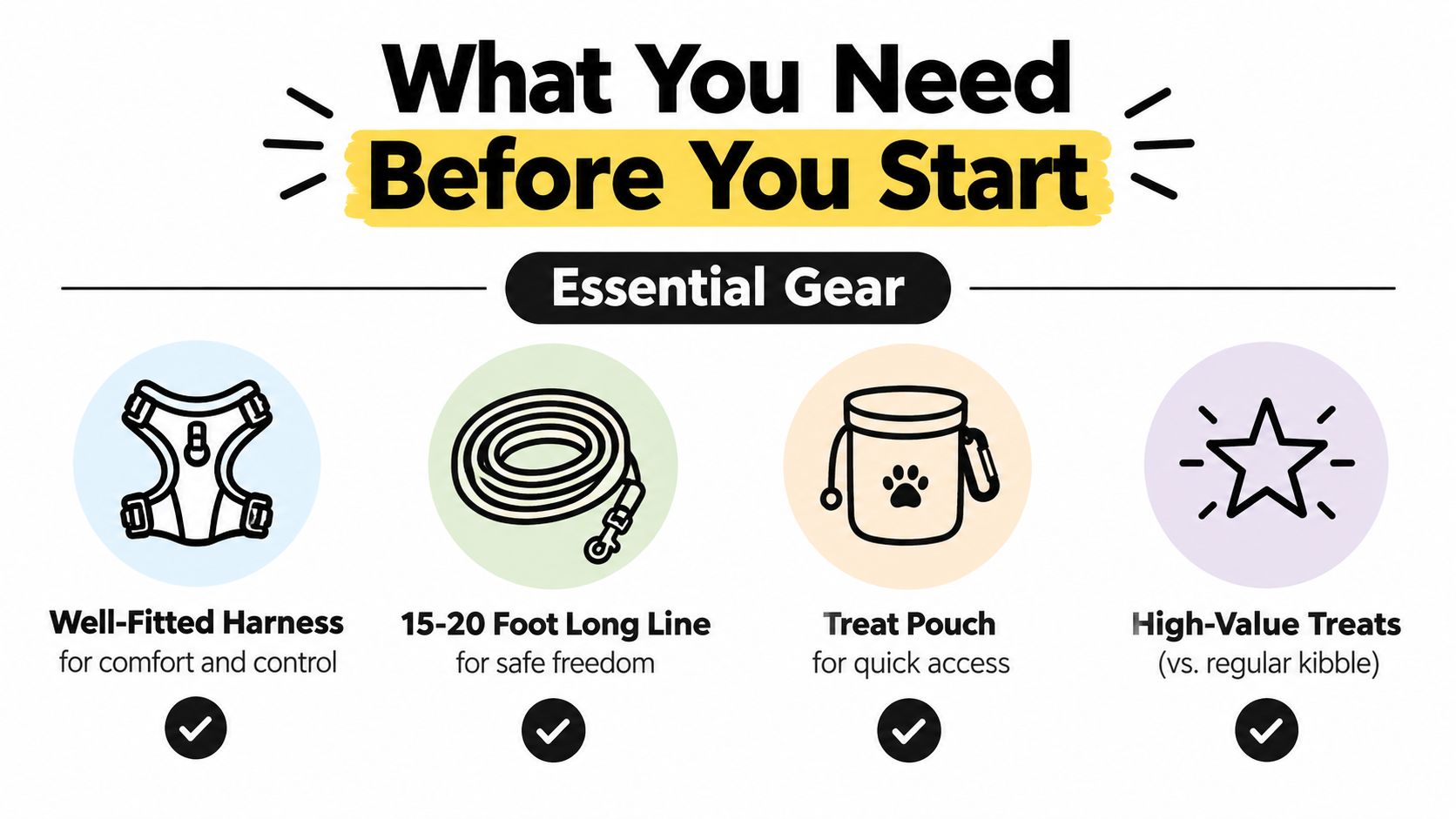
Set up the reinforcement system
Prepare two reward levels before you leave:
- Everyday rewards: Kibble or ordinary treats for easy repetitions in a familiar room.
- High-value rewards: Small pieces of chicken, cheese, cooked meat, or another safe favorite for difficult distractions.
- Environmental rewards: Sniffing, moving forward, greeting a known dog when appropriate, or exploring a permitted area.
Your dog's preference matters more than the label. Some dogs work hardest for food, others for a tug toy, access to scent, or movement. Keep pieces small enough for repeated reinforcement, and deliver them close to your leg or hand target so your dog learns where the useful position is.
Timing determines what your dog thinks earned the reward. Mark the instant your dog disengages from the distraction or begins the alternative behavior, then deliver the reward promptly. A consistent marker word such as “yes” works well if everyone in the household uses it the same way. The training timing guide covers why a delayed reward can reinforce the wrong behavior.
Choose the first environment carefully
Start in a place your dog knows, with minimal movement and sound. Then change only one variable at a time. You might move from the living room to a quiet garden, then add a distant person, then a person walking, rather than jumping directly into a crowded park.
Before each session, check three things:
- Can your dog eat the planned reward?
- Can your dog respond to an easy cue?
- Can your dog look at the distraction and disengage?
If the answer is no, lower the difficulty. Signs that the dog is over threshold include a fixed stare, closed mouth, frantic scanning, lunging, barking, sudden pulling, refusal of food, or inability to turn away. Don't keep repeating the cue in that state. Increase distance, move behind a visual barrier, or end the session.
Training standard: The right starting point is the hardest level at which your dog can still think, eat, and choose an alternative behavior.
Your Progressive Distraction Training Program Week by Week
A four-week plan is useful only if you treat it as a ladder rather than a deadline. Some dogs will need more repetitions at one level, particularly when sounds, fast movement, or other dogs are involved. Aim for brief daily practice, stop while responses are still clean, and write down what your dog did instead of relying on memory.
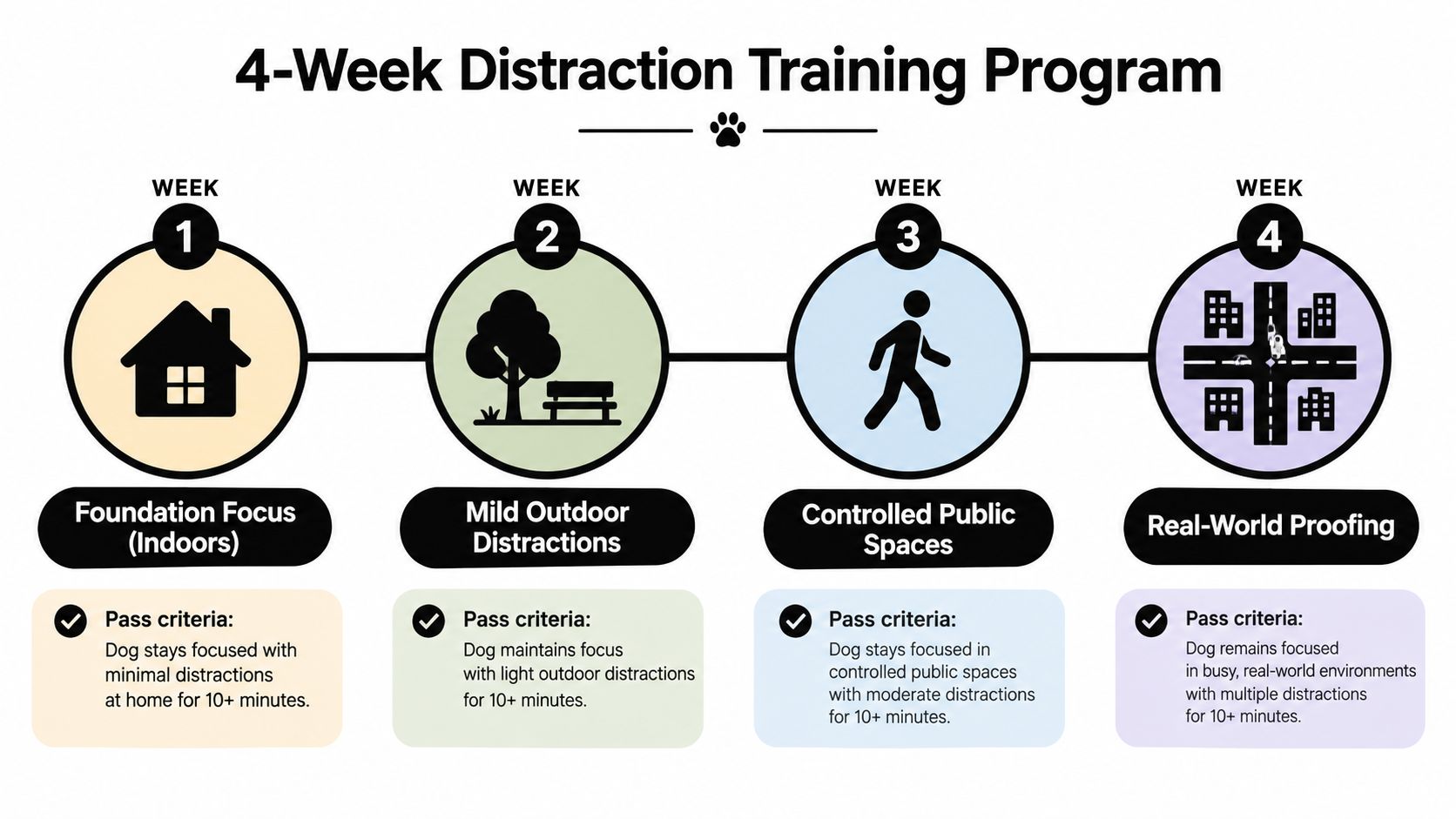
Week 1 builds the indoor response
The first week teaches your dog that noticing your cue and returning to you is a predictable game.
Days 1 and 2, name game. Say your dog's name once in a quiet room. The moment they orient toward you, mark and reward beside your leg. If they don't respond, reduce the room's activity rather than repeating the name. Finish with easy repetitions while your dog is standing, sniffing, or looking away.
Days 3 and 4, add one mild object. Place a toy on the floor or ask another person to sit nearby. Say the name once, wait for the turn, mark, and reward. If your dog approaches the object, allow a pause, then use a cheerful movement cue to regain attention. The object should remain boring enough that your dog can still eat.
Days 5 and 6, teach leave it to check-in. Present a low-value item in a closed hand. When your dog stops pawing or nudging and looks toward you, mark and reward from the other hand. Gradually place the item on the floor while keeping it safely inaccessible, then reward the check-in.
Day 7, review. Mix name responses, hand touches, and short loose-leash movements. Your pass criterion is not perfection. Move outdoors only when your dog can respond promptly to easy cues, recover quickly after looking at a mild distraction, and keep taking rewards.
Week 2 adds mild outdoor distractions
Choose a quiet outdoor location with room to move away. Start at a distance where your dog can notice a person, parked bicycle, leaf movement, or distant dog without losing the ability to respond.
On the first days, practice the look and return. Let your dog see the distraction, mark the first softening of the stare or turn of the head, then reward near you. If your dog needs help, step backward or arc away instead of pulling straight toward the trigger.
Later in the week, add a person walking across your path. Use a hand target or a short “with me” pattern, then release your dog to sniff after passing. Don't add a second moving distraction until the first one is easy.
Pass this stage when your dog can observe mild distractions and return to you across several repetitions without escalating. If your dog starts scanning or pulling, increase distance before increasing reward value. Food can strengthen a response, but it can't reliably compensate for a challenge that is too intense.
Week 3 increases movement and intensity
Now introduce controlled motion. Ask a familiar person to walk, turn, stop, or carry an ordinary object while you work at a comfortable distance. Practice a recall past the person, but arrange the setup so your dog can succeed. Call once, move away, and reward heavily when your dog follows.
Use a long line only in a secure, permitted area, and keep it managed so it doesn't wrap around people or objects. The line gives you safety, not permission to call your dog into a situation where you already know they won't respond.
Add sound separately. A door closing, a distant skateboard, or a quiet verbal cue can be more difficult than a stationary visual distraction. The dog-learning evidence cited earlier found that an acoustic distractor interfered more than a dissimilar light distractor, so treat sound as its own progression rather than assuming visual success transfers automatically.
Your pass criterion is a reliable response at the current distance with manageable recovery after the distraction. If your dog misses a repetition, don't punish or repeat the cue rapidly. Reset with movement, widen the gap, and give your dog an easier win.
Week 4 proofes the skill in real places
Use a quiet section of a familiar public area first. Work near, not inside, the busy part. Practice check-ins, hand targets, loose-leash turns, and short recalls while changing location gradually.
A simple session log keeps the plan honest:
- Trigger: What your dog noticed.
- Distance: Where your dog could still think.
- Response: Turned away, touched hand, followed, pulled, barked, or froze.
- Reward: Food, play, movement, or sniffing.
- Next step: Same level, easier level, or carefully increased difficulty.
Don't chase novelty for its own sake. A dog may perform beautifully beside a quiet café and struggle at a different café with metal chairs, music, and passing feet. Generalization comes from practicing the same response across varied contexts, not from one dramatic test.
A working-dog experiment published in 2024 found that acoustic distraction significantly reduced physical performance and tended to impair cognitive performance. In that experiment, 9 of 12 dogs stopped participating in the rewarded task after becoming sensitized to the sound, which is a strong reminder that trained dogs can still be disrupted by sudden acoustic pressure. (2024 study of acoustic distraction in working dogs)
Exercises That Build Real World Focus Around Triggers
A dog that ignores a squirrel at ten metres may still fail at five. Treat distraction work as a graded proofing ladder, not a single test. Increase only one variable at a time, such as distance, movement, sound, duration, or novelty, and keep the dog able to eat, respond, and recover.
Use this sequence for each trigger:
- Desensitize: Start far enough away, or with low enough intensity, for your dog to remain functional.
- Countercondition: Pair the trigger with food, play, movement, or another reward your dog values.
- Cue an alternative: Ask for a hand target, turn, check-in, loose-leash step, or calm stationary behavior.
- Proof the response: Repeat while the trigger remains present, then change one difficulty variable gradually.
Distance comes before distraction when the dog is over threshold. If your dog will not eat, cannot orient to you, or cannot recover, more treats will not solve the setup. Widen the gap or reduce the trigger's intensity. Distraction becomes useful once the dog can think, because it tests whether the trained response holds while something else is happening.
Match the behavior to the problem
| Trigger Type | Best Alternative Behavior | Progression Tip |
|---|---|---|
| Squirrels or birds | Hand target, then a moving “with me” turn | Begin with a stationary animal at a wide distance before adding movement |
| Other dogs | Look at the dog, then orient to the handler | Start with a calm dog far away and increase closeness only while your dog can eat |
| Scooters and bicycles | Step to the handler's side and walk past | Add speed only after slow movement is easy |
| Children running | Hand target or scatter-and-search in a safe area | Increase movement and proximity separately |
| Café patios | Settle on a mat or stand beside the handler | Practice with sparse foot traffic before adding chairs, sounds, and food smells |
| Doorways | Pause, check in, then cross on cue | Begin with an empty doorway and add people later |
For impulse-control foundations, these dog impulse-control exercises can help establish the alternative behaviors before you take them outdoors.
Similar distractions deserve smaller steps
Dogs may struggle more when a new distraction resembles the one used during training. A familiar bark can carry more emotional meaning than a quiet visual object, so auditory proofing often needs shorter sessions and smaller changes in distance or intensity.
For a squirrel, begin with a distant shape, then a stationary animal, then controlled movement. For another dog, use open space and predictable approaches before practising near a narrow path. Keep an exit route available. The goal is repeated successful choices, not a dramatic pass at close range.
A successful repetition changes the dog's response, not just the handler's ability to keep the treat visible.
Measure learning by what happens before the reward appears. Your dog should check in sooner, recover faster, choose a loose leash more often, or orient toward you before you ask. If the response disappears when food is hidden, lower the challenge and reinforce the behavior with movement, play, sniffing, or access to the environment.
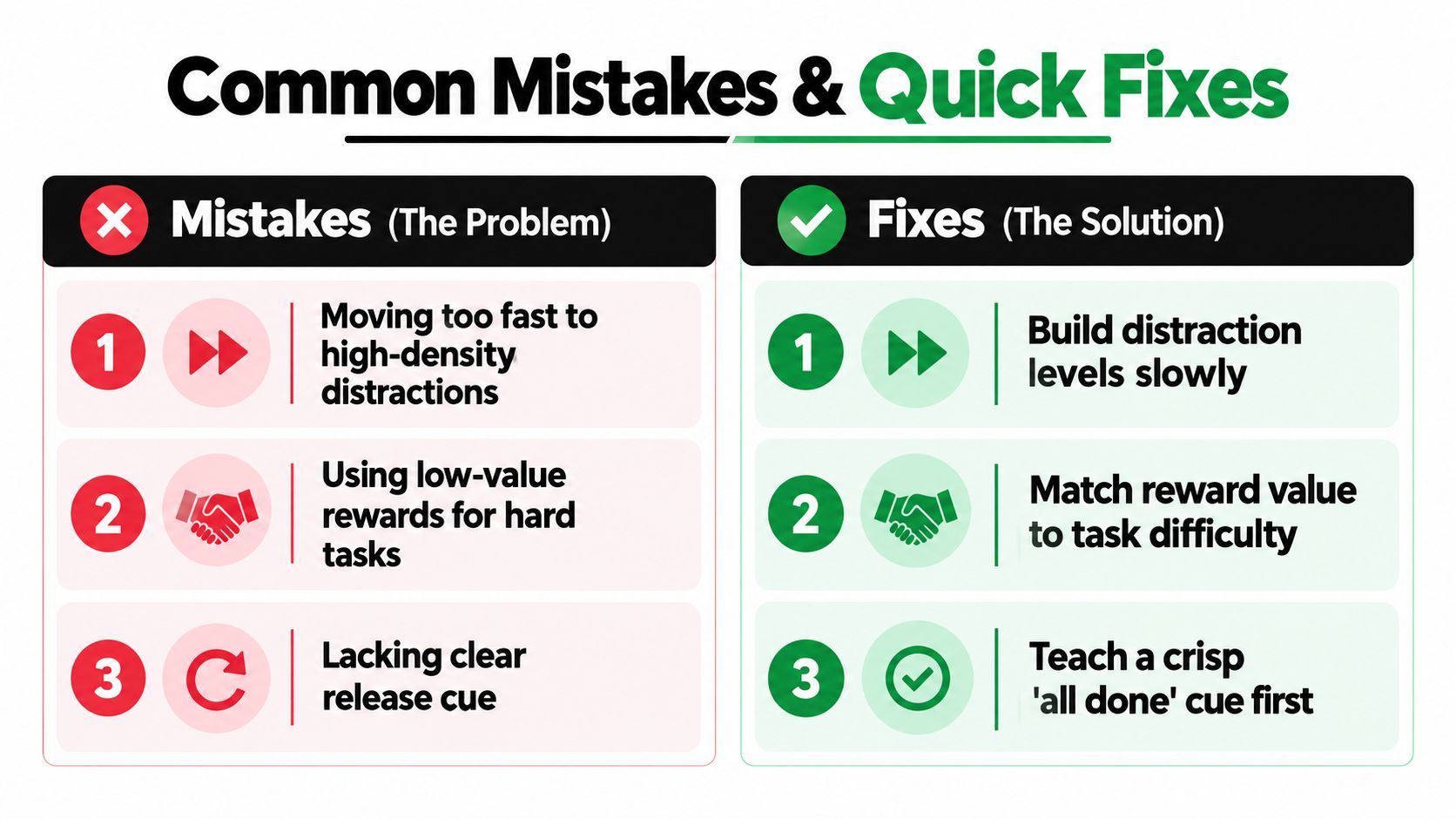
Common Mistakes That Undo Your Progress and How to Fix Them
Training usually stalls for a specific reason. The handler raises distraction too quickly, or keeps adding food when the dog needs more distance. Treat distraction as a graded proofing ladder. Increase one difficulty at a time, and define success before each repetition.
Moving straight into a crowded environment
Symptom: Your dog works indoors, then barks, pulls, or refuses food in a busy park.
Cause: Density, movement, sound, and novelty arrive together. The dog has no clear chance to process one variable before another appears.
Next-rep fix: Return to a quiet park edge and work around one predictable distraction. Start far enough away for your dog to eat, orient to you, and respond to one cue. Then reduce distance gradually. The guide-dog research describes this graded approach, increasing distance, intensity, density, and novelty in small increments. (Guide-dog success and distraction predictors)
Count successful repetitions, not heroic close passes. If your dog cannot take food or recover quickly, the setup is too difficult. Use distance before distraction, then raise only one challenge when the current level is reliable.
Offering ordinary rewards for an extraordinary trigger
Symptom: Your dog eats kibble at home but spits it out when another dog appears.
Cause: The trigger has more emotional or environmental value than the reward can match.
Next-rep fix: Increase distance first, then offer a higher-value reward. Food cannot make an impossible setup workable. If your dog still cannot eat or orient to you, leave and reset later. A useful success criterion is that your dog notices the trigger, disengages, and can respond before the reward appears.
Repeating the cue
Symptom: “Come, come, come” becomes background noise.
Cause: Your dog learns that the first cue has no consequence and waits for a louder version.
Next-rep fix: Say the cue once in a setup where success is likely. If your dog misses, move away, use a practiced hand target, or lower the distraction. Rebuild the response instead of stacking words.
Treating a blow-up as a training opportunity
After lunging or barking, give your dog room to decompress. Stress can linger after a reactive incident, so a quiet sniffing walk or calm indoor activity may work better than another demanding attempt.
The longitudinal guide-dog study also supports using a measurable distraction criterion. It reported a 49.6% overall program success rate. Panting and licking during distraction tests reduced the probability of success, while lower distraction scores were associated with qualification. Distraction points alone predicted qualification with 80.6% accuracy and captured 28.2% of eventual failures flagged by higher scores, as reported in the study cited above.
Adapting the Plan for Puppies Adolescents and Reactive Dogs
Puppies need simple environments, frequent reinforcement, and generous recovery time. Keep early distractions mild and let the puppy investigate safely after responding. The priority is building a cheerful habit of orienting to you, not demanding sustained attention through every exciting event.
Adolescence requires a reset in expectations. A 2025 longitudinal study found the highest prevalence of owner-reported undesirable behaviors at 12 months, with barking, lead pulling, and recall problems appearing among the common concerns across ages. (Study of undesirable behaviors in young dogs) During this stage, shorten difficult sessions, return to easier distances, and reinforce check-ins before your dog reaches the point of pulling or vocalizing.
Reactive dogs need a sharper distinction between distraction and management. If your dog can see a trigger, eat, and respond, a check-in exercise may be appropriate. If your dog is already lunging, barking, freezing, or unable to take food, don't try to distract through it. Create distance, use a visual barrier, and leave the situation.
Handler engagement can lower arousal when you use it before the dog crosses threshold. A university study of reactive dogs found that owner interaction produced significant decreases in vocalization, leash pulling, and attention toward the target dog compared with a no-interaction condition. (University study of owner interaction with reactive dogs)
For ongoing structure, PawCraft offers a personalized 30-day dog training plan based on a dog's breed, age, environment, and behavior challenges, with daily exercises, progression guidance, and success criteria. Use it alongside sensible management and qualified professional support when reactivity creates safety concerns.
Maintain the skill with easy check-ins during ordinary walks, then occasionally practice one carefully chosen distraction. Measure whether your dog notices, disengages, performs the alternative, and recovers. That is how distraction training becomes durable behavior rather than a temporary interruption.
Visit PawCraft to receive a personalized 30-day plan built around your dog's age, environment, breed, and specific triggers. Use its day-by-day exercises and progression criteria to turn distraction work into a practical routine you can follow on real walks.