You leave the apartment with a dog who seems determined to tow you down the sidewalk. One moment, you're moving toward the corner, and the next you're bracing against the leash because a pigeon, bicycle, or interesting smell has become urgent business. By the time you get home, nobody has enjoyed the walk.
Loose-leash walking isn't a personality test or a battle of wills. It's a mechanical skill built through clear consequences. Your dog learns that leash slack keeps the walk moving, while pulling pauses or changes the direction. That difference matters more than repeating “heel” while your arm stretches forward.
Why Loose Leash Walking Feels So Hard at First
Pulling usually persists because it works. A dog leans into the leash, reaches the other end, and still gets closer to the smell, dog, doorway, or patch of grass. Veterinary literature describes leash pulling as self-reinforcing, and a 2024 JAVMA review on canine behavior notes that young dogs are more active and less predictable, which makes frequent pulling more likely.
That doesn't mean your dog is being stubborn. On a crowded sidewalk, the environment is packed with rewards that compete with you. If you're trying to understand the specific reason your dog keeps pulling, this guide to why dogs pull on the leash can help you separate excitement, frustration, habit, and access to something desirable.
Slack is the real cue
Loose-leash walking doesn't require a formal competition heel. Your dog can sniff, walk slightly ahead, or change sides, as long as the leash remains slack and you can move safely together. The training rule is simple:
Practical rule: Forward movement is earned by a loose leash, not by reaching the end of a tight one.
This is stimulus control in everyday language. The leash becomes information. Slack tells your dog, “This position keeps the walk going.” Tension predicts a pause, a turn, or a reset. Treats help build the behavior, but the walk itself is often the most valuable reward.
Short practice also beats one exhausting walk where both of you rehearse frustration. A 2022 proof-of-concept study used checkpoints at baseline, after 4 weeks, and after 8 weeks, showing that loose-leash behavior can be trained and measured inside a structured window rather than requiring many months (study details). A practical expectation is visible progress during the early phase, followed by continued work before your dog can stay reliable around busy urban distractions.
Age, arousal, breed drive, and surroundings change the difficulty. A calm adult dog may progress outdoors quickly, while an adolescent dog who chases movement needs easier locations and more resets. Start where your dog can think, reinforce the first successful steps, and raise the challenge in small increments.
What You Need Before Your First Training Walk
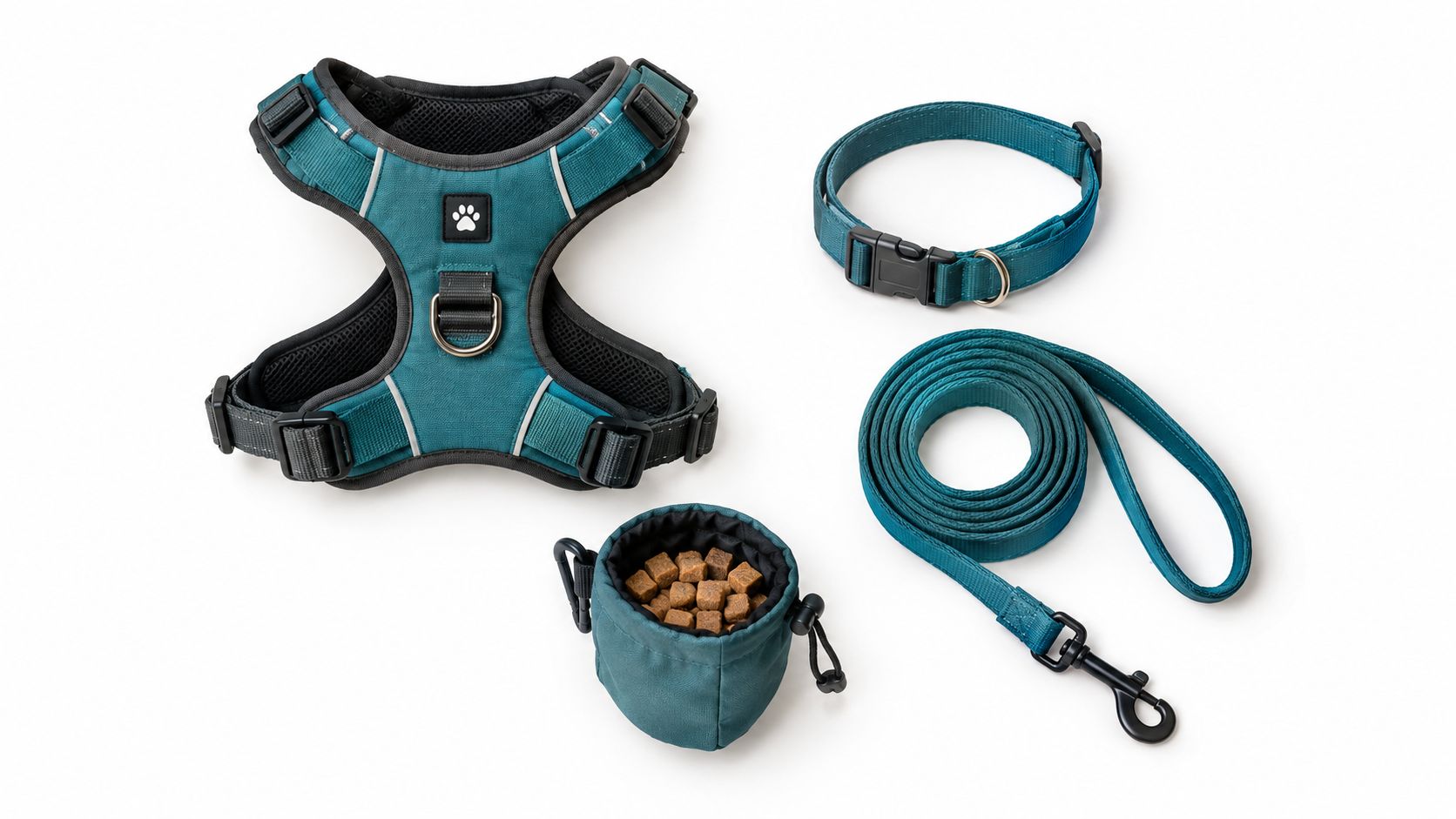
Good mechanics make the lesson clearer. Use equipment that lets you control direction without yanking, and choose a setup that fits your dog comfortably. A well-fitted harness or flat collar, a 6-foot fixed leash, and small, high-value treats are enough for most foundation work. Avoid retractable leashes while teaching this skill because their constant line tension and expanding distance can make pulling pay.
Set up the handler first
Hold the leash near your hip with a soft hand. Don't keep your arm extended like a tow bar, and don't wrap the leash around your wrist or fingers. Leave enough line for a natural walking position, but avoid feeding extra length every time your dog leans forward.
Prepare your reward pouch before you move. Cut treats small enough that you can deliver several without interrupting the exercise. When the leash goes slack, reward promptly, ideally within one second, and place the food beside your leg or at the position you want your dog to revisit. Feeding far in front can pull your dog forward and blur the lesson.
A pre-walk checklist keeps the first repetitions clean:
- Equipment: Check the fit, clip the fixed leash securely, and remove tangled loops.
- Rewards: Use food your dog values in that location, not merely whatever is convenient.
- Starting place: Begin indoors, in a hallway, or in another quiet area with few competing cues.
- Exit plan: Know where you'll stop if your dog becomes frantic, scans constantly, or can't take food.
- Handler goal: Count successful slack moments, not perfect distance.
If your dog is already panting hard from excitement, jumping at the door, or lunging toward the street, don't launch straight into a busy walk. Let the dog settle, move farther from the trigger, or return inside. Training below the point of overload gives your dog a chance to notice leash feedback and make a useful choice.
If you prefer guided support, dog leash training classes can also help you refine leash feel and reward placement with direct feedback.
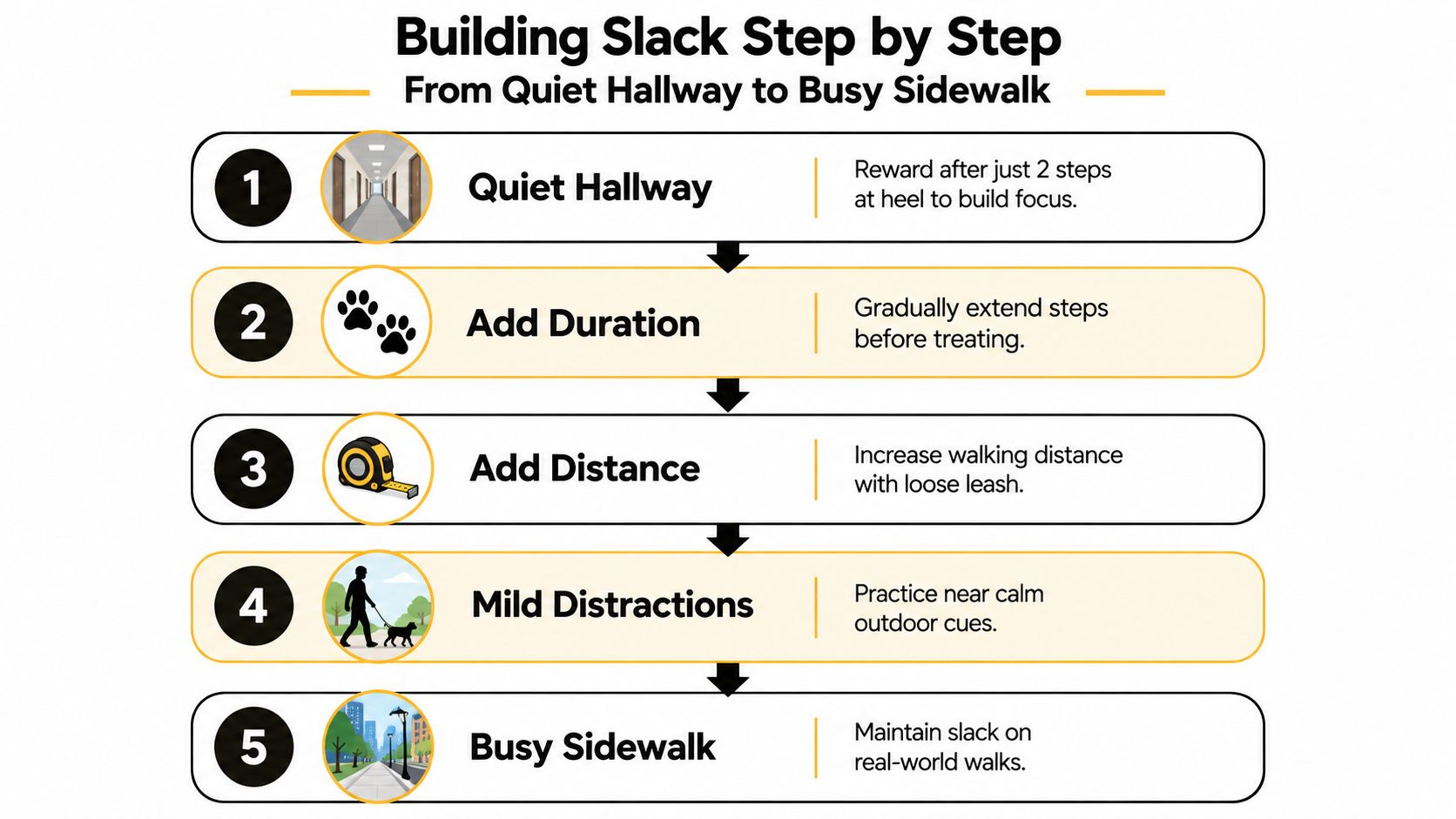
Building Slack Step by Step From Quiet Hallway to Busy Sidewalk
Start in a quiet area where your dog can respond without fighting the entire neighborhood. Stand still, wait for the leash to soften, and reward at your chosen walking position. Then take 2 steps at heel, mark the slack, and deliver the treat. The UC Davis protocol described in the available guidance starts this way, then increases walking duration and environmental distractions gradually (loose-leash protocol).
Begin with easy repetitions
For the first few reps, don't worry about covering ground. Walk two steps, reward, pause briefly, and repeat. If your dog surges before the second step, make the starting criteria easier. Reward a glance toward you, a softened leash, or one controlled step, then build again.
Once two steps feel routine, vary the pattern. Take a few steps, stop, turn, and reward when your dog follows without tension. Let your dog sniff as a planned reward when the leash is loose. This teaches that freedom isn't removed, it comes through calm leash behavior.
When pulling starts, choose one response and apply it immediately. The Tree Method means you stop and become still, like an immovable object, until the leash relaxes. Then reward and continue. The other option is a quick turn away from the direction of the pull, followed by reinforcement when your dog catches up on a slack leash.
Don't drag your dog backward or pop the leash. Your job is to remove forward access, not to create a physical contest. If your dog pulls toward another dog, stop before the leash becomes fully tight when possible, wait for a softer line, and then choose a wider path or turn away.
Add difficulty one layer at a time
Increase only one variable at once. You might add more steps first, then more distance, then a doorway, driveway, or quiet outdoor path. After that, practice on a calm street before attempting a busy sidewalk with traffic, dogs, scooters, and strong smells.
Use the leash as feedback throughout:
- Quiet hallway: Reward after two successful steps and build attention without crowding your dog.
- Longer walking: Add steps between rewards while preserving slack.
- Greater distance: Continue forward for longer stretches before paying.
- Mild distractions: Work near calm outdoor activity, increasing space if your dog locks on.
- Busy sidewalk: Attempt real-world walking only when the earlier level remains manageable.
Advance when your dog can respond promptly, eat normally, and recover after a distraction. Step back when the leash stays tight, your dog stops taking food, or you find yourself repeating cues. The environment isn't a test your dog must pass. It's a difficulty setting you can adjust.
For a visual demonstration of leash handling and direction changes, watch the embedded training video below.
Common Mistakes That Accidentally Reward Pulling
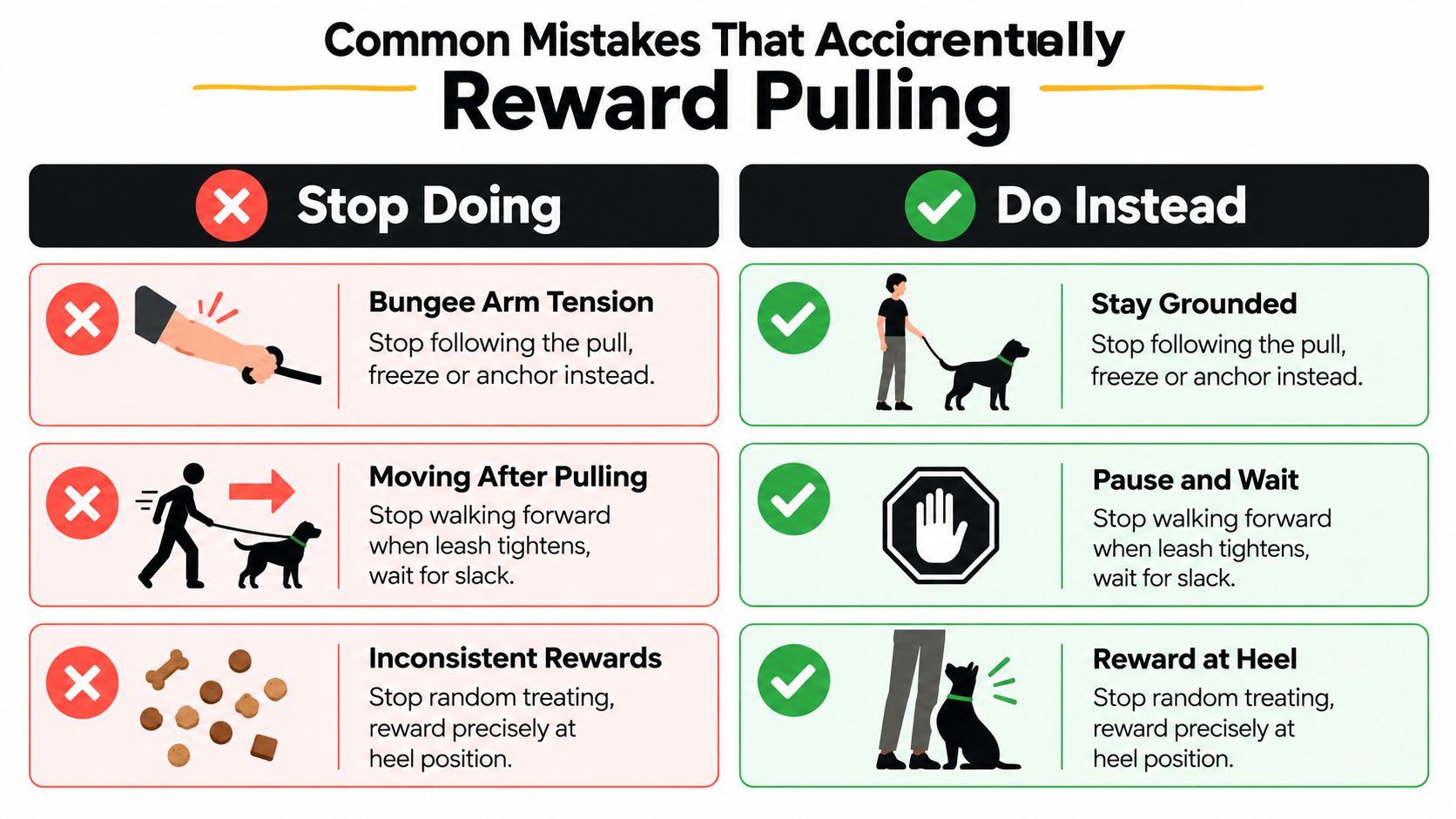
Most leash problems come from timing, not a lack of affection or effort. The classic example is the bungee arm. Your dog pulls, your arm stretches, and you keep moving because stopping feels awkward. From your dog's perspective, the tight leash still produced access.
Compare the consequence, not the intention
A leash correction may interrupt a moment, but it doesn't automatically teach what should happen next. If your dog pulls toward a sniff spot and you allow forward movement after the leash tightens, the dog learns that persistence works. Freeze, wait for slack, then give access or change direction.
| What Happens | Why It Reinforces Pulling | Do This Instead |
|---|---|---|
| Your arm stretches forward as your dog pulls | Your dog continues making progress while tension is present | Keep your hand near your hip and stop moving |
| You walk on after the leash reaches its limit | Forward movement confirms pulling as a useful strategy | Wait for slack, then resume or turn |
| You reward whenever you remember | The dog can't identify which behavior earned the food | Mark and reward slack promptly at your chosen position |
Late rewards create another common problem. If your dog pulls, wanders, returns, and then receives food without a clear marker, the dog may connect the reward to the return, the treat pouch, or random movement rather than the loose leash. Deliver food as the leash softens, then continue walking so your dog experiences both rewards, food and forward access.
Nagging also weakens the contingency. Repeated “easy,” “come on,” or “heel” cues can become background noise when the leash remains tight. Give information through your movement instead. Stop, turn, or create distance, then reinforce the instant your dog makes the line loose.
Short Daily Drills That Fit Real Life
A busy owner doesn't need a perfect training walk. You need repeatable practice that ends before everyone is irritated. Daily sessions of 10 to 15 minutes are commonly associated with visible improvement in 7 to 10 days, while reliable behavior in busy environments usually takes 4 to 8 weeks, according to the available field guidance (training benchmark).
Use two compact templates
For an apartment hallway or corridor, keep the work technical:
- Warm-up heel: Reward a few calm steps near your leg before asking for distance.
- Two-step repetitions: Walk two steps, reinforce slack, pause, and reset.
- Turn and reset: Change direction as soon as tension appears, then reward your dog for following.
- End on success: Finish after a clean repetition rather than waiting for fatigue.
For an outdoor block, make the environment part of the reward system:
- Curb sit and go: Begin with a soft leash before moving away from the entrance.
- Loose-leash walking: Cover a short stretch, paying for slack instead of chasing distance.
- Distraction pause: Stop or turn when your dog notices a trigger, then resume after recovery.
- Cool-down sniff walk: Offer relaxed sniffing when the leash stays loose.
Track decisions, not perfection
During the initial 4-week phase, record a simple observation after each practice. Note how many stretches began and ended with slack, how quickly your dog recovered after a turn, and which distractions caused the first mistake. You don't need elaborate charts. A few consistent notes reveal whether the current environment is appropriate.
At the 8-week follow-up, assess real-world reliability rather than indoor fluency. Can your dog soften the leash after noticing a smell? Can you turn away from a dog without a prolonged struggle? If not, keep the same difficulty and improve the setup instead of adding pressure.
A dog impulse-control exercise guide can complement leash work, especially when your dog struggles to pause before greeting, sniffing, or chasing movement. The important scheduling insight is simple: two short sessions are easier to repeat than one long walk that lets your dog practice pulling for most of the route.
Your Next Walks Made Calmer and More Enjoyable
The most useful question isn't “How do I make my dog stop pulling everywhere?” It's “What can my dog handle while still making good choices?” A young, high-arousal dog may need quiet corridors and generous distance from triggers. A scent-driven dog may work better when sniffing becomes the reward for slack. A reactive dog may need routes with escape space before busy sidewalks become realistic.
Choose the next challenge by watching your dog's behavior. If the leash tightens immediately, lower the distraction. If your dog stays loose but needs frequent rewards, hold the difficulty steady. If your dog can notice the environment, respond to your turn, and keep moving without tension, add only a small amount of complexity.
Loose-leash walking has been practiced in some form for thousands of years, and the oldest known dog-training guide, written by Xenophon around 420 BC, places guided canine behavior in a tradition spanning more than 2,400 years (historical discussion). The modern lesson remains practical: slack earns movement. Build that contingency patiently, adjust for age and drive, and let your dog succeed often enough that calm walking becomes the profitable choice.
PawCraft creates a personalized 30-day dog training program based on your dog's breed, age, environment, and behavior challenges, including leash-pulling exercises with daily steps, progression criteria, and common mistakes to avoid. Visit PawCraft to answer the brief questionnaire and receive a structured plan for your next walks.