Your dog can sit perfectly in the kitchen and forget the cue the moment you step outside. You may be rewarding after the dog has already stood up, repeating a fifteen-minute session because a guide told you to, or saving all your practice for the weekend. None of those problems necessarily means your training method is wrong. Often, the timing is.
Effective training timing works on more than one clock. You need to connect the behavior to the reward within seconds, choose a session length your dog can handle, spread practice across the week, and adjust expectations as your dog moves through puppyhood and adolescence. Breed energy, age, distractions, sleep, meals, and your own schedule all change the right answer.
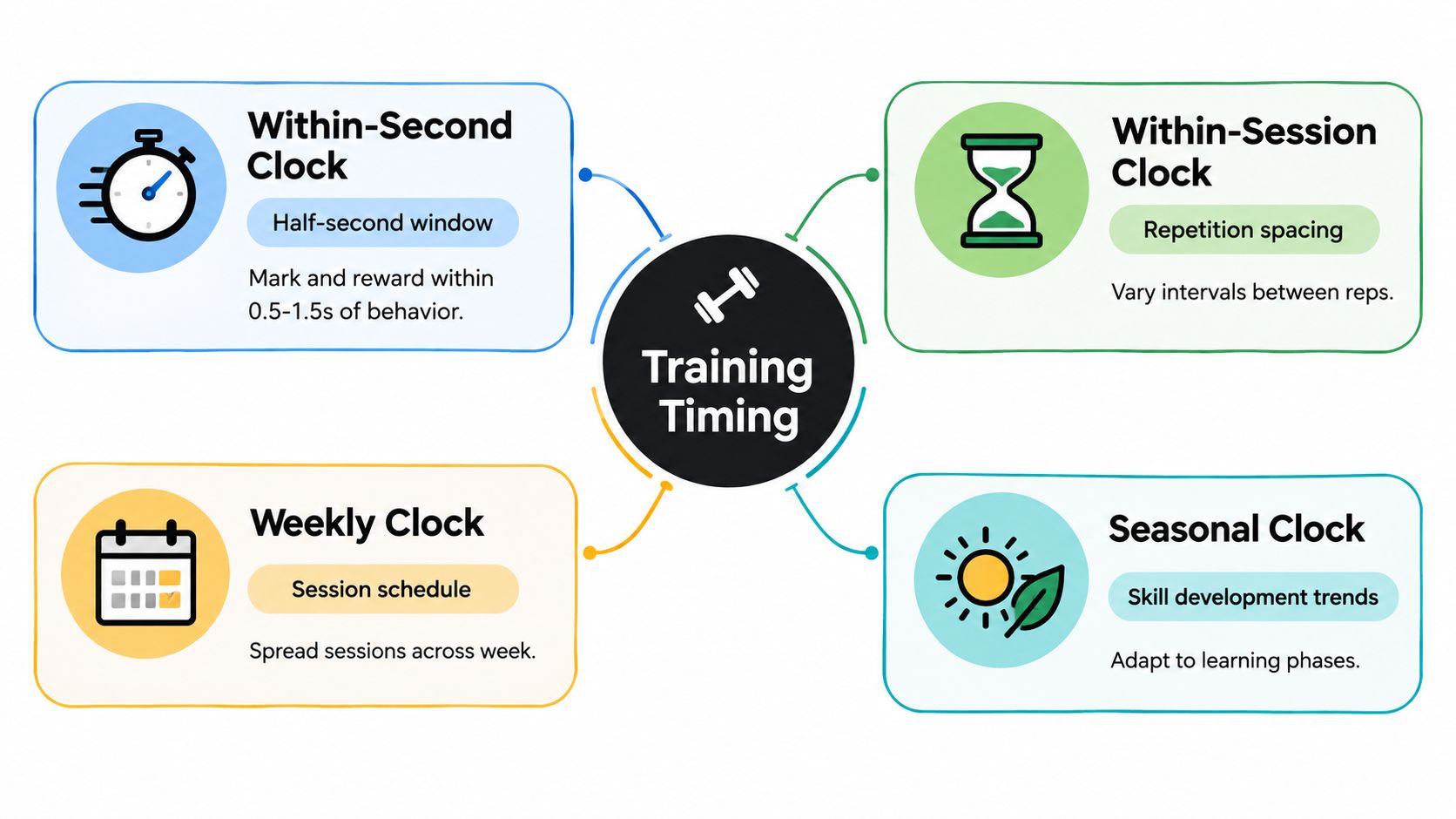
The Four Clocks That Shape Training Timing
Training timing is a layered system, not a single recommendation such as “fifteen minutes twice a day.” The first clock runs inside each repetition. Your dog performs the behavior, you mark it, and you deliver the reward. If that sequence drifts, your dog may connect the reward to standing up, looking away, or moving toward your hand instead of to the behavior you wanted.
The second clock covers the session itself. A short, focused practice period can teach more than a long session that ends with frustration. The third clock is the weekly rhythm. Practice needs to appear often enough for the behavior to stay familiar, but spacing can be more useful than cramming. A controlled study found that dogs trained one or two times per week learned significantly better than dogs trained daily, while one session on a training day outperformed three consecutive sessions. Retention after four weeks remained high across the groups, supporting short, spaced practice rather than marathon training in the study record.
The fourth clock is developmental. A puppy's early socialization period is highly sensitive, while an adolescent may temporarily lose fluency in skills that seemed established. You can use perfect within-second timing and still struggle if you ask a tired puppy for long duration work or expect a distracted adolescent to perform like a settled adult.
Match the clock to the dog
Start by checking four things before you plan a session:
- Age: Young puppies need brief repetitions and generous recovery. Adolescents often need easier criteria during regression.
- Energy level: A working or herding dog may enjoy more structured practice, while a low-energy adult may disengage sooner.
- Environment: A cue learned in a quiet room needs gradual practice around movement, smells, people, and dogs.
- Owner schedule: A routine you can repeat beats an ideal plan you abandon after a few days.
Practical rule: Good timing means the right behavior, at the right moment, for the right dog in the right state of mind.
A Realistic Day in the Life of a Puppy in Training
Scout is an eleven-week-old Labrador. He doesn't need a formal training block added to an already crowded day. He needs brief learning opportunities fitted around waking, eating, toileting, play, and sleep.
After waking, Scout gets a two-minute name and recall game before breakfast. He's alert but not yet frantic, so his owner says his name, marks the turn toward her, and rewards immediately. After breakfast and a potty trip, she works on sit and eye contact for three minutes while coffee brews. When his attention wanders, she ends the exercise instead of repeating the cue.
A mid-morning nap follows. When Scout wakes, the hallway becomes the training space. His owner runs a four-minute loose-leash exercise, rewarding slack in the leash and stopping before he starts grabbing the leash or bouncing off the walls. The practice is small, but it fits the moment when his body and brain are ready.
Let meals and naps do some of the scheduling
At lunch, Scout's owner hand-feeds part of his meal. Each piece of kibble rewards a focused sit and a brief pause before taking food. The meal becomes a short impulse-control exercise without turning eating into a demanding obedience class.
After another afternoon nap, Scout practices settling in his crate for five minutes before dinner. The evening walk carries the most useful real-world work. Instead of marching for obedience the whole time, his owner allows sniffing, rewards him for noticing people without pulling toward them, and keeps the environment manageable.
The active training adds up to roughly twenty minutes, fragmented across the day. That structure is more realistic than expecting a puppy to concentrate through one long block. Owners who want more help fitting practice around meals, rest, and daily disruptions can use this guide to dog training for first-time owners.
Scout's day also shows an important distinction. Training doesn't always look like a person standing in front of a dog with a treat pouch. A name game after waking, a calm pause before food, and a reward for ignoring a passerby all count when the timing is clear.
How Long Sessions Should Be and How Often to Run Them
The useful question isn't “How long should every dog train?” It's “How long can this dog stay accurate, willing, and emotionally steady today?” Age and energy provide a starting point, but the dog's behavior during the session gives the final answer.
The ranges below are practical starting points, not rigid laws. The research on spaced training supports distributing work instead of concentrating it into daily repetition or multiple consecutive sessions in the controlled study. A young puppy may need more frequent contact with a skill, while an adult dog may handle a longer block with greater complexity.
| Age Range | Energy Level | Session Length | Sessions Per Day |
|---|---|---|---|
| Under 12 weeks | Any | 2 to 5 minutes | 4 to 6 |
| 6 to 18 months | Low to moderate | 5 to 8 minutes | 2 to 3 |
| 6 to 18 months | High | 5 to 10 minutes | 2 to 3 |
| Adult | Low | Up to 8 minutes | 2 to 3 |
| Adult | Working or herding | 10 to 15 minutes | 2 to 4 |
The figures in this table are practical programming ranges rather than claims from a single controlled trial. They help you avoid using an adult working dog's tolerance as the standard for a young puppy or a low-energy companion.
Accuracy matters more than the timer
More sessions usually beat longer sessions because each new block begins with fresh motivation. Three four-minute sessions can give you three clean starts, while one twelve-minute session may finish with slower responses, grabbing, avoidance, or careless reinforcement.
End each session while the dog can still succeed. Say a consistent release phrase such as “all done,” scatter a few treats, or offer a brief play break. The end signal prevents the dog from learning that work continues until someone becomes frustrated.
If the dog makes several errors in a row, lower the difficulty or stop. Don't automatically add repetitions. A session that ends with a successful, easy response gives you a better starting point next time than a session stretched past the dog's capacity. For adult dogs needing a more structured approach, this resource on training adult dogs can help you account for established habits and changing motivation.
Reward Timing Within the Session That Actually Drives Learning
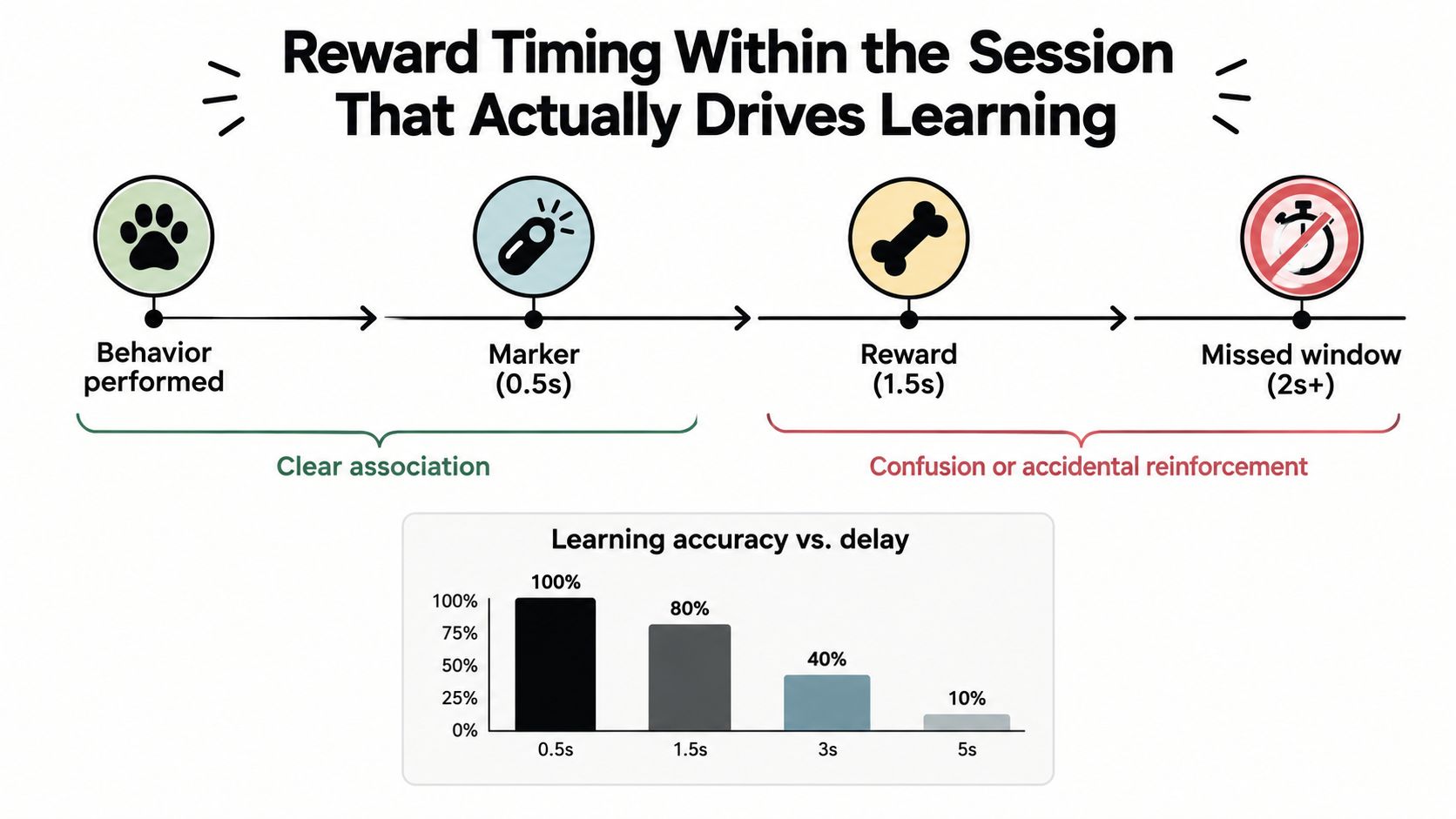
Your marker must identify the behavior, not merely announce that food is coming. If your dog places all four paws on the floor, the click or verbal marker belongs at that moment. The treat follows immediately, but the marker carries the information.
Controlled research found that delays of 0.5 to 2.0 seconds reduced correct responding in already-learned behaviors. Delays of 0.27 and 0.13 seconds weren't significantly different from no delay, which is why precise training should aim for a marker within about a quarter-second when accuracy matters in the timing study.
Change what your hands do
Use this sequence:
- Prepare the reward: Keep food accessible before asking for the behavior.
- Watch the behavior: Focus on the instant the dog meets your criterion.
- Mark immediately: Click or say “yes” at the behavior, not after reaching for food.
- Deliver calmly: Bring the reward to the dog without luring the next repetition.
- Reset: Give the dog a moment before asking again.
Owners often know what to reward but deliver it too late. Video observations from real training sessions found average delays of 0.62 seconds for verbal praise and 0.98 seconds for food, reinforcing the value of teaching handlers to mark behavior immediately in the observational thesis.
If your hands are slow, use a clicker or a short marker word and practice without the dog. Hold a pen, drop it, and mark the instant it reaches the floor. With distance behaviors, mark the moment the dog reaches the intended position, then use a release word separately so the dog learns both the behavior and when it may move.
Timing test: If you can't point to the exact behavior your marker described, your dog probably can't either.
Here is a short visual demonstration of how the marker and reward sequence can work in practice:
Once a behavior is reliable, you can vary the reinforcement pattern carefully. Don't make the reward unpredictable before the dog understands the task. First build a clear history of correct responses, then introduce occasional variation while continuing to reinforce effort and quality.
Building a Weekly Training Schedule Around a Busy Life
A working owner with a forty-five-minute lunch break doesn't need to pretend that two perfect fifteen-minute blocks fit every day. A more durable plan anchors small sessions to events that already happen, such as the first potty break, leaving for work, lunch, dinner preparation, and the evening walk.
Monday might begin with a two-minute eye-contact exercise after the morning potty trip. At lunch, the owner spends three minutes rewarding loose-leash walking before allowing a sniff break. In the evening, a short recall game happens during decompression at home.
Tuesday uses the same morning anchor, then adds a brief leash-pressure exercise before the lunch walk and a calm settle during dinner preparation. Wednesday can repeat recall in a different hallway or quiet outdoor area. The skill stays familiar while the environment changes gradually.
Use weekdays for contact and weekends for expansion
Micro-sessions suit behaviors such as name response, eye contact, recall starts, leash pressure, and waiting at doors. A longer weekend block can support stays, distance work, scent games, or carefully managed exposure to a more distracting setting, provided the dog remains successful.
| Day | Time Slot | Session Length | Skill Focus | Type |
|---|---|---|---|---|
| Monday | Morning potty break | 2 minutes | Eye contact | Micro-session |
| Monday | Lunch walk | 3 minutes | Loose leash | Micro-session |
| Tuesday | Before commute | 2 minutes | Name response | Micro-session |
| Tuesday | Dinner preparation | 3 minutes | Settle | Micro-session |
| Wednesday | Lunch break | 3 minutes | Recall starts | Micro-session |
| Thursday | Morning walk | 2 minutes | Leash pressure | Micro-session |
| Friday | Evening decompression | 3 minutes | Check-ins | Maintenance |
| Saturday | Quiet outdoor period | 10 minutes | Scent and distance work | Consolidation |
| Sunday | Morning walk | 5 minutes | Review and easy wins | Maintenance |
The schedule is a model, not a demand to copy every slot. The main target is a repeatable weekly rhythm. Spaced training can improve acquisition efficiency without reducing medium-term retention, so a busy owner should protect regular contact rather than chase one heroic session as shown in the controlled comparison.
Total weekly minutes matter more than any single session length. A short practice attached to a reliable daily trigger is usually more useful than a long block that only happens when the calendar happens to cooperate.
Timing Training Through the Adolescent Window Most Owners Miss
Puppy socialization gets deserved attention, but it isn't the only developmental window that affects behavior. Veterinary behavior guidance identifies the first three to fourteen weeks as a highly responsive socialization period, with exposure recommended as early as three to five weeks and puppy classes possible as early as seven to eight weeks in suitable conditions in the veterinary review.
Adolescence creates a different training problem. Independent coverage places a distinct adolescent phase around six to twelve months, with regression often peaking around eight to ten months. Large and giant breeds may not reach full maturity until two to three years, so a dog can look physically grown while still developing emotionally and behaviorally in this discussion of adolescent enrichment.
Adjust the criteria, not your expectations of the dog
During early adolescence, simplify familiar cues and reinforce more generously. If your dog suddenly misses a recall in a busy park, return to a quieter location rather than repeating the cue until it loses meaning.
Mid-adolescence is often a poor time to pile on duration, distance, and distractions at once. Keep sessions easier, pause aggressive proofing, and protect recovery time when the dog shows increased scanning, startle responses, frantic movement, or rapid loss of focus.
Late adolescence gives you room to add duration and distractions again, but only when the dog can recover quickly and respond without constant prompting. Measure progress over a month rather than judging every week. Development rarely produces a smooth upward line, and a temporary regression doesn't erase earlier learning.
Developmental adjustment: When the dog becomes less fluent, reduce the difficulty first. Don't punish the information the regression is giving you.
Watch the pattern after each session. “Less per session, more per day” fits a dog who remains willing but tires quickly. “More recovery time” fits a dog who stays aroused long after practice, struggles to settle, or shows worsening responses later in the day. Those observations tell you whether to shorten work, increase spacing, or temporarily reduce environmental demands.
Fixing Timing Problems Before They Become Bad Habits
Many obedience complaints are timing complaints in disguise. A puppy that freezes, mouths, or shuts down may be overstimulated, not stubborn. A dog that performs indoors but fails outside may need a better progression and reinforcement schedule, not a new cue.
Start with a one-week log. Record the time of day, sleep or activity beforehand, session length, environment, skill, reward used, and the point at which accuracy drops. You don't need elaborate software. A note on your phone can reveal whether failures follow long sessions, busy walks, clustered weekend practice, or delayed rewards.
| Problem | Warning Sign | Timing Fix |
|---|---|---|
| Overstimulation | Freezing, mouthing, frantic movement, or shutdown | Cut session length by half and add rest blocks |
| Stalled progress | A familiar cue works at home but fails outside | Reduce daily repetitions, vary reinforcement, and lower distractions |
| Inconsistent gaps | Practice disappears on workdays and clusters on weekends | Anchor one micro-session to a reliable daily trigger |
For overstimulation, change duration before changing technique. End earlier, offer decompression, and return later with an easier criterion. For stalled progress, stop drilling the same response after it has deteriorated. Cap the day's repetitions, vary the reward appropriately, and rebuild the skill in an intermediate environment.
For inconsistent practice, attach training to coffee, the first walk, dinner preparation, or another event that already occurs. If the underlying behavior is more complex, a written dog behavior modification plan can help organize triggers, criteria, and progression.
Read the log at the end of the week and ask one question: does the dog stop working faster than it started? If yes, change session duration before increasing difficulty or replacing your training method.
PawCraft creates a personalized 30-day plan based on your dog's breed, age, environment, and behavior challenges, with day-by-day exercises, timing, progression, and success criteria. If your schedule keeps defeating generic advice, visit PawCraft to build a practical routine around the dog and household you have.