You step out the front door, get halfway down the sidewalk, and then it happens. Your dog spots another dog across the street, stiffens, stares, starts pulling, and within seconds you're holding a barking, lunging tornado at the end of the leash while apologizing to strangers.
That scene makes a lot of people think their dog is stubborn, dominant, or ignoring training. Usually, that's the wrong read. Most leash reactivity is a distance problem first. Your dog got too close, too fast, to something they couldn't handle calmly in that moment.
If you want to learn how to train a reactive dog on leash, stop thinking in terms of “How do I make my dog listen?” and start thinking in terms of “How much space does my dog need to stay able to learn?” That shift changes everything, especially if you live in an apartment, walk busy blocks, or can't avoid surprise triggers.
Why Your Dog Reacts on Leash and What Helps
Leash reactivity often gets mislabeled as bad manners. In practice, it is usually a dog hitting its stress limit in a setup that got too tight, too fast.
A leash removes options. Your dog cannot arc away, pause, sniff, or create space the way they would off leash. Add a narrow sidewalk, a fast approach, or a surprise dog at a building entrance, and many dogs go from alert to explosive in seconds. Barking, lunging, spinning, and slamming into the end of the leash are common outputs of fear, frustration, or over-arousal. Research from Virginia Tech on shelter dogs found links between temperament and leash behavior, with calmer dogs showing less leash reactivity and lower pulling in that assessment setting (Virginia Tech shelter behavior research).
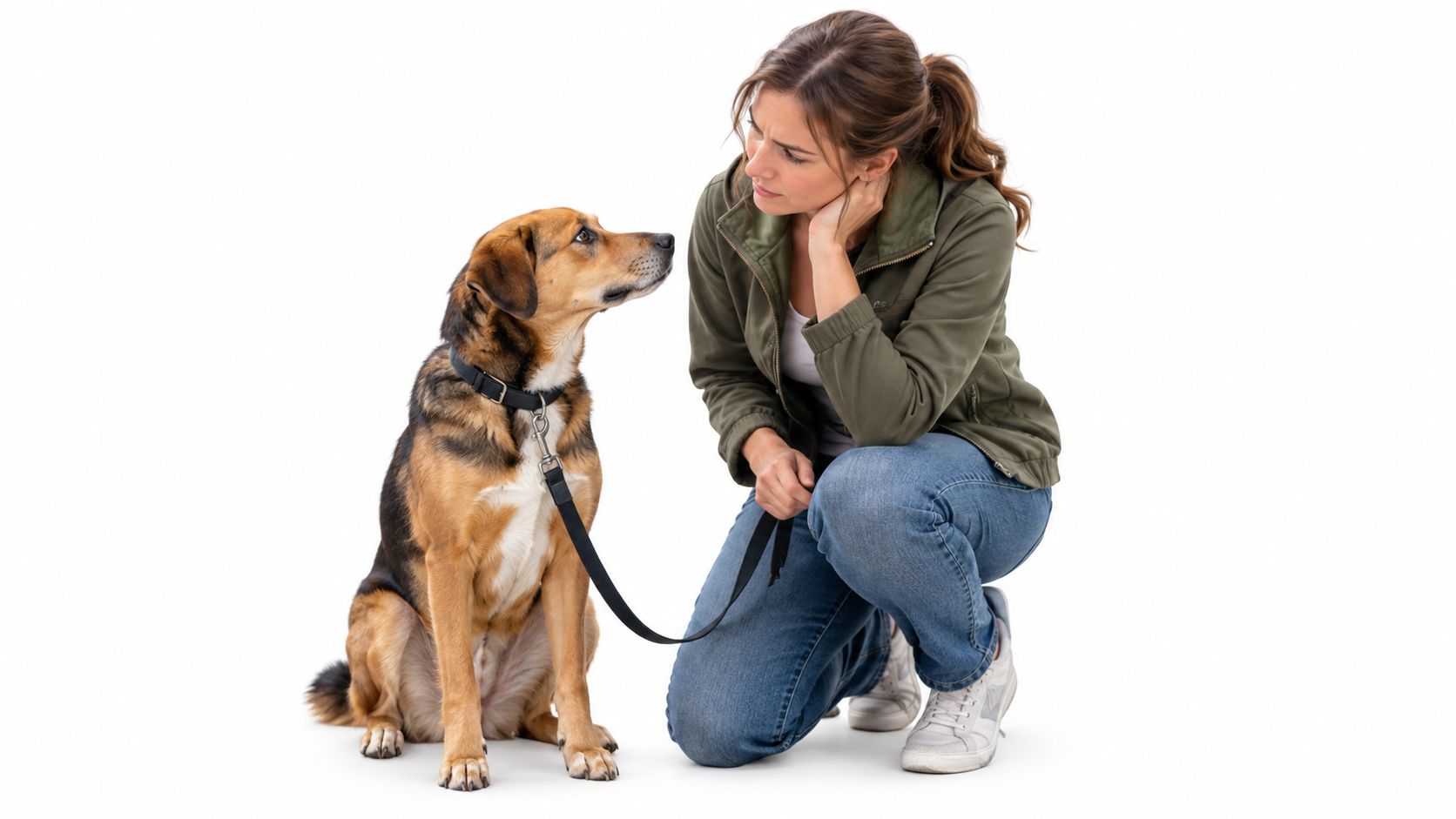
That is why force and repeated corrections so often miss the mark. If a dog is already over threshold, the problem is no longer obedience. The dog is trying to cope. Pressure at that point often adds conflict, and on city walks it can make the next trigger appear even harder because the dog starts expecting stress whenever something shows up. If you need a quick refresher on the patterns owners usually mean by leash reactivity, this guide on what leash reactivity is lays them out clearly.
The core skill is reading threshold
Threshold is the distance where your dog can notice a trigger and still stay workable. Workable means the dog can glance, breathe, take food, move with you, and come back down within a few seconds.
That distance is rarely fixed. One dog may be fine at 40 feet from a calm dog in a parking lot, then need 80 feet on a narrow sidewalk at dusk. Elevators, corners, parked cars, tight hallways, and dogs that stare or move head-on all shrink your margin.
This is the part handlers miss most often.
They wait through the stiffening, the closed mouth, the forward weight shift, and the hard stare, then ask for a sit when the dog is already tipping over. A better call is earlier and simpler. The moment you see your dog lock on for more than a beat, ask one question: can my dog still disengage here? If the answer is no, add distance now. Cross the street, step behind a parked car, turn into a driveway, or make a clean U-turn.
A useful field rule is simple. If your dog sees the trigger and can still eat, turn with you, and recover fast after it passes, you are in a trainable zone. If food gets refused, movement gets sticky, or recovery drags on, the setup was too hard.
What helps on real walks, and what sets you back
What helps is not flashy. It is consistent distance management and clean timing.
- Create space before the reaction: On an urban walk, 10 extra feet made early helps more than a correction delivered late.
- Work at the dog's current threshold, not yesterday's: Good reps at 60 feet build skill. Failed reps at 20 feet build rehearsal.
- Pair the sight of the trigger with something the dog values: Food works well because it changes the prediction, not just the behavior.
- End the rep while the dog is still under control: One calm look and turn-away is more useful than pushing for five more seconds and losing the dog.
What tends to backfire is predictable.
- Correcting the outburst: You may stop noise for a moment without changing the dog's emotional response.
- Walking straight toward the trigger to make the dog deal with it: That usually raises pressure faster than the dog can process.
- Treating leash reactivity like a sit-stay problem: Position cues fall apart when the dog is over threshold.
Success on leash looks less dramatic than many owners expect. It often starts as a shorter stare, a faster turn-away, or needing 50 feet today instead of 80. That is progress worth counting.
Reading Your Dog Triggers Thresholds and Early Warning Signs
You round a parked car, a dog appears half a block ahead, and your own dog goes from loose and sniffy to tall, still, and staring in two seconds. That shift is the moment that matters. If you catch it there, you can change the outcome. If you wait for barking and lunging, you are already late.
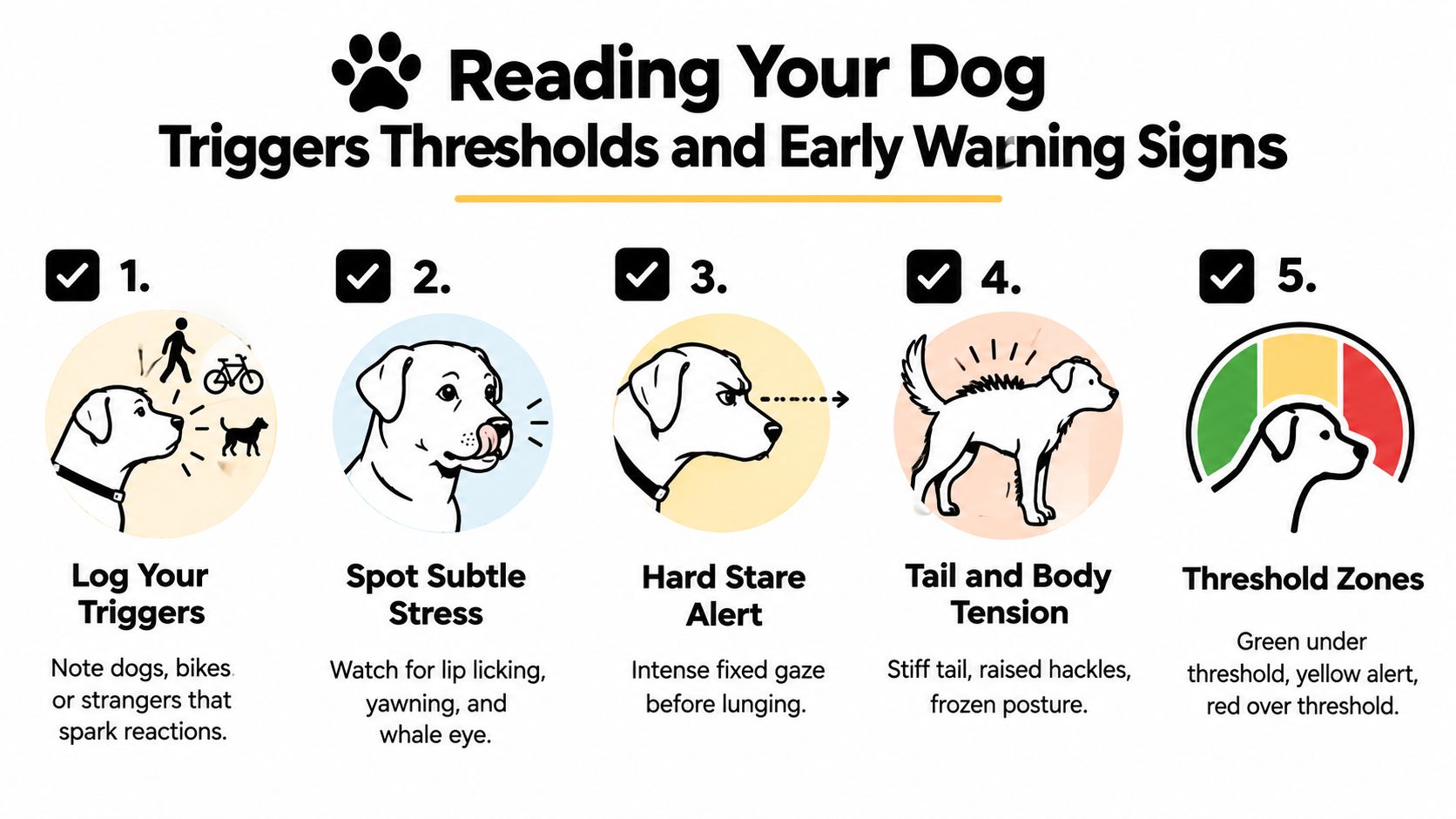
Handlers often focus on the explosion. The useful information shows up earlier. Closed mouth. Breathing pauses. Weight shifts onto the front feet. The neck gets longer. The tail changes carriage. If you need a refresher on the smaller signs, this guide to understanding dog body language is a solid reference.
What to track so patterns become usable
A trigger log should help you make decisions on tomorrow's walk, not just describe what went wrong today.
Record these points:
- Trigger type: Small dog, large dog, runner, scooter, child moving fast, person stepping out of a doorway.
- Distance at first notice: Guess in feet if you have to. Thirty feet, sixty feet, across the street, full parking lot width.
- Setup: Narrow sidewalk, blind corner, elevator lobby, street crossing, dusk, rain, parked cars blocking view.
- Earliest body change: Head snap, mouth closes, pace slows, body goes high and tight, hard eye contact, whining starts.
- Outcome: Turned away easily, needed extra distance, took food slowly, barked, lunged, recovered after ten seconds, stayed aroused for the rest of the block.
That level of detail changes the plan. A dog may look "reactive to dogs" on paper but struggle with surprise appearances at close range, direct approaches, or tight spaces with no exit line.
Find the distance where your dog can still think
Threshold is not a personality trait. It is the point where the dog stops being able to process the trigger and starts running on stress and reflex.
Test this in a place where you can control space. A wide sidewalk, empty schoolyard edge, quiet side street, or the outside of a park works well. Let your dog notice the trigger without walking straight at it.
Watch for three stages:
Aware
Your dog sees the trigger, stays loose enough to move, and can take food without grabbing or spitting it out.Loading
The body gets still or forward. The stare sticks. Responses slow down. Food may still work, but it takes effort.Over threshold
Barking, lunging, spinning, whining that escalates, refusal of food, or inability to turn away.
Do not train in stage three. For many city dogs, stage two is already too close for useful work.
On urban walks, I use simple distance rules. If the dog has just noticed the trigger and can still flick back to the handler, hold or add a little space and work there. If the dog locks on for more than a second or two, add distance immediately. If food gets refused or the feet feel stuck to the sidewalk, leave. Cross the street, duck behind a car, step into a driveway, or make a clean U-turn.
Exact decisions beat hopeful ones
Distance management works best when the criteria are concrete.
- Green zone: Your dog can notice the trigger, eat normally, and turn with you. Stay here and get one or two good reps.
- Yellow zone: Staring builds, muscles tighten, taking food gets slower, or your dog starts leaning forward. Add 10 to 20 feet right away.
- Red zone: Vocalizing, lunging, spinning, or complete fixation. Exit first. Training can wait.
On a busy sidewalk, ten feet often matters more than one more cue. So does angle. A dog that cannot handle twenty feet head-on may do fine at the same distance moving in an arc or with a parked car breaking the picture.
Threshold moves
Do not expect one fixed number.
A dog that can work at forty feet on a quiet morning may need eighty after a bad hallway surprise, poor sleep, or three close trigger sightings in a row. That is normal. Threshold changes with stress load, environment, and how trapped the dog feels.
I tell clients to judge the dog in front of them, not the dog from last Tuesday. If your dog needed more space today, that is information, not failure.
The first hard stare is the cue to act. Waiting for the bark costs you distance you usually cannot get back.
Success in this stage is simple. You spot the early shift, you make a distance decision fast, and your dog stays under the point where thinking shuts off. That skill is the foundation for everything that follows.
Setting Up for Success With Management and Gear
At 7:15 a.m., the walk can feel manageable. At 7:25, the delivery truck is parked at the curb, another dog comes out of the lobby, and you have eight feet of sidewalk left. For reactive dogs, those details matter more than perfect obedience. Good management keeps enough distance on the walk that your dog can stay under threshold and recover between trigger sightings.
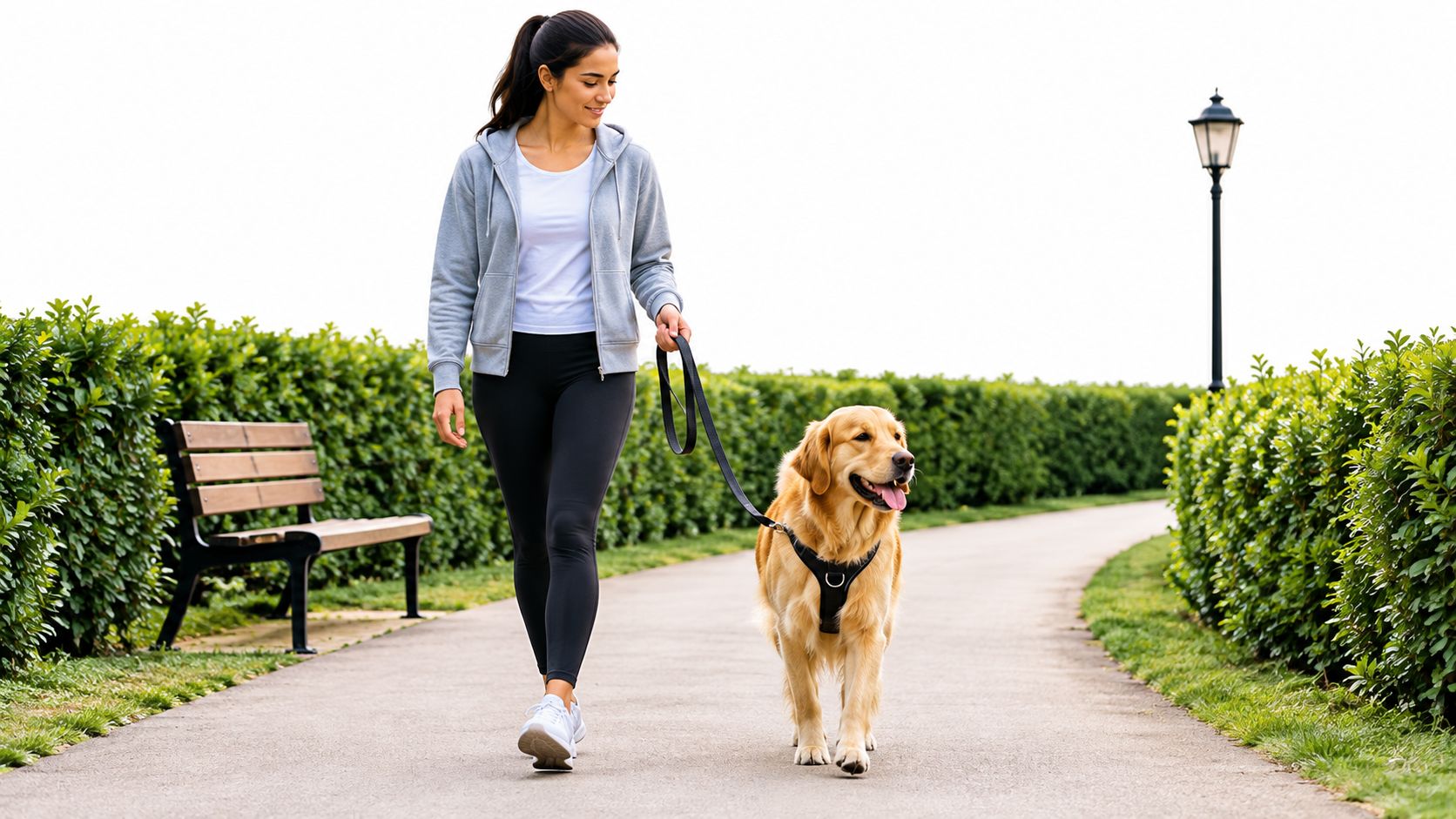
Change the walk setup first
Dogs do better when the route gives you choices.
In city work, I look for space, sightlines, and exits before I think about training reps. A narrow block with no driveway cutouts is a bad training field for a dog that needs 30 feet to stay settled. A wide sidewalk next to parked cars may work fine because you can arc away, pause behind cover, or cross early.
Use the route that matches your dog's current distance needs:
- Pick lower-traffic windows: Go out when you can get space without rushing.
- Choose places with margin: Quiet side streets, apartment perimeters, school lots after hours, broad park edges.
- Map exits in advance: Driveways, loading docks, alleys, building corners, and parked cars give you fast options.
- Avoid squeeze points: Elevators, lobby doors, narrow gates, and dog-heavy entrances often force dogs over threshold before you can respond.
If one block keeps producing bad setups, remove it from the plan for now. Rehearsing the same blowup route rarely builds skill.
Gear should make distance easier to manage
I want equipment that lets the handler move early, turn smoothly, and reduce leash conflict.
For many reactive dogs, that means a well-fitted harness and a regular leash long enough to keep the line soft while you change direction. In practice, 6 to 8 feet works well for most urban walks. Four feet often gets tight too fast. Retractable leashes usually create poor timing and weak control around triggers.
Use gear that supports clear handling:
- A well-fitted harness: Often easier for safe management than a collar alone, especially if your dog hits the end of the leash.
- A regular leash: Enough length for a loose line and smooth turns, without so much slack that the dog reaches the trigger first.
- High-value food in an easy-access pouch: Use food you can deliver in one second, not something you have to dig for.
- If needed, a basket muzzle that has been trained properly: Useful for dogs with bite risk, and it often lowers handler tension too.
Tight leash pressure changes the picture for the dog. Many dogs feel more trapped, push harder into the trigger, or stop being able to eat. Organized hands matter. Keep the leash short enough to guide, loose enough that you are not towing your dog through every pass.
Urban management moves worth drilling
Practice the mechanics before you need them. On a real sidewalk, hesitation costs distance.
These are the moves I want boring and automatic:
- The U-turn: Turn the moment you see the setup is too tight, not after your dog locks on.
- The treat scatter: Drop food at your feet or slightly behind you to interrupt staring and buy a few seconds to leave.
- The parked-car shield: Move so the trigger disappears behind a visual barrier while your dog decompresses.
- The side switch: Put your dog on the far side of your body before a pass, so your body adds a little space.
- The early street cross: Cross while the other dog is still half a block away, not when both dogs are already pulling toward each other.
I tell clients to judge management by outcome, not effort. A successful walk is not the one where you practiced the most cues. It is the one where you prevented repeated red-zone moments, kept enough distance to preserve learning, and got home with a dog whose stress kept trending down instead of up.
If you want extra structure, tools like a written walk plan or a personalized schedule can help. PawCraft, for example, builds a day-by-day training plan based on breed, age, environment, and behavior patterns, which can be useful if you need specific setups instead of generic advice.
The Core Training Method That Changes How Your Dog Feels
This is the part that changes more than surface behavior. You are not just teaching your dog to stay quiet. You are teaching your dog that seeing the trigger predicts something good, while keeping the session easy enough that the dog stays capable of learning.
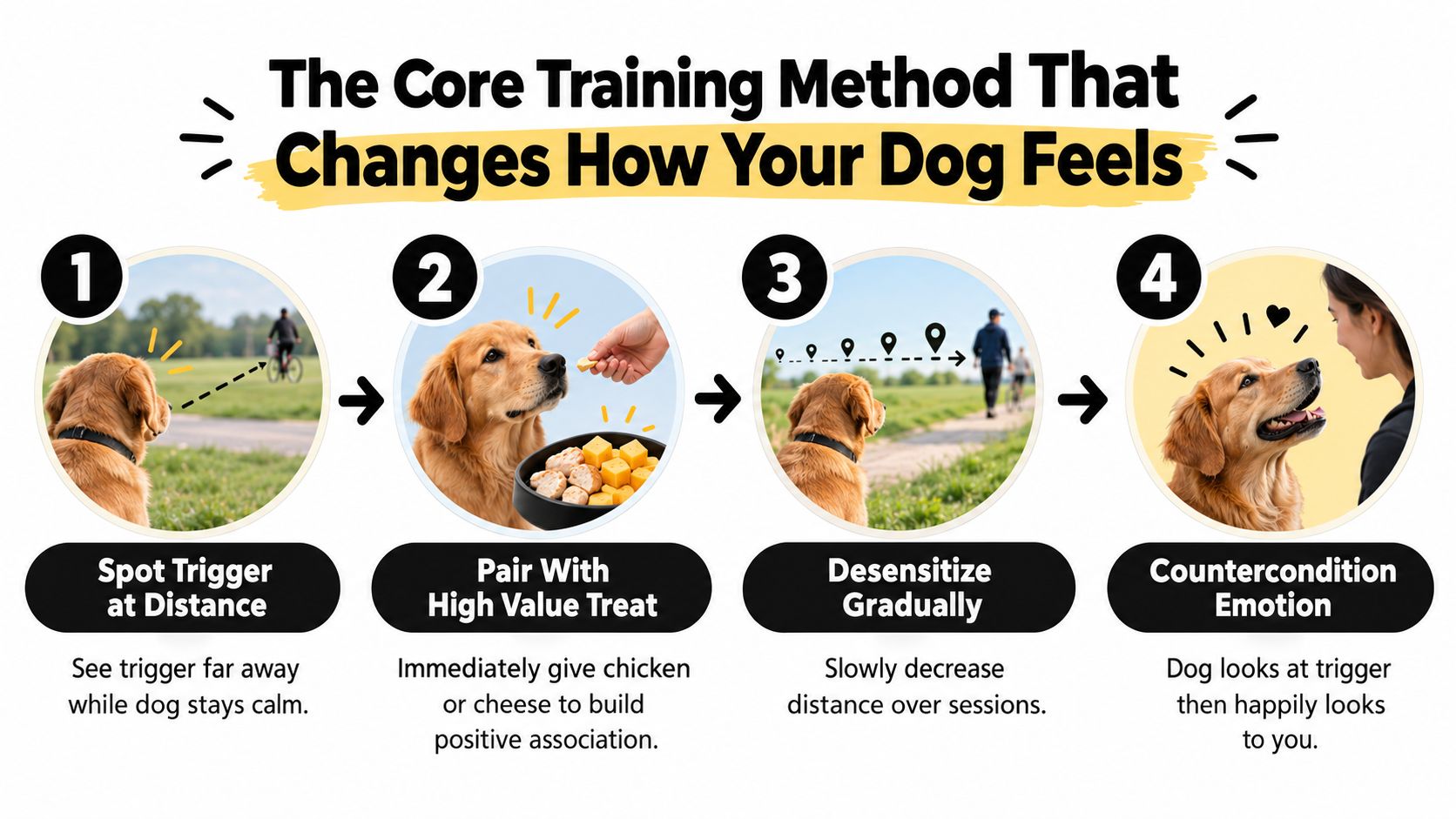
A strong summary of this method appears in classical conditioning for dog training, which fits leash reactivity work well.
The sequence that works on real walks
Here's the clean version.
- Your dog sees the trigger at a workable distance.
- You immediately deliver high-value food.
- The trigger stays far enough away that your dog can keep eating and thinking.
- You repeat until your dog starts seeing the trigger and expecting food instead of escalating.
That's desensitization and counterconditioning. A review summarized in training literature reported clinically significant improvement in 73% of cases, with gains maintained at 6-month follow-up in 68% of dogs when using these protocols (review summary and training discussion).
AKC's step sequence for this kind of work starts at about 20 feet from a quiet, still dog, then decreases distance one foot at a time only when the dog is calmly anticipating the treat (AKC desensitization and counterconditioning guidance).
Timing matters more than most owners think
Food has to arrive fast. If your dog sees the trigger, stares for three seconds, and then gets a treat, you're often late. The goal is to pair the sight of the trigger with the food before the reaction chain builds.
Look for this success pattern:
- Trigger appears
- Dog notices
- You feed
- Dog turns back to you for more
That turn-back is gold. It tells you the dog is starting to feel a different expectation.
This video shows the general rhythm many handlers are trying to build during leash-reactivity work:
When the dog can look at the trigger and then look back to you with a loose body, you're not just interrupting behavior. You're changing the emotional picture.
Should You Stay Close In or Create Space
| Dog Response | What It Means | Your Next Move |
|---|---|---|
| Glances at trigger, eats immediately, body stays soft | Under threshold | Stay there and repeat |
| Stares longer, takes food slowly, body gets tall | Near threshold | Hold or add a little distance |
| Stops eating, vocalizes, pulls forward | Over threshold | Create space immediately |
| Recovers quickly after moving away | Session still usable | Resume at easier distance |
| Stays agitated after the trigger is gone | Stress is stacking | End the session |
What to do when your dog reacts
Don't punish. Don't ask for a fancy obedience routine. Get out cleanly.
Your sequence is simple:
- Increase distance
- Reduce visual pressure
- Let your dog recover
- Restart only if your dog fully comes back under threshold
If not, end the session. That's not failure. That's good handling.
Your Progressive Practice Plan and Troubleshooting Guide
Most owners know what to do in theory. The hard part is doing it consistently enough that the dog stops rehearsing chaos and starts building a new habit. That's where a practice plan matters.
A realistic progression for busy lives
Keep your early sessions short and clean. You want quality reps, not marathon walks full of near misses.
A practical progression looks like this:
- Start with easy setups: Quiet street, parked-car buffer, predictable trigger at distance.
- Move to moderate environments: Wider sidewalks, more motion, but still room to retreat.
- Save hard routes for later: Apartment exits at rush hour, narrow sidewalks, dog-heavy blocks.
Advance only when your dog is repeatedly staying loose, taking food easily, and recovering fast after seeing the trigger. If you have one ugly walk, don't assume the whole plan failed. One bad encounter can raise arousal for the next outing or two.
Common problems and the fix
Some setbacks are almost universal.
Your dog regressed after a surprise encounter
Go back to easier distances for a bit. Don't test whether your dog is “still okay” at the old distance right away.
Your dog explodes at corners or elevator exits
Those are ambush points. Slow down before blind corners, feed through exits, and use visual barriers whenever possible.
Your dog can do parking-lot practice but not neighborhood walks
That usually means the environment is harder, not that the method failed. Neighborhood walks add motion, noise, scent, and surprise. Break that jump into smaller steps.
A dog who can work calmly in one location hasn't generalized the skill yet. That's normal. Dogs aren't being difficult when context changes the picture.
Breed, age, and energy matter
You don't need a different principle for different dogs, but you may need different pacing.
- Herding breeds: They often lock onto motion fast. Give them more distance from moving triggers and shorter sessions before arousal climbs.
- Terriers: They can stay highly engaged with a trigger once activated. Fast treat delivery and clean exits matter.
- Adolescents: Their threshold often swings around. One good day doesn't mean they're ready for a big jump in difficulty.
- Small dogs in dense apartment settings: They often deal with repeated close-range trigger surprises. Management around exits and hallways becomes a huge part of success.
Structured class work can help some dogs because it turns exposure into a managed process instead of random daily chaos. Recent training materials also note that controlled practice settings can reduce leash pulling and vocalization during interactions, which matches what many trainers see when sessions are carefully staged (discussion of managed exposure and leash reactivity).
Calmer Walks Ahead and Your Next Steps
Progress with a reactive dog rarely looks like instant silence. It looks like a looser leash, a quicker head turn back to you, fewer full explosions, and faster recovery after something hard happens.
Measure what matters:
- Can your dog spot a trigger and stay able to eat?
- Can you recover with distance instead of getting dragged into a meltdown?
- Is your dog checking in sooner than before?
- Is your workable distance slowly improving over time?
Those are real wins. They count.
If improvement is uneven, that's normal. Leash reactivity work is rarely linear because daily life isn't controlled. Elevators open. Dogs appear around vans. A bad walk can shake confidence. What matters is whether the overall pattern is getting easier and whether you're making better decisions faster.
Celebrate when your dog stays under threshold in a situation that used to blow up. Get more support when you're seeing frequent red-zone reactions, handling feels unsafe, or your dog's triggers are expanding instead of shrinking. That might mean a skilled trainer, a structured class, or a more personalized day-by-day plan.
If you've been trying to solve this with more cues and tighter leash control, change the question. Don't ask, “How do I make my dog obey near triggers?” Ask, “How much space does my dog need to succeed today?” For most reactive dogs, that's the question that finally leads to calmer walks.
PawCraft creates a personalized 30-day training plan based on your dog's breed, age, environment, and behavior issues, including leash reactivity in apartment and urban setups. If you want a day-by-day schedule with exercises, progression, and success markers instead of generic tips, visit PawCraft.