
Your dog pees on the rug once, and you tell yourself it was a fluke. Then it happens again. Or your dog asks to go outside over and over, squats right away, and only a few drops come out. That pattern can make any owner anxious, especially when the dog has been reliably house-trained for years.
I've talked with a lot of worried owners in that exact moment. Most are trying to answer the same question fast: is this a urinary tract infection, normal aging, or something more serious? The good news is that there are some practical clues you can watch for right away, and those clues can help your vet sort things out much faster.
Is Your Dog Suddenly Having Accidents
A common story goes like this. A dog that has had solid potty manners for years suddenly starts pacing near the door, going out every half hour, then dribbling a tiny amount. Later that night, there's a wet spot on the floor. The owner often wonders if training slipped, if the dog is being stubborn, or if age is catching up.
Most of the time, a dog with sudden bathroom changes isn't making a behavior choice. They're trying to tell you something feels wrong. When the bladder is irritated, dogs may feel a constant urge to urinate even when there's barely anything in there. That urgency can override all the house-training they've learned.
If your dog is normally dependable indoors, a sudden change deserves attention. It helps to think of this less like a training problem and more like a medical clue. That's especially true when the accident comes with repeated squatting, licking, restlessness, or obvious discomfort.
Practical rule: A house-trained dog that suddenly starts having urinary accidents needs observation first, not punishment.
Owners sometimes go down the training rabbit hole because accidents look behavioral on the surface. If you're trying to separate a medical issue from a learned habit, guides on adult dog training basics can help with context, but a sudden change in potty behavior should still put a urinary problem high on your list.
Some dogs act dramatic about it. Others don't. A quiet senior dog may just ask to go out more often or leave a few drops behind after standing up. Either way, changes in urination patterns are worth taking seriously, because the pattern matters as much as the accident itself.
What Actually Causes a Dog UTI
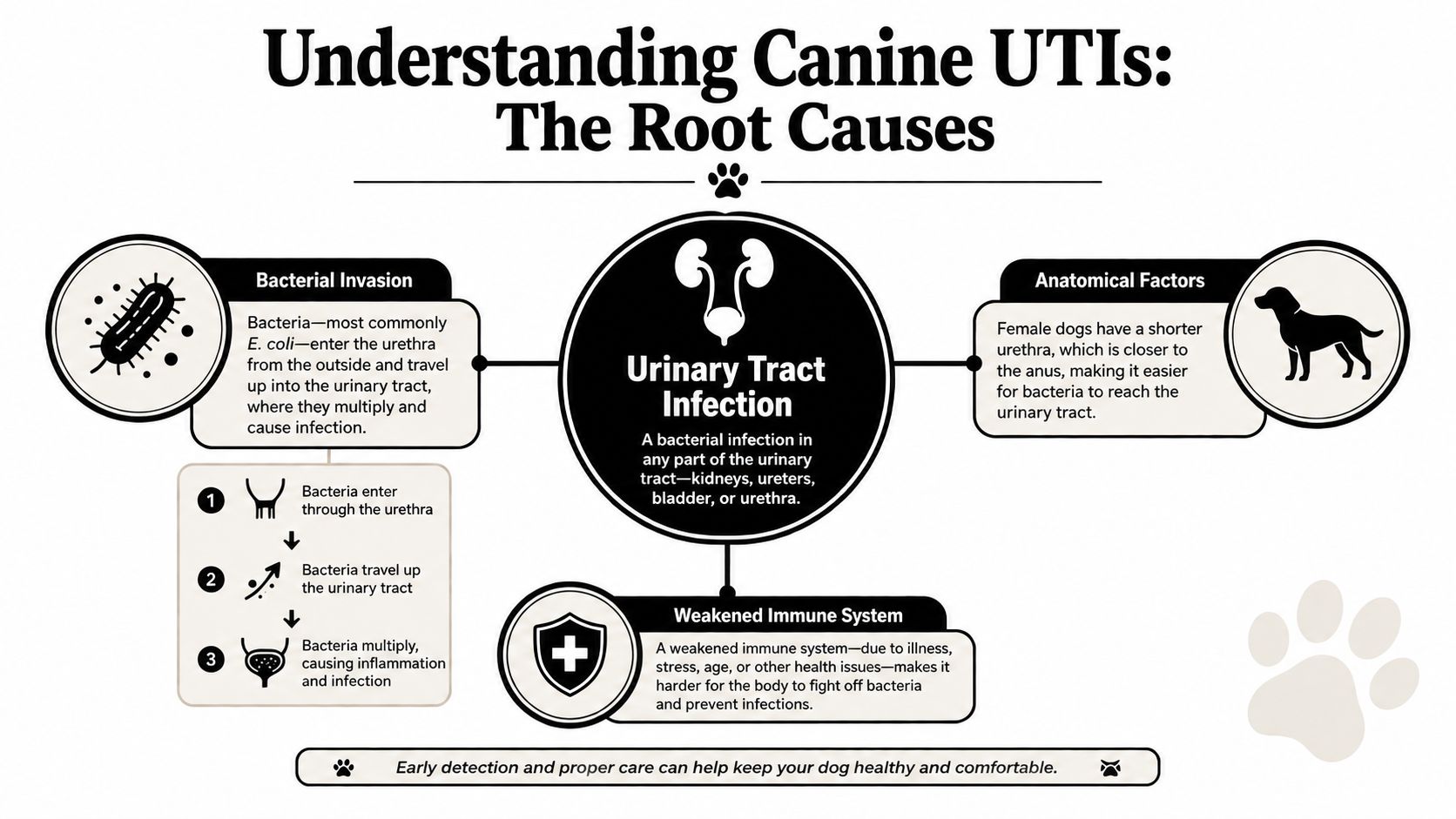
A urinary tract infection, or UTI, usually happens when bacteria get into the urinary tract and travel upward into the bladder. The simplest way to picture it is a one-way path that's supposed to stay clean. A UTI starts when unwanted bacteria go the wrong direction and settle where they don't belong.
The main culprit is E. coli. In dogs with UTIs, Escherichia coli accounts for 33% to 55% of all bacterial isolates, according to a review of veterinary studies published through ScienceDirect's summary of canine urinary tract infection research. That's why vets so often consider bacterial infection first when a dog starts showing urinary signs.
Why bacteria reach the bladder
E. coli normally lives in the gut and can also be found on the skin. That doesn't mean something has gone terribly wrong. It means bacteria that belong in one part of the body have found their way into another.
Female dogs often have an easier path for bacteria to travel because of their anatomy. Other things can raise risk too, including older age, obesity, urinary incontinence, urinary tract stones, chronic kidney disease, and recent antibiotic use. Those risk factors are noted in IDEXX guidance on canine urinalysis and urinary infection diagnosis.
Why a UTI feels so uncomfortable
Once bacteria settle in the bladder, they irritate the bladder lining. That irritation leads to inflammation. Then the bladder starts sending “I need to empty now” signals even when it contains only a tiny amount of urine.
That's why owners often see lots of bathroom trips with very little output. The dog isn't being dramatic. The bladder is inflamed, sensitive, and noisy.
Bacterial UTIs are common, and they're not a sign that you failed your dog. They're a medical issue that needs the right testing and treatment.
The Most Common UTI Symptoms in Dogs
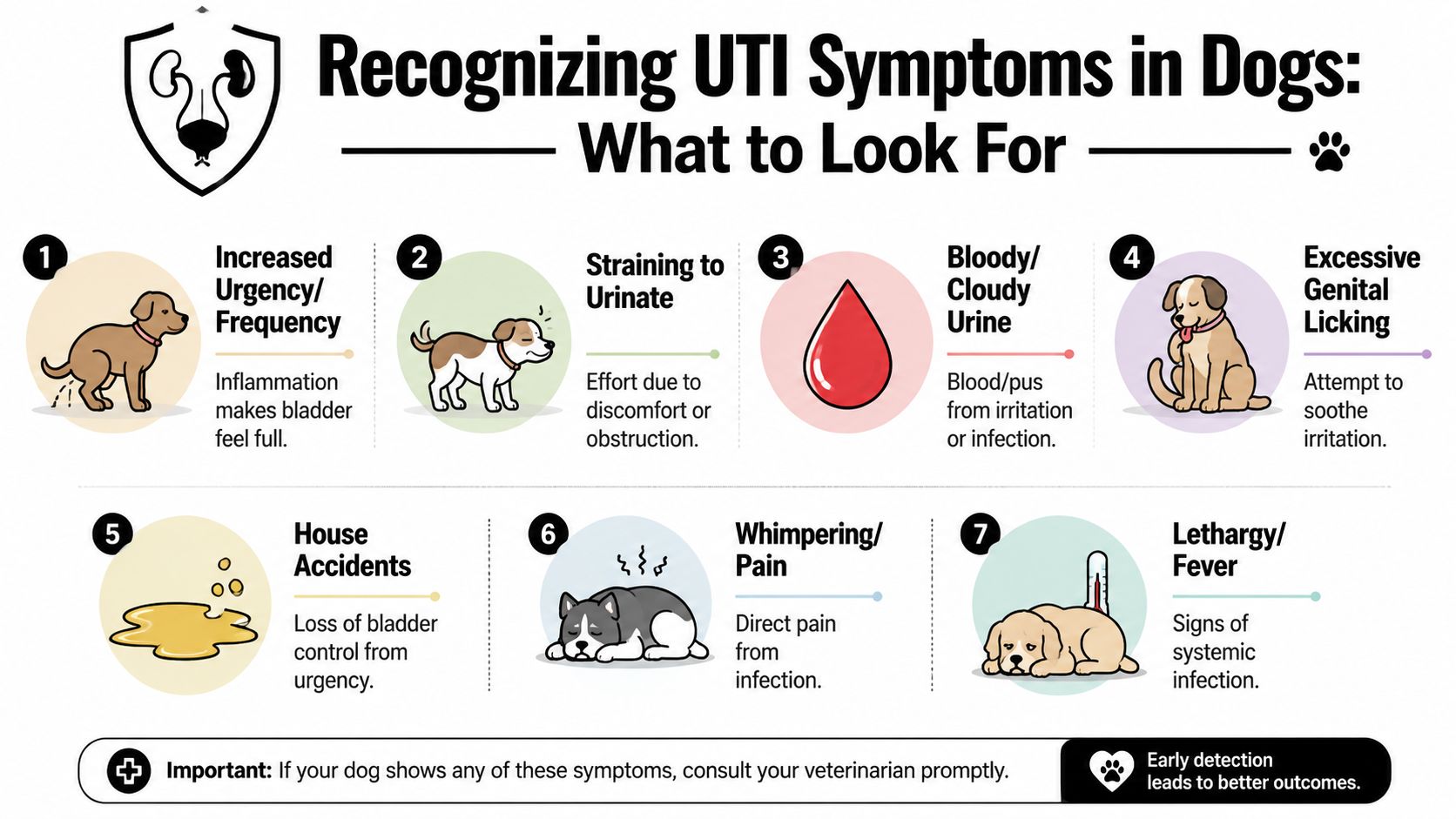
The most helpful way to understand UTI symptoms in dogs is to connect what you see with what the dog is feeling. In bacterial cystitis, the classic symptom group is dysuria, pollakiuria, stranguria, and hematuria, meaning painful urination, frequent small-volume urination, straining with urgency, and blood in the urine. That summary comes from Today's Veterinary Practice on urinary tract infections in dogs.
A checklist can make those signs easier to recognize.
What the classic signs look like
Frequent trips outside
What it looks like: your dog asks to go out much more often than usual, squats repeatedly, and passes only a little urine each time.
Why it happens: bladder inflammation creates a strong urge to urinate even when the bladder isn't full.
Straining or taking a long time to pee
What it looks like: your dog crouches, tenses, and seems to push, but little comes out.
Why it happens: the urinary tract is irritated, so urination becomes uncomfortable and urgent.
Bloody, cloudy, or strong-smelling urine
What it looks like: urine may appear pink, red-tinged, murky, or smell unusually foul.
Why it happens: infection and inflammation can lead to blood cells, white blood cells, and other debris in the urine.
Indoor accidents after reliable house-training
What it looks like: a dog that normally waits suddenly can't.
Why it happens: urgency can override the dog's normal control and routine.
Licking the genital area more than usual
What it looks like: repeated licking after trying to urinate or between potty trips.
Why it happens: dogs often lick when they feel irritation or discomfort.
A short video can also help you compare normal urination with signs that deserve a call to the vet.
How to tell a UTI from incontinence or kidney trouble
Many owners often confuse these symptoms. A UTI often causes frequent, small, often painful urination, which vets call pollakiuria. By contrast, true polyuria means passing large volumes of urine, and that can point to broader problems like kidney disease or diabetes. That distinction is highlighted in Vet Times coverage of urinary tract infection signs in dogs.
A simple comparison helps:
| Pattern | More typical of a UTI | More typical of incontinence or polyuria |
|---|---|---|
| Volume | Tiny amounts or drops | Larger puddles or soaking accidents |
| Comfort | Often painful or strained | Often painless |
| Frequency | Many repeated attempts | Fewer events, but more urine each time |
| Body language | Urgent, restless, squatting often | May leak while resting or sleeping |
If your dog keeps trying to pee but only produces a trickle, think irritation or obstruction and call promptly. If your dog is producing a lot of urine without obvious pain, that still matters. It just points your vet toward a different set of questions.
Scant, painful urine often fits a UTI. Large-volume, painless urine loss often does not.
The quiet version of a UTI
Not every dog reads the textbook. Some high-risk dogs, especially those with concurrent disease such as diabetes, may not show the classic painful signs at all. Owners may notice only subtle changes like polydipsia, which means increased drinking, or a mild shift in potty habits.
That matters because silent or quieter infections can be missed if you wait only for blood in the urine or obvious straining. If your dog is diabetic, immunocompromised, or medically complicated, don't assume “acting normal” rules out a UTI.
What You Can Check at Home Before Calling the Vet
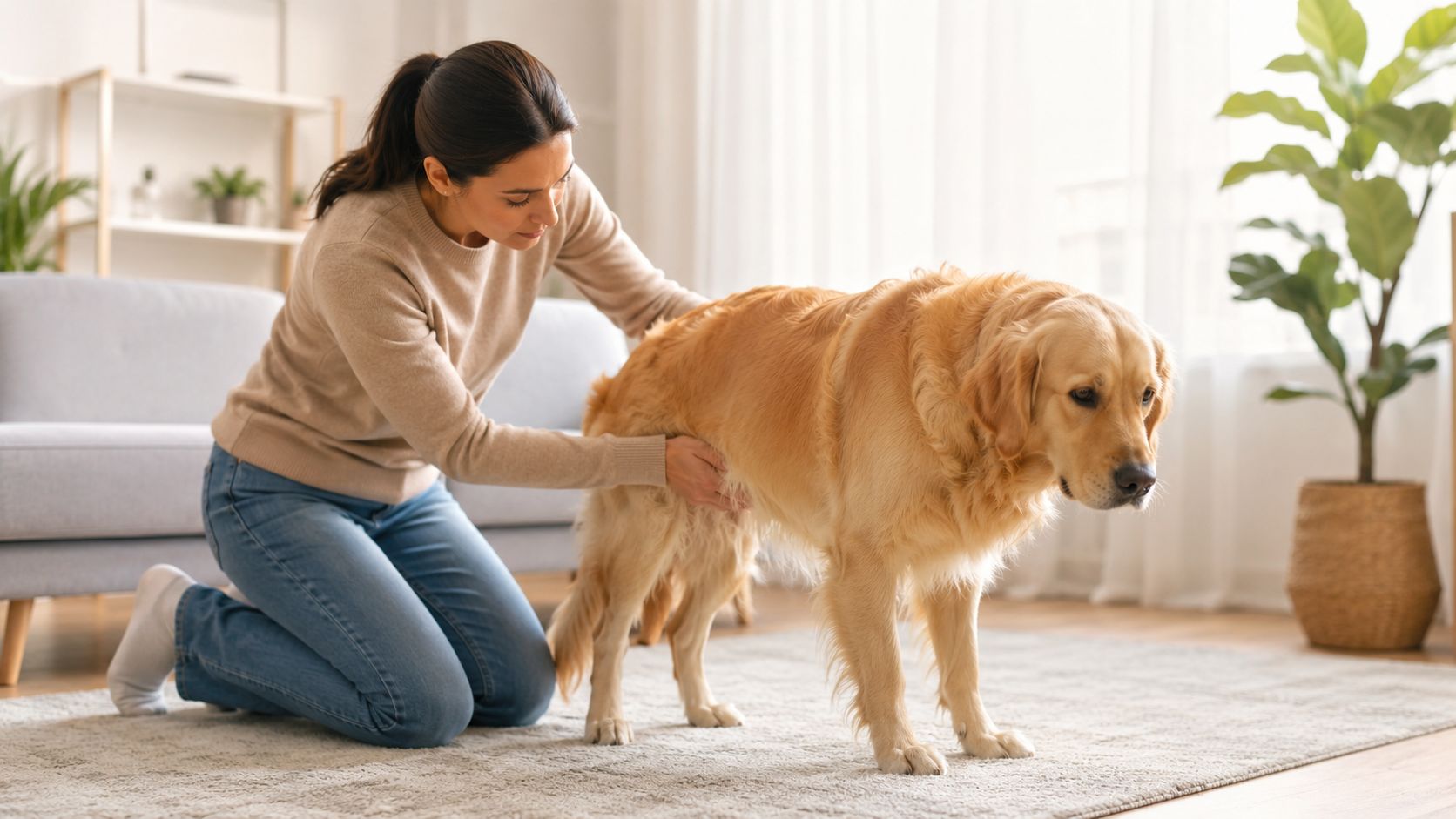
You don't need to diagnose the problem yourself. You just need to gather clean, useful details. Good observations can save time and help your vet decide how urgent the problem is.
What to write down
Keep it simple. A notes app on your phone is enough.
- How often your dog tries to urinate: Count the attempts, not just the successful pees.
- Approximate urine volume: Is it a few drops, a small spot, or a full puddle? This is especially helpful because frequent small amounts suggest pollakiuria, while frequent large amounts fit polyuria more closely.
- Any visible changes in urine: Look for cloudiness, pink or red color, or a stronger smell than usual.
- Signs of discomfort: Whining, pacing, tense squatting, sudden stopping mid-stream, or licking afterward all matter.
- Whole-body changes: Low energy, vomiting, reduced appetite, or seeming “off” can signal that the problem isn't staying local to the bladder.
If your dog has behavior changes around toileting and you're trying to organize what's medical versus habit, a structured dog behavior modification plan can be useful later. For the first call to the vet, though, your symptom notes are the important part.
What not to do at home
Don't give leftover antibiotics. Don't assume cranberry products will fix it. And don't punish accidents.
Try not to press hard on your dog's belly to “check the bladder.” A dog with abdominal pain may react, and the result won't tell you much unless a vet is examining them.
If you can answer “how often, how much, what color, and how painful,” you're giving your vet the details they need most.
How Vets Diagnose and Treat Canine UTIs
You bring your dog in because she has started squatting over and over, but only a few drops come out. Or maybe she is having bigger accidents and drinking more, and you are worried it might still be a UTI. The vet's job is to sort out which pattern fits the bladder, which points higher up to the kidneys, and which suggests a different problem such as incontinence or diabetes.
That distinction matters because straining with frequent tiny amounts usually points to irritation in the lower urinary tract. Large-volume urination is a different pattern. Dogs with kidney disease, hormone problems, or incontinence often pass fuller puddles rather than repeated little spots.
What happens at the appointment
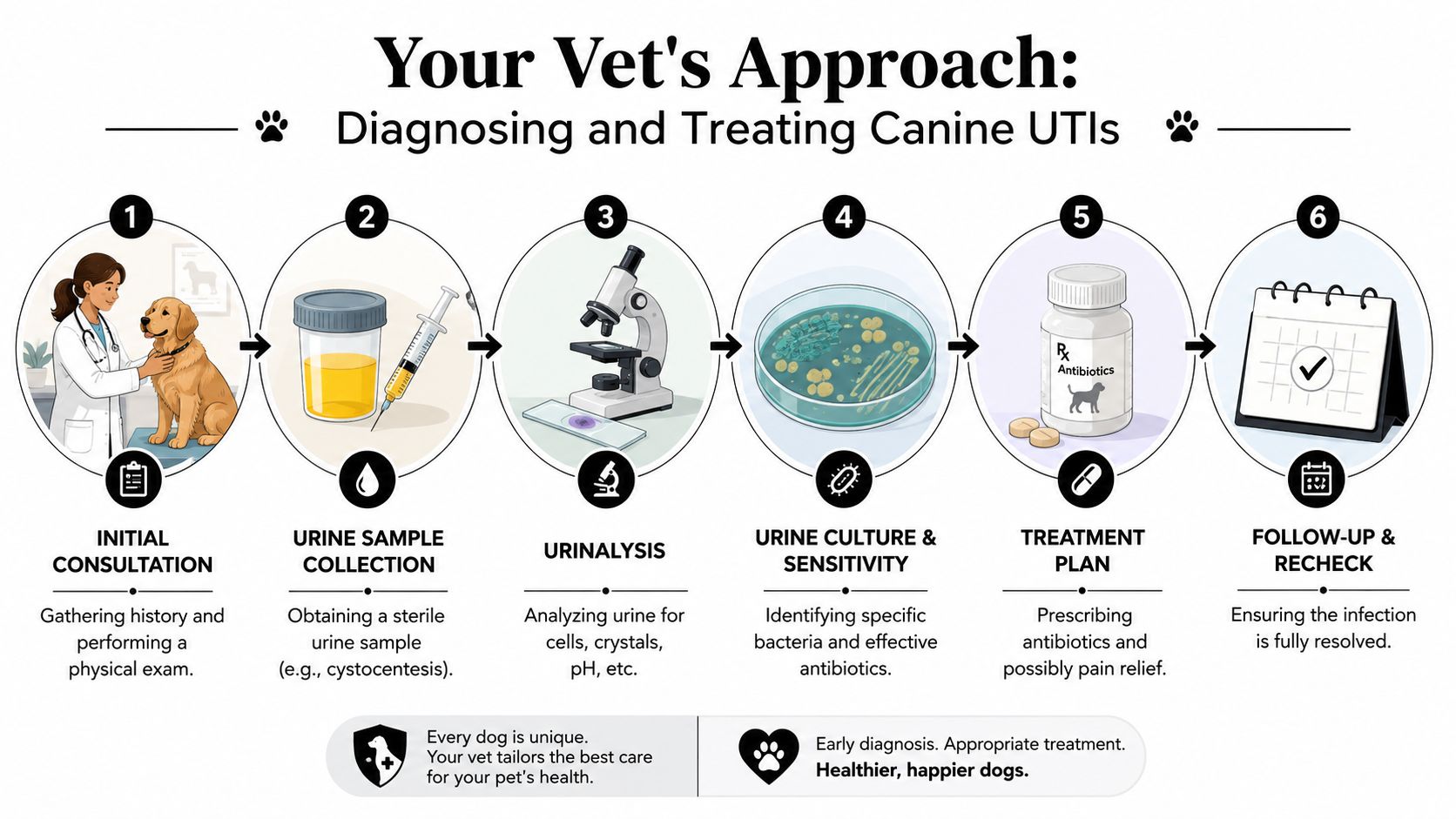
Your vet usually starts with two things. Your notes, and a hands-on exam.
They will ask practical questions that help separate these patterns. Is your dog trying to urinate often but producing very little? Are the accidents small dribbles or full puddles? Is your dog licking afterward, acting painful, or stopping mid-stream? Has your dog been drinking much more than usual, which can hint at a silent infection or another illness in high-risk dogs?
The physical exam helps fill in the rest. Your vet may check for a tense or painful bladder, fever, dehydration, belly discomfort, and signs that the problem is not limited to the bladder.
The next step is usually a urinalysis. That test works like a close inspection of the urine. It looks for blood, white blood cells, bacteria, crystals, glucose, and how concentrated the urine is. For example, a dog with classic bladder irritation may have blood and white blood cells in the sample, while a diabetic dog with a less obvious infection may show sugar in the urine and fewer dramatic signs at home.
Why urine culture matters
A urinalysis can strongly suggest infection, but a quantitative aerobic urine culture is the test that confirms whether bacteria are growing in the bladder. In a dog with urinary signs, a result of ≥1,000 colony-forming units per milliliter confirms infection, according to IDEXX's diagnostic update on urinalysis.
Culture matters for two reasons. First, it helps your vet tell the difference between a true infection and contamination that happened while collecting the sample. Second, it shows which antibiotic is most likely to work. IDEXX also notes that prompt, culture-guided treatment resolves over 90% of uncomplicated cases.
Some owners are surprised when the vet recommends a culture even if the symptoms seem obvious. It makes sense. The bladder is like a room with several possible troublemakers inside. A urinalysis tells your vet there is a problem in the room. A culture identifies who is causing it and which medication is likely to clear it.
How treatment usually works
Many dogs go home with an antibiotic, and some also need pain relief or anti-inflammatory medication. If the history or exam raises concern for bladder stones, kidney infection, recurrent UTIs, or an underlying condition such as diabetes, your vet may recommend imaging, bloodwork, or follow-up urine testing too.
High-risk dogs deserve special attention here. A diabetic dog, for example, may not show the usual straining or obvious pain. They may drink more, urinate more, or seem mildly off. That is one reason vets often test rather than guessing.
If you are still learning what is normal for your dog day to day, these first-time dog owner tips can make it easier to spot a change early.
Important: Even if your dog seems better after a few doses, finish the medication exactly as prescribed unless your vet tells you otherwise.
Call your vet promptly if your dog becomes lethargic, vomits, develops a fever, or cannot pass urine. Those signs can mean the problem is more serious than a simple bladder infection.
Simple Ways to Help Prevent Future UTIs
Prevention usually comes down to helping the bladder empty often and keeping small changes from slipping by unnoticed. A healthy routine gives bacteria less time to settle in, and it gives you a better chance of catching a problem before your dog feels miserable.
A simple way to picture it is this. Urine should move through the system regularly, like rinsing out a bowl instead of letting residue sit at the bottom all day.
Daily habits that support urinary health
- Keep fresh water available all day: Regular drinking helps your dog produce urine and flush the bladder more often.
- Offer predictable potty breaks: Dogs that have to wait too long between bathroom trips give bacteria more time to stay in the urinary tract.
- Keep the rear area clean and dry: This matters most for dogs with long hair, skin folds, urine scalding, or stool that tends to stick to the coat.
- Follow through on rechecks: A dog can seem improved at home and still have inflammation or bacteria left behind, which is why repeat urine testing matters when your vet recommends it.
- Ask your vet before using urinary supplements: Some products may help certain dogs, but they do not replace testing, and they are not the right fit for every cause of urinary trouble.
Which dogs need closer watching
Some dogs do not read the usual script. Instead of straining, whining, or showing obvious discomfort, they may only have subtle pattern changes.
That matters most in higher-risk dogs, including dogs with diabetes, Cushing's disease, bladder stones, or a history of repeat infections. As the Morris Animal Foundation notes in its discussion of urinary tract infection signs in high-risk dogs, dogs with concurrent diseases like diabetes may show polydipsia, or excessive drinking, as an early clue.
This is one of the easiest places to get confused. A dog with a lower urinary tract infection often tries to urinate frequently but passes only small amounts because the bladder feels irritated. A dog with kidney disease or some forms of incontinence often produces larger volumes. The puddles are bigger, and the issue is less about straining than about increased urine output or poor control. If your dog is suddenly drinking much more, flooding the yard with large pees, or leaking urine while resting, do not assume it is a simple UTI.
For first-time owners, building routines around water, potty timing, and observation gets easier with these practical first-time dog owner tips.
Most UTIs respond well to treatment. The best prevention plan is steady daily care plus early attention to quiet changes, especially in dogs that may have a "silent" infection without the usual signs of pain.