You're walking your newly adopted dog when a stranger steps onto the sidewalk. Your dog freezes, barks, or lunges, and you're left wondering whether you've just seen a temporary stress reaction or a preview of the next ten years together. The same question comes up when a puppy hides from a visitor, guards a chew, or gets overwhelmed around another dog.
A temperament test for dogs sounds like it should settle everything. Owners want to know whether a dog is safe around children, compatible with other pets, suited to apartment or rental living, or likely to cope with the pressure of obedience, agility, or other sports. Breed quizzes, DNA kits, and viral behavior videos have also made clean personality labels feel especially tempting.
The truth lies between “crystal ball” and “complete scam.” Temperament is real, observable, and useful, but a single score can't capture every context. Tests work best as a starting hypothesis, then become much more valuable when you pair the results with repeated observation and a structured training plan.
Why Owners Look for a Temperament Test for Dogs
A temperament question usually appears during a practical decision. You may be choosing between puppies, preparing to introduce a rescue dog to children, or trying to understand why a gentle dog reacts differently to people wearing hats. The goal is useful guidance before one confusing encounter becomes a daily pattern.
Families often ask about sociability and safety. Will the dog tolerate clumsy handling from a child? Can it share a home with a cat? Will footsteps and doors in an apartment hallway trigger constant barking? Guidance on dog breeds for kids can help families compare broad tendencies, but the individual dog still needs careful evaluation.
The questions behind the score
A sport home may be watching for different qualities. Does the dog remain engaged when the setting changes? Does it recover after a startling noise? Can it work near unfamiliar people, equipment, and pressure without shutting down?
A landlord or boarding facility may focus on handling tolerance, recovery, resource sensitivity, and responses to unfamiliar dogs. These concerns are valid, yet they measure different situations rather than one universal quality.
Practical rule: Identify the decision first, then choose the assessment that can inform it.
Organized evaluation has a long history. The American Temperament Test Society was founded in 1977 and held its first test in September of that year. By the end of 2012, it had held 1,272 tests, showing that structured temperament testing is not a recent social-media invention. The ATTS records provide testing information across many breeds, but those records still do not turn a test result into a lifelong prediction.
A score is more like a snapshot than a full video. It captures how a dog responded to particular people, objects, pressures, and surroundings at that time. Use it to form a starting hypothesis, then compare it with repeated observation and a practical training plan.
The useful question is not, “Did my dog pass?” Ask instead, “What did the dog notice, how did it respond, and what support could make the next version of that situation easier?” That shift leads from a label to an actionable 30-day plan.
What Canine Temperament Actually Means
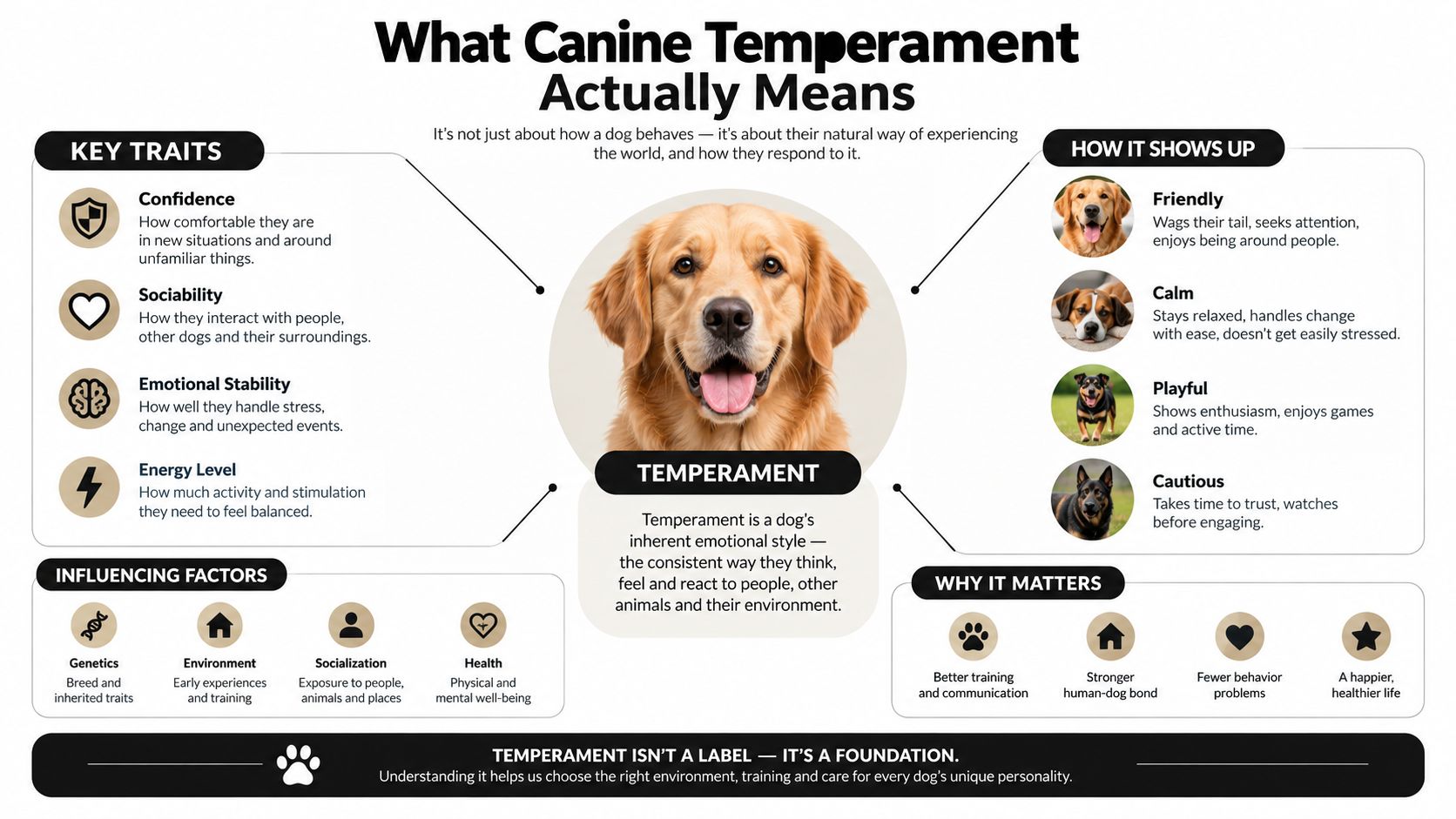
A dog that greets visitors confidently may still freeze around unfamiliar dogs. Another may startle at a dropped pan, then return to play within seconds. Temperament describes these underlying response patterns, not a single pass-or-fail identity.
In trainer language, temperament is a dog's baseline way of responding to novelty, social pressure, possible threat, frustration, and reward. Genetics influence that baseline, while early experience, health, learning history, and environment shape how it appears in daily life. A temperament test can reveal useful tendencies, but it cannot act as a crystal ball. Treat the result as a starting hypothesis for observation and training.
Temperament also differs from a breed stereotype. A breed description summarizes tendencies across a population, while individual dogs can vary widely. It differs from a temporary emotional state as well. A dog that seems withdrawn after a veterinary visit may act normally after rest, recovery, and a return to familiar surroundings.
Climate versus weather
Climate and weather offer a practical comparison. Temperament resembles the climate of a region. Mood is the weather on a particular Tuesday. A stormy Tuesday matters, but it does not describe every condition the region usually has.
That distinction helps prevent owners from treating one startling moment as a permanent identity. Hunger, pain, fatigue, heat, recent conflict, and an unfamiliar handler can all change behavior during an assessment. Test conditions are part of the result, not background noise to ignore.
The traits evaluators often watch
Most assessments examine overlapping dimensions rather than one personality label:
- Human sociability: Does the dog approach, avoid, tolerate, or resist unfamiliar people?
- Dog sociability: Can the dog remain loose and responsive near other dogs, or does proximity create excessive arousal?
- Boldness and recovery: How does the dog handle novelty, sudden change, or an unexpected sound, and how quickly does it return to baseline?
- Prey and chase drive: Does movement trigger intense pursuit, and can the dog disengage when asked?
A dog can be confident with people but uneasy with dogs. Another may love chasing toys and still respond easily to an interruption. These combinations offer more useful guidance than labels such as “dominant,” “submissive,” or “high temperament.”
Temperament is a tendency, not a sentence. Training changes habits, management changes exposure, and improved health can change behavior dramatically. A useful assessment identifies the conditions under which a dog succeeds or struggles, giving you a practical foundation for a focused 30-day training plan.
The Major Formal Tests You Should Know
A formal test is a snapshot taken under specific conditions. The leash, location, handler, timing, and stimuli can all change what a dog shows, so these assessments answer different questions rather than producing one final verdict.
The American Temperament Test Society test places a leashed dog in an unfamiliar setting and presents a standardized series of stimuli. It examines stability, shyness, and thresholds for defensive or aggressive responses. Breed evaluations and other high-stakes screening decisions may use this format, but the result only makes sense alongside the evaluator's observations and the testing context.
The Canine Behavioral Assessment and Research Questionnaire, or C-BARQ, gathers information through an owner-reported questionnaire. Research and shelter programs use it to record behavior patterns across everyday situations instead of relying on one live session. The owner can describe history that an evaluator may never see, although personal interpretation can affect the answers.
The Volhard Puppy Aptitude Test is designed for early puppy screening, traditionally around seven weeks of age. Breeders may compare responses to people, restraint, movement, and novelty when considering placement and early support. A puppy's score can guide the first plan, like an initial map, but it cannot guarantee the dog's adult behavior.
The Suzanne Clothier Wesen test focuses on the relationship between dog and handler. It examines engagement, communication, and self-control during interaction, giving more attention to the pair's pattern than to a simple pass-fail label. That makes it useful when the question is how a dog and person affect each other in real time.
| Test | Format | Administrator | Best For |
|---|---|---|---|
| ATTS | Standardized live stimuli on leash | Trained evaluator | Structured stability and response screening |
| C-BARQ | Owner-reported questionnaire | Owner, researcher, or shelter professional | Everyday behavior patterns and research data |
| Volhard Puppy Aptitude Test | Early puppy exercises | Breeder or trained tester | Initial puppy placement and support planning |
| Wesen | Relationship-based observation | Trained practitioner or handler | Engagement, communication, and self-control |
The administrator matters because setup changes behavior. A dog may act differently with its owner, a shelter worker, a breeder, or a stranger holding the leash. A useful report explains body language, recovery, context, and limits. It should help you choose what to observe and practice during the next 30 days, rather than reduce the dog to a label.
Running a Simple At-Home Assessment
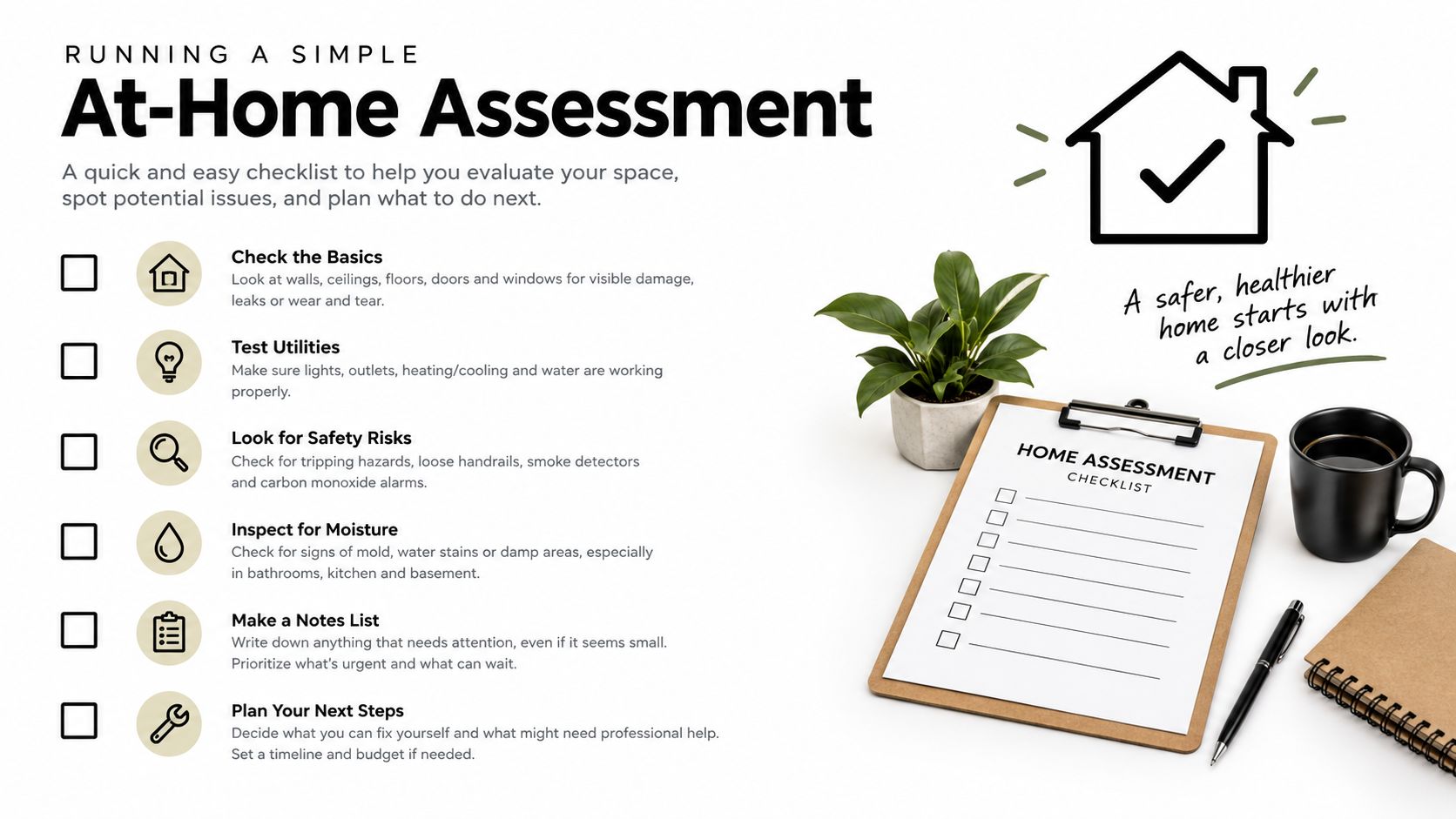
Your dog freezes when the vacuum starts, then relaxes after you call its name. That sequence reveals more than the first reaction alone. An at-home assessment should capture the trigger, body language, and recovery, not force the dog through a challenge course. Begin when your dog is rested, physically comfortable, and able to notice you. Stop if stress keeps building instead of easing.
Use a notebook or spreadsheet. For each station, record the setup, distance, first response, body language, recovery, and a simple 1-to-4 score. You might define 1 as relaxed and flexible, 2 as mildly concerned but able to engage, 3 as strongly stressed or difficult to redirect, and 4 as escalation or inability to recover. The scale tracks patterns for training. It does not grade your dog's character.
Six observation stations
Friendly stranger approach: Ask a familiar helper to approach from a generous distance without reaching toward your dog. Watch for loose movement, turning away, lip-licking, a tucked or high tail, whale eye, barking, and whether your dog reorients to you.
Sudden sound: Play a doorbell recording or drop a light object from a safe distance, never beside the dog. Note the startle, then observe how soon your dog returns to sniffing, eating, or responding to its name.
Moving object: Slowly move a vacuum, skateboard, or wheeled item across the room. Keep enough distance for your dog to watch without feeling trapped. Look for chasing, freezing, avoidance, barking, or voluntary disengagement.
Gentle handling: Briefly touch the shoulders, paws, and ears only if your dog already accepts ordinary handling. Do not restrain, corner, or force a procedure. A stiff body, rapid head turn, repeated lip-licking, or escape attempt means you should reduce pressure.
Food proximity: Give your dog a low-value item and walk past at a comfortable distance. Do not take the food or provoke guarding. Record whether the dog stays loose, pauses, freezes, carries the item away, stiffens, growls, or guards.
Brief separation: Place your dog behind a baby gate while you remain visible for a short period. Observe whether it settles, seeks a toy, or orients calmly. Vocalization is only one part of the response.
Give your dog several minutes between stations, and run different stations on different days. Repeat observations across a week so one tired or unusual afternoon does not dominate your conclusion. Treat the results as a starting map for the next 30 days: lower pressure around difficult triggers, reinforce recovery, and seek professional guidance if safety concerns appear.
This video can help you focus on body language rather than just the obvious behavior.
How Reliable Are These Results Really
A temperament result is useful only when you ask the right question. Reliability asks whether similar observers or repeated sessions produce reasonably consistent findings. Validity asks whether the test measures the trait it claims to measure, and whether that trait predicts behavior beyond the testing room.
Research on dog personality generally offers better support for agreement between observers, consistency over time, and related measures than for separating closely related traits or forecasting behavior in every future setting. The review of dog personality assessment explains why predictive validity is the hardest standard. A test is better understood as a structured snapshot of tendencies than as a forecast of everything a dog will do later.
Why puppy results can shift
A puppy assessment can guide socialization and placement, but it cannot serve as a finished personality profile. One validation study found that puppy assessments reliably predicted only 2 of 8 adult temperament measures, while overall puppy scores were unreliable predictors of adult temperament. The published puppy assessment study supports a measured interpretation: early behavior offers clues, not guarantees.
Shelter testing adds another layer of uncertainty. Confinement, noise, unfamiliar handlers, and repeated transitions may intensify defensive responses. A review of shelter temperament testing reported a false-positive rate as high as 68% for in-shelter aggression indicators and found that some battery-style tests performed no better than chance when predicting resource guarding. The shelter temperament testing review shows why a stressful session may make risk look higher than it is in a predictable home.
| Factor | What Research Shows |
|---|---|
| Observer agreement | Results can show meaningful agreement when evaluators use clear criteria |
| Repeated testing | Consistency is more informative than a single reaction |
| Puppy prediction | Early scores have limited power to forecast adult temperament |
| Shelter aggression screening | Stress can produce substantial false-positive results |
| Real-world prediction | Predicting later behavior across independent settings remains difficult |
Formal testing can still be organized consistently across many dogs. The ATTS records described earlier show a long-running testing tradition, but a pass rate remains a group-level description. It cannot tell you how one dog will respond to visitors, handling, food, or children in a particular household.
Use the result like a weather forecast for one route, not a permanent map of the whole country. Let it identify questions for the next 30 days: Which triggers deserve more distance? How quickly does the dog recover? Which rewards and routines make safer behavior easier? Repeated observations in ordinary settings turn a test score into a practical training plan, while safety concerns call for qualified professional guidance.
The Limits and Ethics of Temperament Testing
A dog may bark at a stranger during one evaluation, then relax around visitors at home. The score captures that moment, not the entire dog. Ethical decisions begin with keeping that difference visible.
An “aggressive” designation can follow a dog through shelter records, insurance paperwork, rental applications, and adoption conversations. Sometimes it reflects a serious, repeated pattern. Sometimes it records one defensive response from a frightened dog in an unfamiliar kennel. Those situations call for different decisions, yet a short form can flatten both into the same word.
Context changes the behavior
Testing equipment, room layout, leash tension, handler confidence, and nearby dogs can influence the response. A dog that freezes when a stranger reaches over its head may be communicating discomfort with overhead handling. That observation does not by itself show whether the dog can live safely with respectful adults, children who follow instructions, or a predictable grooming routine.
A single test is one frame from a film. Repeated observation gives you more of the story. Watch the dog with familiar and unfamiliar people, known and new dogs, in quiet rooms and busy sidewalks, around food and toys, during rest, and after excitement. Record what happened before the behavior, what the dog did, and what helped it return to a workable state.
A responsible label should describe a situation, not replace the dog's history.
Observer bias also matters. One person may call a dog “stubborn” when another sees uncertainty. One evaluator may focus on a bark while another records the softening that followed. Clear descriptions are safer than personality shorthand because they preserve the conditions around the response.
The ethical question is whether people have enough context to make a safe, fair decision. Disclose bite history and guarding, while resisting dramatic conclusions from one stressful reaction. Use testing to guide management, support, and the next month of observation, not as a shortcut to disposal or exclusion. Results should open better questions, not close the dog's future.
Turning Results Into a Personalized Training Plan
A temperament result becomes useful when it leads to a testable training hypothesis. For example, notes showing strong stranger-directed reactivity do not establish “bad temperament.” They suggest that unfamiliar people are currently pushing your dog beyond its workable threshold. The plan should therefore change the distance, predictability, and consequences around those encounters.
Use the same notebook from the assessment. Record the person's distance, your dog's body language, whether it can eat, and how quickly it recovers. Keep sessions brief enough for a successful ending, and offer exceptionally valuable food only while food remains comfortable in that situation. Each session is a small experiment. You adjust one condition, then observe whether the dog can stay responsive.
A 30-day example
During the first week, establish a baseline in quiet locations. Find the distance at which your dog notices a helper without barking, then reward the dog for orienting back to you. The helper should not approach or touch the dog.
During the second week, work with one known helper at that distance. The helper appears, pauses, and leaves while you feed. If your dog stiffens, stops eating, or vocalizes, increase the distance. Re-score the original observation after the week ends. The dog's response sets the pace, not a preferred schedule.
During the third week, vary the helper's position and movement while keeping the task manageable. Introduce variable rewards only after your dog stays responsive, and continue offering breaks. During the fourth week, generalize carefully to a different sidewalk, building entrance, or outdoor space. A skill learned in one quiet location may need practice before it holds up elsewhere.
| Week | Reactive to Strangers Plan | Low Confidence Plan |
|---|---|---|
| 1 | Map threshold and reinforce check-ins at a safe distance | Create predictable routines and reward voluntary exploration |
| 2 | Pair a known helper's appearance with high-value food | Introduce gentle novelty in small, choice-based steps |
| 3 | Vary movement and location without forcing greetings | Add easy obstacles, surfaces, and calm handling games |
| 4 | Practice in carefully selected real-world settings | Generalize confidence to new rooms and quiet outdoor areas |
For a low-confidence dog, emphasize choice, exploration, food scatters, pattern games, and manageable novelty instead of direct social greetings. Forced exposure can make the original concern stronger, so never use it to “prove” that a dog can cope.
Owners who want a clearer structure can review a dog behavior modification plan and adapt its exercises to the dog's threshold, environment, and history. PawCraft can also organize breed, age, environment, and behavior details into a personalized 30-day schedule with daily exercises, progression guidance, and progress checklists. The result is a working plan, not a permanent verdict.
Your Practical Next Steps as an Owner
A temperament result becomes useful when it changes what you do tomorrow. Review your notes and choose one behavior affecting daily life, one situation that reliably triggers it, and one sign that your dog can still learn. Together, these details form a working starting point, not a permanent label.
A simple decision path
- Use a home assessment when: You need a gentle baseline for ordinary situations and your dog can recover without escalating.
- Repeat later when: Your dog has settled into a new home, matured, recovered from illness, or completed meaningful training. Retesting after three to six months may clarify whether changed circumstances affected the result.
- Contact a certified behavior consultant when: Resource guarding escalates, your dog has a bite history, or freeze responses do not soften with distance and choice-based exposure.
- Bring video when: You can film safely without adding pressure. Capture one short clip per stimulus, including the setup and recovery, so a professional can notice signals you missed while handling your dog.
Never stage a dangerous reaction. Have another adult film from a distance, keep your dog below threshold, and stop when fear or defensive behavior increases.
For owners new to training, these first-time dog owner tips can help establish routines for sleep, handling, enrichment, and reinforcement. Predictable days make behavior notes easier to interpret because fewer environmental changes compete for your attention.
A test is closer to a weather forecast than a verdict. It may indicate conditions that deserve preparation, yet the forecast cannot describe every walk. Ask which situations are easy, which are difficult, what your dog does before escalation, and which skills can make those moments safer.
PawCraft organizes temperament observations into a personalized 30-day training program with daily exercises, progression steps, and progress checklists based on your dog's age, breed, environment, and behavior challenge. Visit PawCraft to turn assessment notes into a practical plan you can begin using today.