Your dog hears the doorbell, races across the room, and launches at the first person through the door. You say “off,” reach for the collar, or push the dog away, but the jumping gets bigger instead of better. A large dog can knock over a child or unsettle an older visitor, while a small dog can still create a frantic, difficult greeting.
To stop dog from jumping reliably, you need more than a louder correction. You need to prevent rehearsal, identify what the dog gets from jumping, and teach a greeting behavior that can succeed when excitement rises. The practical sequence is simple, but the timing and consistency matter.
Why Dogs Jump and Why It Keeps Happening
A 90-pound Labrador launches toward a toddler at the doorway. The owner shouts “off,” grabs at the front legs, and pushes the dog back. The dog jumps again, harder. From the human perspective, the interaction is a correction. From the dog's perspective, the jumping produced movement, eye contact, touch, and a loud social exchange.
That's the reinforcement loop. The dog jumps, the person reacts, and the interaction continues. A startled laugh, a knee against the chest, a hand pushing the muzzle down, or a repeated “no” can all provide attention. In a 2019 Applied Behaviour Analysis study of jumping behavior, dogs averaged 6.6 jumps across control, demand, and ignore conditions, but averaged 17.6 jumps in attention and tangible conditions. The result supports a practical training principle: jumping often continues because people accidentally make it socially effective.
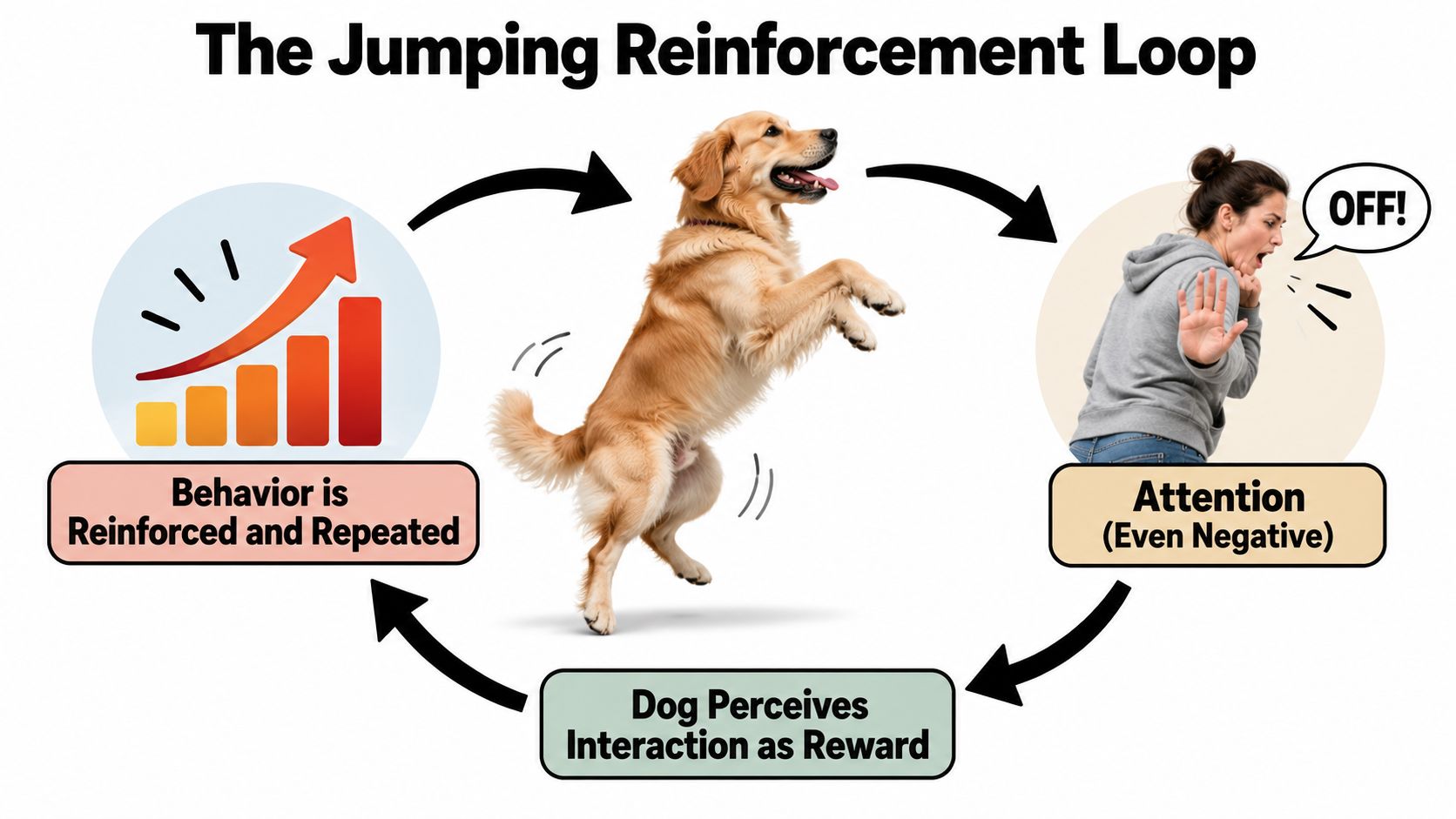
Practical rule: If the dog jumps, remove access to the interaction. If the dog stays grounded, make the interaction happen.
Excitement changes the dog's usable skills
Jumping is also an arousal problem. A dog may sit beautifully in a quiet room and lose that skill when it hears keys, a doorbell, a leash clip, or a familiar person's voice. Leash tension can add frustration, especially when the dog wants to reach someone but can't. Playful dogs may jump because human faces, hands, and movement have become part of the game.
Breed energy, adolescence, and a long history of untrained greetings can compound the pattern. None of that makes the dog “bad” or dominant. It means the dog hasn't learned which behavior works under the specific conditions that trigger the jumping.
Before choosing a correction, learn to read the dog's whole pattern with this guide to understanding dog body language. Jumping is a symptom of missing criteria, weak management, or a reinforcement history that favors launching over waiting.
Figuring Out the Function Behind the Jump
“Attention-seeking” is sometimes accurate, but it's too broad to guide every case. Owner-led functional analysis can help identify why an individual dog jumps. Research on function-based interventions found that time-based reinforcement reduced jumping in 3 of 4 dogs, while conditional discrimination training changed jumping reliably in the presence of specific cues, as described in this study of individualized jumping interventions.
Start by recording each episode for 3 to 5 days. Write down who was present, what happened immediately before the jump, how the dog's body looked, and what happened afterward. You're looking for the consequence that keeps the behavior valuable.
| Function | Typical trigger | Body language cue | First-line fix |
|---|---|---|---|
| Greeting or access | A person enters, approaches, or holds something desirable | Forward weight, direct approach, reaching paws | Block access, then invite a sit or calm approach |
| Attention | A person talks, looks, touches, or reacts | Dog checks the person repeatedly and escalates when ignored | Become still and silent, then reward grounded behavior |
| Arousal or overstimulation | Doorbell, fast movement, play, leash tension, crowded spaces | Bouncy movement, rapid scanning, vocalizing, poor response to cues | Increase distance, lower stimulation, use a mat or scatter feeding |
| Resource competition | Another dog, child, toy, food, or person receives attention | Dog wedges between people, guards proximity, or redirects | Manage distance and resources, then seek professional assessment if guarding appears |
Test one explanation at a time
Suppose your dog jumps when a visitor looks at her. Have the visitor turn sideways, avoid eye contact, and remain quiet. If the dog settles, the interaction itself was probably maintaining the behavior. If she escalates, circles, vocalizes, or starts grabbing the leash, arousal or access frustration may be more important than simple attention.
Change only one variable during each test. A quiet visitor, a gate, a leash, and a food lure all introduced together won't tell you which part helped. For an attention-maintained jumper, silence and removal of eye contact may be enough to create a pause. For an over-aroused dog, distance and decompression must come first because the dog may be unable to learn while flooded with excitement.
The function can also vary by context. A dog may jump at family members for play, at delivery workers for access, and on the sidewalk because leash tension makes the approach frustrating. Use the consequence, not the dog's breed or your assumption, to choose the first protocol.
Setting Up a Doorway Management Plan
Guest arrivals are the most common place to start because the doorway concentrates triggers, movement, voices, and access. Management isn't a backup plan. It keeps the dog from practicing the unwanted response while you teach a replacement.
Before anyone knocks, choose one arrangement:
- Tether: Secure the dog about 6 feet from the door, where the leash can't wrap around furniture or put pressure on the neck.
- Barrier: Place the dog behind a baby gate or in a nearby room with a clear view of the entry.
- Helper: Have a second adult hold the leash while you handle the door.
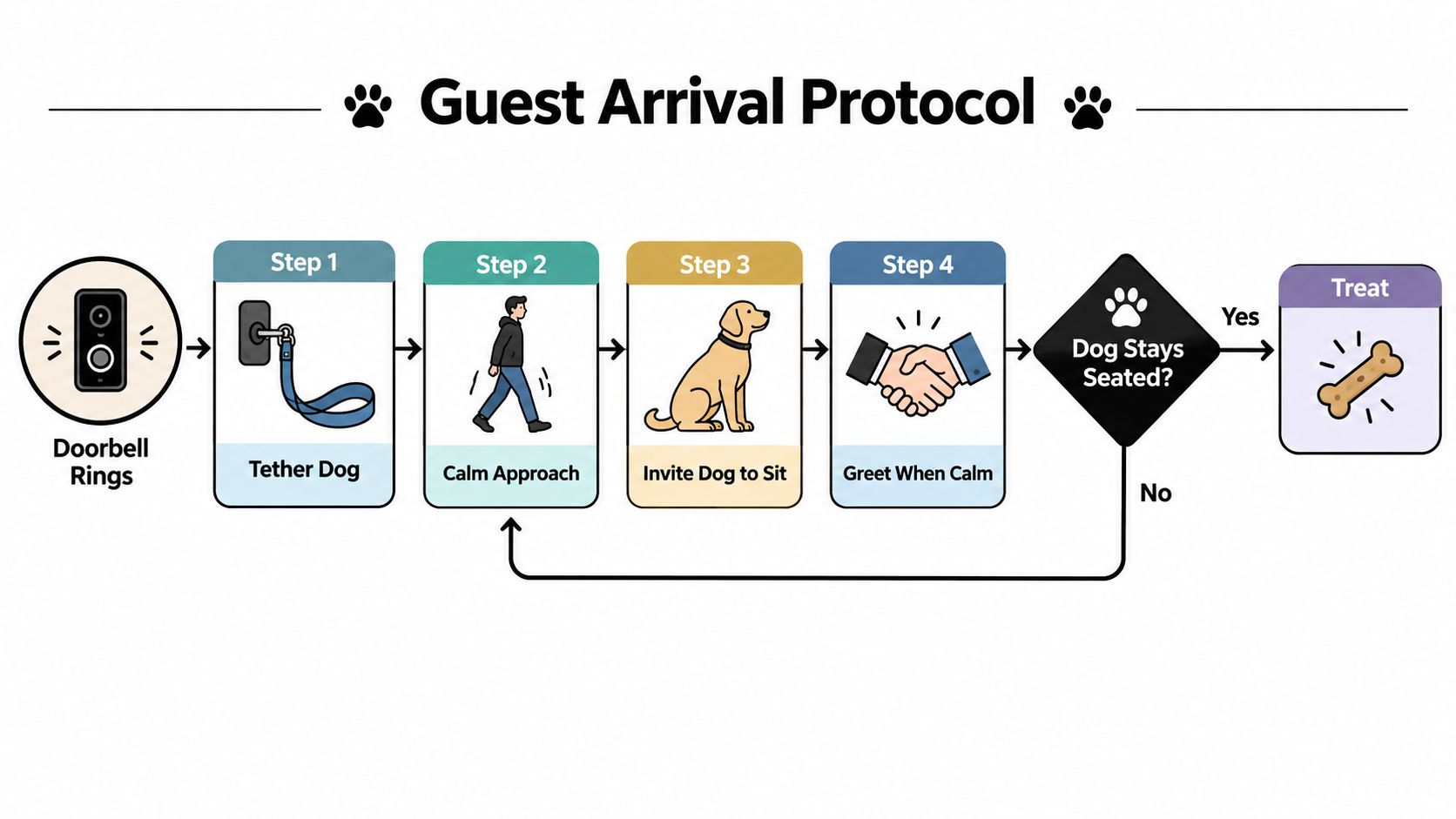
Major welfare guidance recommends removing attention when paws leave the floor, rewarding calm greetings, and teaching an incompatible cue such as sit. Humane World for Animals' greeting protocol describes the same repeatable pattern, while practical kennel guidance for stopping jumping emphasizes barriers, leashes, and preventing rehearsal.
Run the arrival sequence
- The dog hears the knock or doorbell. Say “yes” the moment you see a calm weight shift backward, a pause, or four paws on the floor.
- Drop a treat near the dog's nose, so the dog lowers the head and keeps the body grounded.
- Ask for sit if the dog can respond without lunging. Don't repeat the cue while the dog is bouncing.
- The guest enters only while the dog remains grounded. Keep the leash on even if it feels unnecessary.
- If the dog stands or jumps, the guest turns away immediately. You can calmly guide the dog back behind the barrier or increase distance.
- Mark calm behavior again, then reward. The greeting resumes only when the dog is composed.
Give visitors a literal script:
“I'll turn sideways and ignore your dog until she sits. Please tell me when I can greet her.”
The 3-second rule helps with timing. If the dog maintains four paws on the floor for roughly three seconds, mark and reward before excitement builds again. Keep the first greeting brief, then release the dog away from the visitor so calm behavior doesn't turn into a long wrestling session.
For dogs that also bark at the door, pair this plan with a structured approach to door barking. Practice 5 repetitions twice daily during the first week, using a helper and stopping before the dog becomes frantic. Short, successful repetitions teach more than one chaotic real arrival.
Teaching Sit, Four on the Floor, and Go to Mat
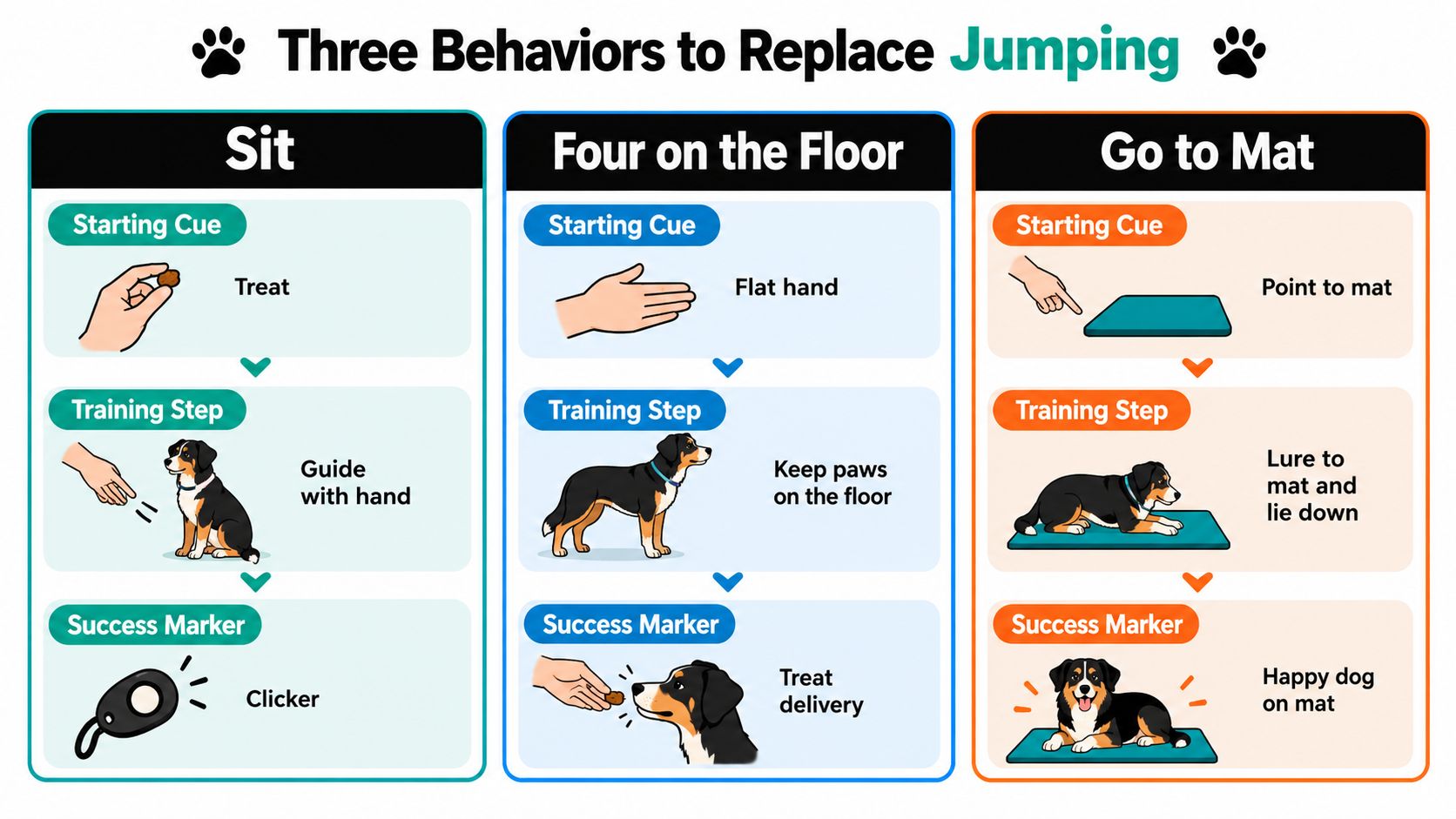
A replacement behavior must be physically incompatible with jumping and easy to reinforce. Sit is useful for dogs who can think around people. Four paws on the floor works better for dogs who become too excited to sit. A mat gives the strongest structure when a visitor needs to come inside and settle.
Build sit as a complete behavior
Hold a treat at the dog's nose and move it slowly toward the space between the ears. As the rear touches the floor, mark with “yes” and deliver the treat from your hand. Then use a release word such as “free,” so the dog learns that sit has a beginning and an end.
Once the dog is offering the movement smoothly, say “sit” just before the hand motion. After 3 to 5 repetitions, begin reducing the lure by showing an empty hand and rewarding from the other hand. Add a hand signal after the verbal cue is reliable, rather than waving food in front of the dog every time.
Don't use sit as a test the dog must pass while a visitor leans over her. Ask for the behavior before the person approaches, reward it, and release the dog only when the body remains loose.
Reinforce grounded movement
For a dog who jumps during walks or can't hold a sit, capture four paws on the floor. The instant all paws touch down, mark and place the reward low, close to the dog's nose. Start by reinforcing a calm grounded moment for two full seconds, then gradually add movement, eye contact, and approach.
Hand targeting gives you another option. Present an open palm at the dog's nose, mark when the nose touches it, and reward beside your leg. This can turn the dog toward a predictable target instead of allowing a leap toward a person's chest. It isn't a substitute for managing distance, but it can help you move an aroused dog through a hallway or away from a stranger.
Make the mat the default station
Choose a defined target, such as a bath mat, dog bed, or folded towel. Reward any glance toward it, then a step onto it, then standing or lying there. Add the cue “mat” when the dog is already moving toward the target, and release frequently at first.
Train the mat away from the front door before adding visitors. A dog who only sees the mat when the bell rings may associate it with frustration rather than calm. Short practice sessions, clear releases, and rewards delivered on the mat create a useful station for real greetings.
The same principles support broader dog impulse-control exercises. The point isn't to suppress excitement. It's to give the dog a practiced action that earns access without paws leaving the floor.
Building Reliability From Living Room to Sidewalk
A dog doesn't automatically transfer a polite living-room greeting to a hallway or sidewalk. Each new location changes the trigger picture, so raise difficulty gradually instead of treating one successful sit as proof that the behavior is finished.
A practical progression
Days 1 to 3, living room foundation. Use a helper who approaches and leaves as if arriving. Run 10 repetitions per session, rewarding sit or four paws on the floor before the helper gets close. Keep the room quiet and the dog on leash if the dog has a history of rushing.
Days 4 to 5, add social pressure. Stay in the same room, but have the helper make eye contact, speak softly, and reach partway toward the dog. If the dog stands, the helper turns away. Reward the instant the dog returns to the chosen greeting behavior.
Days 6 to 7, use the front door. Work with the leash attached while the helper enters and exits. Pay for grounded behavior at the doorway, then practice walking calmly to the mat or greeting station. Don't add a second visitor until the first pattern is stable.
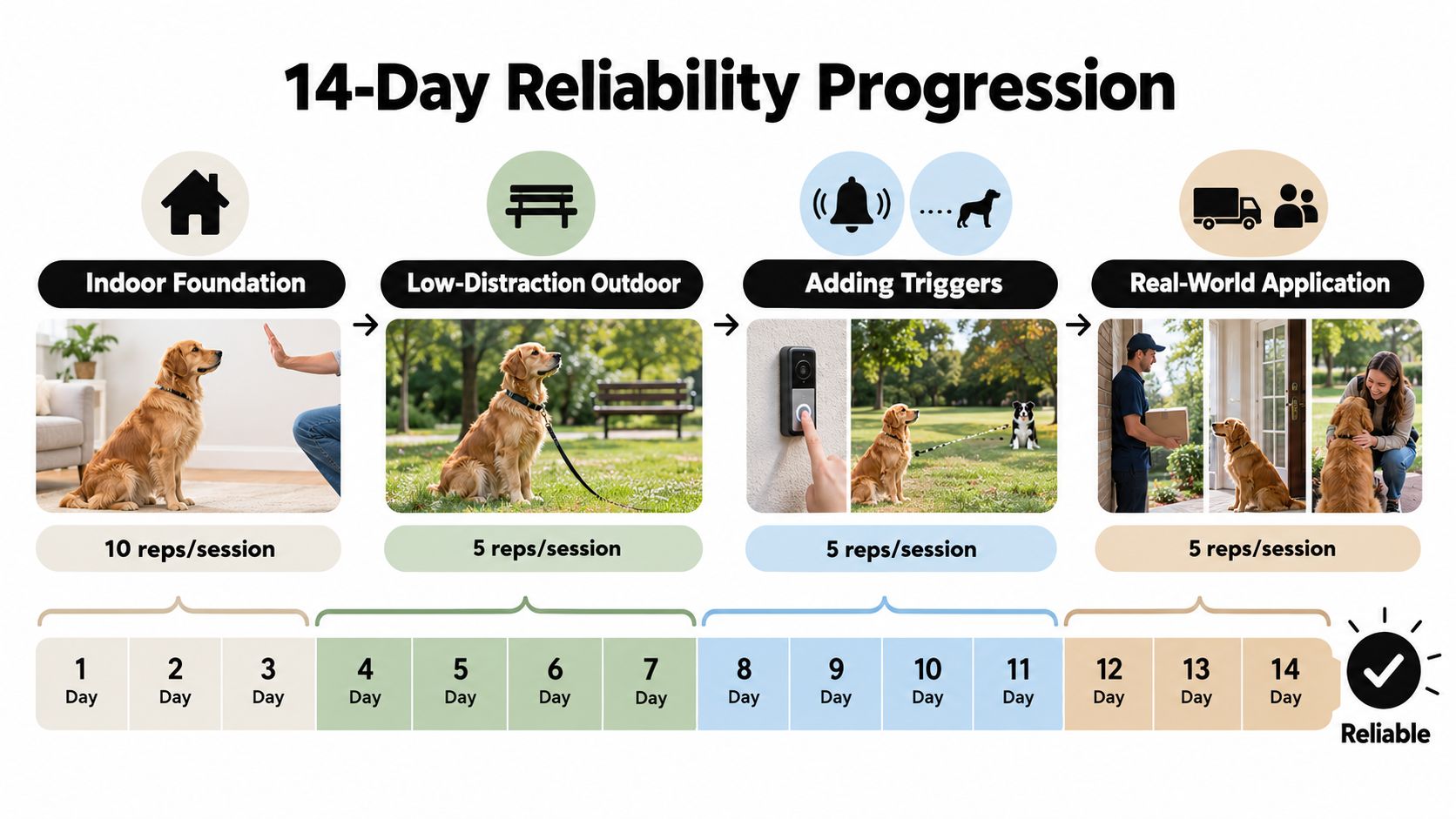
Week two, generalize the skill. Move from the hallway to the front yard, then a quiet sidewalk. Start with a passerby at a comfortable distance, reduce the distance only while the dog stays loose and can eat, and eventually practice a direct approach with a prepared helper. Guidance from VCA on greeting behavior and jumping also addresses leash control, barriers, head halters, and practice with a helper for situations beyond the front door.
Use three criteria before moving up:
- The dog succeeds at roughly 90% over two sessions.
- The body stays calm enough to respond and take reinforcement.
- The dog offers the default behavior before you give the cue.
Expect a plateau around the third session at a new difficulty level. That's information, not failure. Drop back to the last successful distance or distraction, reinforce generously, and try the harder version later.
Over time, replace some food rewards with real-world paychecks. A calm sidewalk greeting might earn sniffing time. Walking past a person without jumping might earn praise or a toy. Keep occasional food reinforcement in the rotation, especially when the environment becomes more difficult, so the behavior remains valuable rather than fading through neglect.
Mistakes That Quietly Sabotage the Training
Physical corrections look decisive, but they often make the situation less predictable. Kneeing the chest, stepping on hind toes, pushing down on the muzzle, or scolding can increase arousal and still give the dog interaction. Humane and veterinary guidance consistently favors removing attention and reinforcing an alternative instead.
Use a barrier, leash, or distance to prevent contact. When paws leave the floor, turn away and wait for grounded behavior. Don't physically punish the dog for trying to reach people.
Common failure points
- Petting at the wrong moment: If paws are on your legs, petting is a reward delivered during jumping. Freeze, remove your hands, and resume touch only after the dog is grounded.
- Mixed visitor rules: One guest turns away while another bends down to say hello. Give every visitor the same instruction before opening the door.
- Leash conversations: Repeating “no, stop, don't pull” while the dog strains toward a stranger can become attention for pulling. Move away, wait for a pause, and reinforce the pause.
- Fading rewards too early: A dog may understand the cue indoors but still need frequent reinforcement at the door or on the sidewalk. Reduce payment only after the dog is fluent at that specific level.
- Allowing one “special” greeting: A dog can't understand that jumping is forbidden except when a favorite person arrives. Keep the rule clear, then invite contact after the replacement behavior.
The clean replacement is always the same pattern: prevent the leap, wait for the grounded behavior, and make that behavior produce access.
If the dog fails repeatedly, the setup is too hard. Increase distance, reduce movement, use a gate, or return to a quieter location. Training improves when the dog gets enough successful practice to learn what earns the greeting.
When to Call in a Trainer or Behavior Pro
DIY training is appropriate for a loose, social dog whose jumping stops when attention is removed and a calm alternative is reinforced. Get professional help when the dog escalates rather than settles, especially if ignoring produces harder jumping, lunging, barking, or redirected frustration.
A veterinary behaviorist should evaluate any history of biting, mouthing that leaves marks, guarding an owner's body from other people, or sudden reactivity in a previously social dog. Adolescent-onset reactivity also deserves attention before the dog rehearses the pattern across visitors and public spaces.
When contacting a professional, ask about credentials such as CPDT-KA, KPA, CDBC, or DVM DACVB. Ask directly whether the plan relies on reinforcement-based methods and how the trainer handles safety during greetings. Be cautious with punishment collars, physical corrections, or dominance-based explanations that treat fear and arousal as defiance.
A sound initial assessment should include a detailed history, observation of the trigger and consequence, a functional hypothesis, a written plan, and follow-up support. A qualified professional isn't a last resort. They can identify the reason for the jumping, adjust the environment, and give you criteria that keep both the dog and visitors safe.
For a personalized plan, PawCraft creates a breed-, age-, environment-, and behavior-specific 30-day training program with daily exercises, progression criteria, and common mistakes to avoid. Use it to organize practice for jumping at the door, pulling toward people, or other related greeting problems, while involving a qualified behavior professional when safety concerns appear.