It's 10 p.m. The first distant firework cracks, and your retriever stops eating, pins his ears back, and claws at the back door. By the time the next boom arrives, he's pacing, panting, and trying to escape the house. You're left wondering whether to comfort him, distract him, or start playing a thunder recording.
That reaction isn't stubbornness, disobedience, or a failure of basic obedience training. Dog training for noise sensitivity works best when you treat the problem as fear, learning history, environment, and sometimes health. Exposure exercises matter, but they're only useful when your dog is calm enough to learn.
What Noise Sensitivity Really Looks Like in Dogs
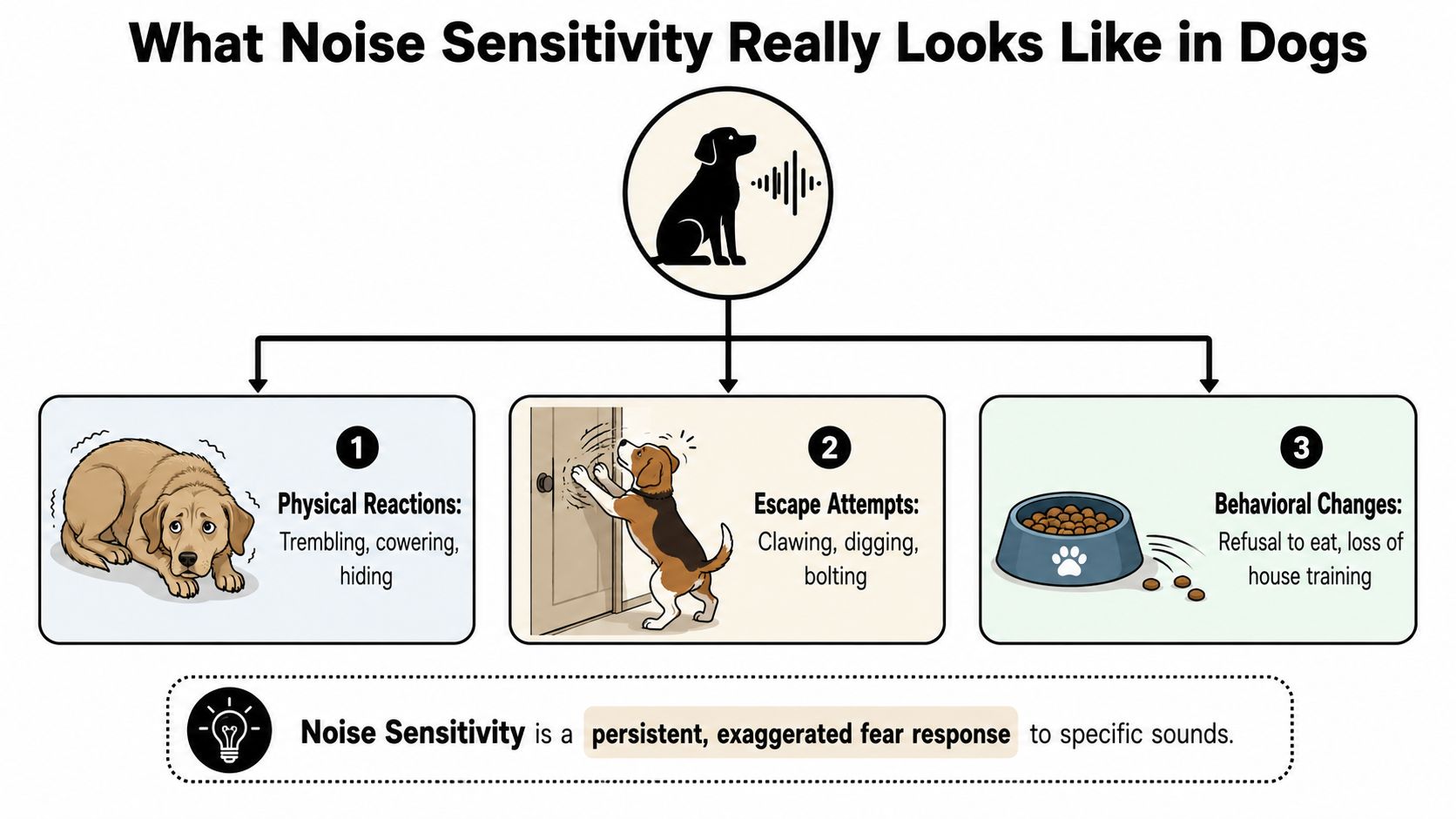
Noise sensitivity is a persistent, disproportionate fear response to specific sounds. A dog may startle at a sudden bang and recover normally, but a noise-sensitive dog stays distressed, anticipates the sound, or reacts more intensely each time.
Common triggers include thunder, fireworks, gunshots, construction, traffic, vacuum cleaners, alarms, and household appliances. The response can range from subtle discomfort to dangerous panic.
Read the whole spectrum
Mild fear often appears before owners recognize a problem:
- Physical changes: Lip licking, ears back, lowered posture, panting, or a backward weight shift.
- Moderate distress: Hiding, trembling, pacing, refusing food, scanning for an exit, or freezing.
- Severe panic: Destruction, self-injury, urination or defecation, bolting, clawing at doors, or trying to break through windows.
The important distinction is recovery. A dog who startles, looks around, and returns to normal activity is showing a normal response. A dog who can't eat, settle, or reconnect with you is already over threshold.
Why the reaction can begin early
Noise fear has two parts. First, the sound produces a direct fear response. Then the dog learns to anticipate it. Dark clouds, wind, a change in household activity, or the familiar pre-firework pattern can become warnings that danger is coming.
Research involving 17 dog breeds found that about 23% of dogs were reported as fearful of noises on average, with fireworks producing the highest frequency of fear responses, followed by loud noises or gunshots, thunderstorms, and heavy traffic. The same research found meaningful differences linked to sex, neuter status, and breed, which supports an individualized training plan rather than a generic obedience recipe. Read the breed and demographic findings in the major noise-fear study.
By the end of this process, you should be able to identify your dog's threshold, run controlled exposure, judge real progress, and recognize when veterinary or professional support needs to join the plan.
Assess Your Dog Before You Start Any Training
Don't begin by turning on a thunderstorm recording. Start with observation. Spend 7 to 14 days recording what happens naturally so you know which sounds matter, where they occur, and how quickly your dog recovers.
Write down the date, time, setting, trigger, activity before the sound, visible behavior, and severity from 0 to 5. A score of 0 means no observable concern. A score of 5 means panic, escape behavior, self-injury, or complete inability to function.
| Date & Time | Trigger Sound | Dog Behavior Observed | Severity (0-5) | Setting & Activity Before Trigger |
|---|---|---|---|---|
Identify the threshold before you test it
Your dog is approaching threshold when you see whale eye, lip licking, a tucked tail, pinned ears, panting, freezing, backward weight shifts, scanning, or a sudden search for an escape route. Refusing a high-value treat is one of the clearest practical signs that the sound is too intense for learning.
Don't wait for barking or lunging. Fear often becomes visible in the posture several seconds earlier. If your dog can't take food, sniff, respond to a familiar cue, or return attention to you, stop trying to train and reduce the sound or increase distance.
Threshold rule: If your dog is reacting, you're no longer teaching tolerance. You're managing distress.
Rule out problems that change the plan
Noise sensitivity may occur alongside separation anxiety, generalized fear, pain, cognitive decline, or sensory changes. A dog with painful arthritis may react more intensely during storms because discomfort reduces the ability to cope. A senior dog who suddenly fears ordinary household sounds deserves a health evaluation, not an assumption that the issue is poor training.
Book a veterinary appointment before exposure work if the fear is new, severe, escalating, or accompanied by unusual physical or behavioral changes. Ask your veterinarian whether pain, illness, hearing changes, or other medical contributors need investigation, including bloodwork where appropriate.
If your log shows a severity score of 4 or 5 more than twice a week, skip solo exposure work and move directly to qualified professional support. You can still manage the environment, but repeated panic rehearses the fear you're trying to reduce. For broader behavior planning, use this dog behavior modification plan guide as a way to organize triggers, management, and training decisions.
The Daily Desensitization and Counterconditioning Routine
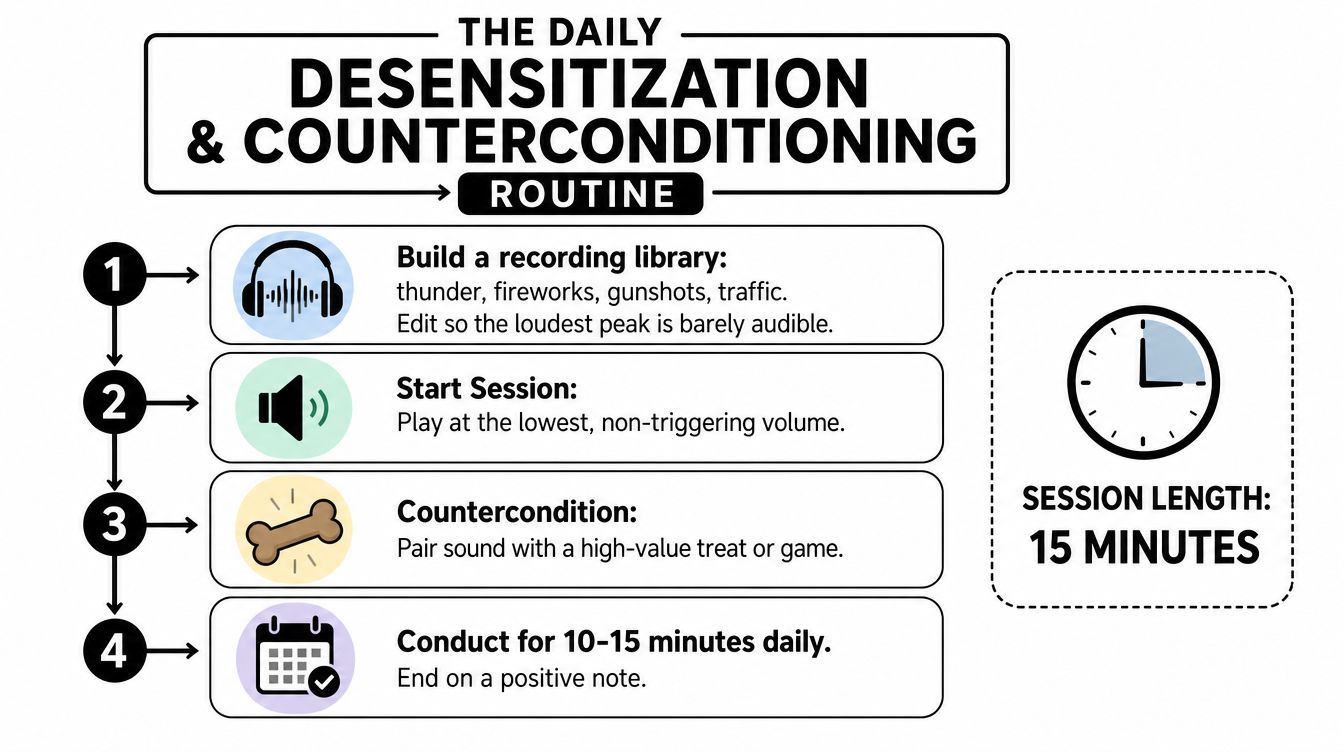
The core method is desensitization paired with counterconditioning. You present the sound below the dog's reaction threshold and immediately pair it with something valuable, usually food, play, or a preferred activity.
This approach only works when the starting point is very easy. The veterinary behavior literature describes a practical routine using very low-volume recordings, continuous food while the sound plays, and pauses of 15 to 60 seconds before resuming. In an expert review, the largest study of recorded-sound protocols reported 54.5% success, lower than counterconditioning to real-life noise and relaxation training. That result is a warning against treating recordings as a complete solution. Review the evidence and common protocol failures in this veterinary literature review.
Set up the session
Create a small recording library for the sounds that affect your dog, such as thunder, fireworks, gunshots, and traffic. Edit or select clips so the loudest peak starts at a level your dog doesn't notice as threatening. Test the volume while your dog is relaxed, not during a real storm.
Choose a reward your dog doesn't receive casually. Freeze-dried liver, small pieces of real meat, or another exceptionally motivating food can work. If your dog prefers activity, prepare a snuffle mat, stuffed Kong, chew, or short tug game.
Run the routine
- Start with the quietest sound. Play the recording at barely audible volume while your dog is relaxed.
- Pair sound with reward. Say a soft “yes” when your dog remains calm and deliver food within about one second. Keep feeding while the sound plays.
- Keep it brief. Run a session for 3 to 5 minutes, two or three times daily, even if your broader daily training window is around 15 minutes.
- Pause and reset. Stop the sound, allow 15 to 60 seconds of calm, then resume only if your dog remains comfortable.
- End before trouble. Finish while your dog is still relaxed, then return to an ordinary pleasant activity.
The sound must predict good things, not pressure. Don't ask for a formal sit while your dog is frightened. Let your dog sniff, chew, eat, or move naturally. A new emotional association matters more than a polished obedience performance.
The rule that governs everything is simple: the moment you see threshold signs, drop the volume immediately. If your dog breaks threshold, end the session, let the nervous system settle, and start at a much easier level the next day.
How to Progress Without Pushing Too Fast
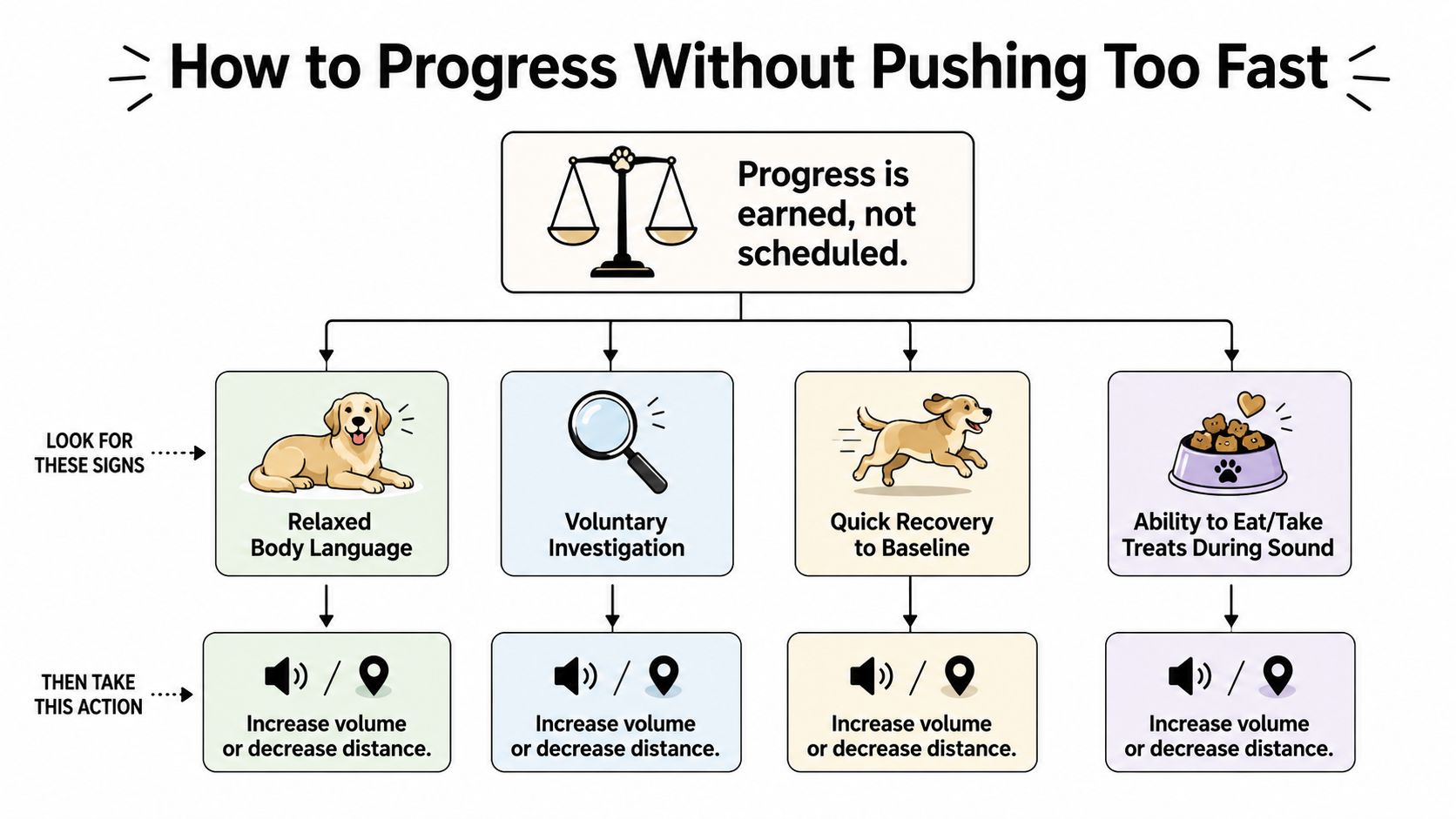
Progress is earned, not scheduled. Don't increase the volume because the calendar says it's time. Increase difficulty only after your dog shows relaxed body language, voluntarily investigates the sound, recovers quickly, and continues to eat while it plays.
A dog who briefly looks toward the speaker, chooses to investigate, and returns to a chew is demonstrating useful progress. A dog who stays perfectly still may be calm, but he may also be frozen. Look for flexible movement and ordinary behavior, not silence alone.
Use one change at a time
Hold a level until your dog responds reliably across several sessions and in at least a few different settings. Then change one variable only:
- Increase the volume slightly.
- Move the speaker closer.
- Extend the sound for a little longer.
- Introduce a different version of the same trigger.
- Add a mild environmental change.
The plan notes call for increases of roughly 10 to 20%, but treat that as an upper boundary, not a target. Many dogs need smaller changes. If you raise volume and move the speaker at the same time, you won't know which factor caused the setback.
Know when to step back
Startle, freezing, retreating, food refusal, scanning, panting, shaking, or slower recovery means you've crossed threshold. Stop the recording, give your dog space, and repeat an easier level in a shorter session.
Don't retreat permanently. Lower the challenge until your dog can succeed again, then rebuild. If performance is inconsistent, the level isn't predictable enough yet. Track the sound level, duration, setting, visible behavior, and recovery time.
Better progress looks boring. Your dog eats, investigates briefly, returns to normal activity, and recovers without a prolonged episode.
Only generalize after the sound itself is manageable. Change location, distance, window position, or background activity one at a time. Equipment choices should also support calm handling, not add pressure. Review guidance on selecting a dog training collar for metal hardware, but don't use equipment to force a fearful dog closer to a trigger.
Common Mistakes That Make Fear Worse
The most damaging mistake is increasing difficulty while the dog is already afraid. Owners often raise the volume because the dog “needs to get used to it,” but intense exposure can strengthen the association between the sound and danger.
Playing fireworks or thunder at full volume to test the dog is worse. It doesn't reveal useful training information. It confirms that the trigger is overwhelming.
Silence doesn't prove comfort
Some dogs stop reacting because they shut down, become exhausted, or learn that escape is impossible. A quiet dog may still have pinned ears, tense muscles, a fixed stare, shallow breathing, or delayed recovery.
Repeating a trigger until the dog stops moving is flooding, not thoughtful desensitization. Your standard should be relaxed behavior plus recovery, not the absence of noise from the dog.
Timing matters
The food should appear immediately before or as the sound begins, then continue briefly while the sound is present. If you wait until your dog is already trembling or hiding, the reward can't reliably change the emotional meaning of the trigger.
Comforting your dog isn't the problem. Calm reassurance can help, especially when paired with distance, a safe space, and predictable choices. Punishment, dragging the dog toward the noise, surprise recordings, and uncontrolled exposure during real storms are the problems.
| Mistake | Why It Can Worsen Fear | Better Response |
|---|---|---|
| Raising volume too quickly | The dog experiences the sound as a threat | Lower intensity and watch body language |
| Testing at full volume | It rehearses panic | Keep every practice exposure below threshold |
| Repeating until the dog goes quiet | Shutdown can look like calm | Check posture, movement, appetite, and recovery |
| Delivering food late | The dog may associate food with the aftermath, not the sound | Feed at the first sound or just before it |
| Using punishment or forced proximity | Fear becomes linked with the handler and trigger | Increase distance and offer choice |
| Running uncontrolled sessions during storms | Intensity and timing can't be managed | Use environmental management and veterinary guidance |
If two consecutive sessions produce marked stress or slower recovery, reduce the challenge. If the same pattern continues, stop experimenting and contact a qualified professional.
When Training Alone Is Not Enough
Training isn't a test of your commitment, and medication isn't a failure. Some dogs are too distressed to remain under threshold, especially during thunderstorms, fireworks, or unpredictable construction noise. In those cases, environmental management and veterinary support come before more exposure.
Seek veterinary advice when the fear is sudden, escalating, severe, or accompanied by aggression, destructive escape behavior, self-injury, panic, or complete shutdown. A veterinarian can assess pain, illness, sensory changes, and other contributors. Sudden fear in an older dog deserves particular attention because medical and cognitive changes can alter the behavior plan.
Add support when learning can't happen
Medication may lower background anxiety enough for a dog to eat, think, and learn during controlled training. It doesn't replace behavior modification, and you shouldn't give human medication or change a prescribed dose without veterinary direction.
Discuss the purpose of every intervention with your veterinarian. One treatment may target predictable firework events, while another may address broader anxiety. Supplements and calming products should be evaluated as supporting tools, not substitutes for diagnosis, management, and training.
Research and veterinary guidance describe noise fear as widespread and often connected with other behavior concerns. A UK survey found 49% of dogs showed some degree of fear of firework, thunder, or gunshot noises, while a large owner survey of 13,700 dogs identified noise sensitivity as the most common anxiety-related trait, appearing in almost one-third of dogs. Review the veterinary discussion of noise-related fear and intervention.
Choose help carefully
Hire a qualified professional if your dog growls, lunges, may bite, cannot avoid uncontrolled exposure, has separation-related distress, shows severe thunder or firework phobia, or makes no reliable improvement after several consistent weeks.
Look for a veterinarian specializing in behavior, a veterinary behaviorist, or a trainer who works under qualified behavioral and ethical guidance. Reject anyone who promises a quick cure, recommends flooding or intimidation, guarantees results, or uses punishment for fear.
A competent professional should review history, observe body language, identify threshold, provide a written plan, and coordinate with your veterinarian. Training can continue, but severe exposure should pause or reduce while the underlying risk is assessed.
Your First 30 Days at a Glance
Tomorrow, begin with preparation, not a loud test. Identify the sounds that trigger your dog, gather clean recordings, prepare high-value food, choose a quiet room, and record the relaxed baseline: loose muscles, normal breathing, ordinary movement, and willing eating.
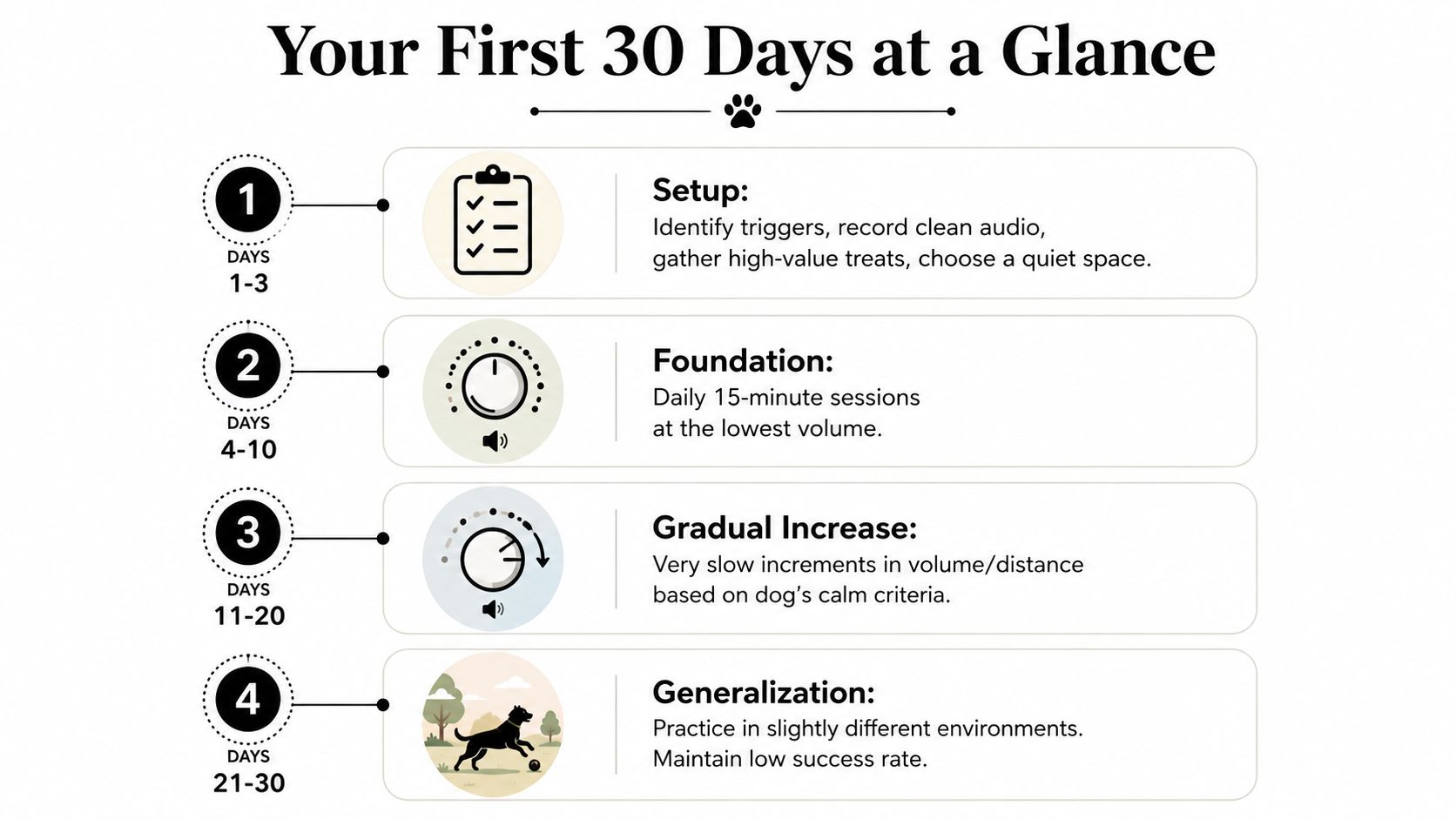
Days 1 through 3
Observe and prepare. Complete the trigger log, position the speaker, test the recording below the fear threshold, and set up a safe area where your dog can move away freely. This phase establishes control, not a training milestone.
Days 4 through 10
Pair the lowest sound level with food, play, or a chew. Keep sessions brief and stop while your dog remains relaxed. Record body language, eating, and recovery after every attempt. Refusal of food means the sound is too intense, or another issue needs attention. Lower the volume or stop.
Days 11 through 20
Add one mild change only after your dog handles the current level reliably. Adjust the volume slightly or change distance from the speaker, never both together. Progress when your dog eats, moves normally, and recovers promptly across repeated sessions. If fear appears, return to the last successful setting.
Days 21 through 30
Practice controlled generalization in a different room, at a modest distance change, or with a carefully selected recording variation. Do not recreate a full storm or fireworks display to test whether your dog is cured. Real-world exposure requires management, and severe fear may require veterinary support alongside training.
Progress is uneven. Repeated threshold breaches show that the plan is too difficult, not that your dog is stubborn. Log every session and reduce intensity after setbacks.
For owners who want a structured starting point, this guide on dog training for first-time owners can help build a foundation. PawCraft creates a personalized 30-day dog training plan based on your dog's age, breed, environment, and behavior challenges. Use it to organize exercises and progression criteria, while involving your veterinarian or a qualified behavior professional when fear is severe.