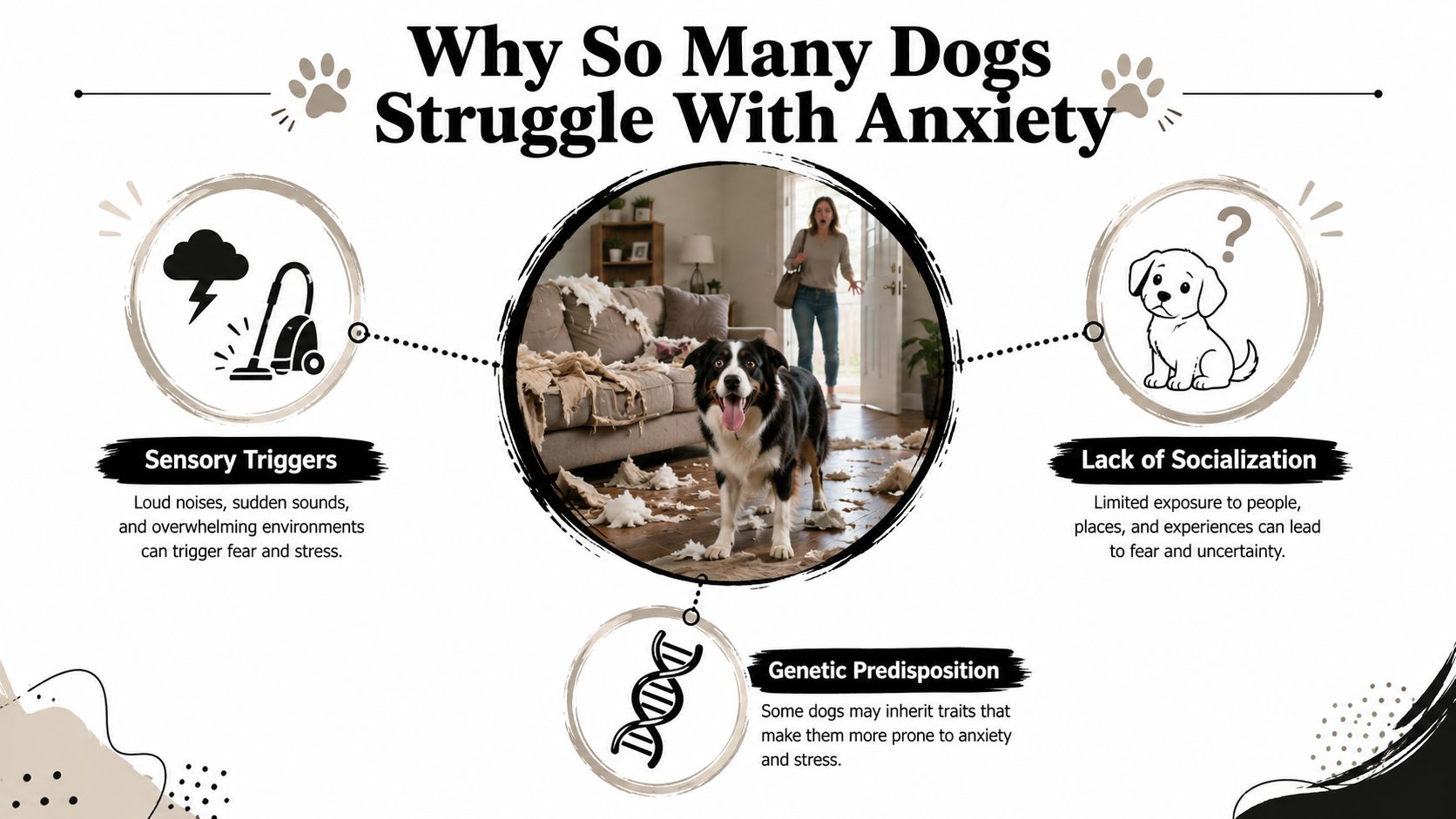
You come home to a shredded couch, a panting dog, and wide eyes that don't look anything like guilt. Or a storm rolls in and your normally confident companion trembles behind the toilet. In both cases, the behavior is communication. Your dog's nervous system has detected a threat, real or perceived, and is trying to create safety.
The fastest way to waste time is to use a generic “calm down” checklist without identifying the trigger first. Triage the anxiety, lower the dog's daily stress load, then add carefully measured behavior work. That order matters because a separation-anxious dog, a noise-sensitive dog, and a dog that panics around strangers need different starting points.
Why So Many Dogs Struggle With Anxiety
Anxiety isn't rare, and it isn't limited to one breed, age, or household. In a large study of 13,700 Finnish pet dogs, 72.5% showed at least one anxiety-related behavior, with noise sensitivity affecting 32%, general fearfulness 29%, separation-related behavior 5%, and aggression 14%. The study is useful because it shows that anxious behavior is a widespread pattern, not an edge case involving only unusually difficult dogs. The Finnish canine anxiety study also identified fear of other dogs, strangers, and novel situations as common patterns.
Start with the trigger, not the symptom
Most anxious dogs fit one or more recognizable categories:
- Separation-related distress: The dog becomes distressed when a particular person leaves or when the household empties. Destruction, vocalizing, pacing, and escape attempts often appear around departures.
- Noise and environmental phobias: Thunder, fireworks, construction, alarms, or vacuum cleaners can cause an abrupt flight response.
- Social or stranger reactivity: An unfamiliar person or dog triggers barking, lunging, freezing, or hiding. Fear can look aggressive, but the emotional driver may be avoidance.
- Generalized anxiety: The dog stays on edge across ordinary situations, with restless movement, scanning, lip licking, or difficulty settling.
Genetics, limited early socialization, unpleasant experiences, chronic under-enrichment, and an unpredictable home can all contribute. Modern companion dogs may also face long periods indoors, frequent building noise, crowded sidewalks, and changing schedules. Those factors don't create every anxiety problem, but they can keep an already sensitive dog close to threshold.
Practical rule: Treat the behavior as information. A dog that destroys a door only when left alone needs a different plan from a dog that trembles whenever the sky changes.
Punishment usually adds another threat to an already overloaded nervous system. If you're considering equipment, understand its purpose and limitations before using it. This guide to metal dog training collars may help you compare equipment, but aversive handling shouldn't be your anxiety protocol.
The correct sequence is straightforward: identify the anxiety profile first, reduce avoidable triggers and daily arousal second, then train below threshold. Randomly adding treats, longer walks, or a calming bed won't fix a mismatch between the problem and the protocol.
Identifying Your Dog's Anxiety Type
Before choosing an exercise, record three things: what happened immediately before the behavior, how quickly the behavior appeared, and how your dog's body looked. A tucked tail and escape attempt point in a different direction from frantic pacing that begins only after departure cues.
The wider owner-reported picture reinforces this need for careful observation. In Dog Aging Project data, 91.0% of dogs received at least one mild or moderate fear or anxiety rating across nine situations, including unfamiliar people, unfamiliar dogs, novel situations or noise, and grooming. The research is summarized in this report on everyday canine fear and anxiety. Those figures don't diagnose your individual dog, but they do show why anxiety should be assessed by context rather than treated as one broad condition.
Four profiles that change the treatment plan
Separation-related anxiety appears around absence, not merely because your dog is energetic. Watch for destruction near exits, persistent vocalization, elimination, or frantic behavior shortly after you leave. A camera is more useful than guessing from the condition of the house because it shows the sequence and duration of the response.
Noise sensitivity tends to be sudden and intense. Thunder, fireworks, building work, or a smoke alarm may produce trembling, hiding, panting, escape behavior, or attempts to follow you from room to room. Noise sensitivity was the most common anxiety-related trait in the Finnish study, affecting 32% of dogs. The published study record also links fear with other behavior patterns, so don't assume the sound is the only issue.
Social or stranger reactivity can involve barking, lunging, freezing, or retreating when unfamiliar people or dogs appear. The dog may be trying to increase distance, not start a confrontation. Forcing greetings often removes the dog's ability to escape and can intensify the response.
Generalized anxiety has no single obvious trigger. The dog may pace, scan, lick its lips, show whale eye, startle easily, or struggle to rest even in familiar surroundings. Genetics and early experience can influence this profile, but a sudden change still deserves medical consideration.
| Anxiety Profile | Trigger Context | Classic Signs | Common Misread As |
|---|---|---|---|
| Separation-related anxiety | Owner leaves or prepares to leave | Exit destruction, vocalization, elimination, escape attempts | Disobedience or boredom |
| Noise sensitivity | Thunder, fireworks, alarms, construction | Trembling, hiding, panting, flight behavior | Drama or attention-seeking |
| Social or stranger reactivity | Unfamiliar people or dogs | Barking, lunging, freezing, retreating | Dominance or automatic aggression |
| Generalized anxiety | Multiple ordinary situations | Pacing, scanning, lip licking, poor settling | Excess energy or stubbornness |
Once you know the profile, you can choose the right protocol. The same “calming” exercise cannot address a dog whose panic begins at the sound of keys and a dog whose fear begins when a stranger enters the elevator.
Calming Your Dog in the Moment
During full panic, your dog isn't ready to learn a new cue. The immediate job is de-escalation, not obedience. Reduce the intensity of the situation before you ask for any behavior.
Start by lowering sensory input. Move to a quieter room, close blinds, dim the lights, and use a fan or low-volume white noise to soften unpredictable sounds. For a dog frightened by visitors, create distance behind a gate or closed door rather than allowing repeated approaches.
Your own body matters. Turn slightly sideways, keep your movements slow, loosen your shoulders, and breathe steadily. Reassurance isn't harmful by itself, but frantic petting, repeated commands, or a high, urgent voice can keep the scene emotionally charged.

Give the nervous system a safer job
Offer an option, not a demand:
- A familiar retreat: A crate covered with a blanket can help if your dog already chooses it and doesn't feel trapped.
- A grounding activity: A frozen lick mat or familiar food toy gives the dog a repetitive task, provided the dog can safely use it.
- Gentle pressure: Some dogs settle with a well-fitted wrap. Remove it if your dog resists, pants harder, freezes, or tries to escape.
- Your proximity: Sit nearby and let the dog decide whether to approach. Don't pull the dog toward you or hold it in place.
Read the body, not just the noise. Tucked ears, a tucked tail, whale eye, lip licking, crouching, and heavy panting indicate continuing stress. Relaxed ears, soft eyes, a loose mouth, normal movement, and voluntary settling suggest recovery.
Trying to train through panic teaches the dog that the frightening event continues while it is trapped. Create safety first, then train later when the nervous system can process information.
Never force a fearful dog to greet a person, enter a room, or remain beside a trigger. Your immediate success criterion is not silence. It's a lower intensity response and a faster return toward normal behavior.
Training Exercises That Build Long-Term Calm
Long-term change comes from controlling the dose of the trigger. The sequence is find threshold, desensitize, countercondition, then build confidence through enrichment. Reversing that order or increasing exposure too quickly is how owners accidentally rehearse panic.
Find the working distance
Threshold is the point at which your dog notices the trigger but can still think. Look for a loose body, soft mouth, normal movement, and the ability to take food. If your dog lip licks, turns its head away, shows whale eye, freezes, or refuses food, increase distance or lower the trigger intensity.
Begin with five to ten minutes, using two to three short sessions per day. End while your dog is still successful, not after the dog has lost control.
Pair the trigger with something valuable
With desensitization, present the trigger at a low level. For a dog worried about other dogs, that may mean seeing a calm dog far away. For a noise-sensitive dog, it may mean a very quiet recording played behind a door.
The instant your dog notices the trigger, deliver a high-value treat. Use a consistent marker word if it helps your timing. Remove or soften the trigger, allow recovery, and repeat. Build calm duration before increasing proximity, volume, movement, or unpredictability.
Counterconditioning is the emotional layer. You're not merely teaching the dog to remain in position. You're changing what the trigger predicts: trigger appears, excellent food arrives, then the trigger disappears. That association must remain below the dog's panic threshold.
Add confidence work between sessions
Use enrichment to lower the amount of unused arousal your dog carries into training:
- Scatter feeding: Toss part of a meal across grass, a snuffle mat, or a safe room and let your dog search at its own pace.
- Decompression walks: Choose a quiet route, loosen the schedule, and allow sniffing without constant commands or greetings.
- Simple problem-solving: Offer a puzzle feeder your dog can complete without frustration.
For adult dogs, structured practice can fit alongside a broader dog training plan for adult dogs. Keep progression conservative. If food disappears from the dog's priorities, the session has become too difficult.
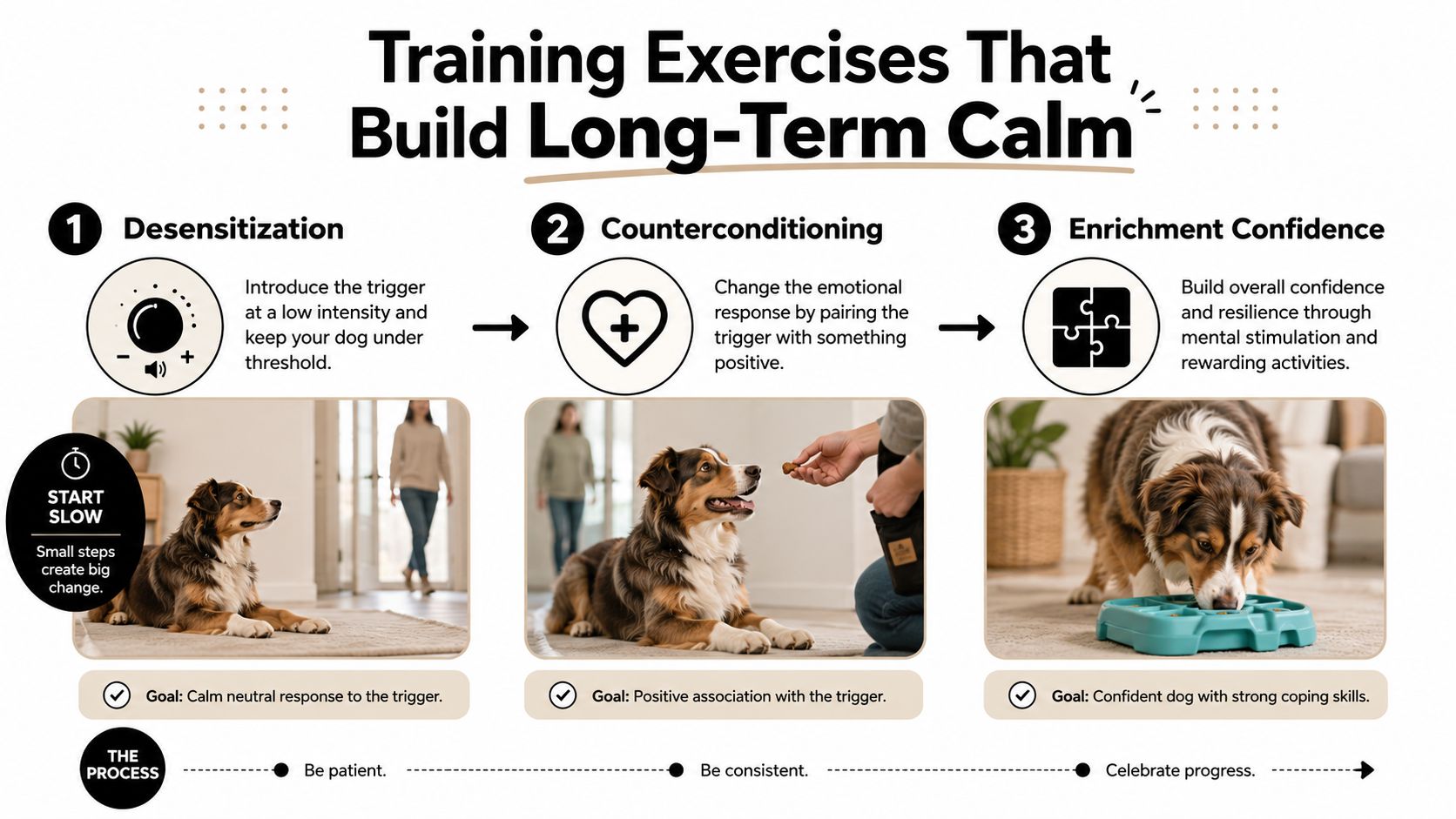
The protocol is demanding because it asks you to measure intensity rather than rely on hope. A review of separation-related anxiety identifies systematic desensitization and counterconditioning as the core approach, with departures beginning so briefly that the dog remains below threshold. The clinical review of separation-related problems also warns against long practice absences that allow panic to repeat.
Environment and Daily Routine That Lower Stress
Training works better when the dog isn't spending the rest of the day absorbing preventable stress. Build the home around four levers: predictability, sound, sight, and recovery space.
Keep wake-up, meals, walks, rest, and bedtime broadly predictable. You don't need to run the household like a military schedule, but repeated cues help an uncertain dog anticipate what happens next. Feed after the same routine, use consistent departure signals, and avoid turning arrivals and departures into emotional events.
Set up recovery before the next episode
Create a retreat in a quiet, low-traffic area. Use bedding, familiar scent, water, and safe enrichment that your dog has already used successfully. A retreat works only when the dog can choose it, so don't drag the dog there as punishment or shut the dog inside during a crisis without prior conditioning.
Match each adjustment to the trigger:
- Sound: Close windows, use a fan, and add low-volume background noise.
- Sight: Use blinds or window film when passing people, dogs, or vehicles trigger barking.
- Scent and association: A dog pheromone diffuser may support the recovery area, but it should complement training rather than replace it.
- Predictability: Use the same calm sequence before guests arrive, grooming, car travel, or alone time.
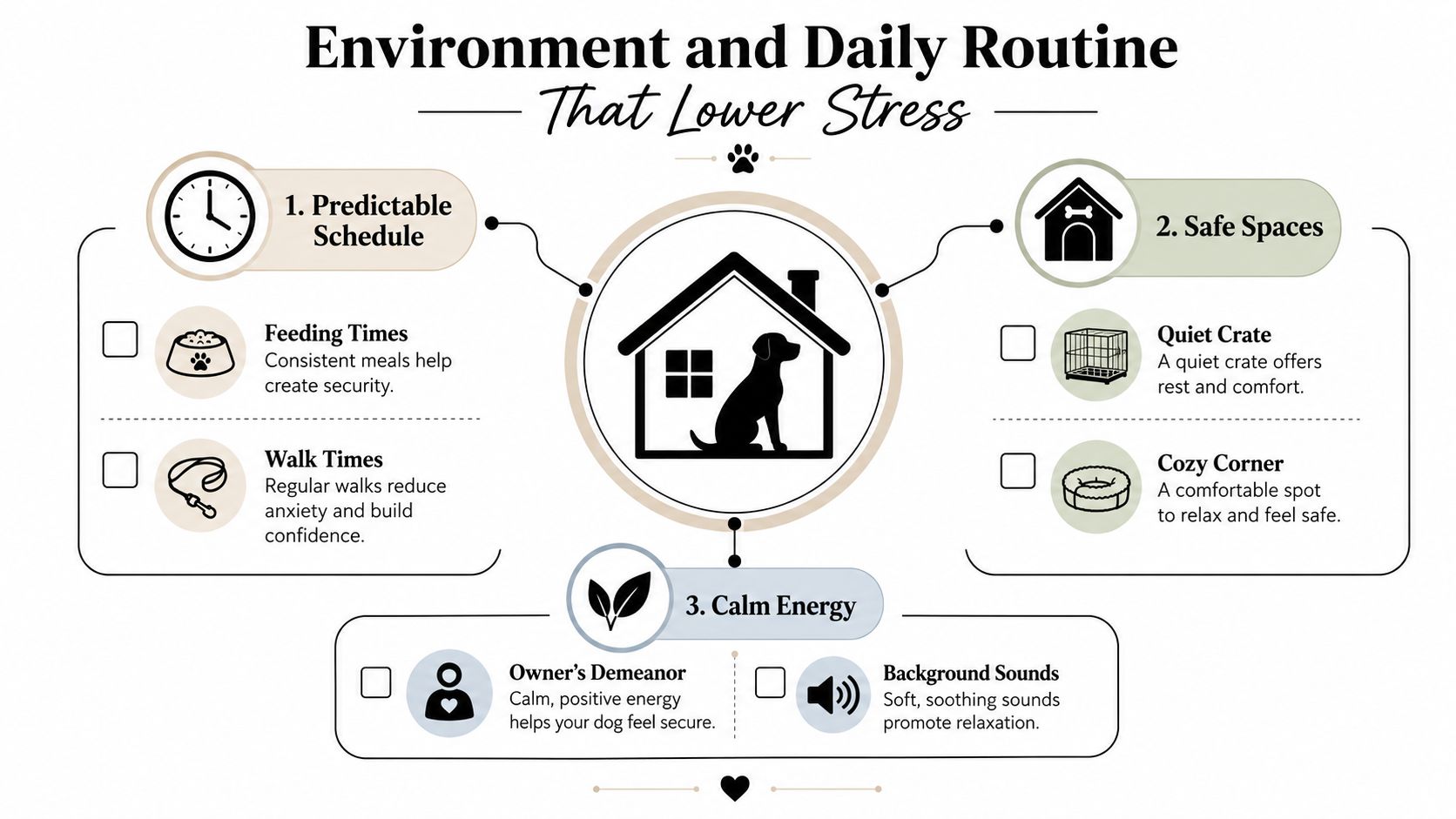
Household behavior can either stabilize or disrupt the plan. Don't punish barking that comes from fear, ambush the dog with guests, or repeatedly rehearse departure cues that predict a long absence. Practice picking up keys, putting on shoes, and sitting back down so those cues lose their power, then reserve true departures for durations your dog can handle.
A consistent routine won't cure a severe phobia. It does remove background uncertainty, which gives desensitization a better chance of working. The aim is not a perfectly quiet home. It's a home where the dog has predictable options when something feels unsafe.
When to Call Your Vet or a Behaviorist
Anxiety-like behavior can have a medical cause. Pain, hormonal disease, gastrointestinal distress, heart rhythm problems, neurological changes, and cognitive decline in older dogs can all alter restlessness, attachment, appetite, or tolerance. A previously stable adult dog that suddenly begins pacing, panting, hiding, or reacting deserves a veterinary assessment before you assume the problem is purely behavioral.
Call promptly when the pattern escalates without an obvious new trigger, your dog injures itself by licking or biting, or appetite changes persist. Food refusal, repeated escape attempts, and inability to sleep also raise the urgency, especially when they appear with physical changes.
Use the right professional
A qualified trainer can help with threshold work, handling, enrichment, and household routines. A veterinary behaviorist is the better fit when anxiety is severe, safety is uncertain, medication may be appropriate, or medical and behavioral factors overlap. Seek specialized support for major separation distress with property destruction, bite risk, conflict between dogs, or a dog that cannot remain under threshold even with careful management.
| Sign or Situation | Handle at Home | Call a Professional |
|---|---|---|
| Mild trigger response with recovery | Reduce intensity and log patterns | Call if the response becomes more frequent |
| Fear around known sounds or sights | Manage exposure and work below threshold | Seek help if escape or self-injury appears |
| Destruction during absence | Use a camera and avoid panic rehearsal | Contact a behavior professional for severe distress |
| Sudden anxiety in an adult or senior dog | Keep the environment quiet while arranging care | Book a veterinary examination |
| Barking or lunging around people or dogs | Increase distance and prevent forced greetings | Get help when there is bite risk or poor control |
| Appetite, sleep, movement, or toileting changes | Note the timing and associated signs | Ask your vet to rule out medical causes |
When calling the clinic, be precise: “My dog's behavior changed suddenly,” “the response begins after this trigger,” “my dog is attempting to escape,” or “my dog has stopped eating.” Describe frequency, duration, body language, recent household changes, medications, and any injury. Clear information helps the team triage the appointment and identify whether medical testing, behavior support, or both should come first.
Your 30-Day Calming Plan With Troubleshooting
A useful plan measures behavior instead of relying on whether the week felt better. Track recovery time, voluntary settling, distance from the trigger, food acceptance, and calm minutes in a crate or retreat. These measures show small gains that can disappear inside a stressful day.
Week one, observe and reduce pressure
Record every episode, including the trigger, starting intensity, body language, duration, and recovery. Set up the retreat, block predictable visual or sound triggers, remove punishment, and use a camera for suspected separation distress. Don't begin difficult exposure work yet. Your first checkpoint is a clearer pattern and fewer avoidable rehearsals.
Week two, build a calmer baseline
Add daily scatter feeding, quiet sniffing, decompression walks, and short reward-based sessions. Practice calm household routines, including low-key departures and arrivals. Teach the dog that the retreat is available without forcing it. Look for more voluntary settling and easier recovery after ordinary disturbances.
Week three, introduce controlled exposure
Choose one trigger and identify the working threshold. Run five to ten minute sessions two to three times daily, presenting the trigger at a low intensity and pairing it with food. Stop at lip licking, whale eye, head turning, freezing, or food refusal. Progress only when your dog can repeatedly notice the trigger and remain loose.
Use a written dog behavior modification plan if you struggle to keep the sequence consistent. A written protocol makes it easier for every household member to use the same distance, marker, reward, and stopping point.
Week four, generalize without rushing
Practice in a second room, on a quieter route, or with a carefully selected helper. Change one variable at a time. If your dog succeeds at home but reacts outside, that isn't failure. The environment may be more intense, so return to an easier starting point.
| Problem | First adjustment |
|---|---|
| Symptoms worsen | Pause exposure, increase distance, and review medical or environmental changes |
| The owner misses sessions | Shorten the routine and assign one clear daily responsibility |
| Another dog interferes | Train separately and manage visual access |
| An adolescent regresses | Return to an earlier successful step instead of forcing maturity |
| Progress plateaus | Change one variable, review threshold, and seek professional feedback |
Pause when stress signals appear repeatedly or recovery takes longer. Push forward only when the dog remains able to eat, move normally, and disengage from the trigger. The behavior-modification dataset summarized by the Center for Canine Behavior Studies found that 64% of 1,308 dogs with fear or anxiety problems improved overall, while 17% showed no change and 19% worsened. The result is a useful reminder that structured work needs monitoring, not blind persistence.
After the first month, maintain the easiest successful exercises while gradually testing real-life variation. Over the next 60 to 90 days, keep logging triggers, recovery, and settling, schedule refreshers, and reduce management only when the dog demonstrates reliable coping. Progress is layered rather than linear. A bad storm, illness, move, or adolescent change can require a temporary step backward.
PawCraft creates a personalized 30-day dog training program based on your dog's breed, age, environment, and behavior challenges, including practical daily exercises and progress criteria. If you need a clearer sequence for anxiety, reactivity, or separation-related work, visit PawCraft and complete the brief questionnaire to receive a plan by email.