Most effective dog training sessions run 3 to 10 minutes, with puppies often capped at 5 minutes and adults sometimes stretching to 15 minutes. For most dogs, 3 to 5 short sessions per day works better than one long session because attention fades and repetition quality drops.
If you're asking how long should dog training sessions be, you're probably already seeing the problem. Your puppy started strong, then wandered off to sniff a chair leg. Or your adolescent dog gave you three nice sits, then hit minute ten and acted like he'd never heard his name before.
That doesn't mean your dog is stubborn, untrainable, or trying to ignore you. It usually means the session went on too long for the job you were asking your dog to do. Good training isn't about squeezing in more minutes. It's about ending while your dog is still focused, motivated, and getting things right.
Most articles stop at a single time range. That's only half useful. Session length shouldn't be based only on age. It should change based on what you're teaching, how much energy your dog brings to the session, and whether your dog is showing signs of mental fatigue. A puppy learning name recognition, an adult polishing leash manners, and a reactive dog working around triggers should not all train on the same clock.
Why Short Sessions Beat Long Ones
A lot of first sessions look the same. You kneel on the kitchen floor with treats, ask for sit, get a few wins, then your dog starts scratching, looking away, or drifting toward the dishwasher. Owners often think, "He needs more practice." Usually, he needs less time at once.
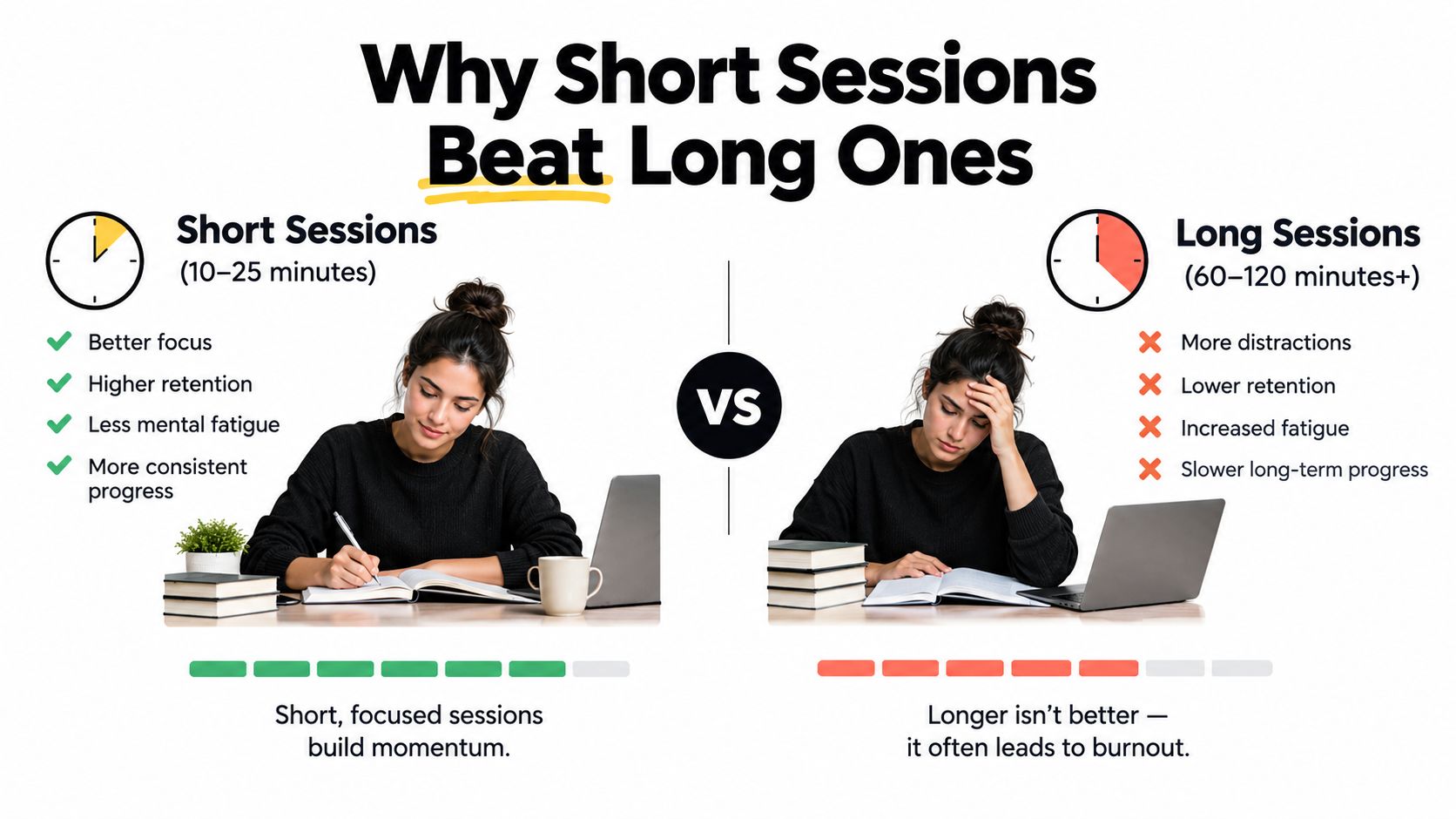
Short sessions work because dogs burn through attention, working memory, and motivation quickly. When those drop, learning quality drops too. The dog may still be moving, but the useful part of the session is over.
What the research supports
A 2021 peer-reviewed dog training study used sessions with a maximum duration of 10 minutes and allowed up to six sessions per day, with shorter durations producing better learning outcomes than longer ones, as summarized in this review of the study. That's a practical takeaway for pet owners. Dogs often learn better in repeated short blocks than in one long lesson.
That matters in daily life. If you spend one long weekend session drilling loose-leash walking, your dog may start making sloppy choices before the session ends. If you instead do several short reps across the day, you catch more good moments and avoid rehearsing mistakes.
What this looks like at home
Think about these two patterns:
- One long session: You practice down, stay, touch, and leash walking in a single stretch until your dog loses interest.
- Several short sessions: You do a few clean reps before breakfast, a tiny recall game at lunch, and a settle exercise in the evening.
The second pattern usually gives you sharper responses because each block ends before frustration builds.
Practical rule: Stop while your dog still wants one more rep. That's usually the sweet spot.
Short-and-often also makes training easier for humans. You don't need a perfect schedule or a dedicated "training hour." You need a handful of focused moments where your dog can still think clearly.
The 3 to 15 Minute Evidence Window
A useful training session often ends sooner than new owners expect. The practical range usually falls between 3 and 15 minutes, with the shorter end working best for puppies, brand-new skills, and busy environments, and the longer end fitting adult dogs who are rehearsing something familiar, according to this roundup of training and veterinary guidance.
That range is a window, not a prescription.
A 3-minute session works like a quick, clean set at the gym. You stop while form is still good. For dogs, that matters because the first few repetitions are often the sharpest. If you are teaching a puppy to respond to their name in the kitchen while the dishwasher hums and someone walks by, three focused minutes can beat twelve sloppy ones.
A 5-minute session is the common sweet spot for many pet dogs learning something new at home. You have enough time for several successful repetitions, a brief reset or two, and a calm finish before guessing, sniffing, or bouncing around starts replacing real learning. As discussed in this summary of APDT guidance, about 3 minutes is enough for many dogs, and longer practice tends to fit dogs with more experience.
Longer does have a place. It just has to match the job.
A 10-minute session often suits an adult dog practicing a skill they already understand, such as waiting at the door or walking politely for part of a quiet block. A 15-minute session is usually the upper edge, not the goal. It can work for an experienced dog in a calm setting, especially if you are polishing known behaviors instead of teaching from scratch.
That is the part many articles miss. Session length should change with the task. Teaching "down" for the first time, proofing recall around squirrels, and reviewing a well-known sit are three different mental workloads, even if the dog is the same age.
| Window | Best For | Example Scenario |
|---|---|---|
| 3 minutes | Puppies, distractions, first steps of a new skill | Practicing name response before your puppy wanders off |
| 5 minutes | New behaviors for many pet dogs | Teaching recall games in the yard with a few clean reps |
| 10 minutes | Adult dogs rehearsing known skills | Practicing loose-leash walking on a quiet street |
| 15 minutes | Experienced adult dogs working on familiar material | Running through several obedience skills with brief pauses |
A simple way to use this window at home is to pick the time based on the difficulty of the exercise, then shorten it again if your dog is highly excited, tired, or easily distracted. Many dogs do well with several short sessions across the day rather than one long block. That gives you more chances to reward good choices while the dog is still thinking clearly.
Past 15 minutes, progress often drops. You are usually collecting tired repetitions, not better ones.
Adjusting Session Length by Age, Breed, and Energy
Age matters, but it isn't the whole story. A sleepy senior Bulldog and a young Border Collie don't use their energy the same way. Session length should flex with both life stage and working style.
Start with age, then adjust for the dog in front of you
Puppies usually need the shortest blocks. Even bright, eager puppies hit a wall fast because self-control and focus are still developing. In a noisy apartment, a puppy may mentally check out well before the owner expects it.
Adolescents are tricky. They often look physically capable of longer work, but their brains can swing between sharp focus and total nonsense. Many can handle medium-length practice on known skills, then need much shorter windows when learning something new.
Adults in their prime often give you the widest usable range. Seniors usually benefit from dropping back down to shorter, gentler sessions, especially if stiffness, sensory changes, or slower recovery show up.
Breed energy changes the usable range
A high-drive herding or sporting dog may stay eager longer, but that doesn't mean you should turn every session into a marathon. Those dogs often do best when you use their enthusiasm in controlled chunks. Low-energy giant breeds, brachycephalic dogs, and dogs that heat up quickly often need shorter, calmer reps even if they're willing to keep going.
| Life Stage | Low Energy Breed | Medium Energy Breed | High Energy Breed |
|---|---|---|---|
| Puppy | Very short sessions with frequent pauses | Short sessions with simple goals | Short sessions with more structure and movement breaks |
| Adolescent | Brief practice on known skills | Moderate sessions if focus is steady | Moderate sessions, but shorten for new concepts |
| Adult | Short to moderate sessions | Moderate sessions for most home training | Moderate to longer sessions for familiar work |
| Senior | Short, low-impact practice | Short sessions with extra rest | Short sessions with careful pacing |
A few practical adjustments matter more than breed labels alone:
- Lower the time in busy places. A dog who can focus in the kitchen may struggle in the hallway, elevator area, or front sidewalk.
- Shorten sessions in heat or after hard exercise. Physical fatigue and mental fatigue pile up fast.
- Cut time if pain might be part of the picture. If a normally engaged dog suddenly slows down, stiffness or discomfort may be affecting performance.
If you want a more personalized way to think about timing, PawCraft's article on training timing by dog and context is useful because it frames timing as a planning decision instead of a fixed rule.
Matching Duration to the Exercise You Are Teaching
Most owners get stuck. They hear one number and try to use it for everything. But the right answer to how long should dog training sessions be depends heavily on the exercise itself.
A useful way to think about it is task-based timing. Research on dog learning has pointed to a gap in one-size-fits-all advice. The better framing is that session length should change by training goal, with shorter durations tending to outperform longer ones, while the ideal setup depends on the outcome being trained, as discussed in this research summary on training duration and learning in dogs.
Four common training jobs, four different clocks
Obedience drills like sit, down, stay, and loose-leash walking often work best in short, repetitive blocks. The dog is doing many reps, and reward timing matters.
Recall usually needs even tighter pacing. Distance, movement, and distractions all add difficulty fast, so quality drops if you drag it out.
Impulse control can sometimes run a little longer because the dog is practicing steadiness rather than rapid-fire movement, but it still needs breaks before frustration builds.
Behavior modification work, like reactivity, fear, or over-arousal practice, is often the shortest of all. The goal isn't to push through. The goal is to stay under the dog's threshold and leave before stress takes over.
| Exercise Type | Ideal Duration | Target Reps | Best Reinforcement |
|---|---|---|---|
| Obedience | Short blocks | Several clean repetitions before interest fades | Food rewards, praise, simple resets |
| Recall | Very short bursts | A handful of high-quality recalls | Food, toys, chase games, release to sniff |
| Impulse control | Short to moderate blocks | Fewer, steadier reps with pauses | Food, access to the real-life reward |
| Behavior modification | Ultra-short exposures | Minimal reps, heavy emphasis on staying calm | Distance, food, safety, environment control |
Do this, not that
- For recall: Do a few exciting reps, then stop. Don't call your dog over and over until the cue gets dull.
- For leash walking: Practice in tiny sections of the walk. Don't wait until your dog is already pulling hard and over-aroused.
- For door manners: Build short pauses with a clear release. Don't keep your dog in a long frozen wait just because they got the first few seconds right.
- For reactivity work: End while your dog is still able to eat and think. Don't stay near the trigger until barking starts.
A training session should match the dog's learning job, not your stopwatch.
Reading Your Dog for Fatigue and Overload
Owners often ask for the perfect number of minutes when the dog is already giving the answer with body language. The skill is noticing the moment when learning starts to slide.
This visual checklist helps spot the pattern faster.
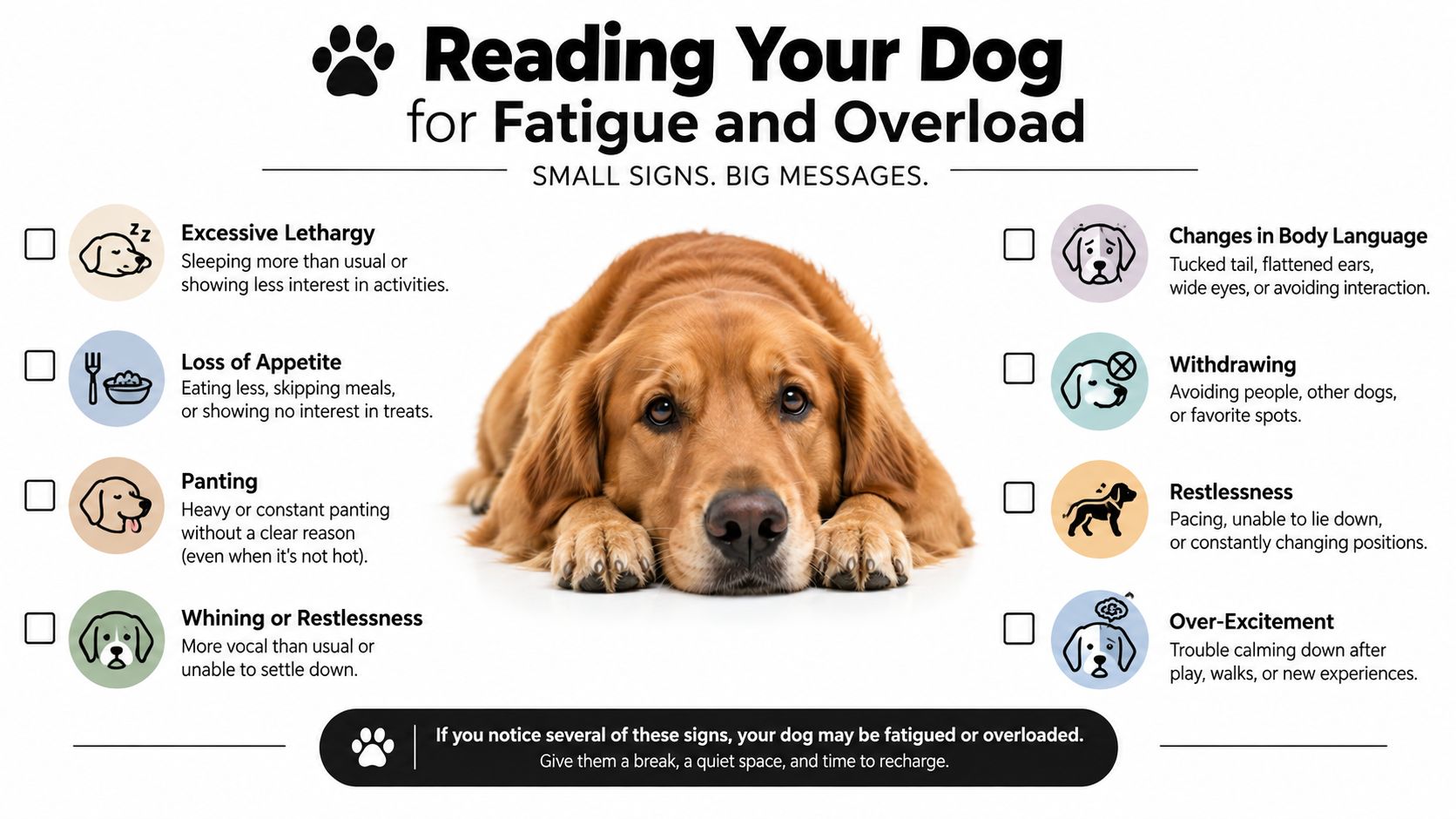
Yellow flags and red flags
Yellow flags mean slow down. Red flags mean stop.
- Yellow flags: Slower responses, sniffing the floor, scratching, yawning, blinking more, looking away between reps
- Red flags: Barking at you, biting the leash, jumping on you, zooming, shutting down, walking off completely
If you see yellow flags, make the next rep easier or end on a simple win. If you see red flags, the session is done.
A simple stop-now rule
If your dog offers two wrong behaviors in a row, don't keep pushing for one more perfect repetition. Ask for something easy your dog knows well, reward it, and end there. That prevents the common spiral where both dog and handler get more frustrated with each rep.
A quick reset video can help if you're still learning what stress signals look like in motion.
Use a body scan between mini sessions
Between short practice blocks, take a few seconds to check:
- Eyes and face: Soft and engaged, or hard and darting?
- Movement: Springy and thoughtful, or frantic and sloppy?
- Interest in rewards: Taking food easily, or spitting it out and scanning?
If you're unsure what those signals mean, this guide to understanding dog body language is a good companion to your training plan.
End sessions based on the dog in front of you, not on the timer you set five minutes ago.
Micro-Session Strategies for Busy Owners
Busy owners often think training only counts if they set aside a formal block. It doesn't. Some of the most effective practice happens in tiny pockets of the day.
Micro-sessions work because they fit naturally into routines your dog already notices. Meals, doors, leash clips, elevator waits, and couch time are all built-in training moments.
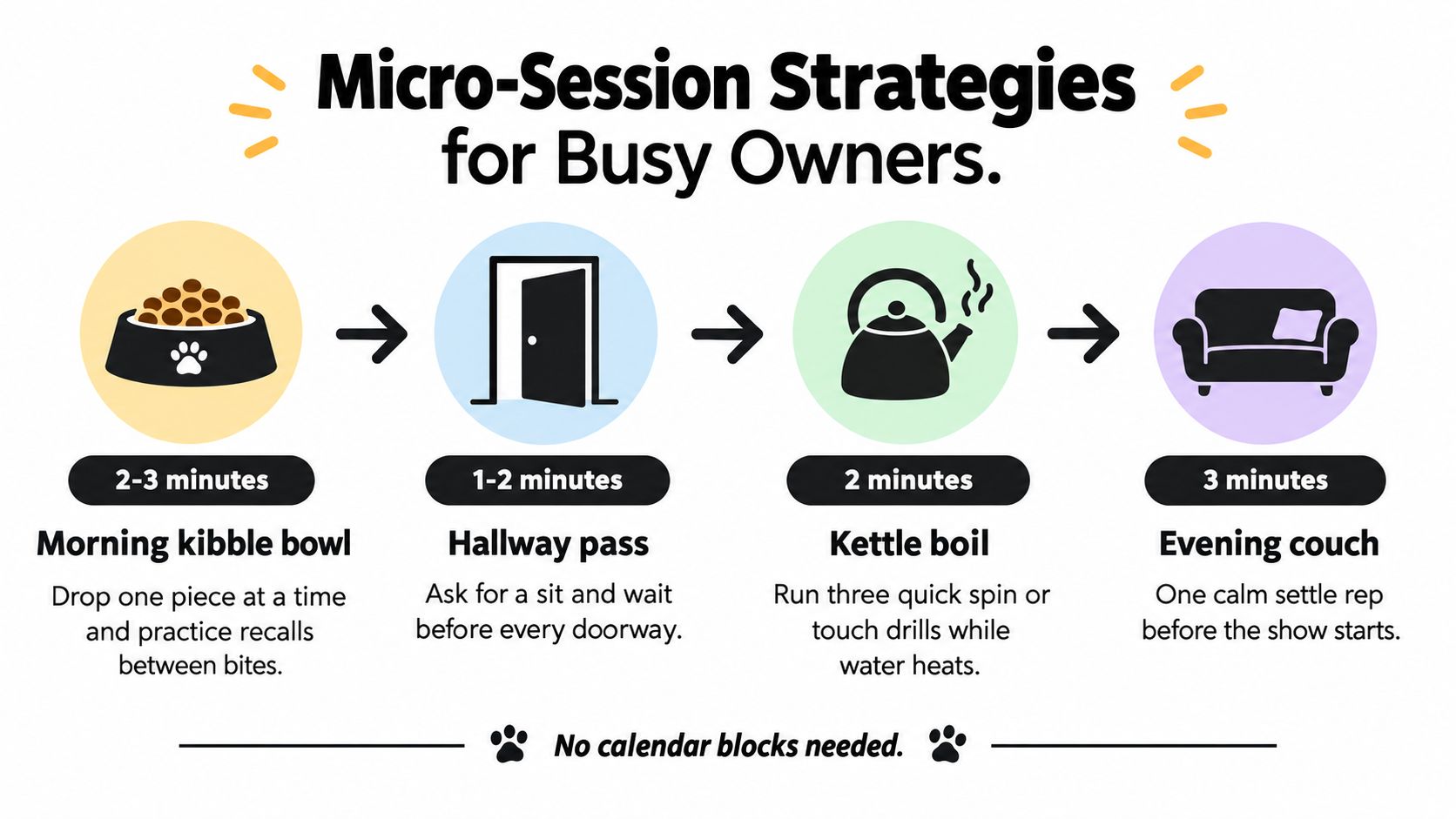
Routine anchors that work
Try attaching a tiny lesson to something you already do every day:
- Breakfast bowl: Ask for a recall or name response before each small handful of kibble goes down.
- Hallway exit: Practice sit and wait before the leash goes on or the apartment door opens.
- Coffee or kettle time: Run a fast touch, spin, or hand-target game while you wait.
- Evening settle: Reward one calm mat or bed behavior before you sit down.
These moments are short by design. That's the point. You don't need a perfect fifteen-minute lesson to make progress.
The rule of three easy wins
End each micro-session on three easy successes. That might mean three quick name turns, three sits, or three calm leash clips. You're building a clean last memory, not squeezing out every possible rep.
A few common mistakes make micro-sessions less useful:
- Training right after high arousal: Don't wedge a precision session between fetch and the front door.
- Drilling one cue all day: Rotate skills so your dog doesn't tune out repeated asks.
- Waiting for a "better time": A calm minute is enough. Consistency beats ideal conditions.
A good daily rhythm might use one short recall game, one doorway routine, one leash skill, and one settle exercise. That's more realistic for most homes than trying to do a single big evening session when both you and your dog are tired.
Sample Schedules and Quick Answers
The easiest plan is the one you'll repeat. Short sessions work best when they already fit your day, so here are two simple models you can steal and adjust.
A weekday plan for a working owner
This version spreads training across normal transition points instead of asking for one dedicated block.
| Day & Time | Session Length | Exercise Type | Goal |
|---|---|---|---|
| Monday morning | Short | Recall | Fast name response before breakfast |
| Monday midday | Short | Obedience | Sit, down, touch in a calm room |
| Monday after work | Short | Leash skills | Start the walk with loose leash focus |
| Monday evening | Short | Impulse control | Wait at doors or before food |
| Monday pre-bed | Short | Settle work | Calm mat behavior before lights out |
| Weekend outing | Moderate | Socialization and leash skills | Practice calm engagement in a new environment |
That basic pattern can repeat through the week with different skills rotated in. If you're raising a young dog, this sample puppy training schedule by age can help you match the day's plan to your dog's stage.
A weekend version with more breathing room
On weekends, many owners accidentally overdo it because they finally have time. Keep the structure, just add a little variety. You might do a few short home sessions plus one slightly longer socialization walk where the goal is calm observation, not nonstop cue practice.
That longer outing still shouldn't feel like a marathon lesson. Let your dog sniff, decompress, and process the environment.
Short sessions during the week plus one thoughtfully planned weekend outing usually beats a giant Saturday drill session.
Quick answers to common edge cases
What if I miss a day?
Just restart the next day. Don't try to "make up" missed training with one huge session.
Can I train two dogs together?
You can for easy known skills, but new learning is usually cleaner one dog at a time. Group work adds distraction and waiting.
What about adolescent regression?
Shorten the session and lower the difficulty. Teenage dogs often need easier wins, not longer lectures.
Do puppies need training every day?
Frequent routine-based practice helps because puppies learn from repetition and timing. Keep it brief and positive.
When should I shorten or lengthen a session on the fly?
Shorten it if responses slow, arousal rises, or your dog starts guessing. Lengthen only if your dog stays focused, keeps succeeding, and the task is familiar.
For nearly every pet dog, 3 to 5 short daily sessions beat one long one.
PawCraft creates personalized dog training plans based on your dog's breed, age, environment, and behavior challenges, which is especially helpful when you're trying to decide not just how long to train, but what to train in each short session. If you want a day-by-day plan with exercises, timing, and progression already mapped out, visit PawCraft.