The car door opens, the leash tightens, and your new rescue dog plants all four feet on unfamiliar pavement. Maybe they're trembling. Maybe they're pulling toward every smell. Maybe they walk into your home, disappear behind the sofa, and refuse the dinner you carefully prepared. None of those reactions tells you who this dog will become.
The first mistake many adopters make is treating arrival day like the start of an obedience course. A rescue dog needs safety and recovery before formal cue training. The practical roadmap below starts with decompression, then builds communication, leash skills, behavior support, and realistic milestones over the first month.
Bringing Your Rescue Dog Home Without Rushing It
The quietest arrival I remember involved a dog who looked almost sedated in the shelter kennel. In the car, he stared at the floor. At home, he froze in the driveway, then spent the evening wedged behind a chair. His adopters assumed he was refusing to move. He was processing a completely unfamiliar environment, with new smells, surfaces, sounds, and people.
Treat the first hours as a decompression zone, not a meet-and-greet tour. Have one confined room ready before the dog arrives. Put down water, remove shoes and jackets that smell like other animals, close the blinds, and clear away anything the dog might chew or knock over. The room can contain an open crate, bedding, and a few simple food items, but it shouldn't become a busy staging area.
For broader preparation, the practical first-time dog owner tips are useful, but rescue arrivals need an especially restrained setup.
Make the first route boring
Have identification tags attached before the dog leaves the vehicle. Use a six-foot leash, not a retractable leash, and walk directly from the car to the prepared room. Don't stop for introductions, neighborhood exploration, photographs, or a tour of the house.
Visitors, children, and other pets should stay away during the initial 48 to 72 hours. That isn't a punishment or a sign that the dog is dangerous. It gives the dog a chance to observe without having to answer social demands from several directions at once.
Practical rule: If your rescue dog can choose between hiding quietly and interacting, let hiding win for now.
Leave the crate door open inside the safe room. Sit if the dog seems comfortable with your presence, but don't reach into the crate, pull the dog from behind furniture, or insist on eye contact. A dog that appears calm may still be overloaded, and what looks like stubborn decision-making is often overarousal or uncertainty.
The first evening should contain very little: a bathroom opportunity, water, food offered without pressure, and sleep. Keep voices low and movement predictable. Your job isn't to prove that the home is exciting. Your job is to make it understandable.
The First Week Is About Decompression, Not Commands
The first week should be organized around lowering pressure and making the day predictable. Formal obedience can wait while you learn how the dog eats, rests, moves through the room, and signals discomfort. A simple routine often teaches more during this period than repeated commands.
Days one and two
Say the dog's name softly throughout ordinary moments, without attaching an instruction. If the dog looks toward you, move an inch in your direction, or pauses to listen, offer food. Hand-feeding meals can help create the association that your voice and presence predict something safe.
Keep bathroom trips close to home. If you have a secure yard, use it. Don't take a newly arrived dog into a busy park, pet store, café, or crowded sidewalk because they seem curious for a moment. Curiosity and capacity aren't the same thing.
You can reward calm behavior, but skip command drills. Don't ask for sit, down, stay, or come while the dog is still scanning every doorway.
Days three and four
If the dog is eating, resting, and recovering from small surprises, add a short solo sniff walk in a quiet area. Keep it brief, around 10 minutes, and let the dog gather information rather than marching for distance. Sniffing, pausing, and looking back are useful signs of engagement.
Toss treats into the crate and let the dog choose whether to enter. Keep the door open. Begin a repeatable cycle of meal, bathroom or walk, and rest at roughly familiar points in the day. Predictability gives the dog fewer decisions to make.
Days five and six
Invite one calm visitor only if the dog is showing relaxed body language. The visitor should ignore the dog at first, avoid leaning over, and toss treats from a comfortable distance. Don't pass the dog around or ask for a greeting.
You can also introduce gentle handling through tiny steps. Touch near an ear, mark relaxed stillness, and feed. Touch a paw, mark, and feed. Stop before the dog pulls away. Handling practice should feel like cooperation, not restraint disguised as affection.
Day seven
Review the signals you saw on arrival. Lip licking, yawning, whale eye, a tucked tail, flattened ears, freezing, and sudden panting all deserve attention. Write down what lowered those signals, such as dimmer light, more distance, less talking, or a longer rest period.
Your first-week success criteria are functional rather than flashy. The dog chooses to approach, eats readily, and sleeps in sight of you instead of staying hidden all day. If those changes haven't appeared, extend decompression rather than pushing harder. A dog that can't settle can't reliably learn a cue.
Foundational Obedience That Actually Sticks
Once the dog is ready to engage, teach communication before demanding control. Use a marker word such as “yes” or a clicker to identify the exact instant the dog performs the useful behavior. Follow it with food immediately, so the dog learns how the game works.
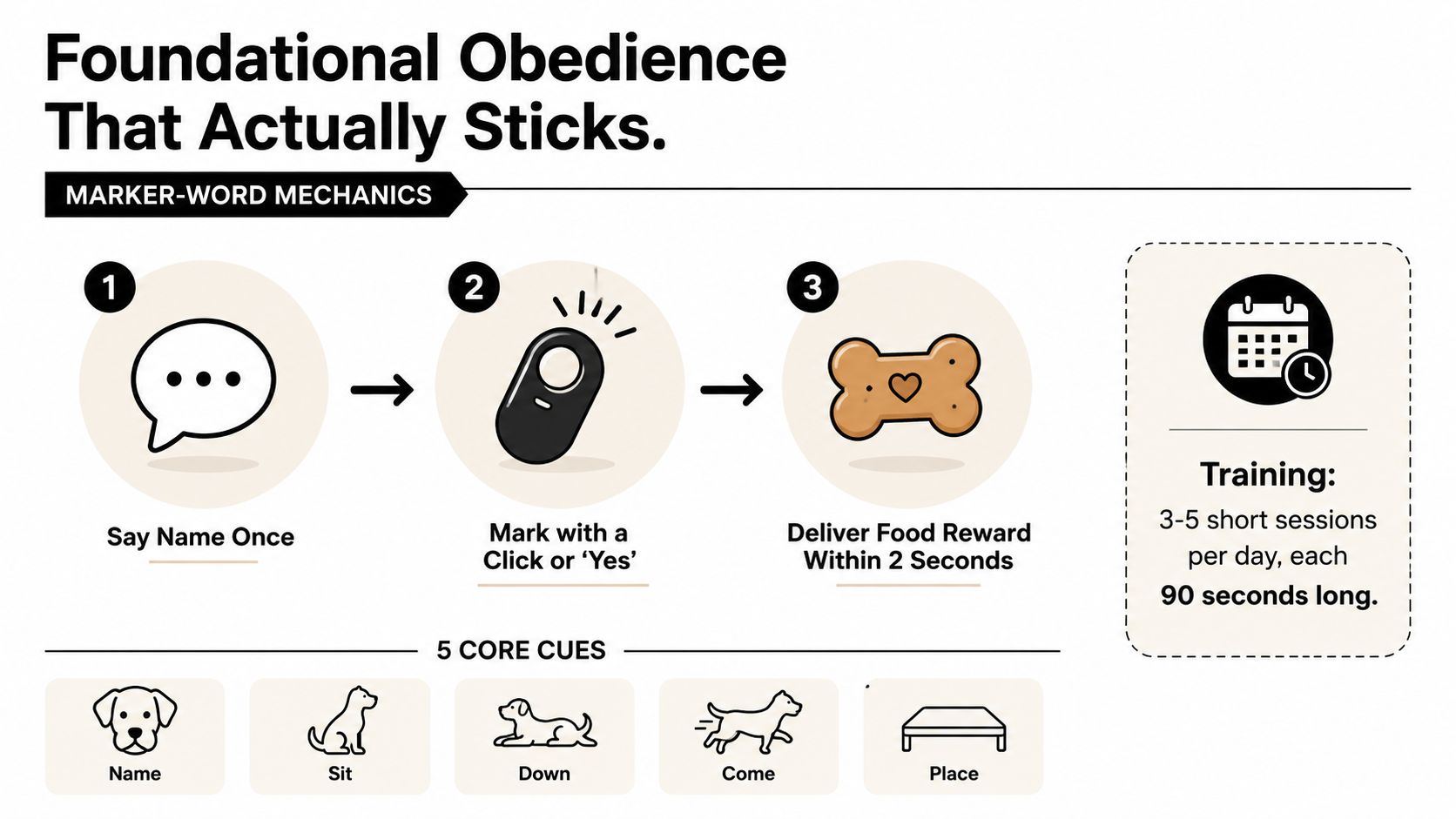
Train in three to five sessions per day, each lasting about 90 seconds. Short sessions preserve attention and make it easier to stop before frustration appears.
Build five practical cues
Name response: Say the name once. The moment the dog orients toward you, mark with a click or “yes,” then deliver the treat to the dog's chest. Feeding at the chest keeps the dog near you instead of encouraging them to snatch and retreat.
Sit: Hold a treat near the nose and move it slowly upward and slightly back. Mark when the rear touches the floor. Don't press the dog's hips down. The lure should guide the movement, not physically place the dog.
Down: From a sit, move the treat between the front paws toward the floor. Mark when the elbows reach the ground. Some rescue dogs find this position vulnerable, so accept slower progress and never drag the treat away to force a collapse.
Hand target: Present an open palm close to the dog's nose. Mark nose-to-palm contact and feed. This becomes a useful redirect on walks and a gentle foundation for recall because the dog learns to move toward a clear target.
Leave-it: Put a treat in a closed fist. When the dog noses, paws, or stares at the fist, wait. Mark the instant the dog disengages, then reward from the other hand. Later, transfer the exercise to an open palm and low-value objects.
The marker-to-food gap should stay around 1.5 seconds. If delivery takes too long, the dog may connect the reward to a later movement instead of the behavior you intended. Freeze-dried liver or small pieces of chicken usually outperform kibble early because stronger food can compete more effectively with a distracting environment.
Don't repeat cues until the dog responds. Repeating “sit, sit, sit” teaches the dog that the first request is optional. Avoid verbal correction while the dog is still learning the rules. Reward-based, function-informed training has support from controlled review evidence, and the relevant meta-analysis of conditioned reinforcement concluded that reward-based methods are at least as effective as aversive approaches, with welfare and learning advantages worth taking seriously.
Loose-Leash Walking and Real-World Distractions
Pulling isn't a moral failure, and it usually isn't solved by making the leash uncomfortable. It reflects some combination of arousal, equipment fit, reinforcement history, and an environment that's more rewarding than the handler. Recent shelter-behavior research found that 86% of shelter dogs pulled on leash during walks, while 45% jumped on handlers during harnessing. The published shelter-dog study also linked leash-grabbing with longer shelter stays, which makes leash work a core handling skill rather than a cosmetic refinement.
Start with equipment that gives you control without adding unnecessary conflict. The harness should sit securely while allowing comfortable shoulder movement. You should be able to slide two fingers beneath the chest straps. A Y-front harness generally permits freer shoulder motion, while a front-clip design can give additional steering help for a strong puller, though fit and the individual dog matter more than the label.
Use a standard six-foot leash while impulse control is developing. Retractable leashes make distance and tension harder to manage, especially when a rescue dog is still learning how to return attention to the handler. If you're comparing equipment options, review the practical considerations in this guide to a metal dog training collar, but avoid treating any collar as a substitute for behavior work.
Progress through manageable layers
Use the three Ds, changing only one at a time:
- Distance: Begin far from dogs, squirrels, traffic, and people.
- Duration: Reward a few loose steps before expecting a longer stretch.
- Distraction: Add one mild trigger only after the dog can stay connected in a quieter place.
A five-minute practice walk on a quiet sidewalk before bed can teach more than an hour-long hike where the dog spends every minute over threshold. Reward check-ins, a loose leash, a turn toward your voice, and voluntary pauses. Say “yes” or click the instant the behavior occurs, then feed close to your leg.
If the leash tightens, become a tree. Stop moving, keep your hands quiet, and wait for slack or a turn back. Then mark, reward, and continue. If the dog can't disengage, increase distance or make a calm U-turn rather than standing in a prolonged battle.
Before a doorway, use an engagement game. Say the dog's name, mark an orientation, and reward. Then move through. Gradually introduce other dogs, squirrels, and busy entrances, always scanning ahead so the dog doesn't encounter a trigger at close range without preparation.
For a visual demonstration of leash mechanics and handler timing, watch the embedded walk-through below.
The marker is the bridge between a structured exercise and an ordinary walk. It tells the dog which real-world choice earned reinforcement, even when the environment keeps changing.
Handling Reactivity, Fear, and Resource Guarding
A rescue dog that lunges at another dog may be trying to create distance. A dog that snaps when you reach toward a food bowl may be protecting access to something valuable. A former stray that hides during a storm may be responding to sound sensitivity, not ignoring your reassurance.
The useful question is what does this behavior accomplish for the dog? Attention, access, escape, distance, and relief can all maintain a behavior. In an applied behavior analysis study of jumping-up behavior, owners using a time-based reinforcement strategy achieved reductions exceeding 80% in two of four dogs, with mean procedural integrity of 96%, as reported in the owner-implemented behavior study. The lesson isn't to copy that protocol blindly. It's to identify function and apply the plan consistently.
| Behavior | Likely Function | First-Line Protocol |
|---|---|---|
| Lunging at dogs on leash | Increase distance or escape pressure | Use LAT or BAT 2.0 at a distance where the dog can still eat and orient |
| Snapping near a food bowl | Protect access to food | Stop reaching toward the bowl, use safe trade-ups, and arrange professional assessment |
| Hiding during thunderstorms | Escape overwhelming sound | Use desensitization with controlled sound exposure and a protected retreat |
For leash reactivity, begin below threshold. If the dog is barking, lunging, or refusing food, the setup is already too difficult. LAT, or “Look at That,” can teach the dog to notice a trigger and then turn back for reinforcement. BAT 2.0 can give the dog more choice about creating distance. Neither protocol works well if the handler waits for the explosion.
Resource guarding requires management before modification. Feed in a protected area, remove high-value items that create predictable conflict, and never test the dog by taking food away. Trade-up games can build trust, but a dog that stiffens, growls, snaps, or bites needs a qualified professional rather than repeated home experiments. Guidance on aggression toward other dogs can help with general orientation, but it doesn't replace an individual safety assessment.
Safety comes before proof. Use a muzzle when a qualified professional recommends one, prevent rehearsal of dangerous behavior, and be honest about any bite history.
Watch for lip licking, yawning, whale eye, tucked tails, freezing, and rapid recovery failure. End sessions before the blow-up. Management isn't giving up. It prevents the dog from practicing the very response you're trying to change.
Knowing When to Call in a Professional Trainer
You don't need to handle every problem alone, and waiting for confidence to appear can leave both you and the dog practicing unsafe patterns. The decision should reflect the dog's needs, not the owner's hope that patience will solve everything.
Match the problem to the professional
| Support option | Appropriate starting point |
|---|---|
| Certified behavior consultant, such as CDBC or CBCC-KA | Fear, reactivity, guarding, separation distress, and behavior plans requiring environmental analysis |
| Certified professional dog trainer, such as CPDT-KA | Foundation cues, household manners, leash skills, and owner coaching |
| General group-class instructor | Dogs comfortable enough to learn around unfamiliar people and dogs |
Escalate promptly for a bite that draws blood, worsening reactivity despite consistent management, separation distress that damages the home, guarding that doesn't improve with basic trade-ups within two weeks, or fear that prevents ordinary daily function. Those cases may require coordinated veterinary and behavior support.
Be wary of trainers who talk about dominance, rely on punishment collars, promise a quick fix, or refuse to discuss the dog's history. A professional should explain what behavior they're observing, what function they suspect, how they'll keep the dog under threshold, and what you should do between sessions.
Use this script on the first phone call:
- “What methods and equipment do you use for fearful or reactive dogs?”
- “How would you manage safety while changing this behavior?”
- “What would make you refer us to a veterinary behaviorist or another specialist?”
Listen for specific answers. “I'll show the dog who's boss” is not a plan. A good practitioner will also tell you what they can't safely address alone.
Your 30-Day Milestones and What Comes Next
A month is long enough to establish direction, not long enough to declare a rescue dog finished. Track recovery, appetite, sleep, voluntary engagement, and the dog's ability to make good choices around manageable distractions.
Use the month as a checkpoint
- Days one through seven: Look for softer eyes, more sniffing, regular eating, voluntary approach, and sleep outside hiding places. Extend this phase if the dog remains shut down.
- Days eight through fourteen: Build the name response and hand target. Add sit and down only when the dog can engage without scanning constantly.
- Days fifteen through twenty-one: Practice loose-leash walking in low-distraction settings. Reward check-ins and stop before pulling becomes frantic.
- Days twenty-two through thirty: Add mild real-world distractions one at a time. Keep distance generous and return to easier work after a difficult outing.
The common failures are predictable. Owners skip decompression because the dog appears quiet, drill commands after the dog crosses threshold, or interpret early warning signals as defiance. Each mistake asks the dog for more control precisely when the dog has less capacity to provide it.
After the first month, shift from emergency improvement to maintenance. Rotate enrichment, preserve positive exposure to ordinary environments, and review behavior periodically rather than waiting for a crisis. One dog may be ready for advanced cues, another for sport foundations, and another for a carefully supported therapy-dog pathway. Temperament and recovery ability should determine the next step, not a rigid calendar.
If you want a structured option alongside hands-on coaching, PawCraft creates a personalized 30-day plan from your dog's breed, age, environment, behavior challenges, and available training time, then delivers step-by-step exercises and progress checklists by email. Visit PawCraft to see whether that format fits the work you're ready to do with your rescue dog.
Start today by preparing a quiet safe room, fitting a six-foot leash and secure harness, and writing down the behaviors you want to reward rather than punish. Then use PawCraft to turn your dog's specific needs into a practical daily plan you can follow through the first month.