Your dog spots a squirrel, locks onto it, and surges toward the end of the leash. You say their name, then “come,” then “come” again, louder each time. Your dog doesn't turn around. In that moment, it feels like defiance, but recall failure usually reflects a mismatch between the dog's training history, the environment, and their emotional state.
Dog training come when called works best when you treat recall as a graduated safety behavior, not a single trick your dog either knows or doesn't know. The reliable version must be built indoors, tested around mild distractions, and carefully transferred to places where movement, scent, wildlife, people, and other dogs compete for attention. You also need clear benchmarks, so “pretty good in the kitchen” doesn't get mistaken for “safe off leash at the park.”
A 2020 peer-reviewed study found that dogs received an average of 20.3 commands per training session and obeyed 15.7 on the first command, equal to 77% first-command compliance. Another 20% responded only after repeated cues, while 3% didn't respond at all, according to the study review and recall-training discussion. That gap between immediate, delayed, and failed responses is exactly why recall needs systematic practice rather than louder repetition.
Why Most Dogs Stop Coming When Called
Most dogs don't stop coming because they're stubborn. They stop because the owner calls too soon, calls too often, or calls while the dog is too emotionally activated to respond.
A dog has an emotional threshold, the point at which excitement, fear, frustration, or reactivity overwhelms the responses they can perform. Below that threshold, your dog may turn quickly and run toward you. Above it, the squirrel, unfamiliar dog, traffic noise, or separation distress can consume so much attention that your carefully reinforced cue effectively disappears.
Recall is a safety behavior
Think of recall as a ladder. Your dog might respond in the living room, hesitate in the yard, and ignore you near a busy trail. Those aren't contradictory results. They're different levels of the same behavior, each requiring its own reinforcement history.
Practical rule: If your dog has already ignored the cue, the next repetition usually teaches them that ignoring it is allowed.
Calling repeatedly creates background noise. Calling when the dog is already beyond threshold creates failed repetitions. Calling from a distance or distraction your dog hasn't earned yet lets the environment reward not coming, whether that reward is chasing, sniffing, greeting, or continuing a game.
Protect the meaning of the cue
Your recall word should predict something worthwhile. Many owners accidentally poison it by using it before a bath, a nail trim, confinement, the end of every walk, or any other event the dog dislikes. The dog learns that coming toward the handler makes good things disappear.
Classical conditioning works in your favor when the cue consistently predicts reinforcement. It works against you when the same sound predicts restraint or loss of freedom. If your current word has been repeated during failed recalls, choose a fresh, distinct cue and rebuild it from the beginning.
Dogs have been trained in organized settings since formal training developed in England in the late 1700s, when dog competitions helped turn informal handling into a structured discipline. The peer-reviewed history and training review connects that development with the broader shift toward systematic methods, consistency, timing, and reinforcement.
Foundations Every Dog Needs Before You Start
Recall training becomes much easier when the setup prevents avoidable failure. Before adding distance or distractions, prepare the cue, rewards, marker, equipment, and training space.
Choose the cue and load the marker
Pick one short, distinct word or sound. Don't use your dog's name as the recall cue, because their name often serves many purposes, from getting attention to warning them about something. Reserve the recall word for one response, turning toward you and moving all the way in.
Use a marker word such as “yes” or a clicker. The marker bridges the moment your dog makes the correct choice and the moment you deliver the reward. Mark within about one second of the dog turning toward you, then pay immediately. If you mark after the dog has wandered past you or stopped to investigate, you may reinforce the wrong part of the sequence.
Build a reward ladder
Start with rewards your dog values. Freeze-dried liver, chicken, or small pieces of cheese may work for difficult stages, while kibble can be useful in an easy room or as part of a lower-intensity repetition.
Don't show the food before every repetition. A visible lure can make your dog follow the treat rather than respond to the cue. Keep the reward hidden, say the cue once, mark the turn, and then produce the reward at your feet.
Control the rehearsal
Begin in a quiet room or a securely fenced yard. Use a long line in unsecured areas, attached to a well-fitted harness or suitable collar, so your dog can't run off and reward themselves for ignoring you. A long line is a management tool, not permission to test an unfinished recall in a dangerous setting.
Run a baseline test before progressing. In a quiet space, say the cue once with the best reward ready. Reinforce only if your dog reaches you within two seconds. If they don't, reduce the distance, improve the reward, or rebuild the cue. You're not ready to add distraction when the response isn't fluent in an easy environment.
Your 30-Day Recall Training Plan
Keep sessions short enough that your dog stays eager. Work for 3 to 5 minutes, complete 8 to 12 repetitions, and stop while responses are still quick. The plan below gives you a progression, but the pass criteria matter more than the calendar.
Week one builds the response
Train in a quiet room for two or three brief sessions each day. As your dog naturally walks toward you, say the recall word once, mark the turn, and toss the reward at your feet. Tossing the food behind or beside you encourages the dog to move fully into your space rather than stopping just out of reach.
Start with easy repetitions. Once your dog understands that the cue predicts a rewarding movement toward you, call from a small distance. Your first pass standard is ten consecutive responses without hesitation. If your dog pauses, looks away, or needs a second cue, shorten the distance and make the next repetition easier.
Week two adds distance without adding excitement
Keep the same quiet-room structure, gradually increasing the space between you and your dog. Then move to a fenced yard while keeping the dog on a long line. Don't add yard distance and strong distractions together. The new location is already a new variable.
Use a release cue such as “go play” after some recalls. This prevents every successful return from ending the activity. You can also reward with a short sniffing break or access to a toy when that activity is safe and appropriate.
Week three introduces mild distractions
Place a rolled ball on the ground, have a family member walk past, or practice while a toy rests nearby. Begin close to your dog and use the highest-value reward if the distraction matters to them. Only lower reward value when speed and accuracy remain strong.
If your dog notices the distraction but still turns promptly, mark the choice generously. If they stare, pull toward it, or need repeated cues, step back two stages. The issue isn't disobedience. The distraction has exceeded the dog's current training level.
Week four moves toward real-world handling
Practice on a 15-foot line on a quiet sidewalk, then in a quiet park. Keep the distance modest at first, and don't remove the line because the dog responded well indoors or in the yard. Reliable off-leash recall requires proofing across environments and distractions.
Advance only after three sessions at the current level, with ten out of ten recalls completed in under three seconds. If latency increases, the dog scans instead of turning, or you need to repeat the cue, drop back a level.
| Week | Focus | Exercise | Pass Criteria |
|---|---|---|---|
| Week one | Cue meaning | Quiet-room recalls with high-value rewards | Ten consecutive prompt responses |
| Week two | Distance and location | Increase distance indoors, then practice in a fenced yard on a long line | Three successful sessions at the current distance |
| Week three | Mild distractions | Add a rolled ball, toy, or passing family member | Ten out of ten responses without repeated cues |
| Week four | Outdoor transfer | Use a 15-foot line on a quiet sidewalk, then a quiet park | Three sessions with ten out of ten recalls under three seconds |
For owners who need help organizing daily practice, PawCraft's guide for first-time dog owners can provide broader structure around routines and foundational skills.
Troubleshooting Common Recall Problems
Start by identifying the type of failure. A dog who ignores you while sniffing a hedge needs a different plan from a dog who freezes when you approach, and neither should be labeled “stubborn” without looking at the pattern.
| Problem | Root Cause | Targeted Fix | Benchmark to Progress |
|---|---|---|---|
| Distraction | The dog has advanced too quickly | Return two stages on the distraction ladder and raise reward value | Prompt responses across three easier sessions |
| Apparent stubbornness | Coming predicts the end of fun or weak reinforcement history | Add a release cue, vary rewards, and reinforce more often | The dog returns promptly and is released back to activity |
| Fear | The dog feels pressure, capture, or an unpleasant consequence | Shrink the environment and pair the cue with a relaxed approach | The dog approaches without backing away or freezing |
| Reactivity | The dog is above threshold around a trigger | Call before the trigger is close and work on threshold distance | The dog can orient to you while remaining emotionally regulated |
Distraction is usually a progression gap
If your dog recalls in the hallway but not when a ball rolls, the cue isn't necessarily broken. The ball has more value than the current training history can overcome. Move back to a quieter setting, shorten the distance, and use a reward your dog cares about.
Don't keep calling in the same failed situation. Each unanswered cue gives the dog more practice choosing the environment.
Fear requires less pressure
A fearful dog may avoid recall because coming close predicts being grabbed, cornered, or taken away. Turn your body slightly sideways, lower your intensity, and reward movement toward you before reaching for the collar. Practice approach and collar-touch games separately from urgent recalls.
Never chase a fearful dog unless immediate safety requires it. Chasing can turn the handler into another source of pressure.
Reactivity must be handled before the recall
Don't try to call a dog out of a full reactive episode. The dog may be barking, lunging, stiffening, or unable to take food. Increase distance before the trigger becomes overwhelming, then reinforce orientation toward you while the dog can still think.
For separation anxiety, the emotional problem may not be recall at all. Guidance from the ASPCA on separation anxiety emphasizes staying below the dog's stress threshold, sometimes beginning with absences of only 1 to 2 seconds. That same threshold principle applies here. If anxiety or panic is driving the behavior, standard recall drills won't solve the underlying distress.
Adjusting Recall for Age and Breed
A puppy, adolescent, senior, and high-prey-drive adult shouldn't receive identical recall training. The cue stays consistent, but the length, reinforcement, environment, and safety margin must match the dog in front of you.
A puppy younger than five months usually learns best through very brief practice woven into the day. Use three to five one-minute sessions rather than demanding a long walk with perfect attention. Build orientation to their name first, then introduce a separate recall word once they reliably look toward you.
Adolescents between six and eighteen months often appear to “forget” recall. They may test whether the cue still matters when wildlife, dogs, or movement compete with you. Expect uneven performance, keep the long line in place, and continue paying fast responses even when the dog has demonstrated the skill before.
Seniors may have hearing loss, arthritis, or cognitive changes. Pair the verbal cue with a visible hand signal, avoid sprinting games that strain painful joints, and reward with calm food delivery or gentle social interaction. If a previously reliable dog changes suddenly, arrange a veterinary check rather than assuming a training lapse.
Breed drives change the distraction ladder
Herding dogs may orient quickly to movement, so directional hand signals and controlled movement games can help. They may also struggle when every moving person or animal becomes an invitation to manage the scene.
Sighthounds and terriers often need careful proofing around wildlife because chasing can be highly reinforcing. Scent hounds may stay absorbed in a trail, making a distinctive verbal cue and controlled scent exposure more useful than relying on an unfamiliar whistle.
For broader guidance on adapting routines to maturity, see PawCraft's adult dog training resource. The practical principle is simple: match the exercise to the dog's sensory abilities, motivation, physical comfort, and breed-related interests.
Safety Rules and When to Call a Professional
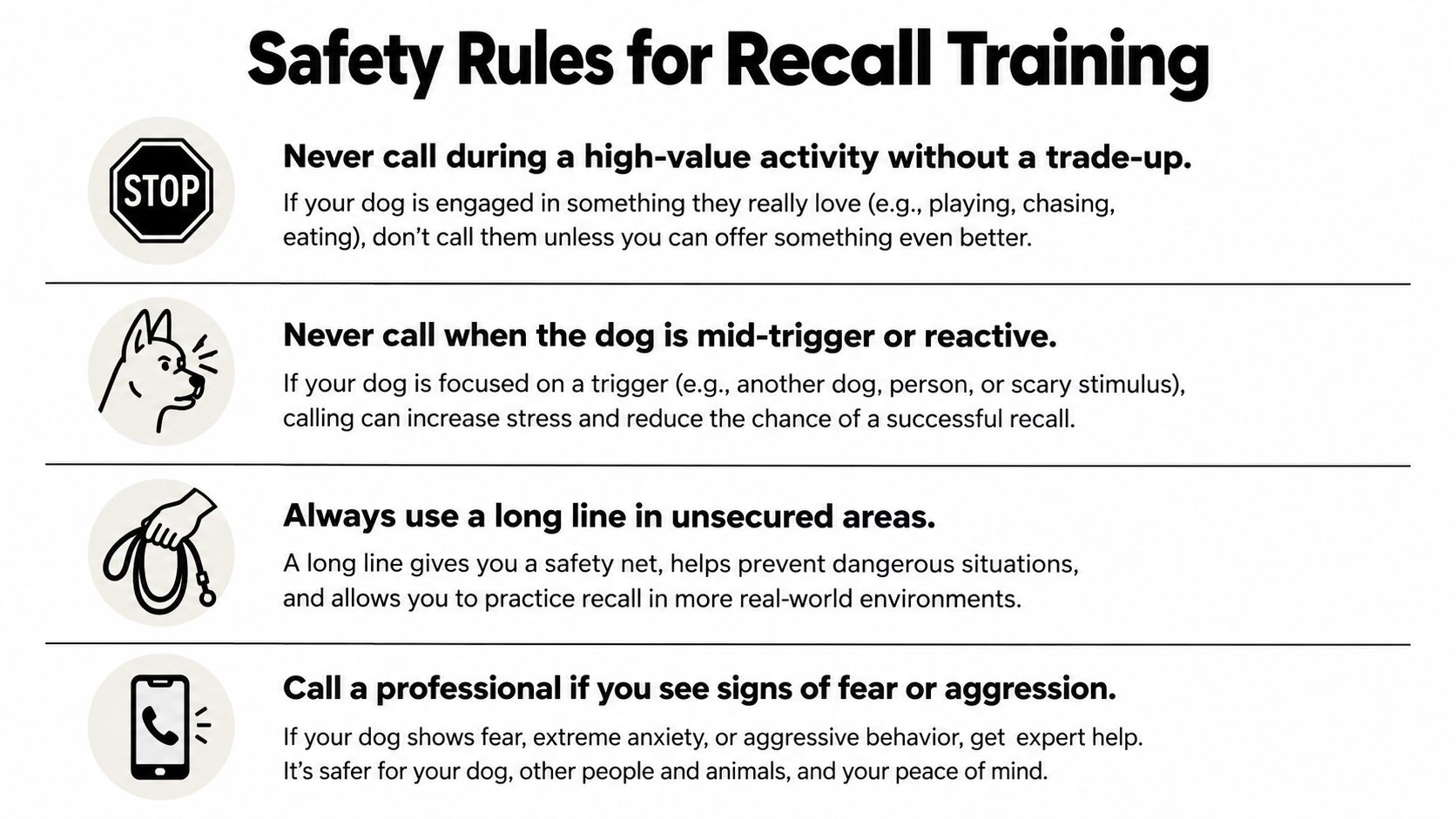
Recall training should reduce risk, not create new opportunities for escape. Keep your dog on a long line in unfenced areas until they have demonstrated reliable responses at the level of distraction you expect outdoors. A dog who responds in a quiet yard isn't automatically ready for a park, trail, or open field.
Don't call your dog away from something valuable without a trade-up. If coming always ends play, sniffing, or freedom, the cue loses value. Call, reward, and release the dog back to the activity when it's safe, so returning doesn't always mean the fun is over.
Never call during a reactive episode. Move away from the trigger, wait for your dog to regain enough composure to process information, and then reinforce an easy orientation response. If the first cue fails, don't chant it. Give the cue no more than twice, then calmly retrieve your dog or use the long line to prevent them from continuing toward danger.
Know when home practice isn't enough
Bring in a qualified force-free trainer, veterinary behaviorist, or certified applied animal behaviorist if your dog has bitten or snapped when called, has run into traffic or become lost after a failed recall, or creates dangerous conflict with other dogs at the door. Professional support is also appropriate when fear or reactivity keeps escalating despite two weeks of adjusted training.
Equipment should support management, not replace skill. If you're comparing options, learn about metal dog-training collars, but choose equipment based on fit, safety, and the individual dog's behavior. Avoid tools or handling methods that add pain or fear to an already fragile recall history.
A short, controlled practice session is more valuable than a dramatic test your dog isn't ready to pass. Track response time, success rate, environment, and the distraction present. When performance drops, lower the difficulty before your dog rehearses another failure.
PawCraft creates a personalized 30-day dog training program based on your dog's breed, age, environment, and behavior challenges, with daily exercises, progression rules, and weekly checklists. If you want a recall plan built around your dog's actual distractions and temperament, visit PawCraft and complete the brief questionnaire.