Most advice for cattle dog behavior issues starts with “be more consistent” or “correct the behavior immediately.” That advice misses the central problem. An Australian Cattle Dog that nips heels, explodes at moving dogs, drags you toward a cyclist, or barks at every sound may not be ignoring a rule. The dog may be over threshold, with a breed-linked motor pattern already driving the response.
Australian Cattle Dogs are intelligent, trainable, and intensely rewarding to live with, but they aren't low-input pets. Their behavior makes more sense when you stop treating every problem as disobedience and start asking, “What level of arousal is my dog carrying, what triggered it, and what useful behavior can replace it?” That shift changes the tools you choose, the timing of reinforcement, and the amount of calm you deliberately build into the day.
Why Your Cattle Dog Is Not Just Being Stubborn
A cattle dog that ignores “leave it” while chasing a jogger isn't necessarily making a considered decision to challenge you. The dog may have crossed the point where familiar cues can compete with movement, excitement, territorial concern, or frustration. Repeating the command louder rarely restores thinking. It often adds more stimulation to an already overloaded nervous system.
Research on Australian Cattle Dogs and related herding breeds supports this reframing. Selection for herding preserves predatory components in a controlled form, and genomic evidence links a working-line haplotype of EPHB1 with increased chase-bite motor patterns. That helps explain why movement-heavy settings can trigger heel-nipping, chasing, and leash reactivity in urban dogs. The behavior may be an overexpressed herding pattern in the wrong setting, not a character flaw (Science Advances research on herding behavior and EPHB1).
Corrections can add fuel
Suppose your dog spots another dog and begins staring. You tighten the leash, jerk it, and shout. Your dog may stop moving for a moment, but the emotional response can remain, or intensify. The other dog now predicts both excitement and unpleasant handling. Next time, your cattle dog may react earlier.
That's why punishment can look effective in the instant while producing a worse pattern over time. Suppression isn't the same as emotional regulation. A quiet dog that's frozen, scanning, or waiting for the next correction hasn't learned to feel safe around the trigger.
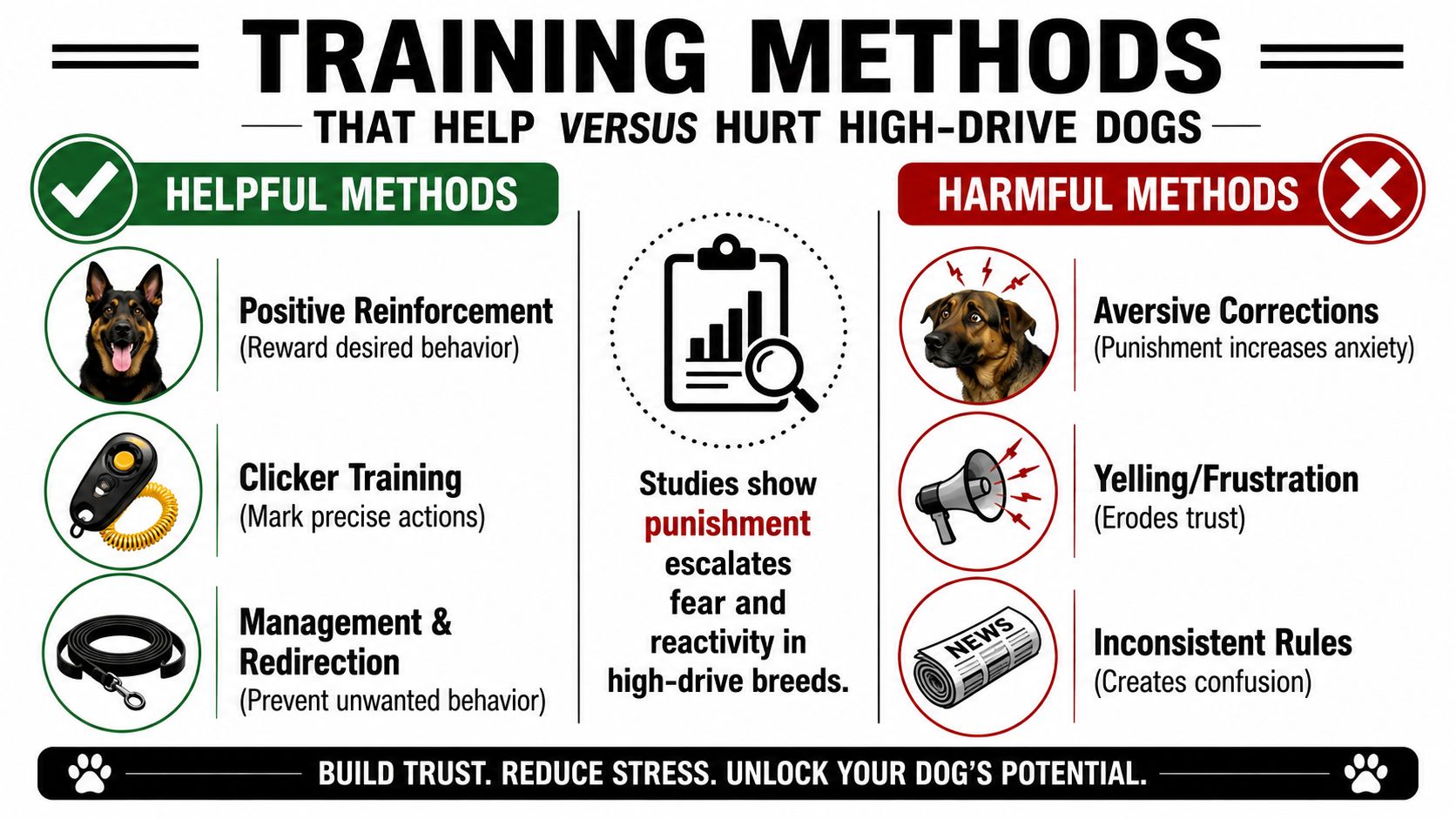
A large review of training research found that dogs trained exclusively with positive reinforcement had the lowest incidence of attention-seeking, anxiety or avoidance, and aggression. The review also associated aversive methods, including shouting, leash jerking, and physical punishment, with more behavioral problems, while 72% of owners reported negative reactions when positive punishment was used (review of training methods and undesirable behavior). The practical lesson is simple: don't confuse force with clarity.
Practical rule: Lower the dog's arousal before you ask for obedience. A cue given below threshold can teach. A cue repeated during an explosion usually becomes background noise.
What the new frame changes
You still need boundaries. Your dog shouldn't nip children, drag you into traffic, or rehearse fence running. But the response should combine management, distance, reinforcement, and a purposeful outlet.
Block access to the behavior before it starts. Teach a replacement such as hand targeting, a mat settle, or carrying a toy. Reinforce the replacement generously, then increase difficulty gradually. The goal isn't to make your cattle dog less driven. It's to give those drives a safe job and teach the dog when the job is over.
The Breed Drives Behind Common Behavior Problems
Cattle dog behavior issues become easier to solve when you connect the visible action to the underlying drive. The same dog that nips a heel at home may be showing the same chase-bite motor pattern that makes movement so compelling outdoors. The context changes, but the engine is related.
Independent breed research describes Australian Cattle Dogs as high in activity, territorial defense, and aggression toward other dogs, while barking and family aggression are more moderate. That profile points toward arousal management and trigger control, not endless drilling of basic commands (Australian Cattle Dog behavioral characteristics).
A practical behavior map
| What you see | Likely drive or pressure | Better first question |
|---|---|---|
| Heel-nipping | Chase-bite and movement control | What movement can I prevent, and what toy or task can replace it? |
| Leash reactivity | Fast response to movement, territorial concern, frustration | How far away can my dog notice the trigger without reacting? |
| Barking at windows | Environmental vigilance and territorial defense | Can I reduce visual access and reward disengagement? |
| Destruction | Unmet physical or cognitive needs, poor settling skills | Has the dog had a purposeful outlet and a planned rest period? |
| Distress when alone | Difficulty coping without the working partnership | Can I build independence in tiny, successful increments? |
Heel-nipping is the clearest example. Herding dogs use movement, pressure, and controlled biting to influence livestock. In a home, a running child or waving pant leg can activate the same sequence. Laughing, chasing the dog, or allowing “just one playful nip” can make the pattern more rewarding.
Leash reactivity has a similar logic. A cattle dog may notice a moving dog, bicycle, or skateboard before you do and respond instantly. The leash removes the option to create space, so frustration and defensive behavior can stack together. Equipment may affect handling, but it doesn't change the emotional trigger or teach the dog what to do instead.
The overlooked need for an off switch
High activity isn't the same as healthy regulation. A dog can complete demanding exercise and still pace, scan, bark, or demand interaction because the dog has practiced activation without practicing recovery. Genomic findings also suggest herding-line dogs are behaviorally adapted toward toy-directed and working-related tendencies, reinforcing the value of structured tasks rather than random stimulation alone (genomic evidence on working-line herding tendencies).
That's why a cattle dog needs both a job and a clear end point. Fetch with rules, scent searches, carrying a toy, food puzzles, and mat training can create a complete cycle: activate, focus, finish, and settle.
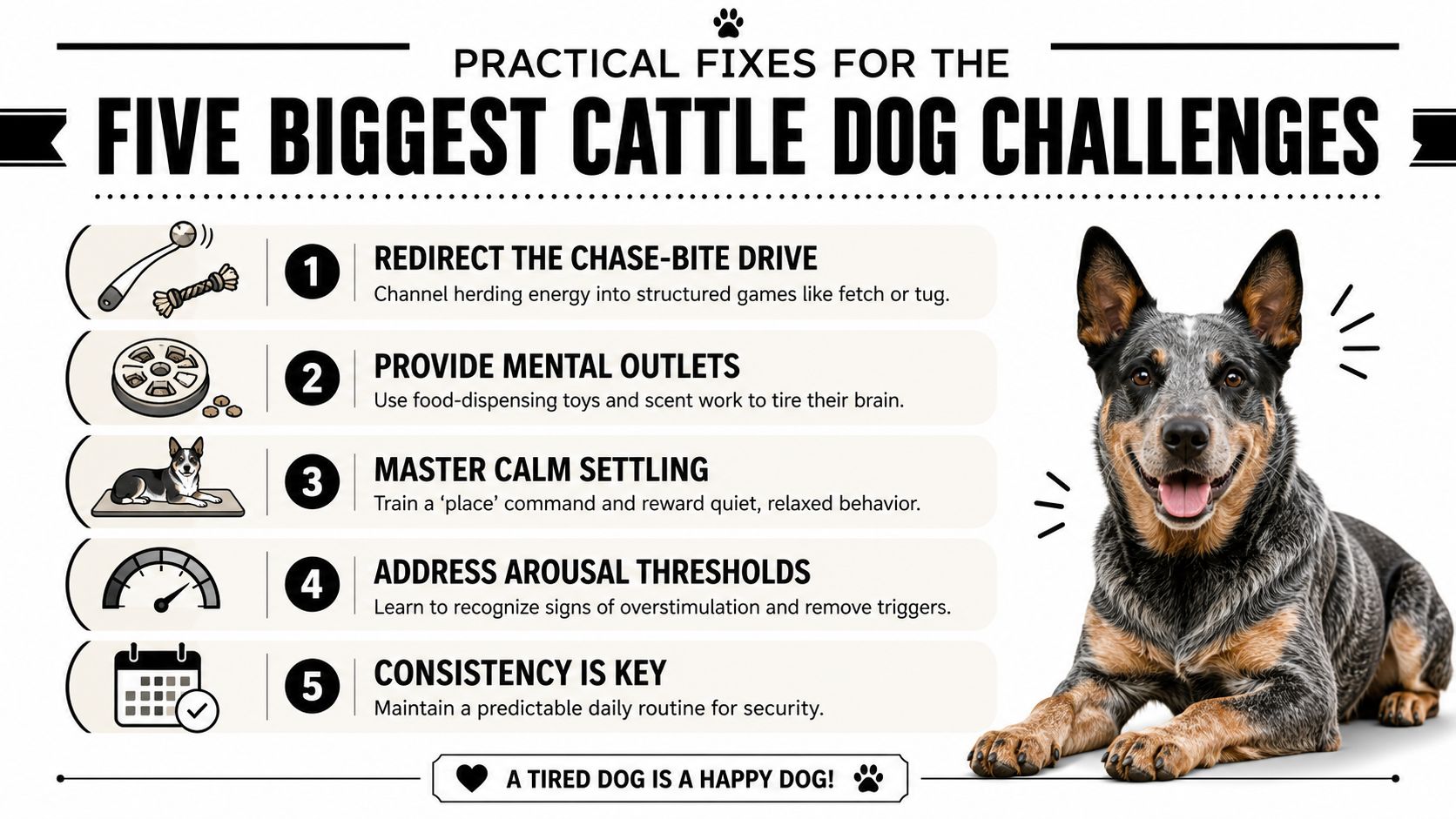
Practical Fixes for the Five Biggest Cattle Dog Challenges
The fastest improvement usually comes from changing what happens before the behavior, not from correcting the behavior after it has erupted. Start with management today, then build skill through short repetitions that stay below your dog's reaction threshold.
Heel-nipping and inappropriate herding
Stop using your legs as the training environment. Keep a tug toy or fleece toy available, and redirect before the dog launches. If your cattle dog targets moving family members, reduce opportunities for rehearsal with gates, leashes indoors, and calmer transitions around doorways.
Teach a sequence:
- Present the toy before movement starts.
- Ask for a simple behavior, such as touch or sit.
- Begin controlled movement.
- Reward the dog for following the toy or carrying it.
- End the game with a clear release cue and a calm activity.
Don't play frantic chase games that send the dog into a biting frenzy. Structured tug, where the dog waits, takes the toy on cue, releases it, and pauses, is more useful than uncontrolled wrestling.
Leash reactivity and pulling
Begin where your dog can see a trigger without lunging. The moment your cattle dog notices it, mark the observation and feed several small rewards while you create distance. If the dog stiffens, stares, vocalizes, or stops taking food, you're too close for learning.
A harness or collar can support safe handling, but changing equipment alone won't teach loose-leash walking. Controlled research found stronger and longer pulling with back-connection harnesses than collars in food-driven contexts, and comparative work found harnesses produced greater pulling force or impulse than several collar types without showing a simple welfare advantage (research on harnesses, collars, and pulling). Choose equipment for control and safety, then train the behavior separately.
Destructive energy
Replace the vague instruction to “exercise more” with a combination of activities. Use a sniffing walk, a food-dispensing toy, a short training session, and a structured game across the day. Physical exertion may reduce restlessness, but problem-solving and predictable recovery teach the dog how to function at home.
Rotate outlets instead of making the dog dependent on one exhausting routine. Food scatters, scent searches, cardboard shredding under supervision, toy retrieval, and impulse-control games can all provide useful work. Avoid escalating exercise indefinitely. A dog that needs increasingly intense activity to feel normal may be practicing arousal rather than learning balance.
Separation distress
Start with absences so brief that your dog remains relaxed. Step away, return, and repeat without dramatic greetings. Increase duration only while the dog continues to cope, and reduce the duration if pacing, vocalizing, scratching, or frantic following appears.
Don't use a crate as a substitute for a gradual plan if confinement itself causes panic. Record the dog when alone so you can see whether the problem begins at departure, after a quiet period, or around a predictable household sound. Severe distress, escape attempts, or self-injury requires professional support rather than repeated trial and error.
Excessive barking
First identify the function. Window barking usually needs visual management, such as frosted film, closed blinds, or moving furniture away from the view. Demand barking needs a consistent rule: barking doesn't produce attention, while quiet behavior, a mat settle, or a toy carry does.
Boredom barking needs an outlet, but alert barking needs a response pattern. Teach your dog to notice a sound, orient to you, and move to a designated place. Reward the disengagement, not the initial alarm. Yelling from across the room often sounds like participation, so it can keep the cycle alive.
Training Methods That Help Versus Hurt High-Drive Dogs
“Positive reinforcement” doesn't mean your cattle dog gets to make every decision. It means you teach the desired response, arrange the environment to make that response possible, and reinforce it clearly. You can still interrupt unsafe behavior, remove access, use gates, end a game, and enforce household routines without adding fear or pain.
The distinction matters because high-drive dogs often react quickly and intensely. An aversive correction may interrupt the outward action while increasing the dog's concern about the trigger, the handler, or both. The review cited earlier found the lowest undesirable behavior incidence among dogs trained exclusively with positive reinforcement, while aversive methods were linked with more problems (evidence on reinforcement and punishment in dog training).
What each approach looks like in real life
| Approach | What the handler does | Main trade-off |
|---|---|---|
| Reinforcement-based | Rewards calm observation, loose leash, recall, toy release, and settling | Requires timing and careful trigger management |
| Aversive-dominant | Uses leash jerks, shouting, physical punishment, or intimidation to suppress behavior | May interrupt behavior but can increase fear, arousal, or defensive responses |
| Mixed, unclear handling | Rewards a behavior sometimes, then punishes it in another context | Creates inconsistent information and slows learning |
A reinforcement-based response to leash pulling might look like this: stop before tension builds, wait for slack, mark the slack, and move forward. If the dog can't disengage, increase distance instead of escalating the leash. The dog learns that calm movement makes the walk continue.
For nipping, calmly block access to your legs, offer the permitted toy, and reinforce release and stillness. For barking, manage the view and reward quiet orientation toward you. These boundaries are firm, but they give the dog a behavior to perform rather than only a behavior to fear.
Tools deserve careful judgment
No piece of equipment can replace timing, distance, or a trained response. A collar, harness, long line, or food pouch can help you manage the environment, but each tool also changes how much physical control you have and how much pressure reaches the dog.
If you're comparing equipment, consider the handling details rather than assuming a category is automatically corrective or gentle. This guide to a dog training collar can help you think through fit, use, and the difference between management and behavior modification.
A clear boundary tells the dog what earns access. A harsh correction often tells the dog only that the situation has become dangerous.
A Daily Structure That Manages Cattle Dog Energy and Arousal
“Exercise your cattle dog more” is incomplete advice. The type of activity, the dog's emotional state, and the recovery period all matter. A frantic game immediately before a busy walk can create a dog who is physically tired but mentally primed to react.
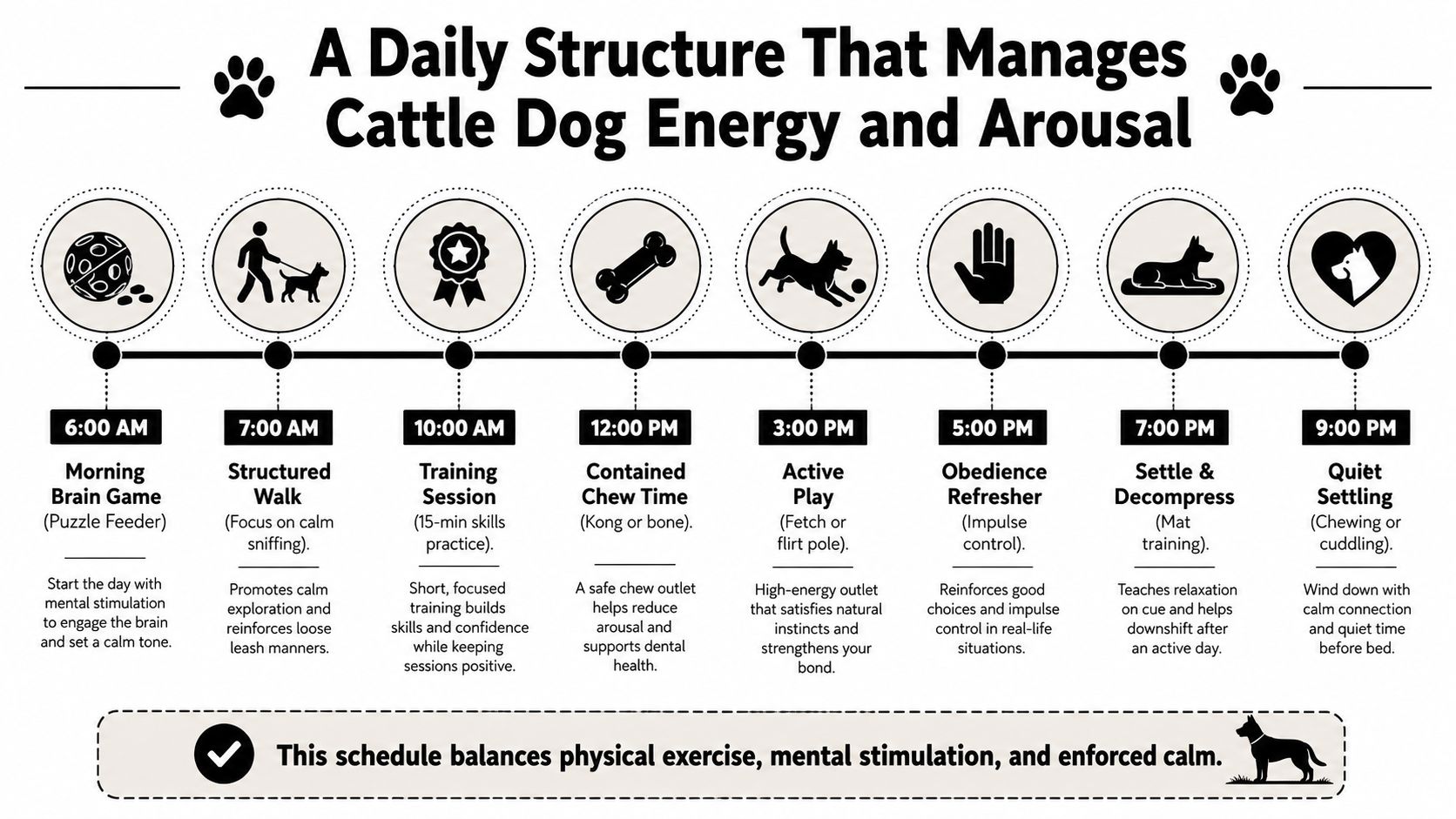
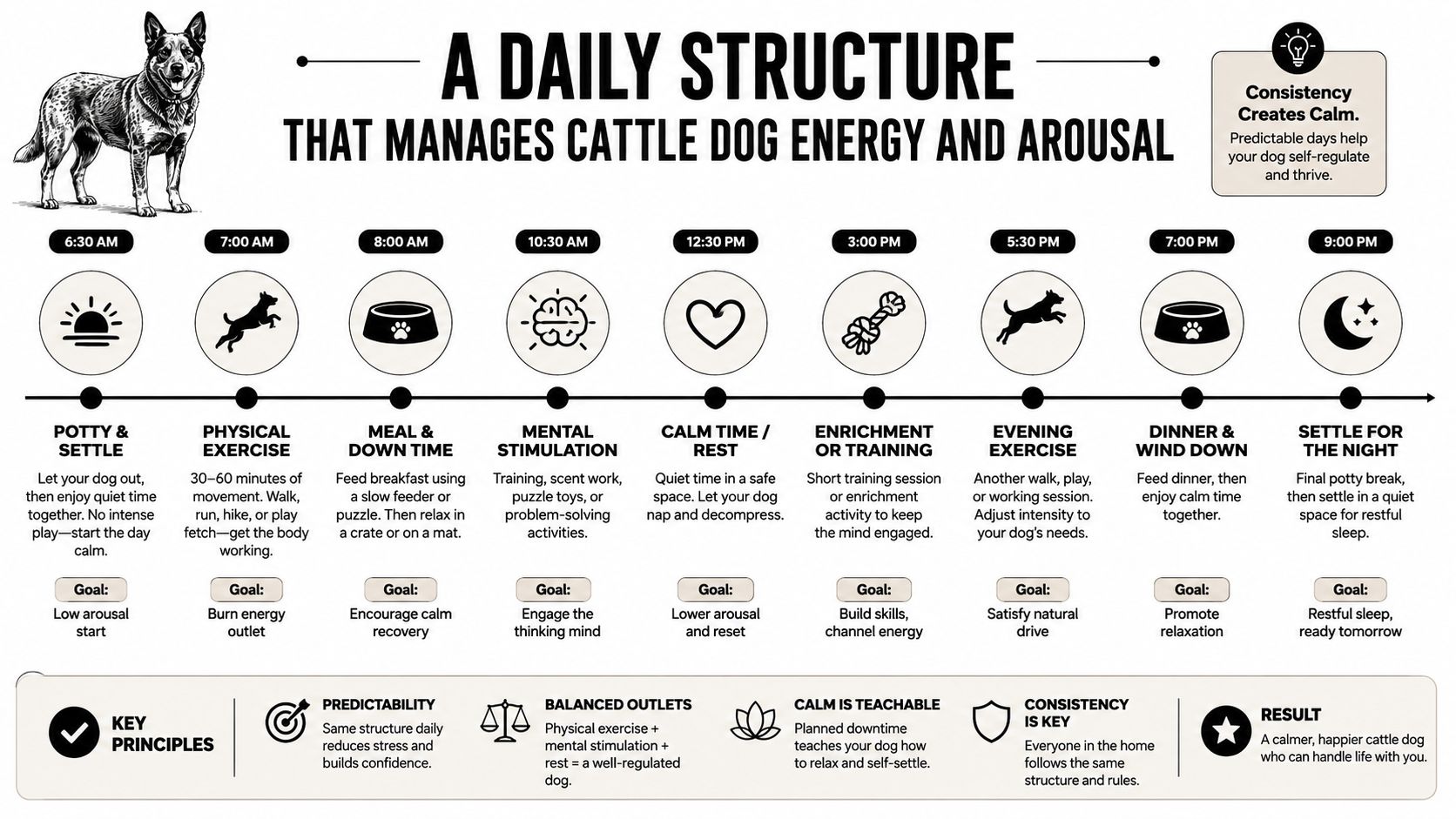
Use a repeatable rhythm that alternates thinking, movement, chewing, and rest. The schedule below is a template, not a rigid prescription. Adjust it for age, health, weather, work demands, and the dog's response.
A workable rhythm
Morning: Begin with a puzzle feeder or scatter feeding rather than immediately launching into high-speed play. Follow it with a structured walk where sniffing and loose-leash choices matter more than distance. Afterward, provide a quiet rest period.
Midday: Use a food-dispensing toy, chew, or scent search if you're working. A short skill session can focus on hand target, place, recall indoors, or toy release. Keep the environment boring enough that your dog can succeed.
Afternoon: Add active play such as fetch with pauses or a flirt pole used under rules. Ask for stillness before restarting. This turns movement into a controlled activity rather than an invitation to chase everything.
Evening: Finish the active part of the day with impulse-control practice, then shift to mat work, chewing, and low-key contact. Don't wait for zoomies to begin before asking for calm. Teach the transition while the dog is still capable of making choices.
Adjustments for limited space
An apartment can support a cattle dog when the routine emphasizes quality over chaos. Use hallway recalls, food searches in separate rooms, toy discrimination, shaping exercises, and controlled tug. Take decompression walks in quieter areas instead of relying solely on busy sidewalks.
Predictability also helps owners. Everyone should use the same release cues, feeding rules, door routine, and response to barking. For broader guidance on building skills beyond puppyhood, use this resource on training adult dogs.
Watch the dog after each activity. Panting, frantic scanning, grabbing clothing, and inability to settle can indicate that the session was too intense or too long. The right routine leaves the dog able to eat, rest, and respond, not merely collapse.
Red Flags That Signal You Need Professional Help
Some cattle dog behavior issues need more than a better treat pouch or a new walking route. Get professional help when safety, welfare, or the dog's ability to recover is deteriorating.
Seek an appropriately qualified behavior professional if your dog has a bite history, makes repeated attempts to bite, or shows aggression that's becoming less predictable. Self-injury during separation, escape attempts, prolonged panic, or complete inability to settle alone also warrants prompt support. A dog that shuts down, refuses food in ordinary settings, or becomes more reactive despite consistent management needs assessment rather than harsher handling.
Choosing the right support
A trainer can help teach skills and change daily routines. A behavior consultant or veterinary behaviorist is more appropriate when fear, aggression, anxiety, or complex emotional responses drive the problem. Ask prospective professionals what methods they use, how they manage safety, how they measure progress, and whether they'll coordinate with your veterinarian when medical factors may contribute.
Avoid anyone who promises instant dominance, guarantees a cure, or treats every reaction as stubbornness. A sound plan should identify triggers, establish a management layer, define observable goals, and explain what you'll do if the dog goes over threshold.
For practical guidance on dog-to-dog aggression and safety planning, review this resource on stopping aggressive behavior toward other dogs. Don't put your dog, another animal, or a family member through uncontrolled exposure while waiting for improvement.
Building a Realistic Long-Term Relationship With Your Cattle Dog
Living with a cattle dog gets easier when you stop expecting a naturally intense worker to behave like a naturally easy companion. Progress may show up first as a faster recovery after seeing a trigger, a softer mouth during play, or a dog that chooses the mat without being reminded. Those small changes matter because they show improved regulation, not just temporary silence.
Expect uneven days. Weather, pain, poor sleep, unfamiliar environments, and accumulated excitement can all lower your dog's threshold. Keep the plan simple enough to repeat, protect calm periods, and measure progress by better choices and quicker recovery rather than perfection.
The payoff is a dog with a job, a structure, and a dependable way to communicate with you. That partnership is far more realistic than trying to erase the traits that make cattle dogs alert, driven, and responsive.
PawCraft creates a personalized 30-day training program around your dog's breed, age, environment, and specific behavior challenges, with daily exercises, progression steps, and common mistakes to avoid. If you want a structured plan for cattle dog behavior issues instead of piecing together disconnected tips, visit PawCraft and build one around your dog.