You're in a 600-square-foot apartment, trying to answer an email while your dog explodes at the elevator opening down the hall. At 6:30 a.m., the alert barking wakes the neighbor next door. By lunchtime, you're embarrassed, frustrated, and wondering whether your dog is impossible to train.
A barking dog in an apartment usually isn't showing a character flaw or a lack of obedience. The barking is information. It may reflect arousal, separation distress, frustration, or an environment that gives the dog too many chances to rehearse the same response. The practical question isn't how to force silence. It's what happens immediately before the bark, what the bark achieves, and what behavior can replace it.
In dense housing, ordinary canine vocalization becomes a management problem quickly. New York City's dog-noise rules use specific thresholds, with uninterrupted barking treated differently during daytime and nighttime hours, as summarized in this apartment-living discussion of barking complaints. That's a useful reminder that a dog doesn't have to bark all day for neighbors or management to treat it as a nuisance.
When the Neighbors Start Knocking
The complaint often arrives after a very specific chain of events. The elevator dings. Your dog rushes to the door, barks sharply, hears footsteps receding, and keeps going because another person appears in the hallway. You call the dog's name. The barking gets louder. Then someone knocks, which creates a second barking episode.
Your first reaction may be embarrassment. The second may be defensiveness, especially if the neighbor says the noise has been constant. The third is often anger directed at the dog. None of those reactions makes you careless. They're normal responses when your home suddenly feels like a public dispute.
The important reframe is this: the barking is a symptom with a cause, not proof that training has failed. In an apartment, sound moves through shared walls, floors, ventilation openings, courtyards, and entry doors. A dog who might be manageable in a detached home can become a serious lease concern when every hallway footstep arrives at close range.
Practical rule: Treat apartment barking as both a behavior problem and a housing-management problem. You need to reduce rehearsal immediately while you teach new responses.
A useful starting point is to document the pattern rather than arguing about whether the dog “barks a lot.” Write down the time, trigger, approximate duration, body language, and what happened after the barking. Did the person leave? Did you approach the dog? Did the dog receive attention? Did the dog remain distressed after the trigger disappeared?
That record separates three common causes: arousal, when the dog reacts intensely to movement or sound; separation, when barking begins around departures or confinement; and environment, when the apartment layout gives the dog constant access to triggers. A short alert burst and sustained panic may both sound like barking, but they need different plans.
The sequence in this article is deliberately practical. First, stop the loudest rehearsals today. Then spend two weeks building a mat behavior, a quiet response, and controlled trigger practice. Finally, use a broader 30-day plan to decide whether the dog is improving or needs professional support.
The Three Real Reasons Dogs Bark in Apartments
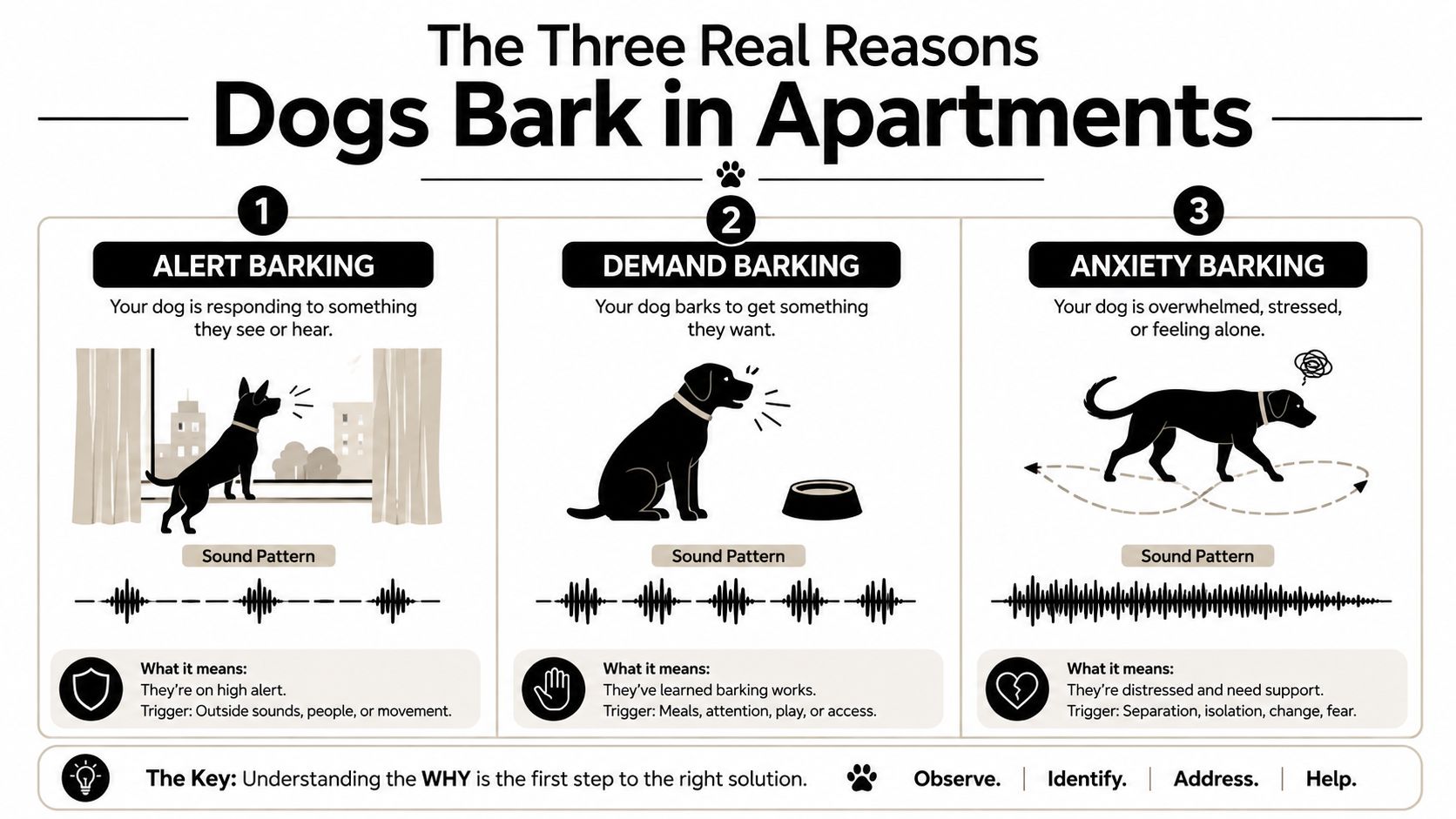
A dog may erupt at the elevator, demand attention during your work call, then panic when you close the bathroom door. Those episodes share a sound, but the behavior underneath differs. The event before the first bark matters more than the noise itself.
Alert barking follows a sight or sound. Common triggers include elevator movement, hallway voices, keys in the corridor, delivery workers, doorbells, traffic outside the window, and activity in a shared courtyard. The dog may freeze, close its mouth, lift its ears, lean forward, and give short, repeated barks. Reduce exposure by removing access to the trigger with frosted film, curtains, furniture placement, or a barrier near the entry. In a small rental, that environmental change often works faster than asking for a quiet response after the dog is already aroused.
Demand barking points toward a result from you. It may happen beside the food bowl, during a work call, near a toy, or when play stops. The dog is usually mobile rather than fearful, making eye contact, pawing, bouncing, or moving between you and the desired item. Calm behavior, such as sitting, lying on a mat, or touching your hand, should open the route to food, play, or attention. Barking cannot be the behavior that makes the person move faster.
Distress barking continues because the dog cannot settle after the trigger disappears. Departures, crate confinement, a closed bathroom door, or an inaccessible person or animal can set it off. Pacing, panting, drooling, scratching, frantic contact with a door, or refusal to eat point to a stronger emotional response. Shorten and simplify alone-time practice instead of repeatedly leaving the dog to panic.
A field study on nuisance-barking risk factors reported several independent associations. Young dogs had higher odds than older dogs, with an odds ratio of 11.2; multi-dog homes had an odds ratio of 5.6; herding breeds had an odds ratio of 3.2; and dogs with home access had an odds ratio of 2.5, according to the field study on nuisance-barking risk factors. These findings support a layered plan rather than relying on a single “quiet” command.
Use this dog behavior modification plan to organize practice. Classify the main pattern by recording what happens before the bark, your dog's body language, and what barking produces.
Quick Wins You Can Use Today
A dog barks at footsteps outside the door, rushes the threshold, and repeats the cycle before you can reach the leash. Reduce rehearsal today, even before training begins. Management lowers the number of explosions while your dog learns a different response. It is especially useful when arousal, separation distress, and environmental triggers overlap.
Start at the front door. Slide a draft stopper along the bottom gap, particularly if hallway scents and footsteps arrive underneath it. Hang a heavy blanket on the wall shared with the nearest neighbor, and place a rug over the hardest, loudest floor surface. These changes will not soundproof a small rental, but they can soften the sound path and reduce the effect of movement outside.
Remove visual fuel next. Apply frosted window film to the lower portion of a street-facing window, keep a curtain partly drawn during busy periods, or cover the dog's viewing height with a cardboard panel. Each uninterrupted view of pedestrians, bicycles, dogs, or delivery workers gives the barking pattern another chance to repeat.
Prevent the first rehearsal
Build prevention around the times your dog reacts most easily:
- Before the building wakes up: Take a sniff-focused walk before the morning hallway rush. Let the dog investigate instead of turning the outing into a fast march.
- At departure: Offer a frozen stuffed Kong as you leave, only if your dog can eat while alone. A dog too distressed to touch food needs a gentler separation plan.
- During hallway traffic: Run white noise, a bathroom fan, or steady audio near the entry. Keep it low enough to blur footsteps without adding more stimulation.
- For the doorbell: Teach a hand signal that predicts moving to the mat. Practice it without visitors so the cue stays clear when the bell rings.
Barking draws attention from people, so reducing intensity and repetition matters. A New York Times report on barking and housing noise discusses the scale of complaints and the acoustic burden barking can create in shared housing.
Complete this evening
Move the dog bed away from the entry, install the draft stopper, cover the lowest window section, prepare the frozen food toy, and start a trigger log. Then test the setup with a quiet hallway recording at low volume. If your dog reacts, lower the sound immediately. You are checking whether the environment helps, not provoking a full barking episode.
Your Two-Week Training Routine
Keep each session short and stop before the dog becomes frantic. Use small, high-value treats, a washable mat, a phone for logging, and the management tools already installed.
Days 1 through 7
Days 1 and 2, baseline. Spend 10 to 15 minutes setting up the log, then record normal life for 48 hours. Note the trigger, first body-language change, bark pattern, recovery time, and your response. Pass when you can identify the most common trigger and the earliest sign before barking. If the dog's reactions are too frequent to record, increase management first.
Days 3 through 5, mat work. Spend 10 minutes teaching “place” beside the door, away from the direct threshold. Feed for looking at the mat, stepping onto it, lying down, and remaining there briefly. Don't add hallway noise yet. Pass when the dog moves to the mat willingly in a quiet room. If the dog leaves repeatedly, move the mat closer to you and reduce the duration.
Days 6 and 7, quiet pauses. Spend 10 to 15 minutes capturing the smallest pause between barks. Say “quiet” softly during the half-second of silence, mark it, and deliver food away from the door. Don't shout the cue over the barking. Pass when the dog begins offering a pause quickly in low-distraction practice.
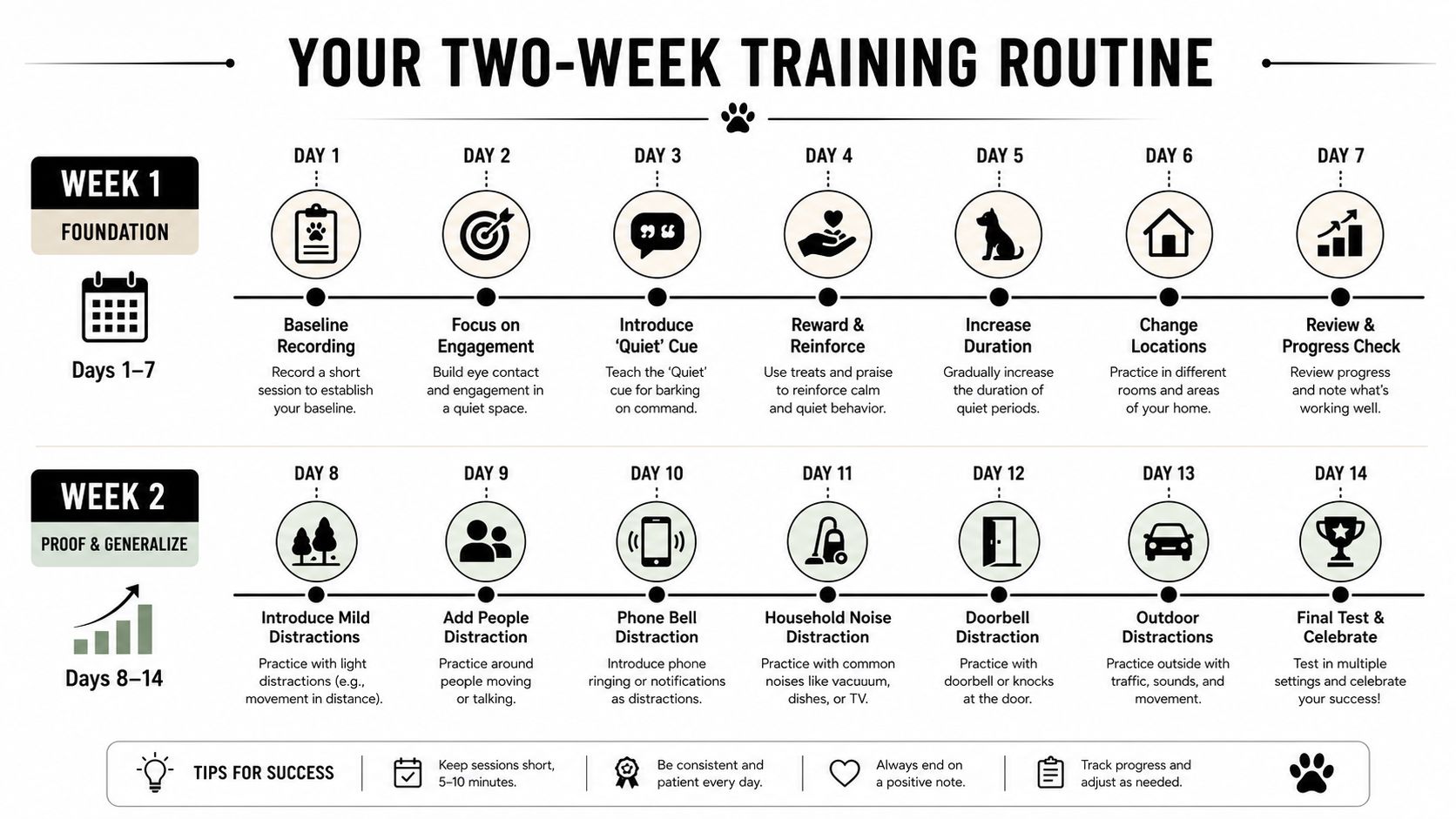
Days 8 through 14
Days 8 to 10, simulated triggers. Use 10 to 20 minutes to play hallway sounds at very low intensity while cueing the mat. Feed before the dog barks, then increase sound only when the dog stays loose and can eat. Pass when the dog notices the sound and turns back to you. If barking starts, reduce volume or distance.
Days 11 and 12, one alert bark. Spend 15 minutes teaching a controlled sequence. Allow one mild alert, mark the turn away, cue the mat, and reward the quiet choice. Never manufacture a high-intensity reaction. Pass when the dog can stop after the first alert during easy practice.
Days 13 and 14, real departures and returns. Spend 20 to 25 minutes across several tiny rehearsals. Pick up keys, step outside briefly, return calmly, and reward quiet settling rather than dramatic greetings. For home-alone barking, use a camera if possible and keep the absence below the point where panic begins. Pass when the dog remains able to eat, settle, or return to the mat.
Remote differential reinforcement has reduced home-alone barking in 3 of 5 dogs in a controlled intervention, with the schedule gradually thinned for practicality, as reported in this automated home-alone barking intervention summary. The useful principle is measurable quiet intervals, not punishment.
Mistakes That Make Barking Worse
Apartment barking often worsens because the response adds arousal instead of teaching a replacement. The fastest way to lose progress is to increase intensity when the dog is already over threshold.
Yelling still gives the dog attention. Barking begins a loud exchange, and your raised voice may interrupt it briefly while adding movement, excitement, or conflict. Use a quiet hand signal, scatter food away from the window, or cue a practiced mat behavior instead.
Anti-bark collars and ultrasonic devices suppress sound without teaching a useful response. Citronella, shock, and startling sounds can make a doorway or window feel less safe, especially when fear or separation distress drives the barking. If you are comparing equipment, review this discussion of dog training collars, then prioritize management and reinforcement over startling the dog.
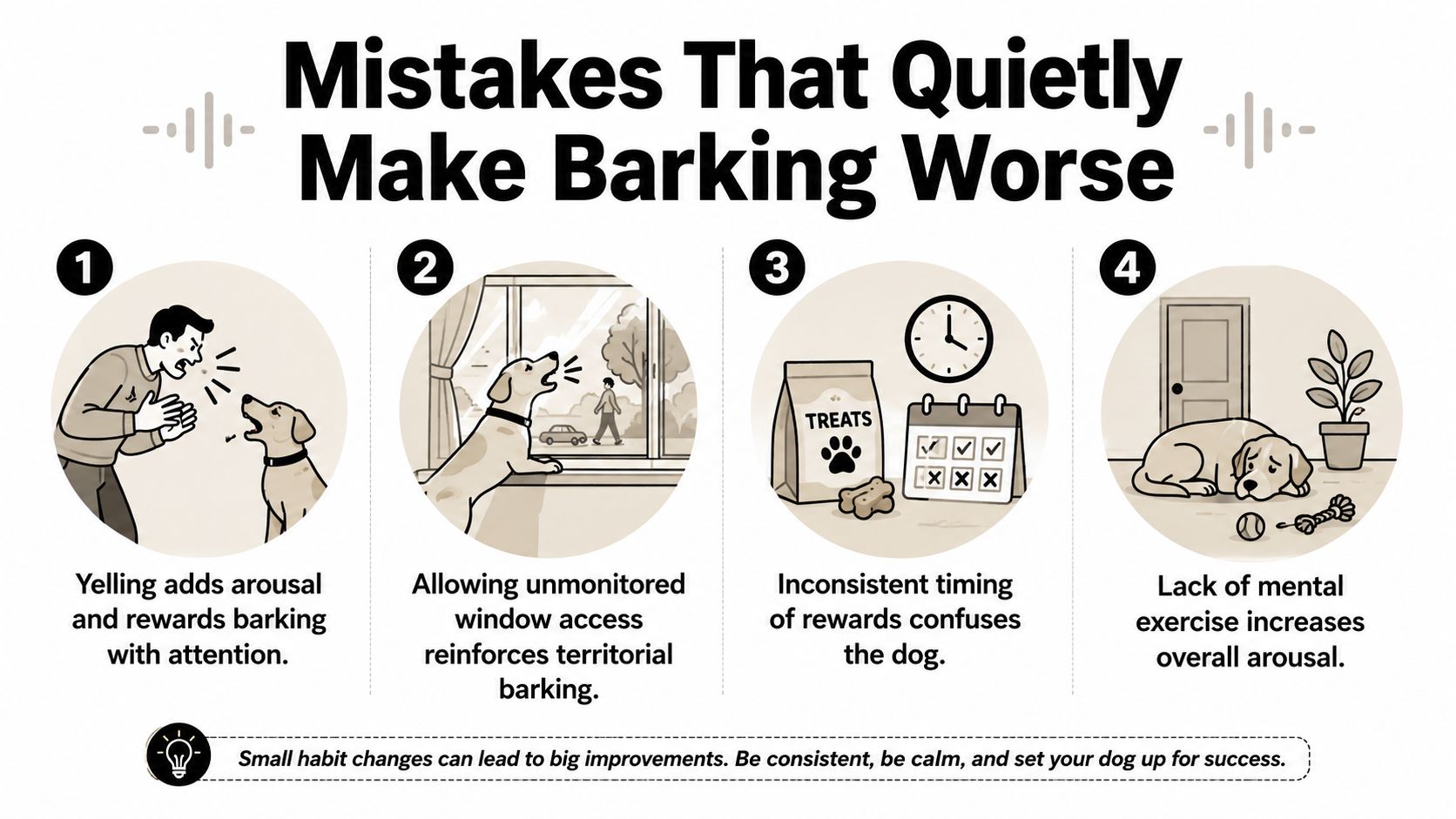
Inconsistent rules keep barking profitable. If barking at the sofa earns play on Saturday but punishment on Monday, the dog receives no stable answer. Decide what barking should produce, then reinforce the replacement behavior consistently during the learning stage.
Skipping activity because the apartment is small leaves arousal with nowhere to go. A dog does not need a yard to work its body. Sniff walks, controlled hallway games, and food searches can provide useful outlets without turning the rental into a racetrack.
Replacement rule: Do not ask the dog only to stop. Teach where to go, what to do with its nose, and how to earn access to attention or play.
Treat tossing works only when people follow the plan consistently. The reported counterconditioning data linked stronger staff compliance with lower maximum barking volume, but the useful lesson is reliability rather than a target decibel figure. A simple protocol applied every day is stronger than a complex one used sporadically.
Small-Space Enrichment That Actually Works
A small apartment can support useful enrichment if you match the activity to the dog rather than trying to exhaust every dog with the same game. Sniffing, searching, chewing, and problem-solving can lower arousal without requiring a large room.
| Activity | Energy Cost | Space Needed | Equipment | Best For |
|---|---|---|---|---|
| Scatter feeding | Low to moderate | One room | Kibble or treats | Dogs who need nose work |
| Find it | Low to moderate | One room | Small treats | Alert dogs who need redirection |
| Towel-rolled kibble | Moderate | Floor space | Towel and food | Food-motivated dogs |
| Snuffle mat | Moderate | Mat-sized area | Snuffle mat | Dogs who enjoy sustained sniffing |
| Toppl or stuffed Kong | Low physical, high mental | One resting spot | Toppl or Kong | Departure routines and settling |
| Flirt pole | High | Clear hallway | Flirt pole | High-energy dogs with impulse control |
| Nina Ottosson board | Moderate mental | Table or floor | Puzzle board | Dogs who enjoy manipulation |
For high-energy herding or sporting dogs, use a flirt pole or controlled fetch in a clear corridor before a training session, but stop while the dog can still respond to you. Mid-energy dogs often do well with two short scatter meals, one earlier and one later. Seniors and low-energy dogs usually benefit more from scent work than from intense chasing.
A five-day rotation
- Day 1: Scatter one meal through a safe room, then practice the mat.
- Day 2: Roll food into a towel and offer a quiet chew afterward.
- Day 3: Use a snuffle mat while hallway noise is masked.
- Day 4: Run a short flirt-pole session, followed by water and a settle period.
- Day 5: Offer a stuffed Kong or Nina Ottosson board during a planned departure.
Rotate the activity rather than leaving every toy available all day. Novelty keeps the dog engaged, while predictable calm periods teach recovery. Avoid using frantic games immediately before a trigger rehearsal if they make your dog barkier. The right enrichment leaves the dog satisfied and able to think, not exhausted and overstimulated.
Your 30-Day Action Plan and When to Call a Pro
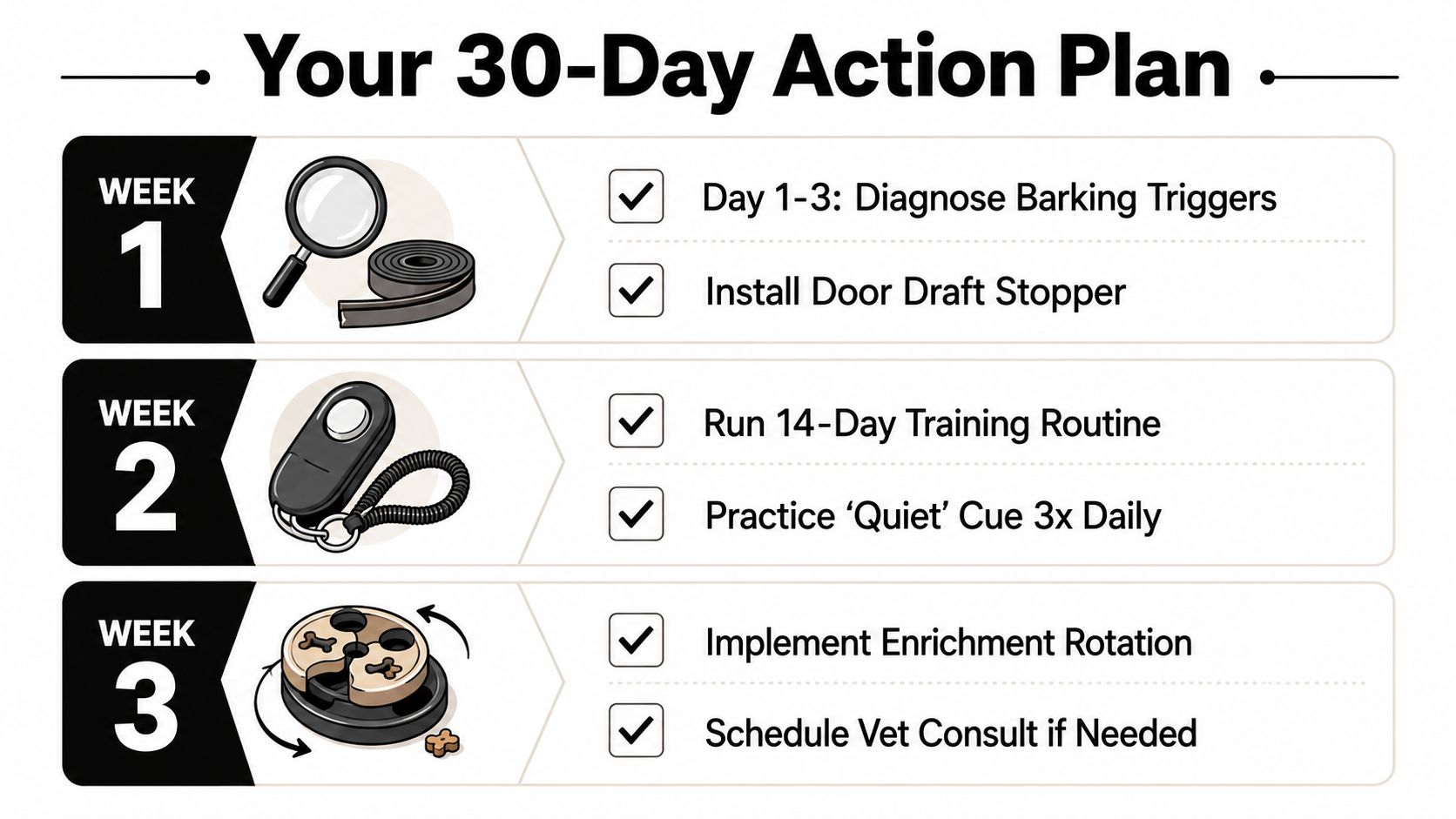
Use the first week to find the pattern and change the apartment. During week one, log triggers, block the worst sightlines, soften the entry sound path, and establish a calm departure item. Your checkpoint is a clear baseline, such as the number of barking episodes during a normal morning, recorded consistently rather than guessed.
During week two, complete the 14-day routine described above, adjusting the calendar to your household. Your checkpoint is functional: the dog can remain on the mat for a brief period after a mild trigger, or can produce a quiet pause and turn toward you.
Week three adds the enrichment rotation and a daily 10-minute decompression walk. Measure whether the dog recovers faster after hearing a hallway sound. Week four stress-tests the plan with carefully controlled trigger rehearsals and reviews neighbor feedback. If barking is less intense, shorter, or easier to interrupt, the plan is moving in the right direction even if occasional alerts remain.
Get outside help when the behavior exceeds ordinary alert training. Red flags include:
- Extended alone-time barking: Barking that persists past 45 minutes when alone requires a separation-focused assessment.
- Escalating destruction: Door, crate, wall, or window damage suggests distress rather than simple noise-making.
- Self-injury: Broken nails, bleeding paws, damaged teeth, or frantic scratching need prompt professional attention.
- Sudden onset in an older dog: A new vocalization pattern warrants veterinary evaluation for possible medical contributors.
- Growl-to-snap sequences: Aggression or redirected biting makes hands-off professional guidance important.
Choose a trainer with CBCC-KA credentials or an IAABC certification for behavior work. A veterinary behaviorist is the appropriate route when fear, panic, pain, or medication may be involved. For a structured adult-dog approach, this adult dog training guide can also help organize daily practice.
The timeline depends on the cause and how consistently you prevent rehearsal. Alert barking may become noticeably easier by the second week, demand barking may take longer, and distress cases often need a slower progression. Full resolution can take months, especially when the dog has practiced the behavior for a long time.
PawCraft creates a personalized 30-day training plan using your dog's breed, age, apartment environment, and behavior challenges, with daily exercises, progression steps, and success criteria. Visit PawCraft to build a practical plan for your barking dog and start with a clearer next step today.