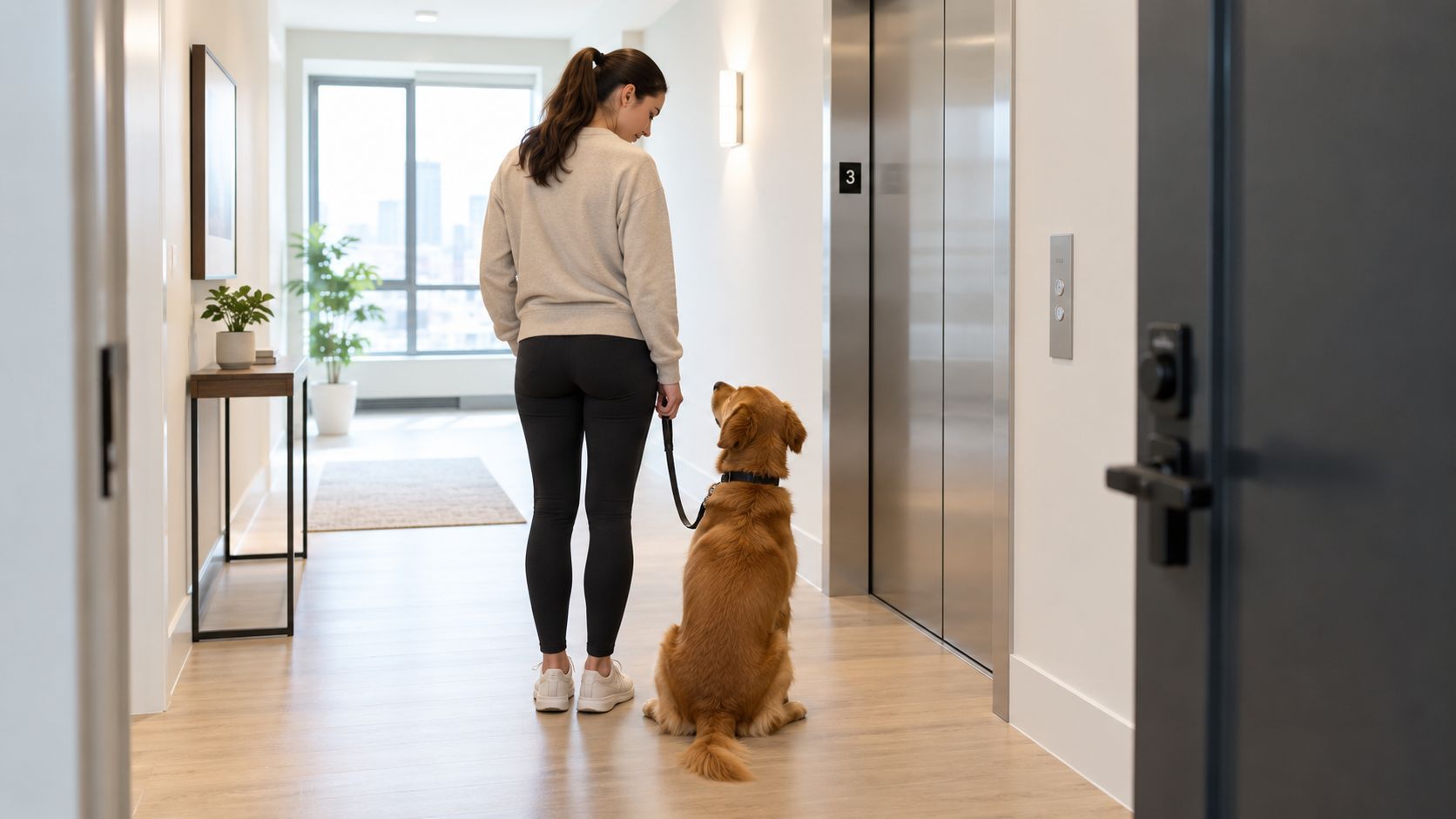
The elevator dings just as your dog hears footsteps outside the apartment. Their ears lift, their nails tap across the floor, and one sharp bark travels through the hallway and possibly through the neighbor's wall. You grab the leash, open the door, and suddenly you're managing a rushing dog, a closing elevator, and a stranger who's trying to get past.
That scene isn't a sign that your dog is impossible to live with. It's a sign that apartment life requires small, repeatable skills for shared spaces. Your dog needs to learn when to wait, where to settle, how to notice a sound without reacting, and how to stay calm while you leave.
Apartment dog training works best as a daily system rather than a single long obedience session. You'll build housetraining around elevators and schedules, replace barking rehearsals with quiet habits, teach hallway manners one doorway at a time, and condition alone time without gambling on a full departure. The aim isn't a silent, motionless dog. It's a dog who can function politely in a busy building.
Introduction to Apartment Life With Your Dog
A calm city dog is built through neighbor-friendly routines. The routine might start with a quiet wait beside the front door, continue with a short sniffing walk, and end with your dog resting on a mat while you answer emails. These moments look ordinary, but they teach the behaviors that matter most in a building.
Think of apartment training as installing traffic lights in your dog's day. The elevator door is a stop signal. The hallway is a low-speed zone. A knock at the door means orient toward you, not launch into a barking sprint. A departure cue means settle with a safe activity, not panic because your keys moved.
You don't need to solve every behavior at once. Begin by observing the moments that create friction:
- At home: Does your dog bark at footsteps, windows, delivery sounds, or movement outside?
- At the threshold: Does the leash appear before your dog is calm enough to walk?
- In shared spaces: Does your dog rush through doors, pull toward people, or stare at other dogs?
- During departures: Does your dog relax after you leave, or does distress begin immediately?
A useful first-month target is not perfection. Look for practical changes, such as fewer rushed exits, faster recovery after a hallway sound, quieter responses at the door, and a dog who can rest after activity. Short repetitions beat exhausting sessions because apartment skills need to work in real moments, not only in a quiet training room.
Breed and temperament still matter. A watchful dog may need more sound work, while a social dog may need more practice passing people without greeting them. An energetic dog may need richer outdoor exploration, but even that dog benefits from impulse-control practice. Space affects management, yet routine and skill-building determine how the space feels.
Why Apartment Living Changes How Dogs Learn
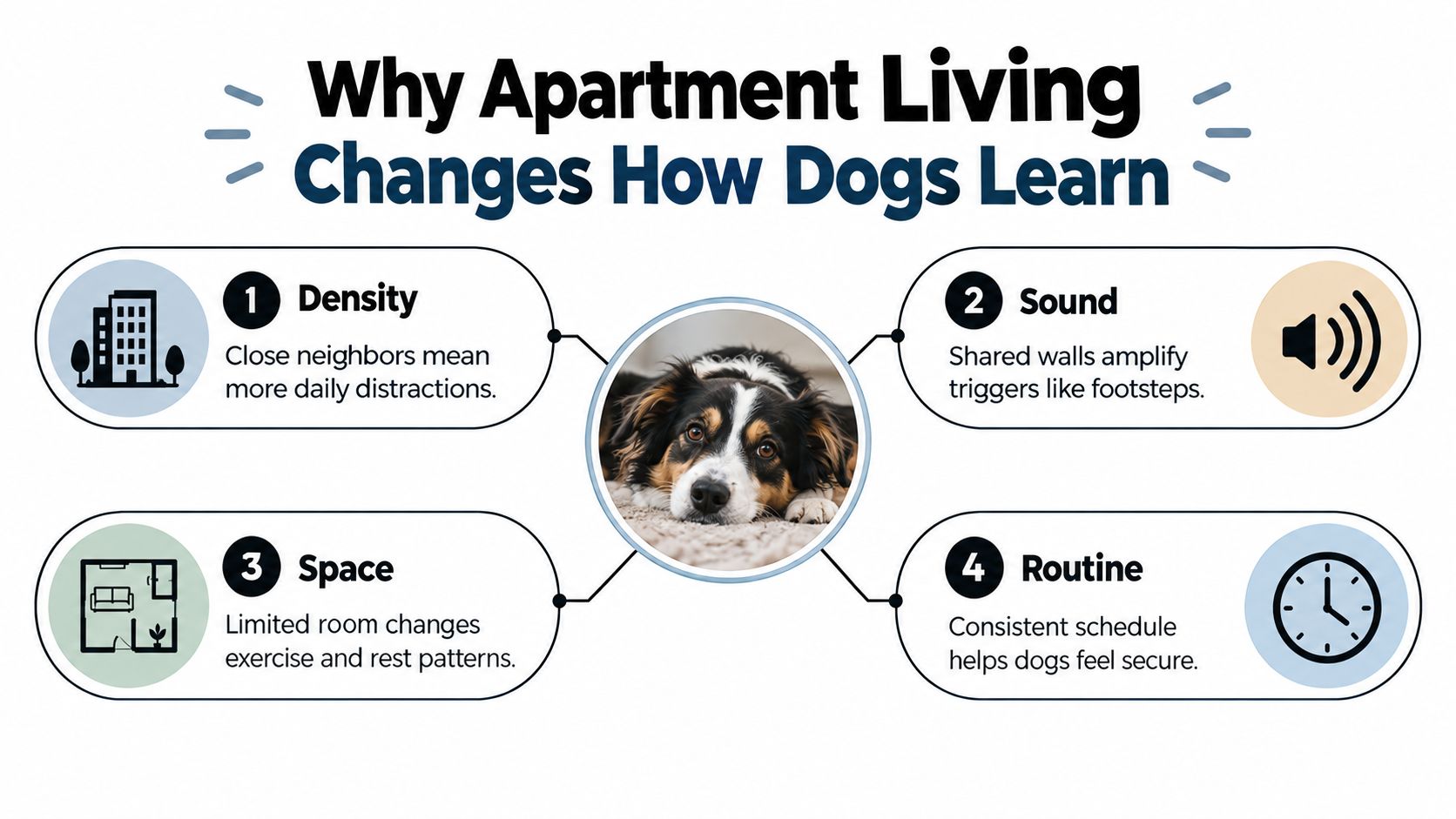
You are halfway to the elevator when its doors open. Your dog surges forward, notices a neighbor inside, and the leash tightens. In an apartment, these moments are part of the training environment. A private yard offers more control over space. A shared building brings footsteps, voices, doors, elevators, and nearby dogs into your dog's daily routine.
Those events become easier to handle when your dog learns what follows each one. Footsteps may predict a calm check-in with you, rather than a rush to the door. The lift bell may signal waiting at the threshold. A dog around a narrow corner may require a pause and extra distance. Because these triggers appear repeatedly, every reaction can rehearse a habit.
A published cross-national dog survey found that 55.8% of dogs in the sampled population lived in urban or suburban apartments, while 63% were left alone for more than 3 hours per day. It also reported that 59% took part in more than 1 hour of activity daily and 76% participated in two or more dog-training activities. The figures do not prescribe one schedule, but they show why apartment training must connect exercise, alone time, and daily learning. The published survey provides this urban-living baseline.
Threshold moments carry extra weight
A threshold moment is a transition where arousal can rise quickly. Examples include:
- The front door opening
- The elevator arriving
- A dog appearing around a corner
- A visitor knocking
- The owner picking up keys
- The leash being clipped on
Triggers can stack. Your dog might hear a neighbor, spot a dog in the lobby, and then enter a crowded elevator. The last event may produce a large reaction because earlier stress has already reduced your dog's ability to wait and think.
That makes impulse-control micro-skills more useful than trying to tire the dog out. Ask which transition needs a pause, a cue, or more space. A dog that waits at the doorway, checks in, and watches calmly may cope better than a tired dog that still rushes when the lift opens.
The survey found that 55% of dogs could reliably perform four or more tasks, supporting a practical apartment-training approach: repeated practice can build useful household obedience even with limited floor space. Train the dog in front of you, not the floor plan. A large dog may rest comfortably in a compact apartment, while a small dog may struggle with constant sound or frustration. Building routines, such as waiting at thresholds, settling after hallway noises, and using a quiet plan for barking or alone time, determine how manageable shared living becomes.
Housetraining and Crate Setup for Small Spaces
Housetraining in a high-rise has one extra step: your dog must get from the apartment to the appropriate outdoor spot before urgency wins. The elevator, hallway, and lobby are part of the bathroom plan, not obstacles you'll deal with later.
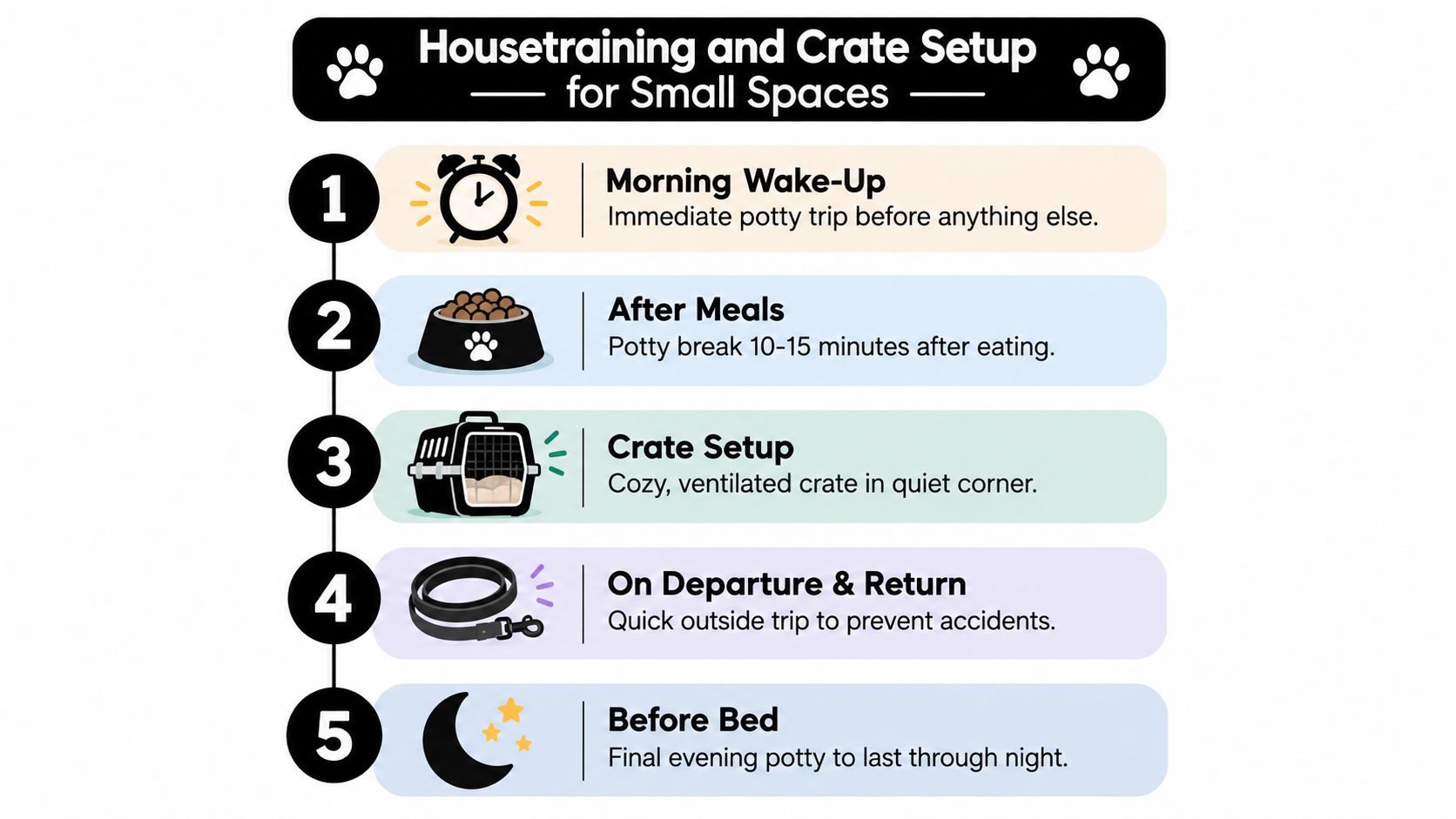
Start by connecting potty trips to predictable events. Take your dog out after waking, after meals, after active play, before a departure, after returning, and before bed. Puppies usually need closer supervision and more frequent opportunities than adult dogs, while an adult rescue may need time to show you their signals and adjust to a new routine.
Build a fast route
Choose the most direct path from the crate or sleeping area to the exit. Keep the leash, waste bags, shoes, and treats together so you aren't searching while your dog circles. If the building has a long corridor, practice moving calmly through it outside urgent potty moments, because a dog who only sees the hallway during emergencies may become frantic there.
Watch for individual signals:
- Sudden sniffing: Your dog may be searching for a place.
- Circling or pacing: Take the behavior seriously, even if it seems mild.
- Moving toward the exit: Reinforce that choice by going out promptly.
- Restlessness after a nap or meal: Treat it as a scheduling clue.
Clean accidents with an enzymatic product designed for pet odors. Ordinary surface cleaning may leave scent traces that encourage repeated investigation or marking. Don't punish an accident after the fact. Your dog won't connect a delayed correction to the earlier behavior, and fear can make future signals harder to notice.
Make the crate a quiet place
A crate should function as a resting den, not a penalty box. Choose a size that lets your dog stand, turn, and lie down comfortably, then place it away from a shared wall, busy entry path, or direct view of the front door. Ventilation matters, and the location should allow your dog to rest without being constantly interrupted.
Condition the crate in small pieces. Toss a treat inside with the door open. Feed part of a meal near the entrance, then farther inside. Close the door briefly while you remain nearby, open it before your dog becomes worried, and gradually vary the duration. A stuffed food toy can help create a positive association, but it shouldn't be used to push through panic.
Use this puppy crate-training guide for additional setup ideas, especially if your puppy resists confinement.
A simple apartment rhythm might look like this:
| Moment | Training priority |
|---|---|
| Wake-up | Go directly outside |
| Meal | Offer food, then prepare for a later potty trip |
| Midday | Combine a bathroom break with sniffing and calm observation |
| Departure | Potty first, then a safe resting activity |
| Evening | Practice one hallway or elevator skill |
| Bedtime | Take a final outdoor trip |
The schedule is a starting point, not a rigid test. If accidents happen, shorten the gap between opportunities and increase supervision. Consistency gives your dog a map, which matters more than achieving a flawless day.
Keeping Barking Neighbor Friendly in Close Quarters
Barking becomes an apartment problem when your dog gets repeated opportunities to practice it and the behavior affects people beyond your home. A bark at an unusual sound is different from a pattern of scanning, barking, pausing, and barking again whenever someone passes the door.
Cities have treated persistent barking as a practical nuisance rather than a vague annoyance. A New York reporting study described about 7,200 dog-related noise complaints per year over a five-year period and identified 431 buildings with verifiable barking complaints in a single year. Its definition of persistent barking was at least 10 minutes during the day or 5 continuous minutes at night. The New York reporting provides this complaint context and threshold.
The point isn't to frighten you. It's to train before barking becomes a rehearsed building-wide pattern.
Start with a seven-day record
Keep a simple diary for a week. Record the time, sound, location, what your dog did, how long recovery took, and what happened immediately before the bark. An official municipal guide recommends a detailed 7-day diary and advises owners not to reward barking, to teach a stop cue, and to identify the actual trigger. Use the municipal barking guide as a practical logging reference.
Your notes might reveal that the issue isn't “barking at everything.” It may be delivery activity near the door, footsteps during a particular quiet period, or dogs visible from a window. Once you know the pattern, change the setup:
- Block rehearsal: Close blinds or use privacy film if window movement triggers barking.
- Reduce access: Move furniture away from the front door if your dog patrols it.
- Prepare rewards: Keep small treats near the trigger area.
- Offer a station: Teach your dog to go to a mat when sounds occur.
- Protect recovery: Give your dog space after a startling event rather than adding more stimulation.
Reinforce the pause
Wait for the smallest break in barking, mark it with a calm “yes,” and deliver a treat away from the door or window. Over time, add a cue such as “quiet” only when your dog can already pause. Avoid shouting. To a dog, your raised voice may sound like participation in the alarm.
Practice low-intensity sound exposure with a hallway recording or a soft knock. Keep the volume low enough that your dog can eat, orient toward you, or settle. If your dog stops taking food, rushes to the door, or stays tense, lower the intensity and increase distance.
Quiet isn't passive. Place, settle, and orient-to-handler are replacement behaviors that give your dog a job. They also help you respond consistently when a neighbor's door closes or the lift machinery starts.
Hallway Elevator and Leash Skills for City Buildings
The building itself can become your training classroom, but only if you practice when your dog is below their reaction point. Start inside the apartment with a leash clipped on and no plan to leave. Reward your dog for standing beside you, looking at the leash, or choosing to sit. Then walk to the door and wait.
Use a repeatable exit protocol
Follow the same sequence each time:
- Approach slowly: Keep the leash loose before you touch the handle.
- Pause at the threshold: Ask for a wait, even if it lasts only briefly.
- Open a small gap: Reward your dog for staying behind the line.
- Scan the hallway: Step out only when the path is clear.
- Release calmly: Invite your dog forward rather than letting the opening pull them through.
If your dog surges, close the door or step back without a leash battle. The lesson is simple: rushing makes access pause, while calm behavior keeps the trip moving.
At the elevator, stand to the side instead of directly in front of the opening. Let passengers exit before your dog enters. If the elevator is crowded, wait for another one. A short delay is easier for everyone than forcing a worried dog into a small moving space.
Make leash equipment part of the plan
Equipment can change how pulling feels. A peer-reviewed study found that dogs pulled harder and more steadily when the leash was attached to a back-connection harness than when attached to a neck collar, particularly when food was the target. The study explains how attachment location affected pulling mechanics.
That doesn't make one piece of equipment universally correct. It means you should notice whether your setup accidentally makes forward pressure effective. Prioritize a calm pre-walk state, reward frequently during the first steps, and stop forward progress when the leash tightens. For a fuller practice sequence, use this dog leash training guide.
In a narrow hallway, reward your dog for noticing a neighbor and then looking back at you. If another dog appears, create distance before your dog lunges. Step into a doorway, turn around, or wait near a wall. Controlled observation is a city skill, and it's often more useful than trying to make every encounter social.
Practice door knocks and elevator sounds at low intensity inside the apartment. Pair the sound with a mat, a treat scatter, or a calm turn away. With enough easy repetitions, the hallway becomes familiar rather than a daily surprise.
Daily Enrichment Exercise and Calm Alone Time
Apartment dogs don't need every minute filled with intense physical activity. They need a balanced pattern of movement, sniffing, problem-solving, social contact when appropriate, and uninterrupted rest.
A useful day may include a purposeful sniff walk, a short session of leash or threshold practice, a food puzzle, and a protected nap. A chew or frozen food toy can occupy your dog while you work, but enrichment should match the dog's chewing style and be introduced safely. Rotate options so the activity stays meaningful without turning the apartment into a constant buffet of stimulation.
This mental enrichment guide for dogs can help you choose activities that use the nose and brain, not just the legs.
Treat alone time as a gradual lesson
Separation practice starts before the front door closes. Pick up your keys, sit down, and put them away. Walk to the door, return, and reward calm behavior. Later, step outside briefly and come back before your dog escalates. The duration should be short enough that your dog can remain relaxed.
Keep departures boring and returns calm. A frozen Kong or puzzle toy can help, but it won't solve panic if your dog is already too distressed to eat. Use a camera if possible so you can observe what happens after you leave rather than guessing from the condition of the room.
A dog who whines briefly and then settles may need more enrichment, a better routine, or gentler departure cues. A dog who panics, paces, drools, scratches at exits, vocalizes persistently, or stops eating when alone needs a slower plan and professional guidance. Confinement distress can also be different from separation distress. Some dogs struggle mainly with the crate or a restricted space, while others become distressed whenever the person leaves.
Apartment rule: Never use a full-length absence to test whether a worried dog will “get used to it.” Panic is not a training repetition.
Apartment living makes this work especially important because vocal distress can affect neighbors and become harder to manage once it's repeated. Build independence while you're home, protect sleep and recovery, and adjust the plan at the first signs of rising stress.
Troubleshooting Common Apartment Training Challenges
Use the problem's location and timing to choose your next exercise. Don't add more activity when the core issue is a doorway pause, and don't treat panic as ordinary boredom.
| What you notice | Likely training priority | First adjustment |
|---|---|---|
| Accidents after waking or meals | Housetraining timing | Shorten the route and leave promptly |
| Barking at the door | Trigger management | Log the sound, block rehearsal, reward pauses |
| Rushing into the elevator | Threshold control | Practice waits at the apartment door first |
| Pulling from the first step | Arousal and equipment | Calm the pre-walk routine and reinforce loose leash |
| Distress immediately after departure | Alone-time conditioning | Return to shorter absences and observe with a camera |
Track progress through behavior, not just silence. Your dog may recover faster after a sound, wait longer at the threshold, choose the mat without prompting, or accept a treat near the elevator. Those small changes show that the dog's response is becoming more flexible.
For the next week, choose one home skill, one building skill, and one independence skill. Practice the home skill during quiet moments, the building skill when the hallway is manageable, and the independence skill below your dog's stress threshold. If the behavior stays intense or worsens, ask a qualified trainer or veterinary professional for individualized support.
Your apartment doesn't have to be spacious to support a calm dog. It needs predictable routes, clear pauses, thoughtful trigger management, and training that respects your dog's temperament. A personalized plan can help match those steps to your dog's breed, age, environment, and specific challenges. PawCraft creates a 30-day program with daily exercises, progression guidance, and checklists for situations such as barking, leash pulling, and apartment living. Visit PawCraft to build a practical routine you can start using today.