At 6 p.m., your two-year-old Border Collie has already had a walk, a game of fetch, and plenty of attention. Somehow, he's still ricocheting around the living room, shredding a couch cushion while you stand there exhausted. You call his name, he grabs the leash, and the evening turns into another wrestling match.
That scene gets labeled “too much energy,” but the label often points at the wrong problem. Many high-drive dogs need physical activity, but they also need help lowering arousal, controlling impulses, and transitioning from action to rest. Dog training for high energy dogs works best when exercise, mental work, recovery, and impulse control operate as one plan.
Why High Energy Dogs Really Act Up
The dog in that living room may not be under-exercised. He may be over-aroused, with a nervous system that keeps choosing movement because nobody has taught him how to come back down.
Arousal shows up in recognizable ways: rapid panting that doesn't match the weather, hard staring, frantic scanning, jumping, mouthing, leash biting, and an inability to settle even when the environment is quiet. The dog can know a behavior in the kitchen and lose access to it completely outside. That isn't stubbornness. It's a sign that the dog has crossed the point where learning and decision-making are still available.
The threshold problem
Every dog has a threshold. Below it, the dog can notice a trigger, hear you, take food, and choose a trained response. Above it, the trigger takes over. A barking dog that won't eat a familiar treat isn't making a thoughtful refusal. He's telling you the training setup is too difficult.
Daily life pushes energetic dogs over that line constantly. The front door opens, a delivery person appears, children run through the hallway, a squirrel crosses the path, and the leash tightens before the handler has even responded. Rehearsing that sequence teaches the dog that frantic behavior is the fastest available outlet.
Practical rule: If your dog can't take food or orient toward you, stop adding commands. Create distance and reduce stimulation first.
Exercise alone can make the situation worse when it builds stamina without teaching recovery. A dog that spends every day chasing a ball at maximum speed may become better at demanding, anticipating, and escalating around the ball. Research on working dogs also supports the value of structured conditioning paired with arousal and performance work, rather than treating generic exercise as the complete answer. Research on fitness and leash-walk behavior describes pulling as a common walking problem and connects fitness work with reduced arousal and improved performance in working dogs.
The useful question isn't, “How do I wear this dog out?” Ask instead, “What activity helps this dog move, think, and recover?” That question produces a plan you can repeat tomorrow.
The Three Daily Pillars of an Effective Plan
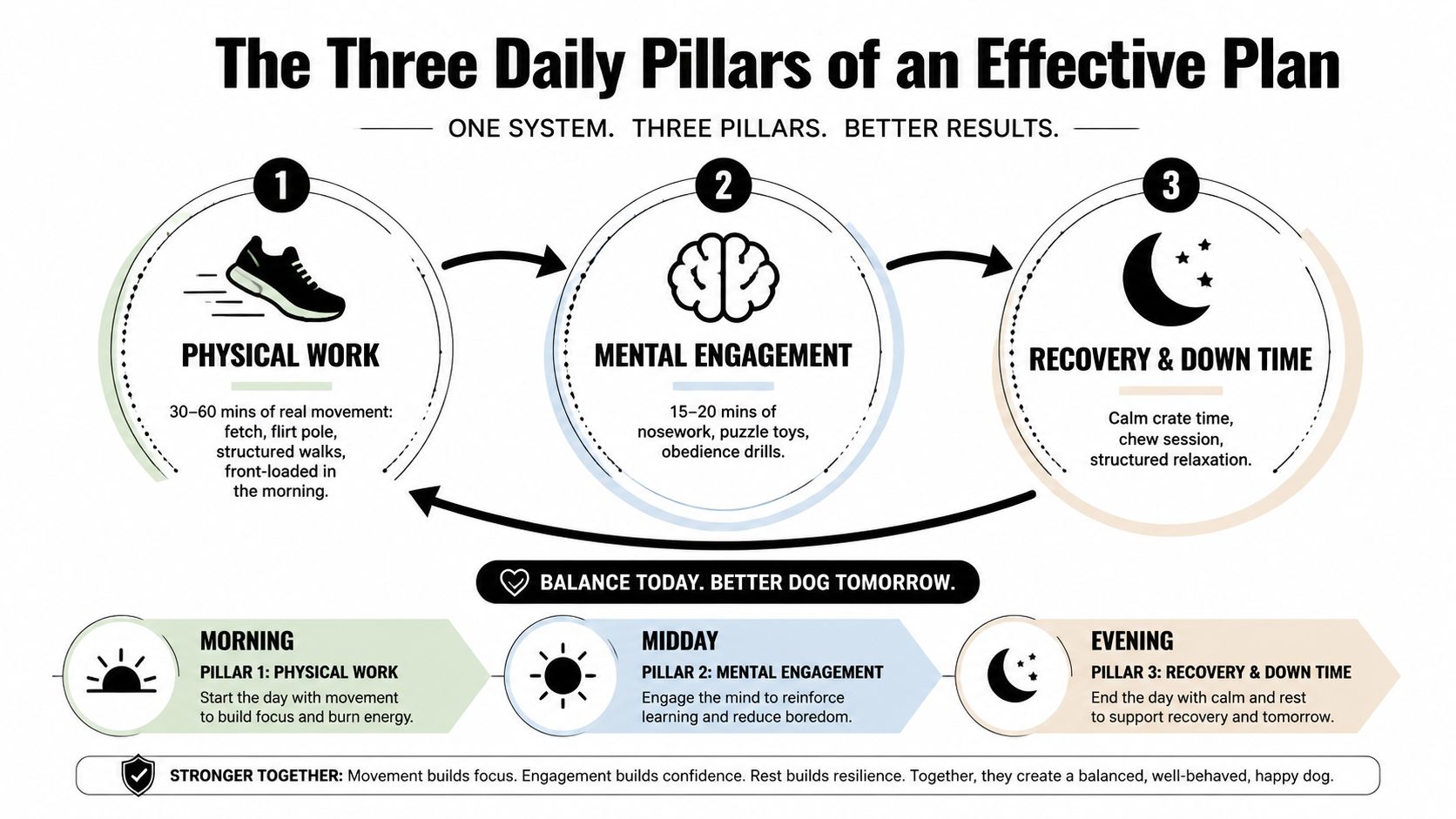
A high-energy dog needs more than a longer walk. Build the day around three connected jobs: physical work, mental engagement, and recovery with impulse control. Skip physical work and the dog may struggle to focus. Skip mental work and the body gets exercised without the brain being organized. Skip recovery and the dog learns to go from maximum excitement straight into household chaos.
Start with movement
Use real movement in the morning, before the dog has time to practice barking, pacing, or stealing household objects. Fetch with pauses, a flirt pole with clear release cues, hill walking, and a structured sniff walk can all work. The right choice depends on the dog's joints, fitness, and arousal pattern.
The point isn't to chase exhaustion. Finish physical activity while the dog can still respond to a familiar cue, then shift into a lower-intensity task.
Make the brain work
Follow movement with nosework, a food puzzle, a short search game, or obedience drills. Sniffing and problem-solving change the texture of the dog's effort. A dog that has used his brain to locate food or respond accurately often transitions more smoothly than a dog that has only sprinted.
Research summarized in a university-linked activity study gives useful context for planning. Dogs were ranked on a 1-to-5 energy scale, with 5 representing high energy and 4 representing medium-to-high energy, and movement patterns differed between non-overweight and overweight companion dogs, including time spent trotting, galloping, and walking on leash. The activity and energy research supports tracking how a dog moves rather than relying only on a breed label.
Teach the downshift
Recovery is active training. After exercise and mental work, offer a chew, calm crate time, or a mat settle in a quiet area. During the rest of the day, scatter short impulse-control repetitions through normal routines.
A realistic schedule might look like this:
- 7 a.m. physical work: Movement first, followed by a slower walk home and a food puzzle.
- Noon mental work: A short scent search, a few targeting repetitions, or a puzzle toy in a calm room.
- 6 p.m. impulse practice: Door manners, waiting for dinner, mat work, and a controlled transition into evening rest.
Keep the sessions short enough that the dog succeeds. The pillars reinforce one another, so don't compensate for missed training by creating a marathon session later.
Teaching Impulse Control That Actually Sticks
Impulse control grows through repeated choices, not through a single long “settle” lesson. Start with situations your dog already finds exciting, but make the first version easy enough that the dog can win.
Build polite exits
At the front door, ask for a sit before clipping on the leash. If the dog holds the sit, attach the leash and reward. Reach for the handle, pause, and reward again if the dog remains grounded. Open the door only while the sit holds, then use a release word such as “free.”
If the dog lunges, don't argue or yank. Close the door, wait for the leash to soften, and reset the repetition. You're teaching that access to the outside comes through control, not force.
For meals, lower the bowl while the dog waits. If the dog breaks position, lift the bowl calmly and try again. Put a brief pause between the bowl reaching the floor and the release word, then reward eye contact before giving permission to eat.
Turn a mat into an off-switch
Place a mat several feet from the action. Lure the dog onto it, mark the instant all four paws land, and deliver the treat on the mat. Gradually reinforce a relaxed posture, then use the mat after a game, a greeting, or a walk.
Begin with a calm-down that lasts only long enough for the dog to succeed. Add duration before distance. Add distance before distractions. Introduce a real distraction only when the dog can recover easily at the current level.
Reward timing matters more than most owners realize. Say your marker word the instant the correct behavior happens, then deliver the treat within roughly half a second. Start with ordinary kibble for simple repetitions and upgrade to chicken, cheese, tug, or a favorite toy when the environment becomes harder.
The dog shouldn't have to guess which moment earned the reward. Mark the behavior first, then pay it.
Research on trained dogs found that greater combined training experience was associated with faster learning on an inhibitory-control task, while scent-work dogs showed stronger inhibitory control and persistence than pet dogs. The peer-reviewed study on training and inhibitory control supports short, repeated cognitive practice rather than assuming physical exercise will solve impulsivity.
Stop before the dog blows past threshold. Three successful repetitions are more useful than fifteen frantic ones.
Loose-Leash Walking for Dogs That Pull Like a Locomotive
Loose-leash walking starts with equipment and body position, not with repeated corrections. Use a standard 4-to-6-foot leash, a well-fitted front-clip harness, or a properly introduced head halter for a committed puller. Skip the retractable leash while you're teaching the baseline, because constant length and tension make the target behavior harder to understand.
If you're comparing collar materials or training setups, this guide to metal dog training collars can help you think through the equipment choice without confusing gear with the behavior plan.
Stand with your dog near your left hip. Hold the treats near your sternum, not dangling ahead of the dog's nose, and keep the leash in the opposite hand. The starting picture is simple: slack leash, dog near your side, handler moving predictably.
Walk five steps. The instant the leash goes slack, mark and feed at your hip. Feeding at your hip matters because it brings the dog back to the position you want, instead of rewarding a forged-ahead position. Repeat five-step chains until the dog offers slack reliably, then build toward longer chains before changing direction.
Reset tension without a fight
The moment the leash tightens, become a tree. Stop moving completely, keep your shoulders quiet, and wait. Look back rather than down, because bending toward a pulling dog can add attention and physical pressure. When the leash drops, mark, reward near your hip, and continue.
Layer distractions slowly. Start in an empty driveway, then work near a parked car, then a person at a generous distance, and finally a squirrel or moving dog. If the dog locks onto a trigger, switch direction early and create space instead of waiting for the explosion.
A recent comparison of collars and harnesses found that different tools changed pulling and welfare outcomes, while class-based research found that owner intervention reduced vocalization, pulling, and attention toward triggers more than no intervention. The research on leash tools and handler intervention points to a practical conclusion: distance, timing, and handler behavior matter as much as the device.
Quit after three failed repetitions at the same level. That pattern means the setup is too hard. Move back to the last successful distance and rebuild.
Adjusting the Plan for Breed and Age
“High energy” describes a training challenge, not a complete genetic profile. A Border Collie, Jack Russell Terrier, Labrador Retriever, and adolescent mixed breed may all pull, jump, and fail to settle, but they may need different outlets and different rewards.
Herding breeds often need a job with rules. Named retrieves, a flirt pole with a clear release cue, directional games, and scent searches usually offer more useful structure than repeating unrestricted running. Reward eye contact, responsiveness, and stopping, not only speed.
Terriers tend to bring strong chase and tug preferences. Use short prey-style repetitions, then trade the toy cleanly for food or restart the game on cue. Praise alone may not compete with the environment, so use tug or a chase-based reward when the dog needs a powerful reason to disengage.
Sporting breeds can become over-social and over-petted during training. Keep rewards precise. Feed for the behavior you want, then release the dog to retrieve, sniff, or move instead of turning every correct response into prolonged handling.
Adolescents under 18 months need extra care. Keep formal sessions to about three minutes maximum, choose lower-impact work such as swimming or hill walks, and avoid forced retrieves until growth plates close. Seniors benefit from scent games, trick training, and controlled movement over distance running.
| Group | Session Length | Best Reward | Exercise Swap |
|---|---|---|---|
| Herding breeds | Short, repeated work blocks | Named toy games or food | Structured retrieve and scent tasks instead of repetitive sprinting |
| Terriers | Brief prey-style repetitions | Tug, chase, or food trade | Controlled flirt-pole work instead of unrestricted chasing |
| Sporting breeds | Moderate skill blocks with clear releases | Retrieve, food, or sniff access | Retrieval with pauses instead of endless throwing |
| Adolescents under 18 months | About 3 minutes for formal sessions | Food, play, and exploration | Swimming or hill walks instead of forced retrieves |
| Seniors | Gentle, low-impact sessions | Food, scent access, and calm interaction | Nosework and tricks instead of distance running |
For a broader framework on changing expectations as dogs mature, use this guide to training adult dogs, especially when a dog's physical capacity and emotional regulation no longer match puppy-era assumptions.
Troubleshooting When Progress Stalls
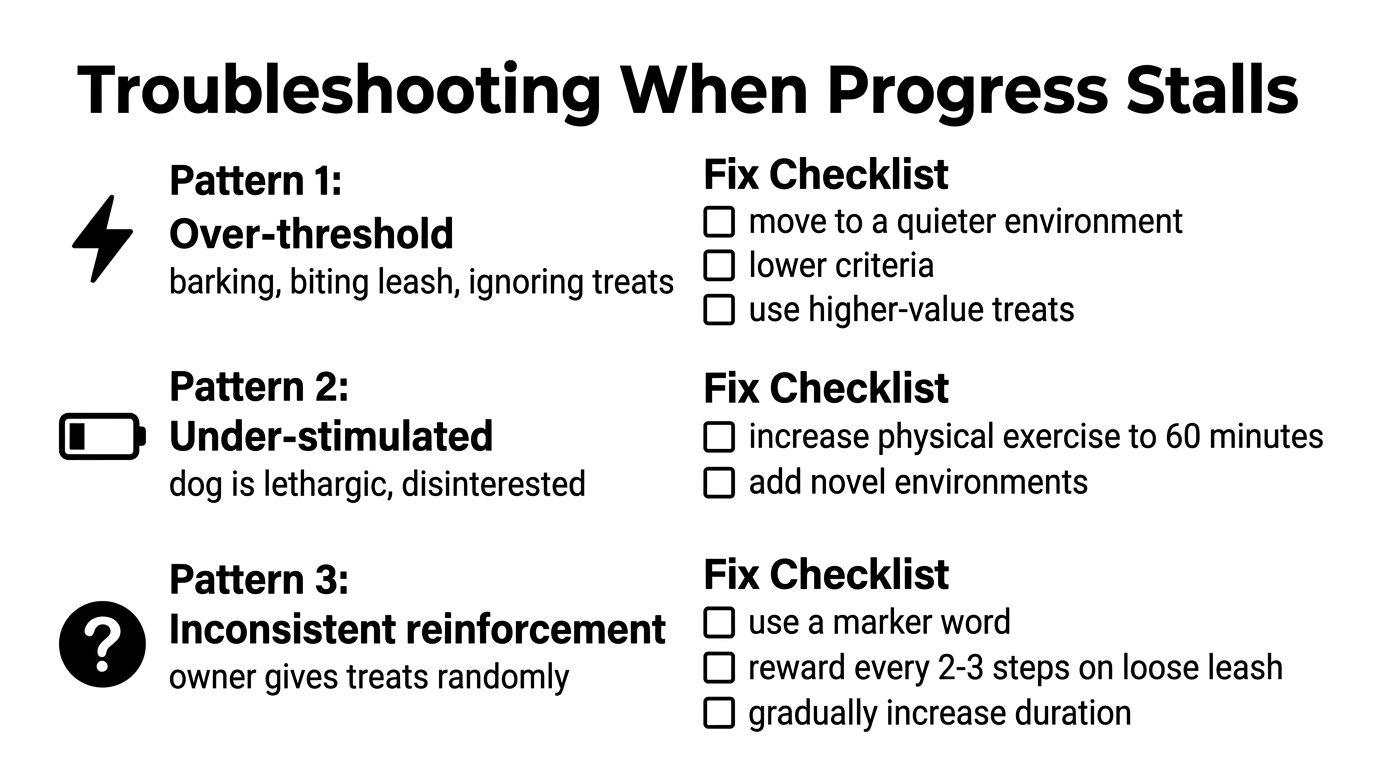
Progress usually stalls for a reason you can observe. Don't add more commands until you identify whether the dog is overloaded, under-challenged, or learning that reinforcement is unpredictable.
The dog is over threshold
Barking, leash biting, frantic scanning, and refusing food are clear warning signs. End the outing rather than trying to overpower the reaction. Return next time with half the difficulty, such as more distance, fewer triggers, a quieter route, or a shorter exposure.
Avoid confrontational handling. In an Ohio State review of owner-reported training techniques, aversive tactics including alpha rolls, yelling, forced release, grabbing the jowls, and shaking triggered aggressive responses in at least a quarter of the dogs they were used on, while reward-based training triggered aggression in very few dogs. The Ohio State review of training methods supports reducing arousal, teaching a low-distraction alternative, and reinforcing calm behavior rather than punishing an overwhelmed dog.
The dog is under-challenged
A dog that looks lethargic or disinterested may need more variety, not a longer route. Add scent trails, food searches, novel but manageable environments, or a purposeful job. Keep physical work appropriate for age and soundness, then observe whether the dog can recover afterward.
Reinforcement keeps changing
If you reward every third response, then praise the next one, then offer nothing for several successful repetitions, the dog gets an unclear payment history. Feed every correct response during a rebuilding period, using a marker word before the food. Fade rewards only after the behavior is reliable in the current environment, and reduce payment gradually rather than randomly.
If your dog works only when treats appear, the behavior isn't ready for fading. This dog behavior modification plan is useful for organizing criteria, reinforcement, and environmental management around a specific problem instead of chasing symptoms.
Your First 30 Days and What Success Looks Like
Treat the first month as a controlled build, not a test of how much stimulation your dog can survive.
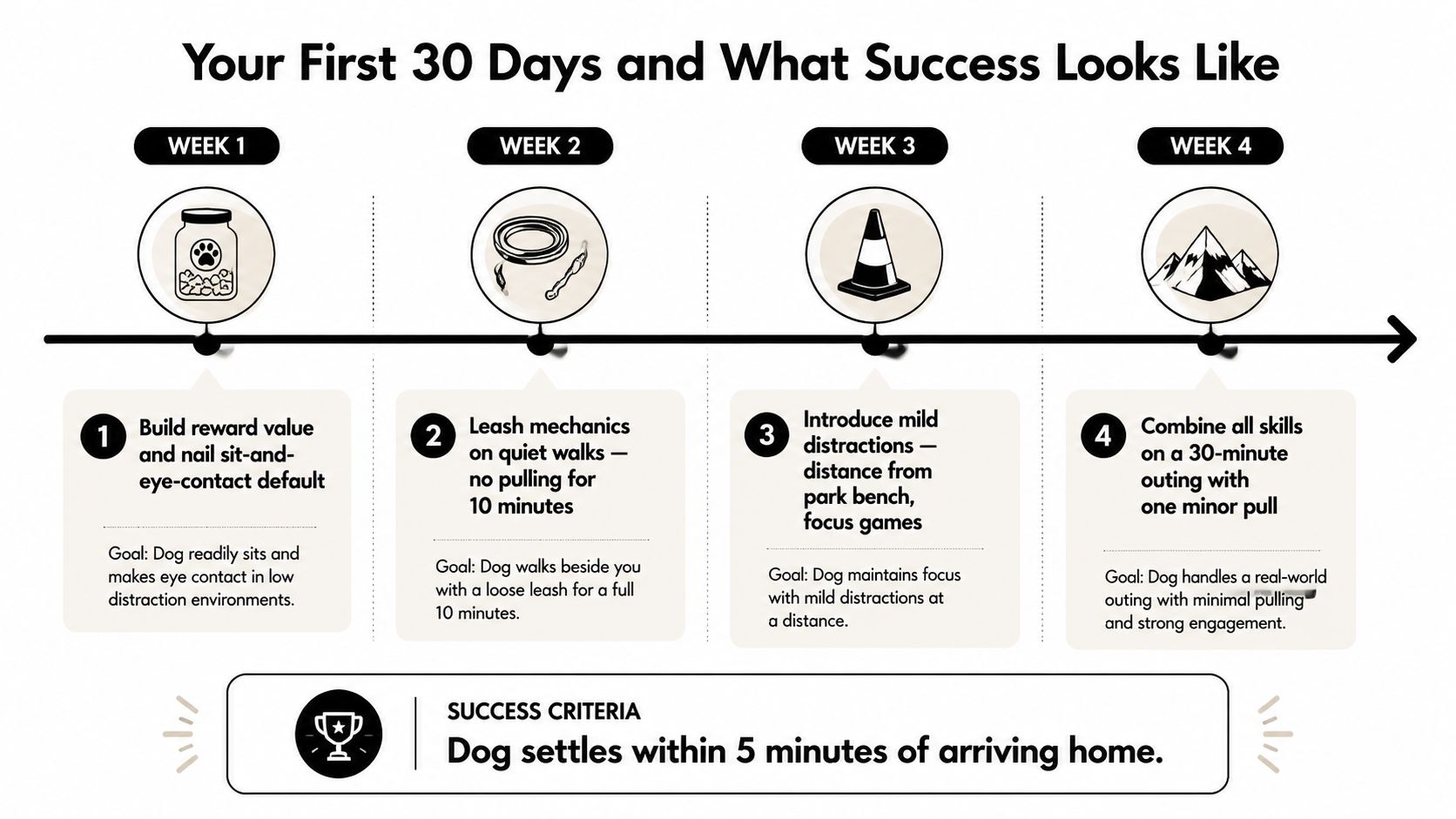
Week 1 is about reward value and default behavior. Teach the dog that checking in, sitting, and orienting toward you produce useful consequences. Work indoors and in quiet outdoor spaces.
Week 2 adds leash mechanics on calm streets. Reinforce slack leash, short check-ins, and easy direction changes. Don't judge the dog by a busy park yet.
Week 3 introduces mild distractions, such as another dog at a generous distance or a person near a quiet bench. Expect some regression, especially in a young adolescent dealing with fear or hormonal changes. Reduce difficulty instead of labeling the dog unreliable.
Week 4 combines the skills in a realistic setting, perhaps a quiet café patio or a familiar neighborhood route with controlled exposure. Success means fewer mid-walk explosions, quicker check-ins, and a faster transition into rest at home. It doesn't mean perfect behavior in every environment.
Use a clear quit rule. If the dog shuts down, barks repeatedly beyond 8 repetitions, or refuses treats, the session is over. That doesn't mean the training day is ruined. End calmly, meet the dog's needs, and make the next session easier.
Arousal control is a long project, and this month is only a starter structure. Consistency beats intensity because every calm repetition gives the dog a clearer alternative to frantic behavior.
PawCraft creates a personalized 30-day dog training program based on your dog's breed, age, environment, and behavior challenges, with day-by-day exercises, progression steps, and weekly checklists. Complete the brief questionnaire and visit PawCraft to get a practical plan for leash pulling, barking, poor recall, or impulse control.