You're standing on a quiet sidewalk with a new puppy at the end of a fully taut leash. The puppy has stopped to sniff, your shoulder is already tense, and neither of you knows whether to wait, move, call, or pull. That first walk often feels like a test you didn't study for.
The better approach starts before the sidewalk. In the first week, leash work may mean clipping a short lead to a well-fitted harness for thirty seconds indoors, rewarding a glance in your direction, and ending while the puppy is still relaxed. No traffic, greetings, or passing dogs are needed. The aim is to teach the puppy what the leash means before the outside world competes for attention.
Your First Leash Walk Without the Chaos
An outdoor walk is usually the worst classroom for loose-leash mechanics. The puppy has scents, movement, people, dogs, sounds, and open space to process. If the leash concept is brand new, those distractions can push the puppy past the point where food, praise, or your voice matters.
Start during a calm play window, not immediately after the puppy has become frantic with energy. Clip the leash to the harness, let the puppy notice it, and reward calm movement. Walk only a few steps across the room, then pause. You're not trying to create a perfect heel. You're teaching the puppy that staying connected to you makes good things happen.
Beginners often miss the first signs of progress because they're waiting for a long, polished walk. Look for smaller changes instead:
- The puppy voluntarily returns to your side after investigating.
- The line becomes slack for two or three steps.
- The puppy chooses eye contact instead of scanning the room.
Those moments are the raw material of reliable leash behavior. Mark them with a click or a quiet “yes,” then deliver the reward immediately beside your leg.
Trainer's rule: Weeks one and two are about building the reflex before the walk, not surviving the walk.
Leash pulling deserves early attention because it can involve considerable force. A 2024 study recorded a largest pulling event of 412.5 N, while half of participants experienced leash tension of at least 125 N during routine at-home walks, and leash walking also increased stride-time variability compared with walking alone. Those findings, reported in the real-world leash-tension study, help explain why early training affects both handling and walking stability.
Your first "walk" might be a calm loop around one room. That isn't a failure. It's the first repetition your puppy can understand.
The Gear and Treat Setup That Actually Works
Good equipment reduces friction, but it doesn't teach the behavior by itself. Choose each item according to the puppy's body, movement, and current skill rather than buying a tool marketed as a complete solution.
Fit the puppy before choosing control
A Y-front or front-clip harness is a practical starting point for many puppies still learning balance. Check that the straps sit clear of the shoulders and that you can fit two fingers between the harness and the puppy's chest. Recheck the fit regularly as the puppy grows. If the puppy is frightened by equipment, introduce it gradually with food instead of forcing it over the head.
A collar can work for identification and calm, already-trained dogs, but it isn't my first choice for teaching a puppy that regularly leans into the leash. Research summarized in a 2024 review of leash equipment found that dogs in one comparative study pulled significantly more on a martingale collar than on several other tested options. That result doesn't mean equipment replaces training. It means the setup can change how much physical opposition you're managing.
For more detail on collar choices, see this guide to metal dog training collars, but avoid treating any collar as a substitute for reinforcement and careful progression.
Use a standard 1.8 m, or 6 ft, leash for ordinary practice. A longer tracking line is useful later for controlled recall and distance work, but it creates too much slack and clutter for early indoor repetitions. Skip retractable leashes during foundation training. Their constantly changing length makes it harder to teach a clear difference between slack and tension.
Make reinforcement fast and precise
Keep pea-sized, soft treats in a waist pouch or bait bag. Your treat should arrive within about one second of the correct behavior. A clicker can work, but a consistent verbal marker such as “yes” is easier when your hands are busy.
Use this simple arrangement:
- Keep the treats in your left hand.
- Hold the leash in your right hand.
- Mark the instant the leash loosens, the puppy looks at you, or the puppy moves with you.
- Deliver the treat beside your leg, not several steps ahead.
During active walking practice, a frequent reinforcement rhythm of roughly one treat every three to five seconds can help a beginner puppy understand the game. If you reward ten seconds after the leash went slack, you may pay for sniffing, pulling, or turning away instead. Gear gives you safer handling. Timing creates learning.
A Day-by-Day Leash Training Progression
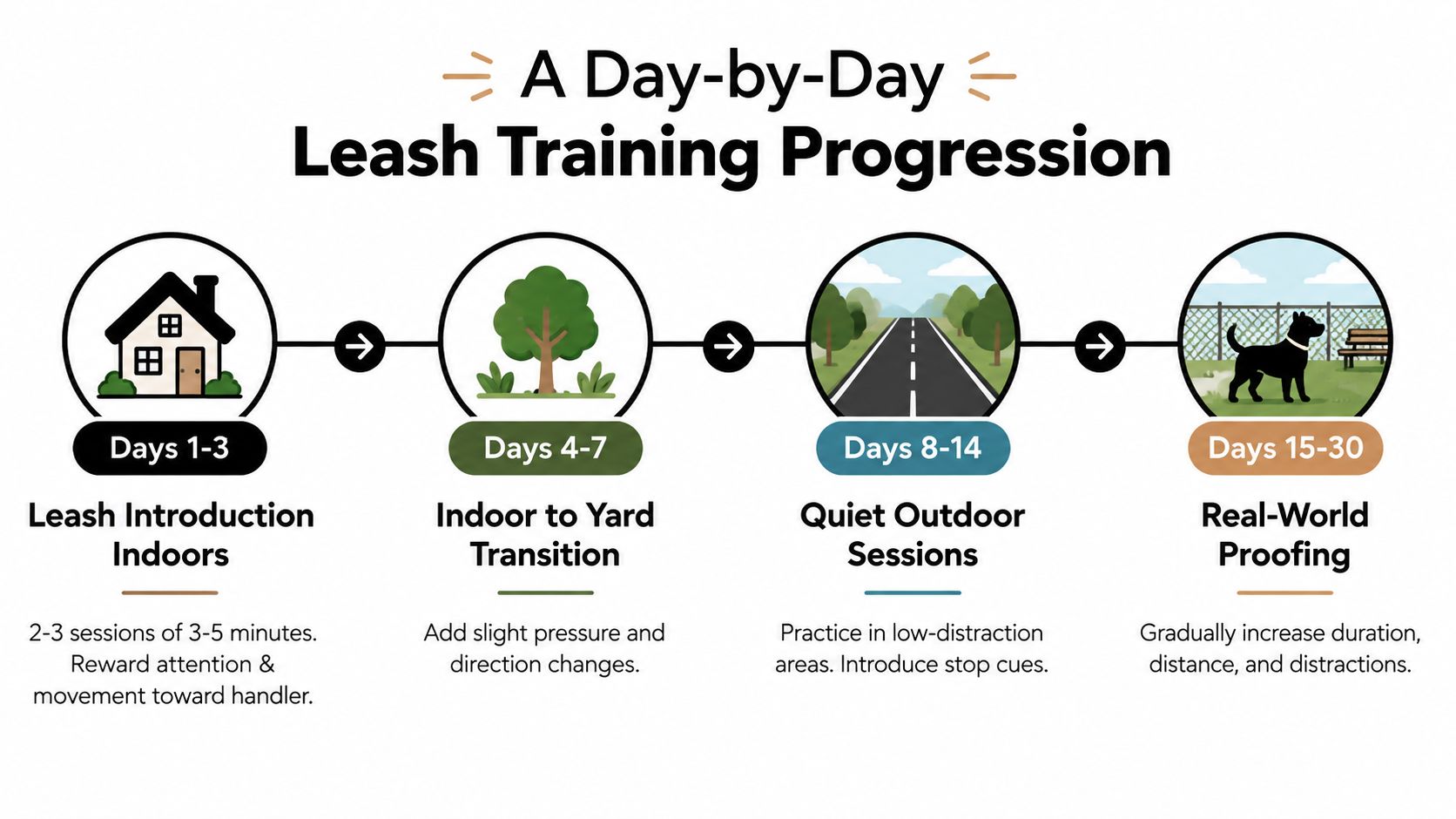
A useful month-long plan changes the environment only after the puppy can perform the behavior in the current one. The fastest controlled university protocol in the available comparison reached loose-leash mastery in an average of 8.75 training intervals, about 43.75 minutes, while the next-best method averaged 12 intervals, about 60 minutes. The practical lesson from that leash-training comparison is simple. Short, repeated practice beats one exhausting session.
Days 1 to 3
Work indoors with the leash attached for two or three sessions of three to five minutes. Reward attention, movement toward you, and any voluntary slack. Don't deliberately create leash pressure yet. Say “with me” as the puppy starts moving beside you, mark the correct step, and pay immediately.
Keep the route tiny. A few steps from the kitchen to the living room can produce useful repetitions without competing distractions.
Days 4 to 7
Add the cue “let's go” or “with me,” then use a soft food lure briefly to guide the puppy through a low-distraction room or fenced yard. Run three or four sessions of five to eight minutes. Your first meaningful criterion is a full minute of sustained slack, not a formal heel position.
If the puppy pulls toward a smell, stop before the leash becomes a route to that smell. Wait for slack, mark it, and resume. Forward movement is part of the reward, but it must follow the behavior you want.
Days 8 to 14
Move to a quiet driveway, calm path, or empty cul-de-sac. Keep sessions close to ten minutes and introduce three response patterns:
- Stop before tension appears when you see the puppy speed up.
- Change direction when attention drops, using “this way.”
- Reward eye contact before moving toward anything interesting.
The puppy doesn't need to ignore the world. The puppy needs to check back in with you.
Days 15 to 30
Add mild distractions first, then busier routes. Extend walks toward fifteen minutes only when the puppy can still eat, respond, and recover quickly after noticing something. Use an 80% success rule as a practical guide. If the puppy succeeds on roughly four out of five opportunities, make one part of the exercise harder. If success falls below that, reduce distance, duration, or distraction.
The clearest advancement signal is not a calendar date. Move forward after three consecutive sessions in which the puppy offers the target behavior without being prompted. Hold the current phase when the puppy needs constant luring, stops taking food, or begins pulling repeatedly.
Common Mistakes That Quietly Sabotage Progress
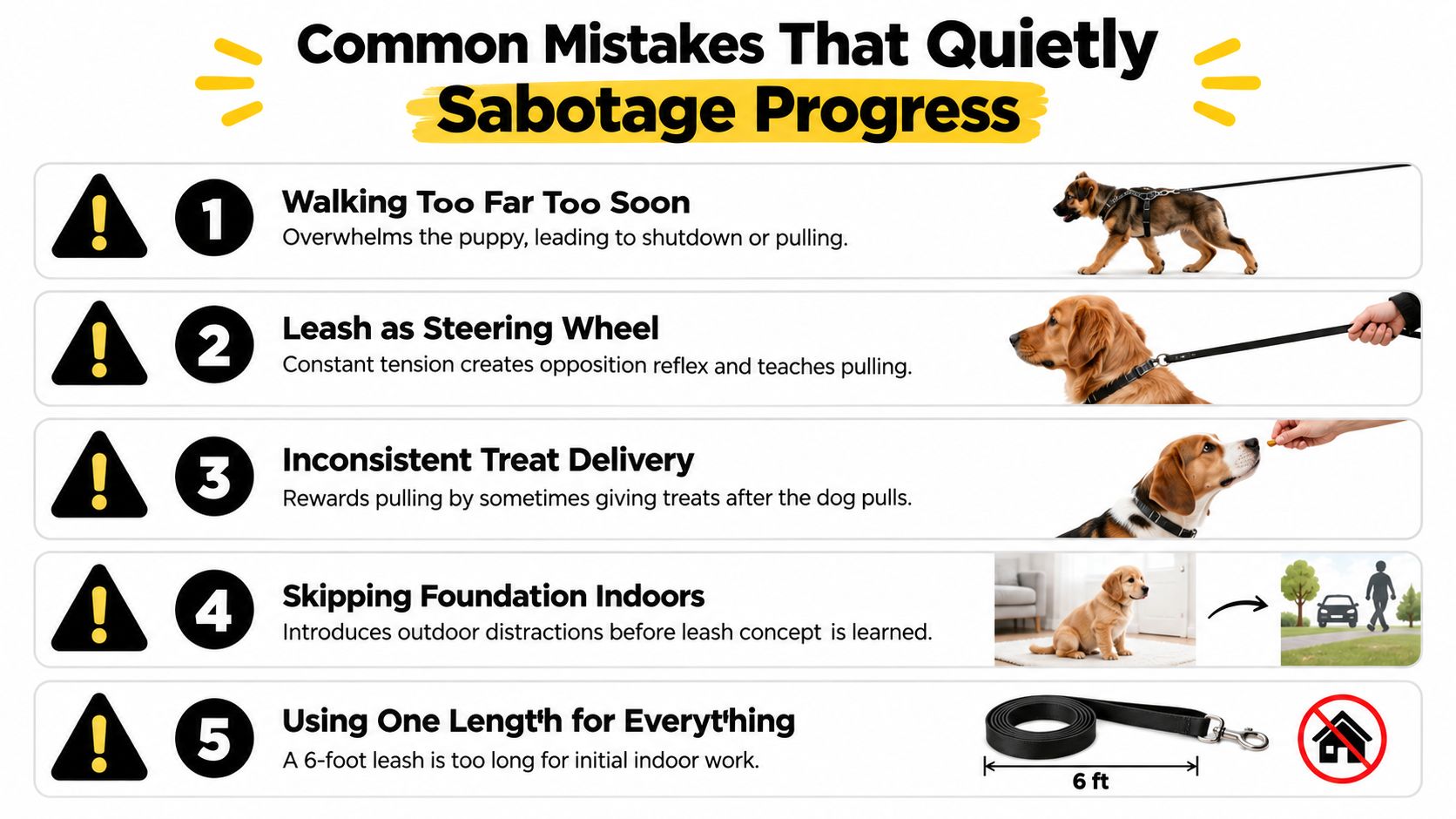
The biggest mistake isn't using the wrong phrase. It's allowing the puppy to choose the session length and difficulty. A puppy that has lost the ability to respond isn't being stubborn. The environment has become harder than the current skill can support.
Five corrections that matter
Walking too far too soon turns a training outing into sensory overload. Cap early practice at roughly one house-length or less, then return while the puppy is still successful. Distance is an advanced variable, not proof that training is working.
Using the leash as a steering wheel teaches the puppy to lean into pressure. Keep your hand soft and let the leash function as a safety line. Change direction with your feet and reward the puppy for following.
Delivering treats inconsistently creates accidental reinforcement. If the puppy pulls and sometimes receives food, attention, or access to a smell, pulling remains a useful strategy. Mark the instant tension disappears, then pay.
Calling the puppy's name to stop pulling can weaken the name association. Reserve the name for attention and recall, then use “this way” or “let's go” for movement changes.
Stopping rewards too early is common when owners see a few successful walks. Continue paying generously through the first three weeks of practice before gradually reducing treat frequency. Replace some food rewards with access to sniffing, movement, or a brief play break, but keep reinforcement in the picture.
A shelter-dog observational study recorded leash pulling during 86% of walks, which is consistent with the broader lesson in the observational leash-behavior research. Pulling is common because it often works. The handler must change what pulling produces.
The useful question isn't “How do I make the puppy obey?” It's “What level of difficulty lets the puppy make the right choice?”
If the puppy succeeds indoors but unravels outside, that's usually an intensity mismatch, not a character flaw. Move somewhere quieter, shorten the session, increase reinforcement, or create more distance from the distraction.

Troubleshooting Pulling and Reactivity
Pulling has different causes, so the same correction won't solve every case. A puppy dragging toward a tree needs a different plan from a dog barking at another dog or lunging at a skateboard.
| Cause Pattern | Tell-Tale Symptom | Primary Fix |
|---|---|---|
| Excitement pulling | The puppy surges toward scents, people, or movement | Play “find it” with tossed treats before the trigger arrives |
| Frustration | Barking or straining because access is blocked | Increase distance and use hand-targeting pattern games |
| Fear | Lunging away or toward skateboards, strangers, or unfamiliar dogs | Avoid forced greetings and work below the fear threshold |
| Learned pulling | The puppy has practiced pulling for weeks and keeps moving forward | Reset with stationary food and resume forward motion only after calm behavior |
For excitement, scatter a few treats on the ground before the puppy reaches the interesting object. This gives the nose a job and creates a predictable pattern. For frustration, increase distance early, before barking starts, then reward hand touches and check-ins.
Fear requires more caution. A front-clip harness may improve handling while you change the training plan, but it doesn't make forced exposure safe. Avoid greetings the puppy can't manage, and leave enough distance for the puppy to notice the trigger without losing access to food.
For learned pulling, return to a stationary treat-on-the-floor exercise. Place the treat down, wait for the puppy to settle, and require a calm sit or slack leash before forward movement resumes. The puppy learns that calm behavior restarts the walk, while pulling pauses it.
Use equipment when physical management is the immediate problem. Change the plan when the puppy is too aroused, frightened, or distracted to learn. Those are different decisions.
If the dog's reaction toward another dog concerns you, use this resource on stopping aggressive behavior toward other dogs. Bring in a certified force-free professional if sustained lunging intensifies past week three, or if the reaction includes growling or snapping toward people.
Adapting the Plan to Breed, Age, and Environment
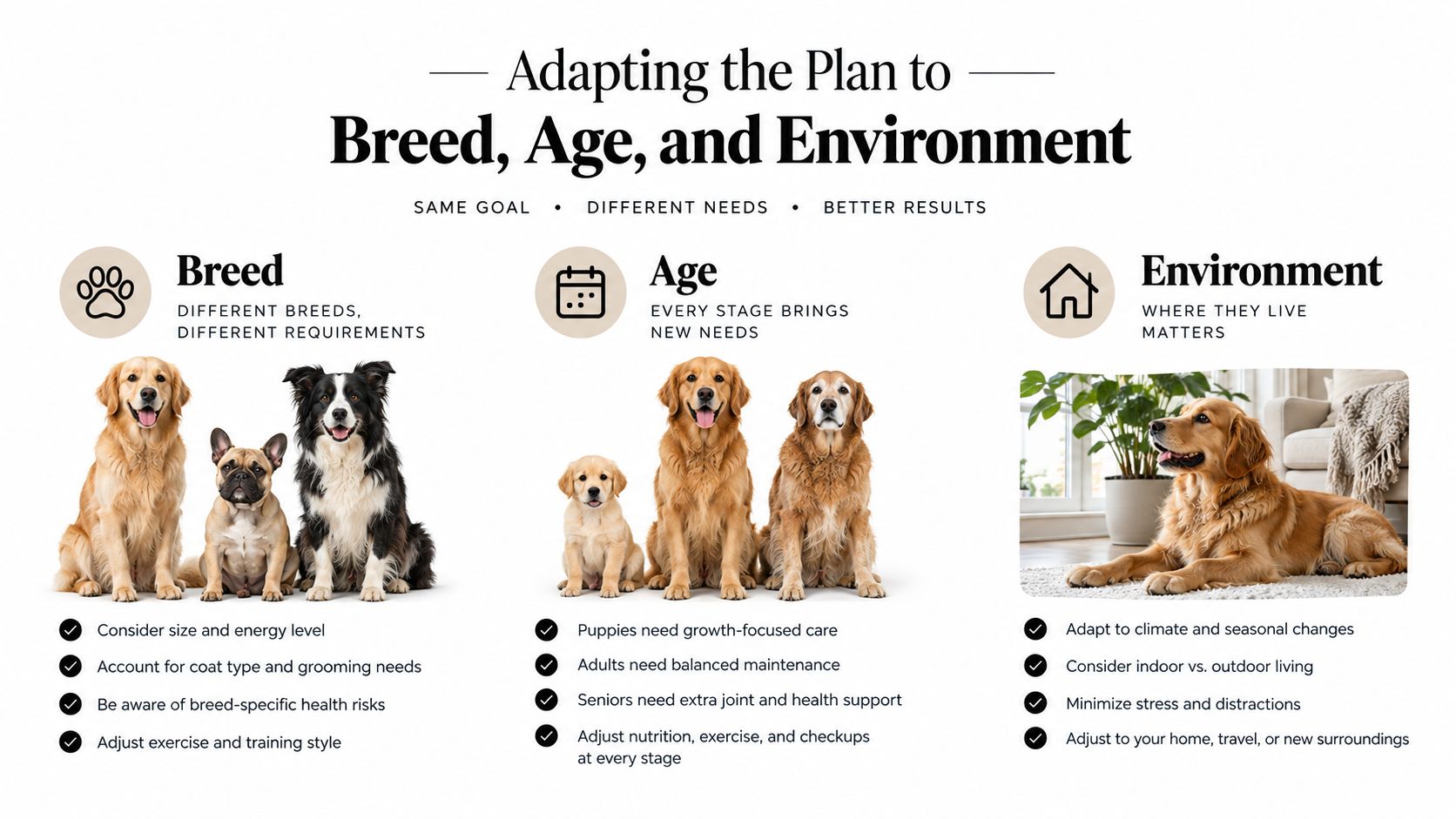
A generic leash plan fails when it treats every puppy as if the same setting creates the same difficulty. The right adjustment depends on the puppy's drive, physical development, and daily surroundings.
Herding breeds and terriers often need faster session rotation and a higher treat rate because their arousal can rise quickly around movement. Brachycephalic puppies may need slower, shorter outings with regular water breaks. Giant-breed puppies need frequent harness-fit checks as their bodies change, with particular care around shoulder movement and pressure.
Age changes the practical workload too. Puppies under ten weeks may learn more from two three-minute sessions than from one ten-minute walk. During teething weeks, choose lower-impact surfaces such as grass over pavement when possible, and prioritize calm connection over distance.
Let the home environment set the first location
Apartment owners often need to build skills in hallways, entry areas, and building stairwells before attempting a busy sidewalk. Those spaces still contain sounds, doors, elevators, and neighbors, but they allow tighter control over distance and escape routes.
Suburban owners face the opposite trap. A large yard can give a puppy too much freedom too early, so deliberately create low-distraction practice with a short lead. A quiet driveway may be more educational than an open lawn because it encourages the puppy to notice your movement.
Decision rule: Match the day's distance, duration, and distractions to the puppy's weakest area, not its strongest.
If the puppy can walk calmly for a long time but cannot pass a person, reduce distractions before increasing duration. If the puppy handles people but tires quickly, shorten the outing. If the puppy stays engaged indoors but loses focus outside, keep the outdoor route simple and pay more often.
A personalized structure can help owners make those trade-offs consistently. PawCraft generates a 30-day dog training plan based on breed, age, environment, and behavior challenges, with daily exercises, progression guidance, and success criteria.
Your 30-Day Recap and What Comes Next
By the end of a well-structured month, a puppy should be showing useful foundations: attention to its name, loose-leash movement indoors, calmer loose-leash work outside, more neutral pass-bys, and a sit before crossing a curb. Those skills don't need to look perfect. They need to appear reliably enough that you can adjust the environment instead of wrestling with the leash.
Use the same proof points throughout the plan. The puppy advances when it offers the behavior without prompting across three consecutive sessions. It stays in the current phase when it needs constant luring, stops taking food, or loses the ability to recover after a distraction.
Week five is not the end of training. Layer in a dependable recall, a place cue, and a polite door greeting. Leash manners become easier when the puppy also knows how to disengage, settle, and wait. A broader dog behavior modification plan can help organize those skills when leash work exposes a deeper behavior pattern.
Keep one focused ten-minute session each week, plus two brief check-ins during real walks. Most regressions come from owner drift, not dog failure. Return to the last successful level, reward the behavior you want, and rebuild from there.
PawCraft creates personalized 30-day dog training plans that adjust leash exercises for your puppy's breed, age, environment, and behavior challenges. If you want clear daily steps and progression rules instead of generic leash advice, visit PawCraft and create a plan for your dog.