Your dog holds a sit beautifully while you stand three feet away in the living room. Then the doorbell rings, a visitor steps inside, or a squirrel darts across the sidewalk, and the “stay” disappears. That doesn't mean your dog is stubborn or untrained. It means the behavior hasn't been taught to withstand real interruptions yet.
The most reliable answer to how to teach stay to a dog isn't drilling one long hold in one quiet place. It's building a clear behavior in small layers, paying the dog before they make a mistake, and teaching them that remaining in position still works when the environment changes.
Why Stay Is Really About Interruption Resistance
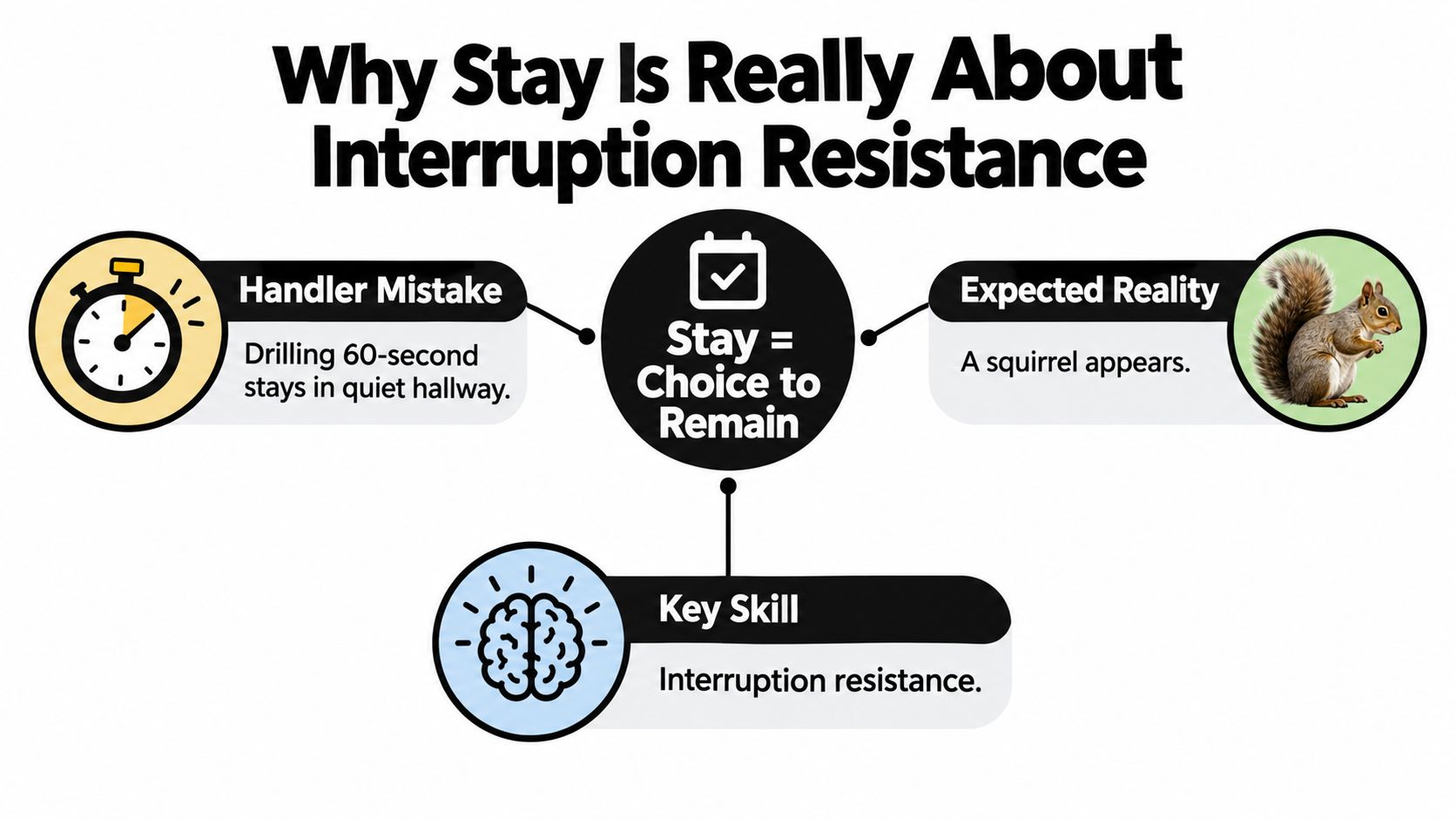
Stay is the choice to remain in position while something competes for your dog's attention. A dog may hold a 60-second stay in a quiet hallway and still break when a squirrel appears, a doorbell rings, or someone walks past. Understanding the cue and resisting an interruption are separate skills.
The competing event may be exciting, frightening, socially rewarding, or more interesting than the treat in your hand. The quality that keeps the dog in place is interruption resistance, and it matters more in daily life than a long hold in an easy room.
Cornell's veterinary guidance defines stay as holding a position until the handler returns or releases the dog. Wait usually means pausing briefly before moving on. That distinction makes stay useful for guests entering, crossing streets, and controlled pauses during walks. The guidance recommends starting with a sit or down, pausing for only 1 to 2 seconds, rewarding, then adding duration and distance one step at a time. Cornell's guide to teaching stay describes that progression.
The three variables that matter
Every stay contains three training variables:
- Duration: How long the dog remains still.
- Distance: How far you move away.
- Distraction: What changes around the dog.
Raise one variable at a time. A dog that holds for several seconds beside you may fail as soon as you add distance. A dog that succeeds across the room may break when a family member walks past, even though the duration stays the same.
Self-control also has limits. Research summarized by Cornell examined trained dogs held in a stay for 10 minutes before an unsolvable persistence task. In one experiment involving 13 dogs, the stay group gave up faster than the control group. A second experiment involving 22 dogs found that a glucose drink restored persistence, suggesting that prolonged self-control can affect later behavior. Cornell's summary of canine self-control research explains why marathon sessions may backfire.
Use short, successful, well-reinforced repetitions instead of endurance contests. Build an explicit proofing ladder, moving from duration to distance to carefully chosen interruptions, and lower the difficulty when the dog's self-control is depleted.
Dogs that struggle with impulsive movement in other exercises may benefit from these dog impulse control exercises, which support the same foundation without making every session a stay drill.
Setting Up Your First Stay Reps
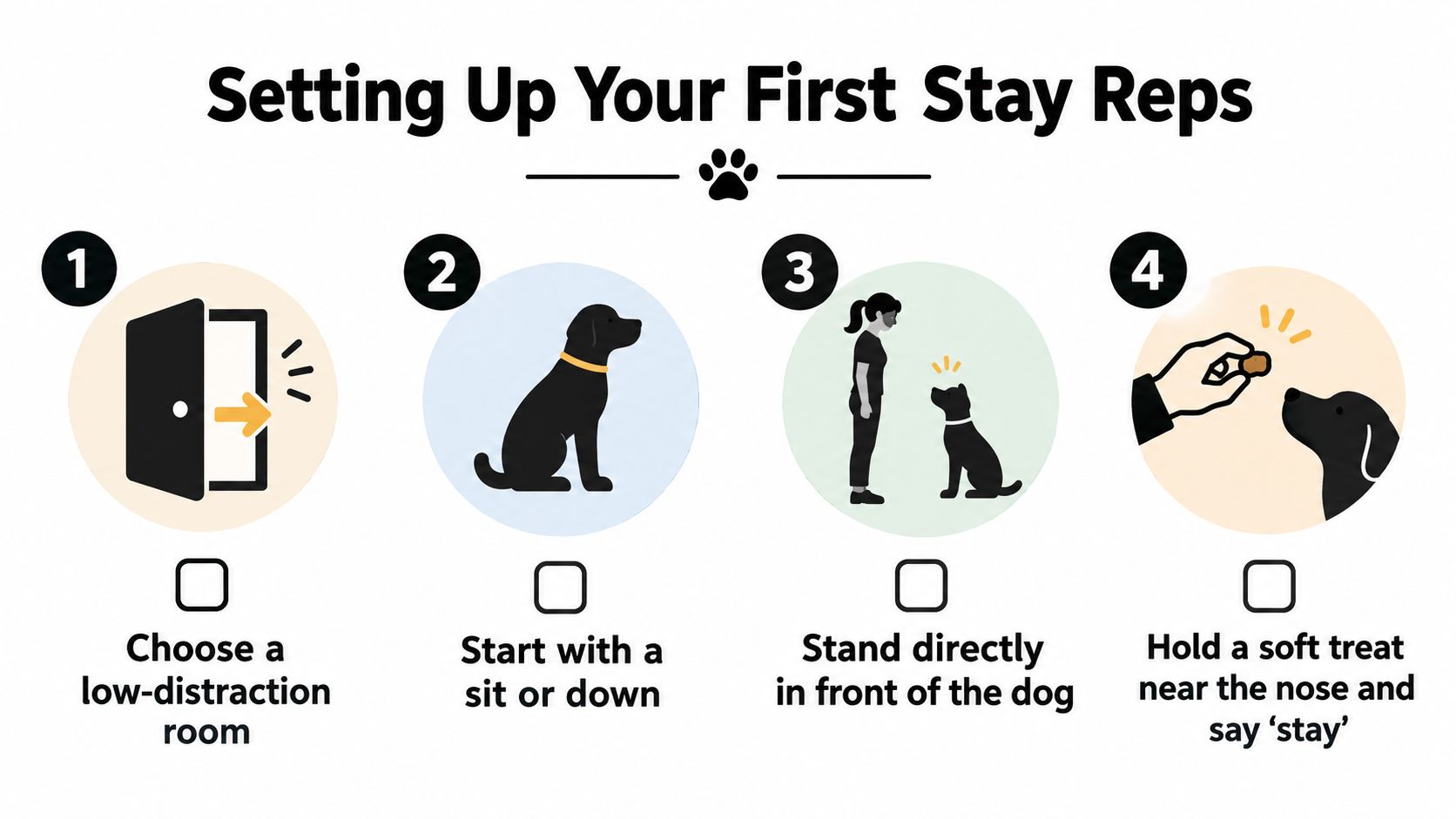
Start indoors, in a room where your dog already feels comfortable and the floor isn't slippery. Put away toys, separate other pets, and choose a time when nobody needs to walk through the space. Your first session should feel almost boring. That's a feature, not a flaw.
Ask for a sit or down, then stand directly in front of your dog. Hold a soft treat near their nose without waving it around, say “stay” once in a calm voice, and pause for 1 to 2 seconds before marking success with “yes.” Deliver the treat while the dog is still in position.
The first five repetitions
Use this opening pattern:
- Rep one: Ask for sit or down, say “stay,” count to two, mark, and feed.
- Rep two: Count to three, mark before movement, and feed.
- Rep three: Count to five, then mark and feed.
- Rep four: Count to seven only if the earlier repetitions were calm.
- Rep five: Repeat an easier duration, rather than automatically making the final repetition harder.
Stop after five successful repetitions for the first session. A first session should take under three minutes, including resets and rewards. Ending while the dog still wants to participate protects the behavior from sloppy final attempts.
Your marker must happen before the dog moves. If you wait until the dog stands, creeps, or turns toward you, you may accidentally reinforce the movement instead of the stay. Keep your shoulders upright and avoid bending over the dog. Leaning forward can act like an invitation, especially for a dog that expects hands, food, or social contact to move toward them.
Timing rule: Mark the stillness you want, not the recovery after your dog has already broken.
Cornell's veterinary recommendations also support starting with very brief holds and building gradually. The practical details are in this marker training guide for dogs, which can help you make the “yes” meaningful before you raise the difficulty.
A short demonstration can help you notice details such as hand position, posture, and reward placement:
Keep the setup consistent at first:
- Use one room: Don't add a new location before the dog understands the basic pattern.
- Use one surface: A stable floor makes body position easier to maintain.
- Remove competing rewards: Toys, food bowls, and other pets can create accidental distractions.
- Reset cleanly: After feeding, release the dog, then begin again rather than dragging them back into position.
The early goal isn't impressive duration. It's teaching the dog that “stay” predicts calm stillness, a quick marker, and a reward delivered before they move.
Building the Duration Distance and Distraction Ladder
Once the first repetitions are easy, build a proofing ladder. The safest rule is simple: change one variable, then return to an easier level before changing another. If you increase duration, keep distance and distraction steady. If you step away, shorten the hold.
A useful working threshold is 8 successful repetitions out of 10 at the current level before you advance. That isn't a law of learning, but it gives you a practical decision point. If the dog fails, return to the last level that felt fluent instead of repeating the failed version until the dog gives up.
Cornell's veterinary guidance describes stay as a three-part skill involving duration, distance, and distraction. It recommends increasing time gradually before adding distance and practicing in real-life contexts so the dog learns that the behavior applies beyond the original room. The detailed veterinary behavior guidance supports that stepwise approach.
A practical progression
Use the following ladder as a starting framework. Treat each entry as a separate training target, not a demand to complete the entire row in one session.
| Level | Duration | Distance | Distraction | Urban Setting |
|---|---|---|---|---|
| Foundation | 2 seconds | Half step back and return | Handler faces dog | Quiet room |
| Early build | 5 seconds | One full step | Handler turns sideways | Apartment hallway |
| Developing | 10 seconds | Three steps | Handler walks in a circle | Lobby |
| Intermediate | 20 seconds | Across the room | Family member walks past | Elevator lobby |
| Advanced | 45 seconds | Out of sight for 1 second | Treat on floor six feet away | Quiet sidewalk |
| Proofing | 90 seconds | Out of sight for 10 seconds | Doorbell or another dog visible | Sidewalk with more activity |
The distance ladder should remain controlled. Take a half step back and return, then one full step, then three steps, and only later cross the room. Out-of-sight work comes after the dog understands that your disappearance doesn't automatically end the behavior.
Distractions need their own progression too. Start by turning sideways, then walk in a circle, ask a family member to pass, place a treat on the floor six feet away, add a doorbell ring, and eventually work with another dog visible. Don't combine a new distraction with a new distance unless the current level is already dependable.
Apartment handlers can use the lobby, elevator lobby, and a quiet section of sidewalk. Practice during low-traffic hours before testing busier periods. These step-by-step dog training principles are especially useful when your available training space is small but challenges happen outside.
Choosing Rewards That Speed Up Learning
Food usually speeds up early stay learning because it can be delivered quickly and precisely, without asking the dog to move toward you. That timing matters most when you are teaching the dog to resist interruptions rather than hold still in a quiet room.
A benchmark summarized by the International Association of Animal Behavior Consultants Foundation compared food, verbal praise, and petting during sit-stay learning. Dogs rewarded with food reached 10 sit-stays in a row in about 5 training blocks on average, compared with 12 blocks for verbal praise and 13 blocks for petting. In that benchmark, food cut acquisition time by more than half compared with the other two rewards.
Praise still has a place. It may be enough once the behavior is fluent, but a dog learning stay around movement, sounds, or other dogs often needs a reward with greater immediate value.
| Reward Type | Strength | Weakness | When to Use |
|---|---|---|---|
| Food treats | Fast, clear, and easy to place while the dog stays still | Some dogs become overly focused on the hand | Early teaching and difficult distractions |
| Verbal praise | Convenient and socially rewarding | May not compete with movement or environmental interest | After the behavior is fluent, or paired with food |
| Petting | Useful for dogs who enjoy calm contact | Touch can make a dog lean, creep, or stand | After release, or with dogs who remain settled during contact |
Match the reward to the proofing level. Use ordinary kibble for maintenance once stay is familiar, soft training treats for regular practice, and a higher-value option such as freeze-dried chicken when distractions are strong. If the dog fails repeatedly, increase reward value or reduce the challenge. Do not keep repeating the same difficult setup.
Place food low and calmly, preferably between the front paws or close to the mouth. This supports stillness and avoids pulling the dog toward your hand. Save enthusiastic petting for after the release unless you have already confirmed that touch does not disturb the position. During early duration work, even a cheerful hand moving toward the dog can become the interruption you are trying to proof.
Release Cues and Keeping Stay Honest
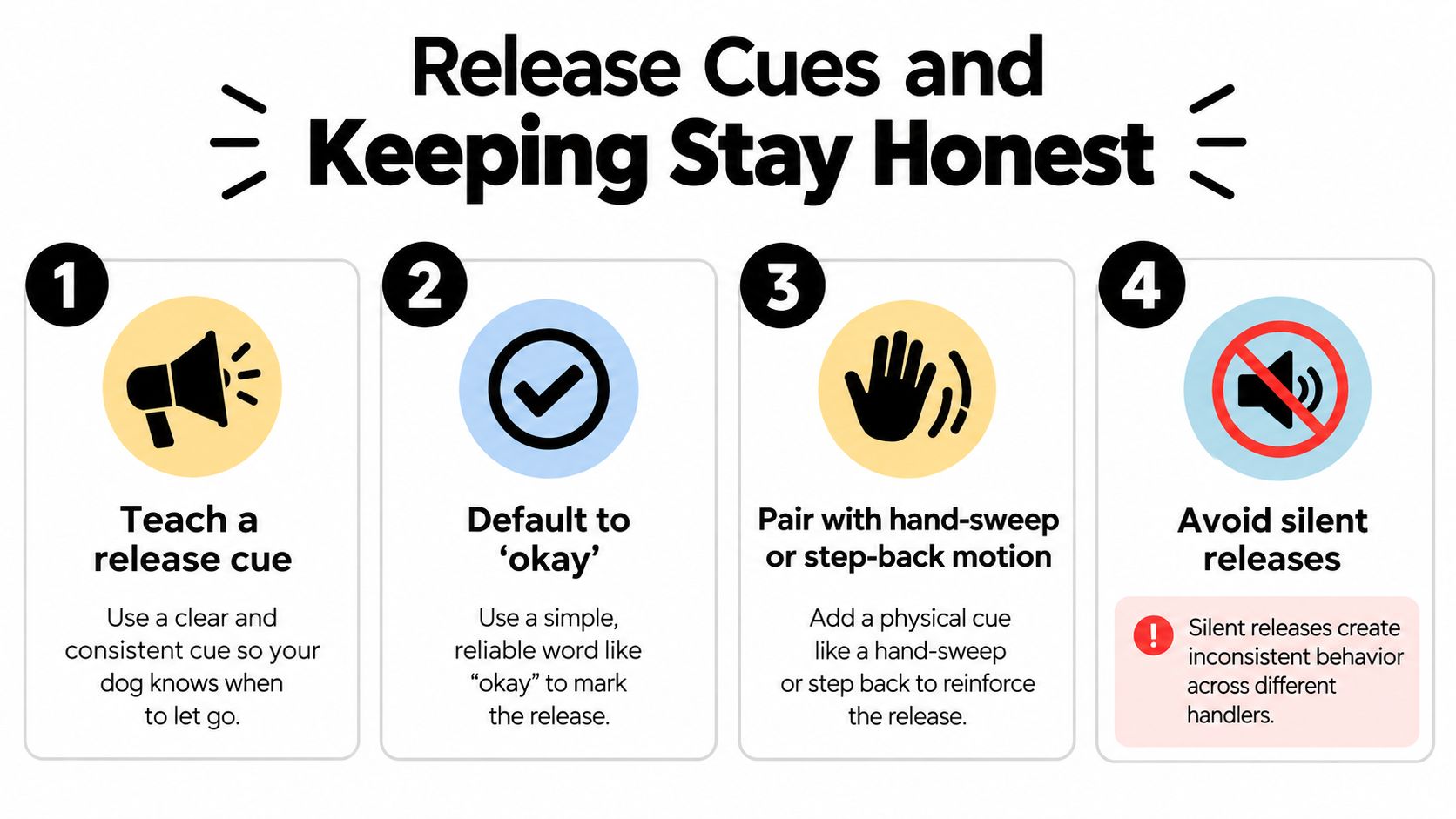
A stay needs a clear ending. Without a release cue, different family members will finish the exercise in different ways. One person may step away, another may reach for the collar, and a third may stop paying attention. The dog then has to guess when movement is allowed.
Choose one default release word, such as “okay,” and pair it with the same physical signal every time. A small hand sweep or a step-back motion works well. Say the release cue only after you've delivered the reward for staying, then invite movement.
Feed before the dog moves
One of the most useful habits is delivering the treat before the release. If you wait until the dog breaks, the dog may learn that standing up is what makes food appear.
Use this sequence:
- Ask for sit or down.
- Say “stay.”
- Wait for the planned interval.
- Mark while the dog is still.
- Feed in position.
- Say “okay.”
- Add the hand sweep or step-back signal.
- Let the dog move.
If the dog gets up after the marker but before the food reaches them, make the next repetition easier. Don't scold, and don't turn the mistake into a chase. The behavior becomes clearer when the reward arrives while the dog is still where you asked them to be.
The research summarized by Cornell also shows why self-control deserves respect. Prolonged staying can draw on broader self-control mechanisms, so repeating difficult holds without recovery can weaken later work. Finish a session after two clean wins in a row, even if the dog could theoretically continue. If you see four errors in one block, reset to the last reliable threshold rather than pushing harder.
Freshness comes from thoughtful variation, not constant escalation:
- Change locations: Move from the living room to a hallway, then to a quiet outdoor area.
- Keep the release predictable: Use “okay” consistently while the dog is learning, then introduce context-specific release cues only when the first cue is solid.
- Add recovery: Give the dog a quiet sniff or short rest between demanding holds.
A reliable stay ends because you release the dog, not because the dog runs out of patience.
Troubleshooting Common Stay Problems
Most stay failures aren't mysterious. They tell you exactly which part of the training plan is too difficult, too weakly reinforced, or poorly timed.
Breaking before two seconds
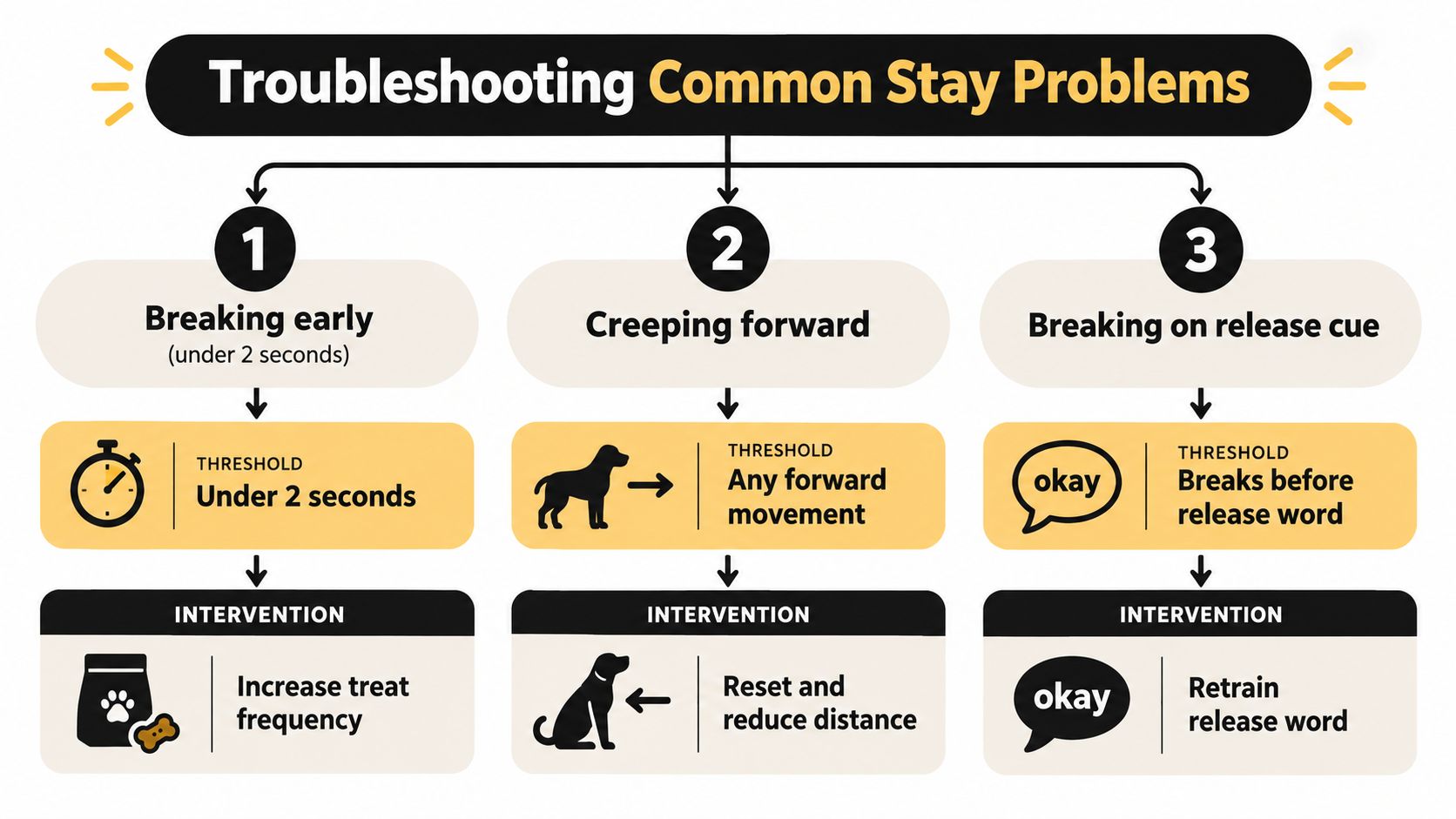
If your dog breaks under 2 seconds, the reward rate has probably collapsed for the current setup. The dog may not yet understand that stillness earns food, or the treat may be too weak to compete with the environment.
Return to a food lure position near the dog's nose. Say “stay,” count briefly, mark immediately, and feed. Use several easy repetitions before adding even a small amount of time. If the dog is distracted by the room itself, remove toys, close the door, and work with the dog facing away from visual activity.
Restlessness after three or four seconds
Restlessness often appears as paw movement, leaning, creeping, or repeatedly checking your hand. That usually means duration has been increased while your body position or distance has also changed.
Reset to within arm's reach and keep your feet still. Ask for a shorter hold, feed before the dog shifts, and then release. Once the dog settles, add duration without stepping away. Later, add a small distance change while returning to an easier duration.
Problems tied to age or body position
Young puppies need short, manageable practice. For puppies under 5 months, prioritize down-stays when appropriate and avoid asking for prolonged upright positions that may strain developing joints. The plan should fit the puppy's body and attention span, not an adult dog's benchmark.
Older dogs may need a veterinary check if staying, sitting, rising, or walking suddenly becomes uncomfortable. A dog that breaks because they're physically uneasy needs a health assessment and a training adjustment, not repeated cues.
Handler errors matter just as much:
- Pre-empting the release: If you reach for the treat or move your hand in a way that predicts freedom, deliver the food first and release second.
- Retreating into the dog: Step away from the dog's line of movement, not toward their front feet. If your body crowds them, shorten the distance.
- Releasing on failure: Don't say “okay” after the dog stands. Reset with an easier repetition, then use the release cue after a successful hold.
A clean reset teaches more than a correction. When the dog repeatedly succeeds at the easier level, the original failure pattern loses its payoff.
Your 30-Day Stay Training Milestones
A month-long plan works best when each week has a checkpoint rather than a vague promise of reliability. The targets below are practical benchmarks, not a test your dog must pass on schedule.
Week one
Work in a low-distraction room. Build 3-second holds at 1-foot distance, using 10 to 15 repetitions per session. Keep the dog close, reward in position, and practice the release cue consistently.
If your dog breaks repeatedly, stay at this level. A dog who needs another week isn't behind. They're giving you information about the current difficulty.
Week two
Introduce mild handler movement and work toward 10-second holds at 3 feet. Walk only a small distance, return promptly, mark, feed, and release. Keep the room quiet while the dog learns that your movement doesn't automatically end the stay.
High-drive or adolescent dogs may plateau here. That's common in practical training, especially when movement is more reinforcing than food. Shorten the hold, improve the reward, and alternate easy repetitions with carefully chosen challenges.
Week three
Add real-life events such as dropped keys and another person walking past. Build toward 30-second holds at 6 feet, but don't add both the hardest distraction and the longest duration in the same repetition.
Practice one household distraction at a time. If the keys cause a break, hold duration steady and reduce distance. If distance causes the break, remove the distraction and rebuild the movement separately.
Week four
Combine duration, distance, and mild household noise, working toward a 60-second hold at 10 feet. Include door movement, quiet conversations, or normal activity only after the dog has shown success with each component separately.
Older or low-energy dogs may exceed these benchmarks, while energetic dogs may need more time at earlier stages. Assess the dog's weekly checkpoint. Advance when the current level is steady, repeat the week when it isn't, and remember that consistency matters more than speed.
PawCraft creates a personalized, day-by-day 30-day dog training plan based on your dog's breed, age, environment, and behavior challenges, which can help turn these stay milestones into a routine that fits your household. Visit PawCraft to generate a plan with daily exercises, progression guidance, and weekly checklists.