You call your dog from the living room, and they trot over before you've finished the word. Then you step outside, say “come,” and get nothing but a twitching ear while your dog follows a scent, watches a bird, or pulls toward another dog. That contrast is frustrating, but it usually isn't stubbornness or a broken relationship.
Listening is a behavior your dog learns in specific contexts. A cue practiced beside the sofa may not yet mean the same thing on a busy sidewalk. To make your dog listen to you reliably, you'll need to build a strong reinforcement history, improve your cue timing, and gradually teach the same behavior around increasingly difficult distractions.
Why Your Dog Listens at Home but Ignores You Outside
In the living room, your dog knows the arrangement. The floor is familiar, the sounds are predictable, and you're probably holding their attention with food, praise, or a toy. Outside, the competition changes immediately. A trail offers smells, movement, unfamiliar people, other dogs, wildlife, and countless opportunities for your dog to reward themselves without you.
That outdoor “sit” isn't functionally identical to the indoor version. At home, your dog may sit while looking at you and waiting for a treat. On a trail, sitting means turning away from a powerful scent or pausing while another dog passes. Your dog may understand the word perfectly and still lack the practice needed to perform it under those conditions.
Practical rule: If your dog ignores a cue outside, lower the difficulty instead of raising your voice.
Many owners search for advice on training a dog as a first-time owner and hear “be consistent.” Consistency matters, but it doesn't solve generalization by itself. Your dog needs repeated, successful practice in different rooms, yards, driveways, paths, and distraction levels.
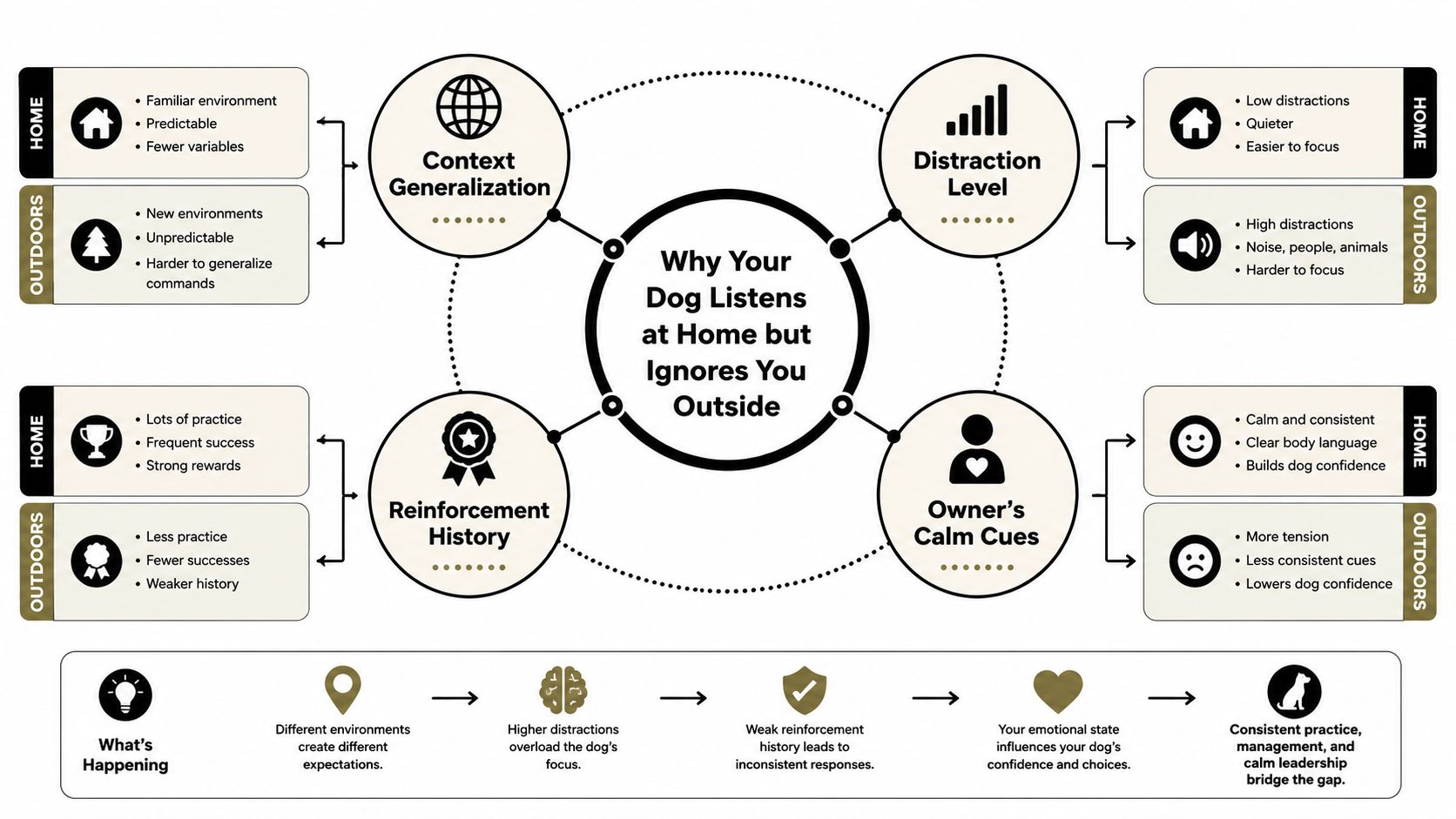
Start by asking what changed when your dog stopped responding:
- The environment became more rewarding. A scent or moving animal may beat the reward you brought.
- The cue became harder. Your dog may never have learned to respond while aroused or distracted.
- Your timing became vague. Delayed rewards can reinforce sniffing, pulling, or turning away instead of the behavior you wanted.
The useful question isn't, “Why is my dog disobedient?” Ask, “What does my dog know in this context, and what is rewarding them right now?” That diagnosis tells you where to train next.
The Science Behind Getting a Dog to Listen
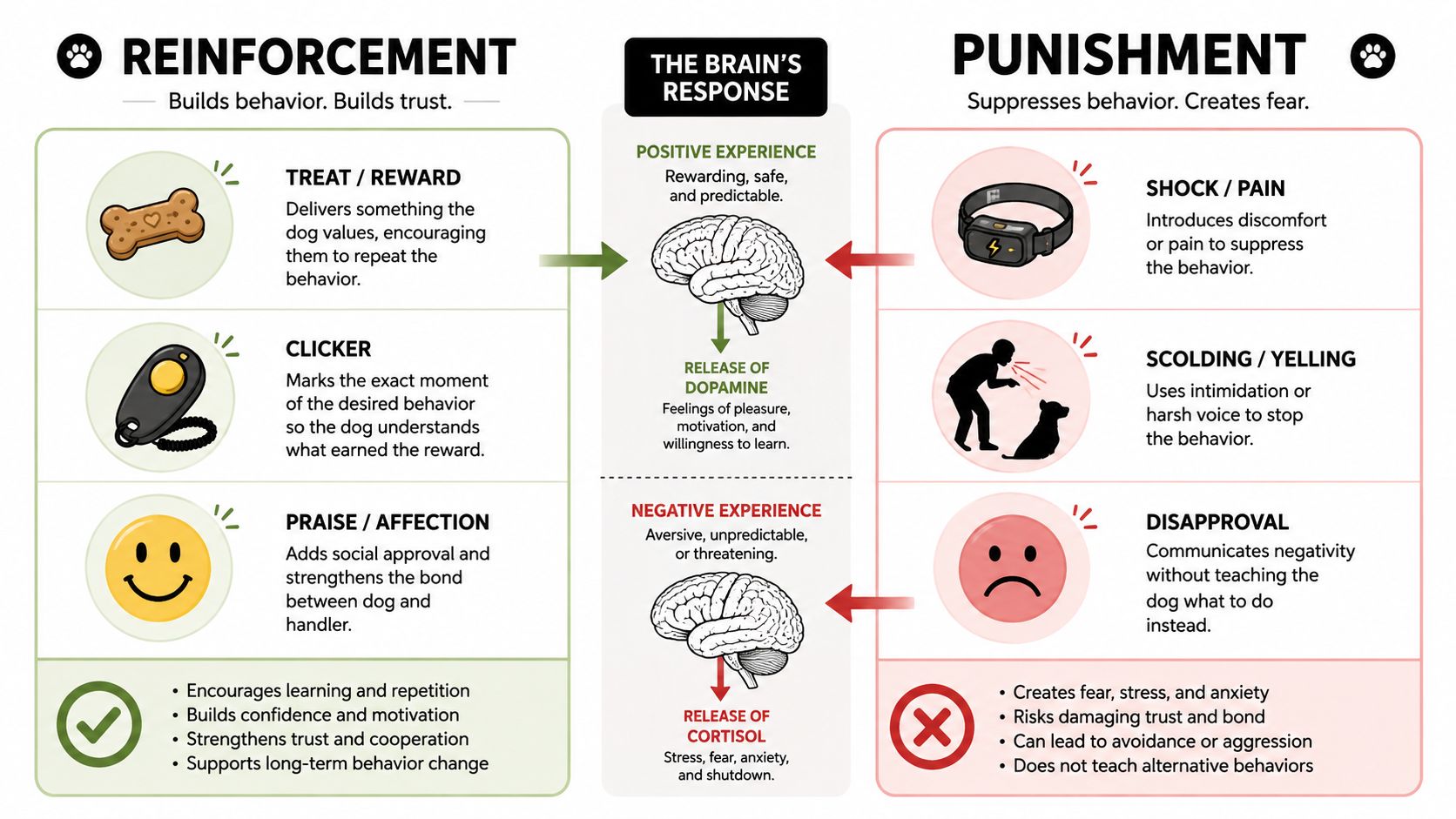
Dogs repeat behavior that produces valuable consequences. If your dog looks at you and receives praise, food, play, or access to something interesting, checking in becomes worthwhile. If pulling reaches a smell or ignoring recall keeps a dog moving toward a distraction, those choices become worthwhile too.
This is reinforcement in everyday language. The cue comes first, your dog performs a behavior, and something meaningful follows. A clicker can mark the exact response, while a treat pouch lets you deliver food quickly. Even the doorbell works as a learned signal because it predicts what happens next, such as a visitor entering.
A large study of 127 dog owners found that reward-based training was strongly associated with better obedience, while punishment had no positive obedience link in the study's eight tasks. The same research reported that 66% of owners used vocal punishment and 12% used physical punishment, compared with 60% using praise, 51% using food rewards, and 11% using play. Those findings are reported in the Animal Welfare study on dog training methods.
Punishment can interrupt a behavior, but interruption isn't the same as teaching your dog what to do instead. A forceful correction may stop pulling for a moment while leaving your dog without a clear replacement behavior. Reward-based training builds a response you can ask for again.
Timing changes what your dog learns
The reward has to follow the correct behavior quickly. In a learning experiment, 60.0% of dogs learned a task when reinforcement was immediate, compared with 25.0% when reinforcement was delayed by one second, as described in this review of reinforcement timing in dog learning.
Mark the behavior at the instant it happens. If your dog turns toward you, say “yes” immediately, then deliver the food. If you wait until your dog has wandered away, you may reward the wandering instead.
A controlled study comparing reward-based training with electronic-collar approaches found that dogs learned recall and sit, but the reward-focused group performed better on several measurable outcomes. The study reported an overall average of 77% first-command compliance, 20% compliance after repeated cues, and 3% disobedience, with verbal cues making up 66% of the signals used. The Frontiers study on reward-based and electronic-collar training also concluded that an electronic collar didn't improve recall effectiveness over reward-focused training.
Watch this short demonstration for a visual example of clear training communication:
Three Core Exercises Every Listening Dog Knows
Reliable listening starts with behaviors you can practice safely and measure. Use small, tasty rewards, a marker word such as “yes,” and sessions that end while your dog is still engaged. Three to five minutes is enough for one practice block.
Recall
Begin in a fenced yard or another secure area, with your dog attached to a long line. Say your recall cue once in a cheerful voice, then move backward or crouch so turning toward you feels easy.
The moment your dog turns toward you, mark it and reward. Don't wait for a perfect finish before paying. You're first teaching the response to the cue, then adding the final position later.
Practice about 10 repetitions per session. If your dog doesn't turn, don't repeat the word over and over. Reduce the distance, remove the distraction, or use a more valuable reward. A recall cue should predict something good, not a frustrated owner or an immediate end to all outdoor freedom.
Attention
Say your dog's name once. When they orient toward you, mark and feed. You can begin by placing a treat near your eyes, but fade the hand lure quickly so your dog learns to respond to the name rather than stare at the food.
Build the eye contact gradually, from one second toward five seconds. Pay before your dog looks away. Add movement and mild sounds only after your dog can succeed in the current setup.
Leash manners
Walk with the leash loose. When it tightens, stop moving without jerking the leash. Wait for your dog to turn back, soften the leash, or step toward you. Mark that choice, reward near your leg, and continue.
The pause removes the accidental reward of forward progress. Your dog learns that a loose leash keeps the walk moving, while pulling makes the environment temporarily boring.
| Exercise | Setup | Reps and session length | Progression cue |
|---|---|---|---|
| Recall | Long line in a secure, quiet area | About 10 repetitions in 3 to 5 minutes | Increase distance or distraction after success on 8 of 10 repetitions |
| Attention | Quiet room, then mild movement | Short repetitions, building eye contact from 1 to 5 seconds | Add duration or movement while keeping responses clean |
| Leash manners | Quiet path with room to stop | Several loose-leash steps in a 3 to 5 minute block | Add distance, then mild distractions, without repeated pulling |
A Week-by-Week Plan to Build Reliable Listening
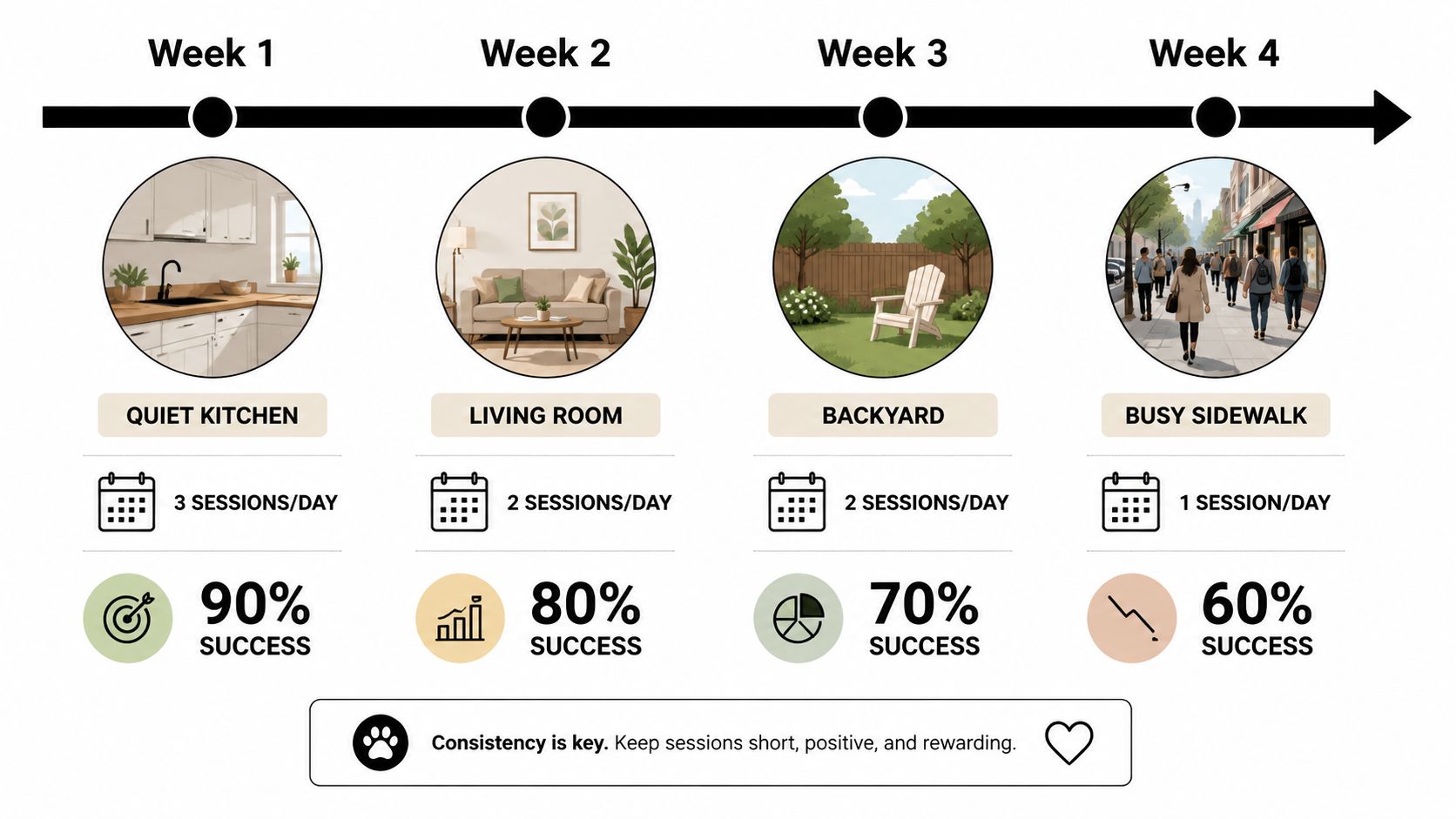
Treat each new environment as a new lesson. A cue trained in the kitchen doesn't automatically transfer to the pavement, so advance only when your dog is succeeding rather than guessing.
Week 1, make the response easy
Use a quiet kitchen or empty living room. Run three five-minute sessions each day, practicing name response, sit, recall over a short distance, and a few loose-leash steps indoors. Use small, high-value treats and reward immediately.
Aim for a 90% success threshold before increasing difficulty. If your dog misses repeatedly, shorten the distance, lower your voice, remove movement, or return to an easier behavior.
Week 2, add mild interruptions
Keep the sessions short, but introduce a television at low volume, a family member walking through the room, or a toy placed nearby. Run two sessions each day and look for roughly 80% success before moving on.
The distraction should be noticeable but manageable. Don't start with a favorite toy waved directly in front of your dog. You're teaching your dog to notice the interruption and still choose you.
Week 3, move outdoors
Use a fenced yard or quiet driveway. Practice leash position, attention, and recall over 10 feet while keeping the long line attached when appropriate. Run two sessions each day, aiming for about 70% success.
If your dog can't respond, the setting is too difficult. Move farther from the street, wait for a quieter period, or return indoors for a few repetitions before trying again.
Week 4, practice real-world listening
Choose one manageable location, such as a quiet sidewalk, the edge of a dog-friendly park, or an open area with enough distance from distractions. Run one focused session each day. Start far from dogs, bikes, or busy activity, then reduce distance only while your dog remains responsive.
A practical progression is to increase one challenge at a time. Add distance before duration, duration before distraction, and distraction before combining all three. If your dog drops below the current success level, don't push through. Step back to the previous environment and rebuild.
For additional foundations, use this guide to dog training for first-time owners alongside your daily practice. The important part isn't completing a calendar perfectly. It's learning to recognize whether your dog is ready to level up or needs an easier repetition.
Common Mistakes That Break Your Dog's Listening
Most owners aren't careless. They're responding quickly in real life, often with a dog already pulling, barking, or racing toward something interesting. That's why small habits matter. You're training the dog you have, not the dog you planned for.
The most damaging pattern is a late reward. If your dog sits, you pause, they stand, and then you hand over the treat, the dog may connect the food with standing. The reinforcement-timing evidence shows how sharply learning can weaken when the reward is delayed, so prepare the treat before giving the cue.
Repeated cues create another problem. “Come, come, come” teaches your dog that the first word is optional and the later words carry the pressure. Say the cue once, then change the setup or calmly help your dog succeed.
| Symptom | Likely cause | Fix |
|---|---|---|
| Your dog ignores their name on walks | You use the name during unrewarded or unpleasant moments | Reserve the name for moments when you can mark and pay orientation |
| Your dog responds only after several commands | You repeat the cue until compliance | Give one cue, wait briefly, then lower the difficulty |
| Your dog looks away after sitting | The treat arrives too late | Mark the instant the dog sits and deliver immediately |
| Your dog pulls toward every smell | Pulling has produced access to the environment | Stop when the leash tightens, then reward slack before moving |
| Your dog avoids you when you reach for the leash | Coming to you often ends fun or starts an unpleasant event | Practice recall, reward, and release your dog back to something enjoyable |
| Family members get different behaviors | Household rules change from person to person | Agree on the cue, permitted behavior, and consequence of each response |
Be careful with your dog's name. If it mostly predicts scolding, nail trimming, or the end of play, it loses value. Build it back with easy orientation games and immediate rewards.
For equipment decisions, don't treat a collar as a substitute for training. A guide to metal dog training collars can help you understand equipment choices, but your dog still needs clear cues, safe management, and reinforcement for the behavior you want.
Adapting Training for Reactive and High-Energy Dogs
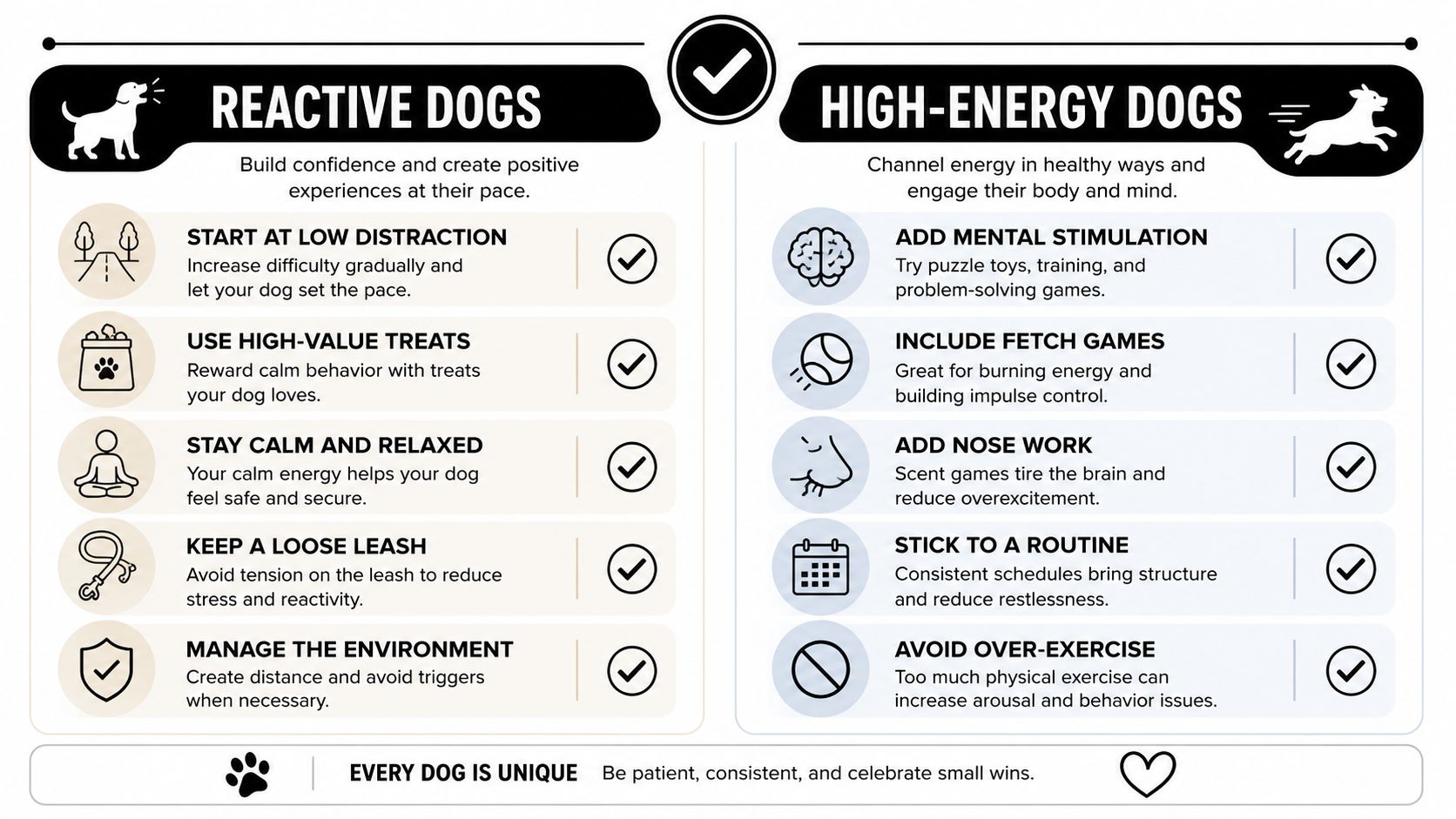
More exercise can help a dog cope with daily life, but it doesn't automatically teach attention. A physically fitter dog may still pull toward smells, lunge at dogs, or make independent choices when the environment becomes exciting. For high-energy dogs, combine movement with structured thinking.
Try pattern games, controlled sniffing walks, food puzzles, and brief impulse-control exercises before heading into a difficult environment. Herding and sporting dogs often benefit from jobs that ask them to orient, pause, and make a choice. Terriers may need careful management around fast-moving prey, while huskies and other independent dogs may require especially valuable reinforcement and patient repetition. Guardian breeds may need more distance and time to process unfamiliar people or dogs.
Reactive dogs need threshold work, not forced exposure. Start at a distance where your dog can notice the trigger without lunging or barking. When your dog looks at the trigger, use a “look at that” pattern, mark the observation, and reward the return of attention to you.
If your dog has gone over threshold, stop asking for obedience and create distance.
A trigger that produces barking, lunging, or frantic scanning has already made the exercise too hard. Increase distance, choose a quieter location, or end the session. Don't correct the reaction and then move closer.
For a more detailed behavior-specific approach, review this resource on stopping aggressive behavior toward other dogs. Bring in a qualified, force-free professional if your dog has a bite history, can't remain under threshold at a safe working distance, or your frustration is starting to control the session. Safety comes before obedience goals.
Success Criteria and Your Next Steps
After your first progression, judge the behavior by what your dog can do, not by whether they seem generally better. Useful self-checks include:
- Recall: Your dog comes from 10 feet with a mild distraction in a controlled setting.
- Doorway manners: Your dog offers a sit or pause before moving through.
- Leash behavior: Your dog can pass one manageable trigger without constant tension.
- Attention: Your dog holds eye contact for three seconds after the cue.
These are training benchmarks, not guarantees for every public situation. A dog may meet them in the yard and still need more practice near traffic, dogs, wildlife, or crowded paths.
Adjust the work to the dog in front of you. Puppies under five months often do better with very short repetition cycles and frequent breaks. Senior dogs need joint-protective, low-impact exercises rather than repeated jumping or sharp turns. Scent hounds may respond better when sniffing becomes part of the reward system, while working breeds often need extra impulse-control practice and a clear job.
Your next step can be a positive reinforcement class, a structured activity such as rally, agility, or nosework, or private help from a certified force-free trainer. If you want a personalized schedule rather than assembling every exercise yourself, PawCraft creates a 30-day plan from your dog's breed, age, environment, and behavior challenges, with daily exercises and progression guidance.
Listening isn't a finished product. It's a maintained skill, and brief daily practice usually serves you better than occasional marathon sessions. Revisit the basics when distractions increase, and give your dog a tune-up whenever real-world reliability starts slipping.
If your dog listens indoors but falls apart outdoors, visit PawCraft to get a personalized 30-day training plan built around your dog's breed, age, environment, and specific listening challenges. Answer the short questionnaire, then use the day-by-day exercises and success criteria to practice with more structure and less guesswork.