The doorbell rings, you open the door with a pizza in one hand, and your dog shoots through the gap before you can react. A few seconds later, you're standing in the street calling a name that suddenly seems meaningless while your dog heads toward the most interesting smell, squirrel, cyclist, or person nearby.
Learning how to stop dogs from running away takes more than repeating “come” louder. A safe solution combines humane recall training, reliable containment, daily enrichment, and an honest review of what triggers the escape. Treat the problem like both a behavior challenge and a home-security failure, because recall alone can't compensate for an open gate or a fence your dog can climb.
Start With Safety and a Calm Response
When a dog slips out, the first few minutes matter, but panic usually makes the situation harder. If your dog races through the front door during a delivery, don't sprint after them shouting. Chasing can turn the escape into a game, while angry calls can make you look threatening and encourage your dog to keep distance.
Secure the immediate area first. Ask someone to close nearby gates, move cars away from the road, and keep other household pets indoors. Call your dog in a bright, inviting voice, crouch sideways rather than looming over them, and move away from them if they're watching you. A treat pouch, squeaky toy, or open car door can create a stronger reason to approach than repeated commands.
Practical rule: Your dog's return must never predict punishment.
If the dog doesn't come immediately, enlist neighbors to check yards, garages, and familiar routes. Post a clear description and recent photo in local lost-dog groups, then contact nearby shelters, animal control, and veterinary clinics. Check the collar for a visible identification tag, and verify that the microchip registration has current contact details. A large U.S. survey found that 14% of owned dogs had been lost at least once within a five-year period, and 93% of those dogs were eventually recovered. The same study found that 14% of recoveries happened through an identification tag, while 7% of lost dogs were never reunited with their owners. Read the survey summary on lost-dog recovery and visible identification.
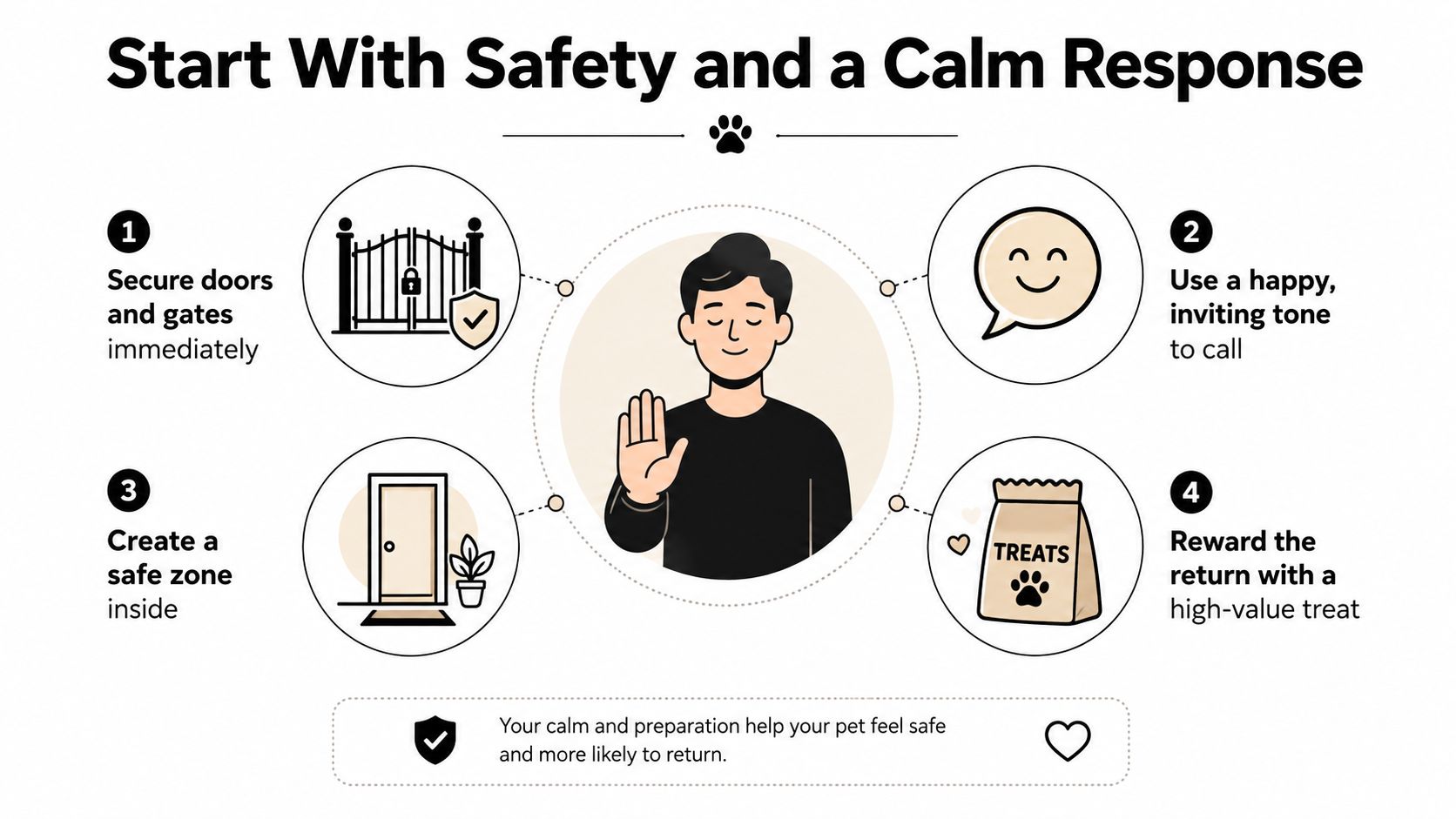
When your dog returns, reward them immediately and keep your voice relaxed, even if you're frightened or furious. Scolding after the fact doesn't explain which behavior caused your reaction. It can teach the dog that approaching you is unsafe, which weakens the recall cue you'll need next time.
Before bed tonight, complete four checks:
- Lock doors: Keep exterior doors secured, and create an interior buffer with a closed room, baby gate, or exercise pen.
- Verify gates: Test every latch and inspect the fence line for a gap your dog could use.
- Refresh identification: Replace damaged tags and confirm the microchip record.
- Record the context: Note who was present, what happened immediately before the escape, and how your dog left.
Identify Why Your Dog Runs Away
A dog that darts through the front door has a different problem from one that digs beneath a fence during a storm. Start by identifying the exact escape pattern rather than labeling the dog stubborn, disobedient, or naughty. The useful question is, what did the dog gain or avoid by leaving?
Watch each exit point for fifteen minutes when it's safe to do so. Record the time of day, who was nearby, weather conditions, sounds, and the event immediately before the attempt. You may discover that the dog only rushes the door when guests arrive, patrols the fence when cyclists pass, or digs at one corner after being left alone.
Common causes often overlap:
- Door excitement: Visitors, delivery drivers, and departing family members create movement and social opportunity.
- Prey drive: Squirrels, cats, birds, cyclists, and running children can trigger pursuit before the dog processes a cue.
- Fear: Thunder, fireworks, construction, and sudden noises can produce flight behavior rather than deliberate exploration.
- Separation distress: A dog may try to escape in an effort to follow a person who has left.
- Boredom or excess energy: A dog without enough physical activity or mental work may create its own adventure.
- Boundary weakness: A loose latch, eroded soil, low fence, or climbable object can make escape easy.
- Developmental testing: Adolescent dogs may investigate limits while impulse control remains inconsistent.
| Trigger | Likely Cause | First Response |
|---|---|---|
| Door opens for visitors | Excitement and learned door-dashing | Put the dog behind a closed interior door or gate before opening the entrance |
| Fence-line pacing | Frustration, territorial arousal, or moving distractions | Block visual access and supervise outdoor time |
| Digging beneath one corner | Escape habit, scent, boredom, or weak ground | Reinforce the corner and provide supervised digging or scent activities elsewhere |
| Squirrel or cyclist passes | Chase motivation | Increase distance, use a long line, and reinforce turning back toward you |
| Thunder or fireworks | Fear and flight response | Create a secure indoor safe area and discuss anxiety support with a veterinarian |
| Leaving the dog alone | Separation-related distress | Record the behavior and seek qualified behavior guidance |
| Sudden wandering in an older dog | Pain, sensory decline, confusion, or illness | Arrange a veterinary examination |
Medical factors belong in the audit. Pain, overheating, vision or hearing changes, neurological problems, and untreated anxiety can alter behavior. A sudden escape pattern deserves veterinary attention, especially if it appears alongside restlessness, confusion, appetite changes, sleep disruption, or unusual sensitivity.
Don't assume there's one cause. A dog may be bored in the yard, excited by a squirrel, and helped by a gap under the gate. Once you know the combination, match the response to the trigger: recall and boundary skills for the behavior, containment for the opportunity, and professional or veterinary support for fear, anxiety, or medical concerns.
Build Recall and Boundary Skills
Recall becomes dependable when the dog learns that turning toward you pays better than continuing away. Start in the least distracting place available, often a hallway or quiet room, and create many easy successes before asking for a response outdoors.
Use this progression:
- Choose one cue. Use your dog's name followed by a unique recall word or whistle. Don't repeat the cue while the dog ignores you. Repetition teaches the dog that the sound has no immediate meaning.
- Reward orientation first. Say the name and cue once. The instant your dog turns their head or body toward you, mark the response with praise and deliver a high-value treat.
- Make the return worthwhile. When the dog reaches you, feed close to your body, touch the collar or harness briefly, and release them back to normal activity. This prevents recall from predicting the end of every enjoyable moment.
- Practice in short bursts. Aim for three two-minute sessions across the day. Stop while the dog is engaged, not after they become distracted or tired.
- Add distance with a long line. Work at ten, twenty, and thirty feet in a secure area. Use a harness suited to the line, keep the line from tangling, and avoid testing off leash near roads or unsecured boundaries.
- Increase distraction gradually. Add a family member walking past, then a toy, then another dog at a safe distance. If the response deteriorates, reduce the distraction or distance instead of saying the cue repeatedly.
A veterinary study comparing reward-focused handling with remote electronic-collar and control protocols found the highest first-command “Come” performance in the professional reward-based group, at 82.5%, compared with 71.0% in the e-collar group and 72.4% in one control group. Across sessions, dogs averaged 20.3 commands, with 77% obeyed on the first command, 20% after multiple commands, and 3% disobeyed. The study concluded that an e-collar was unnecessary for effective recall training. Review the veterinary study on reward-based recall training.
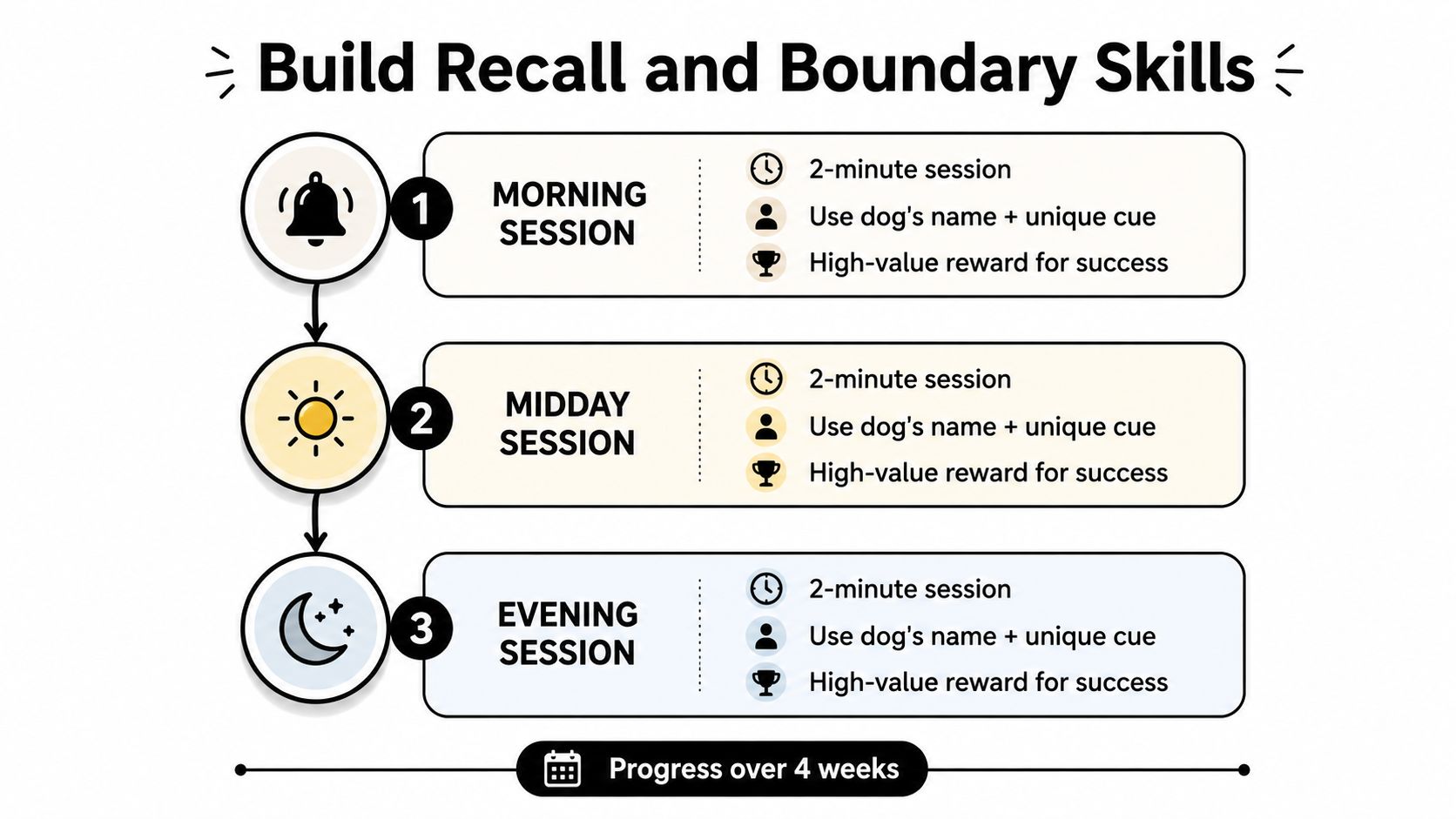
Boundary work teaches the dog where to pause, not merely how to return after leaving. Begin at an interior doorway. Stand near the threshold, reward the dog for waiting, open the door slightly, close it if they move forward, and reward again when they settle. Apply the same pattern at a garden edge or gate, using a visual marker and a reward station.
Advance only when the current behavior is stable. Useful criteria include:
- The dog responds to the first call in eight of ten sessions.
- The dog holds a boundary stay for thirty seconds.
- The dog can ignore a passing jogger at a safe distance.
- The dog returns promptly on a long line before you consider any off-leash practice.
Food rewards can become less frequent as the behavior strengthens, but don't remove reinforcement entirely. Mix treats with praise, a toy, permission to sniff, or a return to play. For a broader foundation, use this guide to training adult dogs.
Reward-based methods also have support from owner-reported field data. In a sample of 579 owners, reported training method and success differed strongly, and more owners using reward-based methods for recall or chasing problems reported success than owners using e-collars. See the owner-reported recall and chasing data.
Make Home and Yard Containment Reliable
Training can fail in a single unlatched gate. A containment audit makes the environment carry part of the safety burden instead of asking the dog to make a perfect decision every time.
Inspect every exit from the dog's perspective. Look beneath fences, around shared walls, at gate corners, and near drainage areas. Check whether a dog can push a latch, climb onto a storage box, jump from a retaining wall, squeeze through a window, or use patio furniture as a launch point. Test self-closing hardware rather than assuming it works.
| Method | Reliability | Cost | Best For | Limits |
|---|---|---|---|---|
| Physical barrier | High when correctly designed and maintained | Variable | Dogs that dig, climb, chase, or door-dash | Requires installation, inspection, and repairs |
| Active supervision and leash management | High during direct supervision | Low to moderate | Temporary control and busy entryways | Fails when people forget or become distracted |
| Long line in a secure area | Strong for supervised outdoor practice | Low to moderate | Recall training and controlled exploration | Can tangle, drag, or provide no protection if left unattended |
| Electronic or invisible fence | Depends heavily on the dog and context | Variable | Some owners seeking a boundary without a visible fence | May suppress crossing without physically preventing escape |
Physical barriers should carry the highest responsibility for a determined escape artist. A privacy fence can reduce visual triggers, a self-closing gate prevents casual human error, and a fence extender can make climbing more difficult. Digging dogs may need an L-shaped footing that extends along the ground or turns beneath the soil. Climbers may need coyote rollers or the removal of nearby objects that provide support.
Electronic fencing has a serious trade-off. It can warn or correct at a boundary, but it doesn't physically stop a dog that crosses, and a highly motivated dog may continue through the boundary and then remain outside it. Reported escape rates were 44.0% for dogs on electronic fences, compared with 23.3% for dogs behind see-through fences and 23.3% for dogs behind privacy fences. Review the comparison of containment types and reported escapes.
Use a leash-on rule for door dashers. Before opening an exterior door, place the dog behind a closed interior door, secure gate, or attached leash. Visitors should follow the same procedure, and delivery routines should include a dog-safe room rather than relying on a verbal stay during a sudden distraction.
Reduce Escapes With Daily Management
A dog that has fewer reasons to escape and fewer chances to rehearse escaping is easier to train. Daily management should match the dog's age, health, breed tendencies, and living environment, rather than following a generic exercise prescription.
Give physical activity a clear purpose. A structured walk can provide movement and loose-leash practice, while a slower sniff walk gives the dog time to investigate safely. Controlled off-leash play belongs in a secure area, not an unfenced park where one squirrel can override months of training.
Mental work matters just as much. Rotate food puzzles, use scatter feeding in a safe room or yard, hide treats for scent games, and add short training sessions during ordinary routines. A dog who has spent part of the day searching, solving, and practicing self-control has less need to invent stimulation at the fence.
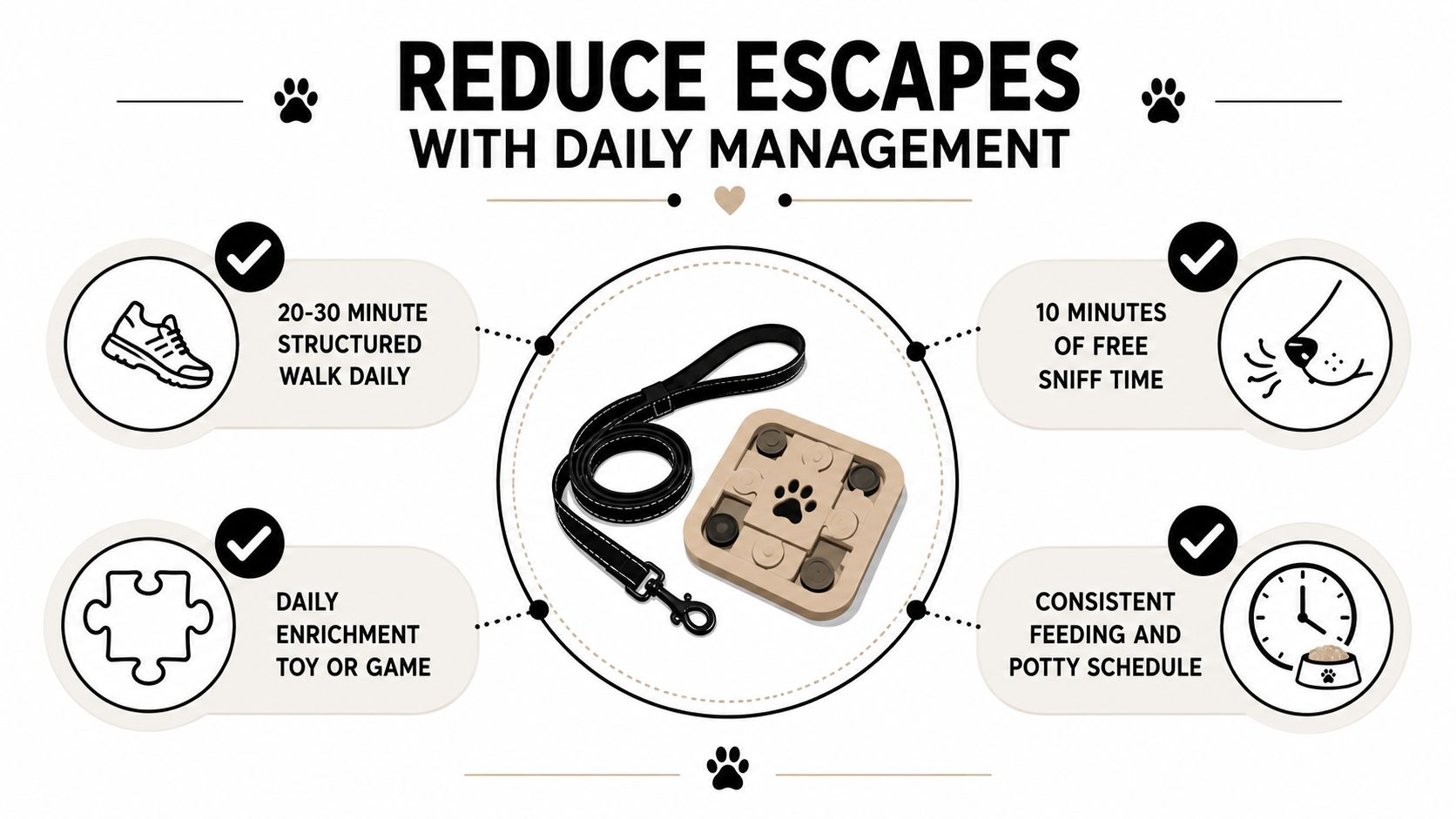
Door manners should become a household routine, not a trick performed only during training. Teach a station cue on a mat or bed, reward the dog for staying there while the handle moves, and release them through the doorway only after the person has control of the leash or the second barrier.
A predictable schedule also exposes changes quickly. Keep feeding, bathroom breaks, rest, alone time, and exercise reasonably consistent. Before leaving, offer a safe enrichment activity and reduce fence-line frustration by bringing the dog indoors if a recurring trigger is active outside.
Use this simple matching system:
- Bored dog: Add sniffing, food searches, and problem-solving games.
- Overexcited door-dasher: Use the station cue and a physical buffer.
- Fence patrol dog: Block the view and supervise outdoor access.
- Chase-driven dog: Use a long line and practice at a distance from moving triggers.
- Storm-sensitive dog: Move indoors before the noise begins and provide a secure retreat.
Management isn't a failure of training. It protects the dog while training catches up.
Track Progress With a Practical Training Plan
A written plan prevents random practice. Keep a notebook or phone note with four fields: distraction, response speed, escape attempt, and result. Record whether the dog turned toward you, reached you, stayed behind the boundary, or needed the difficulty reduced.
A workable first-week routine can fit around full-time work or apartment living:
- Morning: Two minutes of indoor recall before breakfast, followed by a food puzzle or scatter feed.
- Midday: A short boundary exercise at the apartment door, hallway, patio, or garden entrance.
- Evening: Two minutes of recall on leash or long line, then a sniff walk or scent game.
- Every exit: Complete a fast check of the latch, gate, leash, harness, and dog location before opening the door.
If you can't create one long block, split the work into two five-minute sessions. Frequent, successful repetitions are more useful than an exhausting session that pushes the dog past their ability to focus.
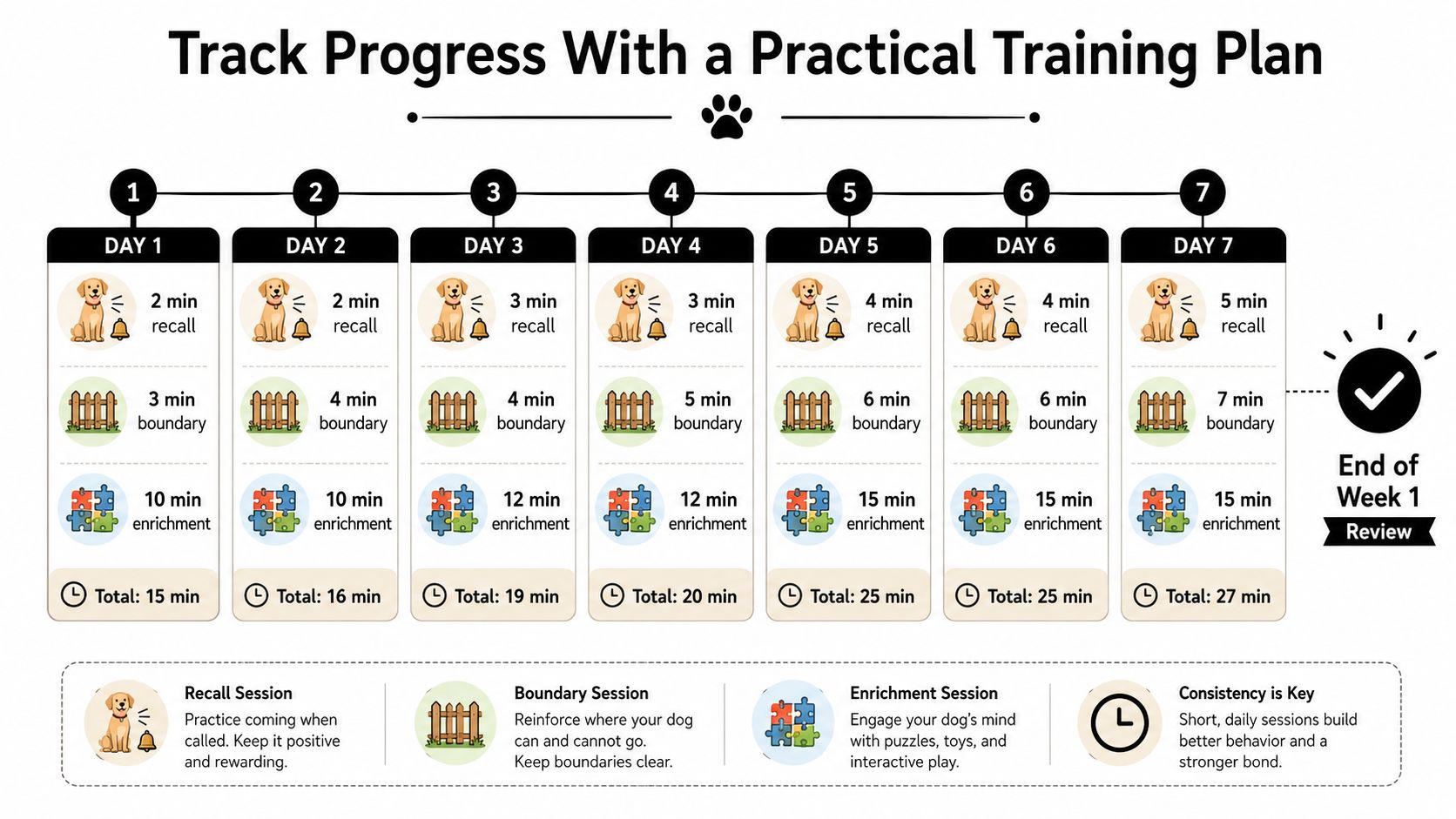
Use checkpoints to decide whether to progress:
| Review point | Practical success measure |
|---|---|
| Day 3 | The dog turns toward the cue promptly in a low-distraction room and can pause at the door with help |
| Day 7 | The dog responds reliably indoors, completes boundary repetitions, and has made no successful escape during supervised yard time |
| Day 14 | The dog works on a long line with mild distractions and returns before reaching the end of the available space |
These are training targets, not guarantees of off-leash readiness. A dog can perform well in the kitchen and still fail when a rabbit, storm, or open gate changes the situation.
Signs of progress include faster orientation, more frequent check-ins, relaxed waiting at exits, and fewer attempts to test the fence. If the dog stalls, lower the distraction, shorten the distance, improve the reward, or return to a simpler location. For a more structured behavior framework, use this dog behavior modification plan.
Troubleshoot Setbacks and Know When to Get Help
Treat every escape as useful information, not proof that training has failed. Write down the method, location, weather, time, recent routine changes, and person supervising. A dog that squeezed under the same gate needs reinforcement at that point, while a dog that bolted during fireworks needs anxiety management and indoor containment.
Match the fix to the failure:
- Leash slipped: Check fit, use a secure harness, and consider a backup connection for supervised outings.
- Low fence point: Reinforce the specific section rather than assuming a general repair is enough.
- Delivery escape: Put the dog in a secured room before the doorbell or delivery arrives.
- Prey sprint: Stop testing recall near intense triggers and return to long-line work at a greater distance.
- Storm breach: Move the dog indoors early and discuss fear treatment with a veterinarian.
- Repeated digging: Install a physical footing and supervise until the new arrangement has been tested.
A dog with more than one recent off-property escape, repeated boundary breaches, or a history of ignoring recall near distractions should stay leashed or on a long line outdoors until 30 consecutive clean days have passed. That rule protects the dog from rehearsing the behavior and protects you from confusing temporary improvement with dependable safety.
Don't use harsher equipment as a substitute for diagnosis. A professional review of metal dog training collar considerations can help you compare tools, but the recall evidence cited earlier supports reward-focused training rather than relying on aversive equipment as a shortcut.
Get qualified help when the behavior changes suddenly, the dog becomes aggressive when cornered, separation anxiety seems likely, storms or fireworks trigger dangerous flight, or consistent sessions produce no meaningful improvement. Choose a certified force-free trainer for practical coaching, and ask your veterinarian about referral to a veterinary behaviorist when anxiety, pain, medication, or complex aggression may be involved.
PawCraft creates a personalized 30-day dog training program based on your dog's breed, age, environment, and behavior challenges, including recall practice, long-line management, daily exercises, and measurable progression criteria. If you need a structured plan rather than scattered advice, visit PawCraft and build a step-by-step routine for safer doors, boundaries, and outdoor time.