Your dog spots a squirrel, hits the end of the leash, and turns your shoulder into a brake. Your fingers go white around the handle, your arm starts burning, and a stranger passing by offers the usual advice, usually something involving a sharper collar or “being the boss.” By the time you get home, you're frustrated, your dog is overstimulated, and tomorrow's walk already feels like a chore.
That cycle keeps pulling alive. Your dog pulls, you move, your dog reaches something interesting, and the behavior pays off. Dog leash training pulling is first a safety problem, then a manners problem. A loose leash protects your balance, your dog's neck and breathing, and your ability to handle sudden distractions.
This plan gives you a practical 30-day progression built around short daily practice, clear reinforcement, and objective checkpoints. You can run it before work, after work, or in several brief windows. If you're still getting your footing as an owner, these first-time dog owner tips can help you build the wider routine around training.
The Daily Walk That Shouldn't Feel Like a Tug-of-War
Reframe the problem before you grab the leash
The first mistake is calling the behavior “stubbornness.” Your dog isn't making a moral choice to ruin your walk. They're repeating an action that has produced movement, access, smells, greetings, or the chance to chase something.
That doesn't make the pulling harmless. A dog that surges toward a road, another dog, or a dropped food item can put both of you in a bad position before you have time to react. A slipped collar, a twisted leash around your legs, or a sudden yank through your wrist can turn an ordinary outing into an emergency.
Practical rule: If the leash is tight, forward movement stops. If the leash is slack, the walk resumes.
Use that rule immediately, even before your dog has mastered it. You're changing the payoff structure. Pulling no longer guarantees progress, while calm leash pressure becomes the route to whatever comes next.
Train the reflex, not just the appearance
Loose-leash walking doesn't require a formal heel. Your dog can sniff, drift slightly ahead, or walk on either side as long as the leash stays loose and you can change direction safely. The finish line is a repeatable slack leash, not a rigid marching position.
For the next month, keep the work small and predictable:
- Before the walk: Practice name recognition and check-ins in a quiet space.
- During the walk: Stop the instant tension appears, then reward the reset.
- After the walk: Record what happened instead of relying on your mood.
The rest of this guide treats pulling as a trainable reflex with predictable mechanics. You'll know what equipment to use, what behavior earns food and forward motion, and when your dog is ready for a harder environment.
Why Dogs Pull and Why It Matters More Than You Think
Two mechanisms usually drive the behavior.
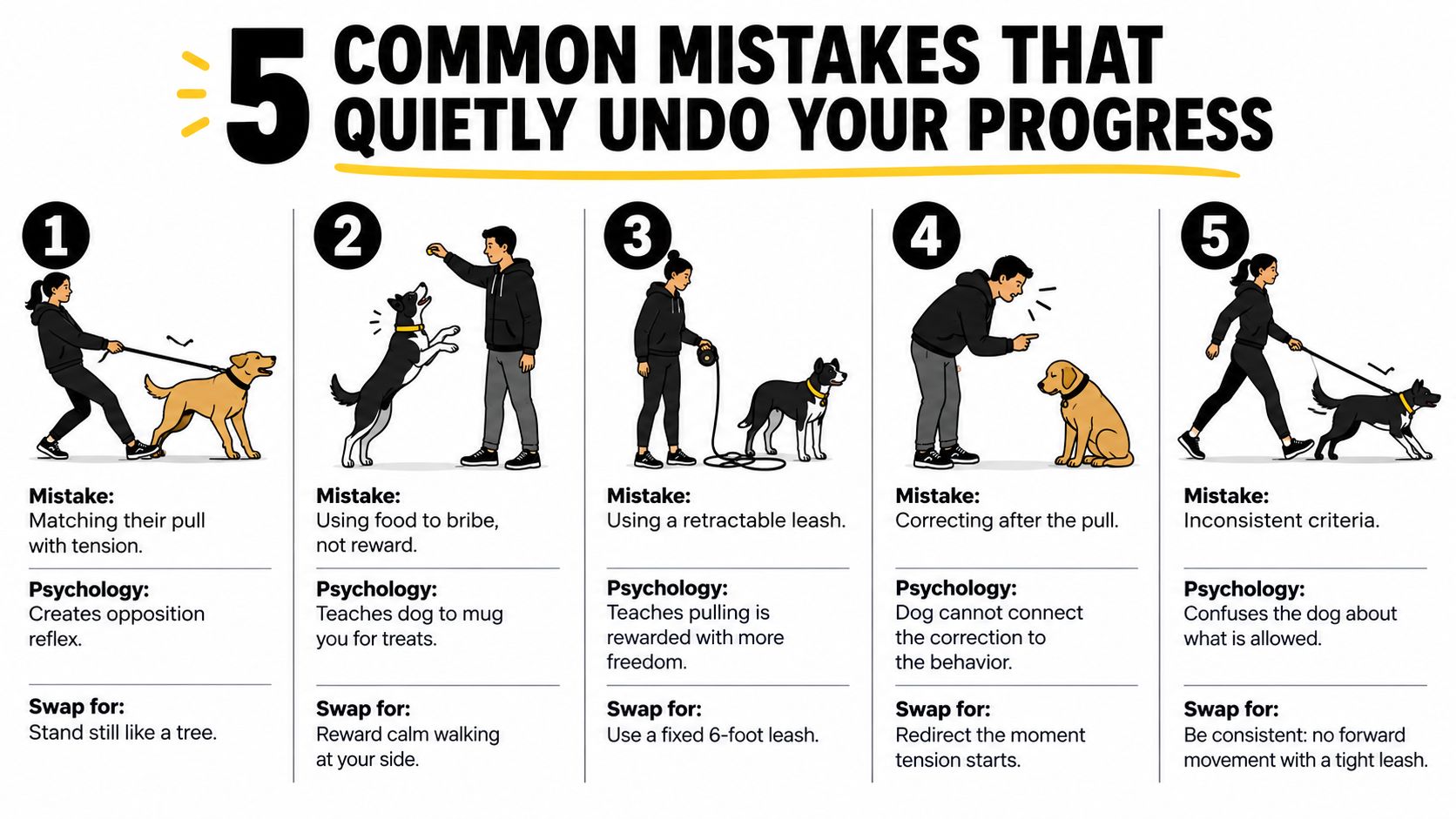
The first is the opposition reflex. When pressure appears against the body, dogs often push into it rather than yielding smoothly. If you pull backward while your dog pulls forward, you create a physical contest. Your dog learns to brace, you add more pressure, and the leash becomes a signal for resistance.
The second is forward-momentum reinforcement. Your dog sees a tree, scent, bird, dog, or person. They lean into the leash, the leash tightens, and you keep walking. The dog reaches the interesting thing, so pulling has done its job. Even occasional success keeps the habit strong because your dog can't predict when the next pull will pay.
The visible result is the same: a dog at the end of the leash, often breathing hard and ignoring the handler. Shelter dogs show how widespread the issue is. A survey cited in a 2025 shelter-dog study found that 82.7% of dogs pulled on lead, while pulling occurred in 86% of observed walks, with an average of 6.1 pulls per walk in that study (shelter-dog leash behavior research).
The safety cost isn't theoretical
Leash handling also creates risk for people. A U.S. national NEISS analysis estimated 356,746 dog leash-related injuries from 2001 to 2018, with 54.2% caused by pulling and 38.3% caused by trips or tangles (population-level leash injury analysis). Those figures don't mean every pulling dog is dangerous, but they do show why you shouldn't treat hard pulling as a cute quirk to fix later.
For dogs, repeated pressure can create breathing and movement problems, particularly when a collar concentrates force at the neck. Small and short-nosed dogs deserve especially careful handling because airway compromise can become serious quickly.
| Injury type | Common cause | Breeds most affected | Long-term risk |
|---|---|---|---|
| Neck and airway strain | Repeated pressure from a tight collar | Small and brachycephalic breeds | Breathing discomfort and worsening sensitivity to leash pressure |
| Shoulder and forelimb stress | Bracing against forward force | Strong pullers and dogs with long strides | Altered gait and reduced willingness to walk |
| Handler wrist, shoulder, or balance injury | Sudden lunges and leash tangles | Any dog that pulls unpredictably | Falls, dropped leash, or loss of control |
Start by reducing the physical contest with sensible equipment. Then teach your dog what slack means.
Choosing the Right Leash Setup Before You Start Training
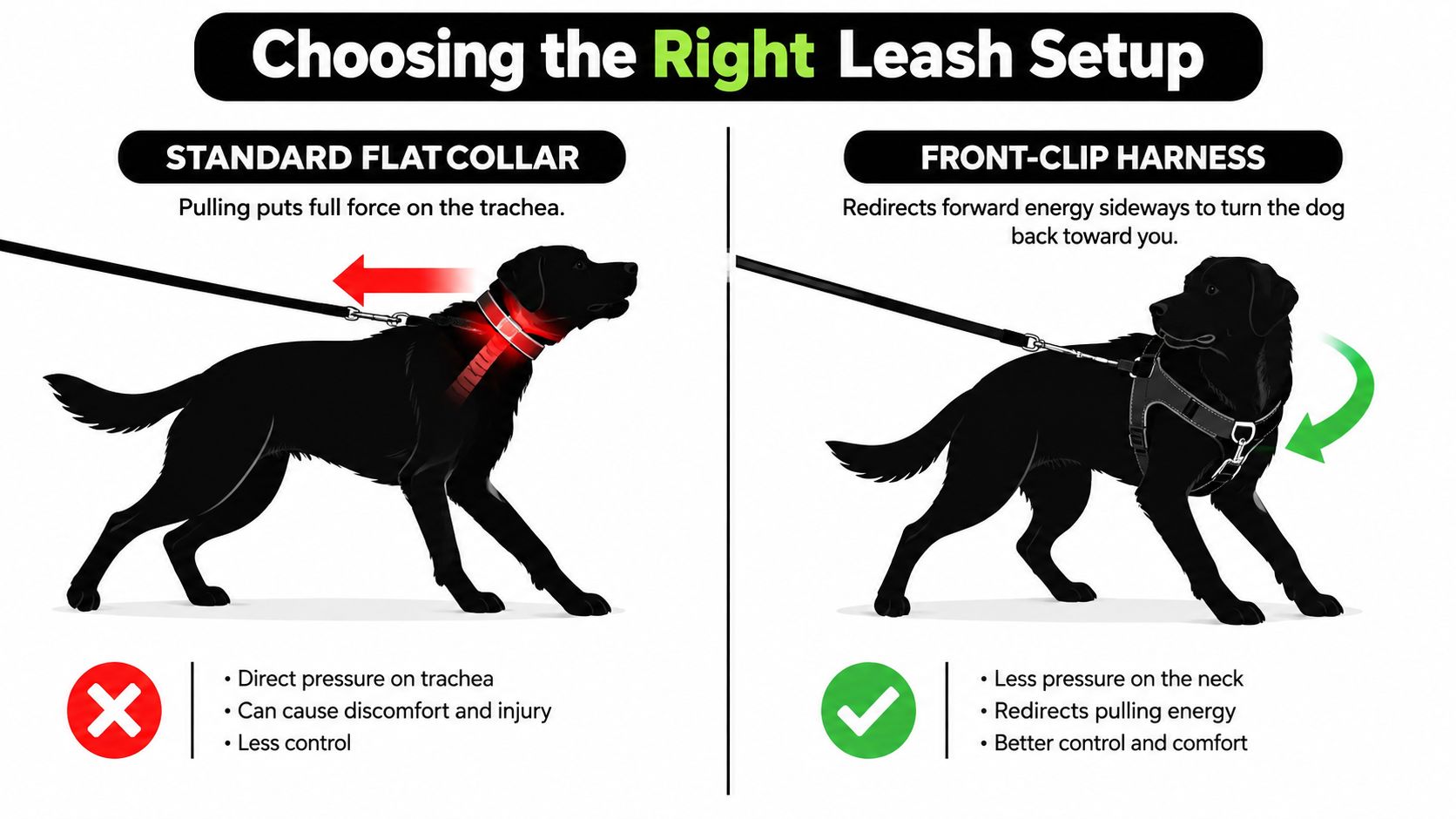
Equipment can make training safer, but it can't teach loose-leash walking by itself. The evidence is also more complicated than “harness good, collar bad.” Biomechanics research found greater maximum and average tension, and longer pulling duration, when food was used as a lure with a back-connection harness compared with a neck collar. A 2024 study reported 60.5 ± 3.91 N of mean pulling force on a harness versus 37.81 ± 3.51 N on a collar (recent restraint-force research).
Match the setup to the pulling pattern
Choose equipment based on how your dog pulls, not just their weight or breed label.
- Small or insecure pullers: Use a well-fitted, padded front-clip harness and a fixed six-foot leash. Avoid letting the harness rub behind the elbows, and reward every soft turn back toward you.
- Strong, confident pullers: A front-clip harness or carefully introduced head halter can improve control. Keep the leash handling gentle, and never jerk a halter because neck rotation can be abrupt.
- Dogs that surge toward triggers: Add distance before adding restraint. The tool should help you redirect safely while you pay for looking back at you.
- Tiny dogs: Prioritize a chest plate and straps that distribute pressure without chafing. Don't use a heavy leash that adds constant drag.
Skip prong, choke, and shock collars for this plan. They add discomfort or startle to an already difficult physical interaction, and they don't replace the behavior lesson your dog needs. For background on collar choices and handling, see this guide to metal dog training collars, but don't confuse a correction tool with a training protocol.
The correct setup reduces risk for the next walk. Reinforcement changes what your dog does on the walk after that.
Clip the leash, wait for slack, mark with a calm “yes,” and deliver the treat beside your leg. If the leash tightens, stop or turn. Every equipment choice in this section still depends on that timing.
Your 30-Day Loose-Leash Progression Week by Week
Train in short windows, then stop while your dog can still think. Food should be small, soft, and easy to deliver without bending over or waving it in front of your dog's face.
Week 1 builds attention before distance
Start indoors or in a quiet yard. Leave the leash unclipped for the first exercises.
- Say your dog's name once.
- When they look at you, mark the glance and feed near your leg.
- Take one or two steps away.
- Reward your dog for following without leash tension.
- Repeat until your dog checks in voluntarily.
Practice in several brief sessions each day. Don't advance because your dog can stare at food. Advance when they can disengage from a mild distraction and choose you.
Week 2 makes slack the gate to movement
Move to a quiet sidewalk or low-distraction outdoor space. Use the “be a tree” protocol. The moment the leash tightens, plant your feet and wait. Don't pull backward, repeat cues, or drag your dog toward you.
As soon as the leash slackens, mark within 1.5 seconds and feed. Then take a few steps forward. The reward is both food and resumed movement, so your dog gets a clear answer about how to continue the walk.
Repeat the week if your dog can't recover without repeated leash pressure. Your job is to make the right answer easy enough to succeed.
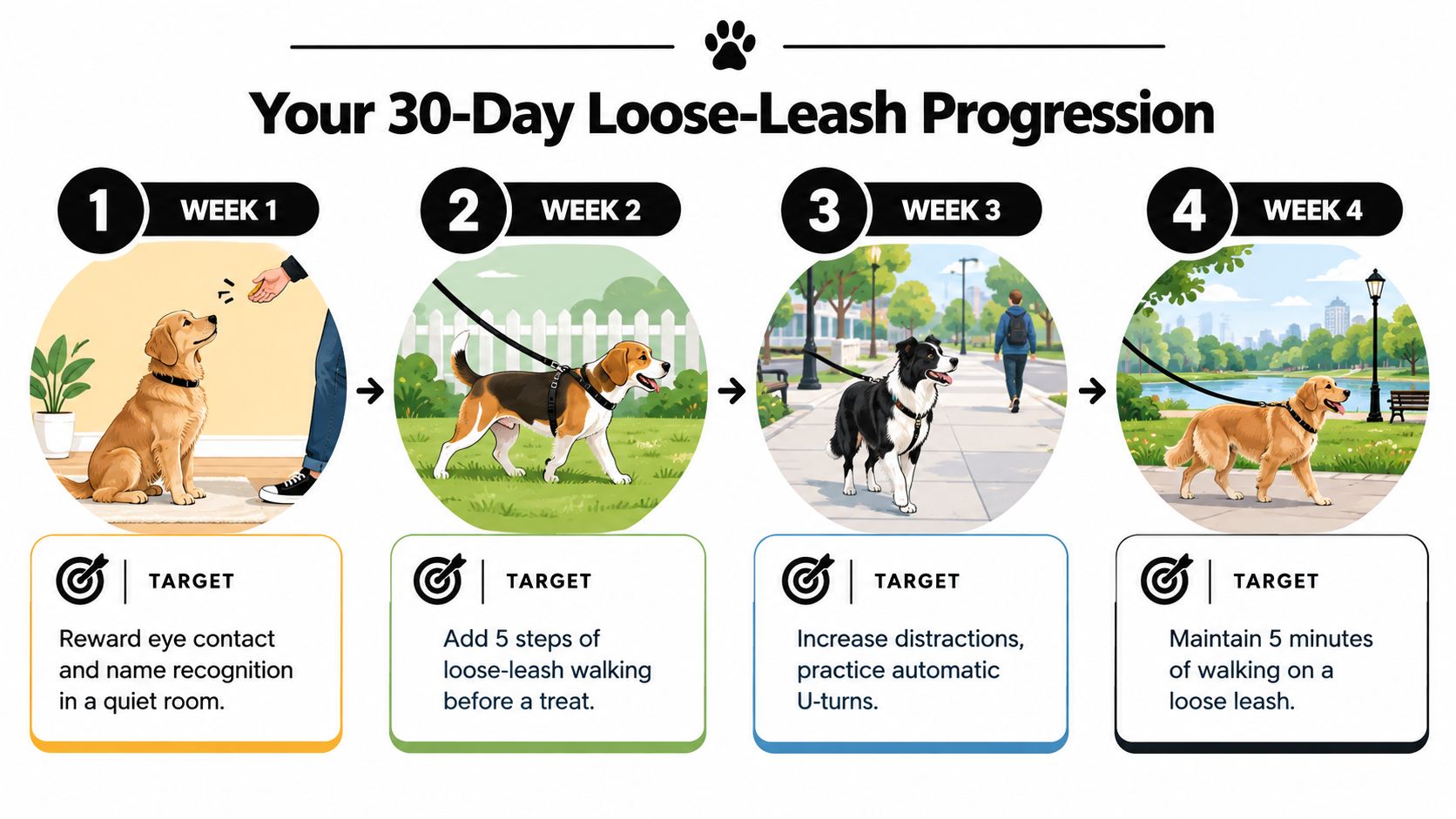
Week 3 adds duration and controlled freedom
Use a quiet open area and, where safe and lawful, a long line or 20-foot extension walk. Don't use a retractable leash for this exercise. The long line gives exploration room without teaching your dog that pulling produces more line.
Reward every 6 to 8 steps when the leash remains loose. If tension appears, shorten the task, reset, and reward the first calm return. A controlled university comparison found that the Major-Minor Walking Program reached loose-leash mastery in an average of 8.75 intervals, about 43.75 minutes, while the next-best method required 12 intervals, about 60 minutes (controlled loose-leash walking study). The lesson is simple: tight reinforcement timing and quick resets matter more than grinding through a miserable walk.
Week 4 generalizes around real triggers
Start far enough from other dogs, cyclists, squirrels, or busy entrances that your dog can eat and respond. Reinforce calm check-ins on a variable schedule, but pay immediately when your dog notices a trigger and returns attention to you.
If tension stays above three events per block, repeat the current week. Don't increase distance, speed, and distractions at once. Change one difficulty variable, then watch the leash.
Adjusting the Plan for Your Dog's Breed and Age
The progression stays the same, but the starting point changes. A young puppy, a powerful adolescent, and an arthritic senior don't have the same physical endurance or distraction threshold.
Puppies should begin with equipment comfort, name recognition, and a few calm steps indoors or in a private yard. Public-surface training should follow your veterinarian's guidance about vaccination status and local disease risk. Keep the lesson brief enough that the puppy finishes curious rather than frantic.
Adolescent dogs often look “trained” one week and reckless the next. Treat them as learners, not failed adults. Lower the distraction level, increase check-ins, and use several short sessions instead of demanding a full polite walk.
Seniors need softer surfaces, shorter routes, and more time to turn. A sudden increase in pulling can reflect discomfort, so arrange a veterinary check when the behavior changes without an obvious training explanation. Dogs recovering from surgery, including spay or neuter procedures, should follow their veterinarian's exercise restrictions before resuming progression work.
| Dog profile | Equipment swap | Session change | Key cue |
|---|---|---|---|
| High-prey-drive sighthound or husky | Front-clip harness with secure fit | Spend longer in low-distraction practice before sidewalk work | “Check in” |
| Brachycephalic dog | Y-front harness that avoids pressure across the throat | Short, slow outings with frequent breathing breaks | “Easy” |
| Reactive herding breed | Front-clip harness and secure fixed leash | Begin with parallel walking at distance | “Look” |
| Young puppy | Lightweight, comfortable harness or collar suited to veterinary advice | Several tiny indoor or yard sessions | Name |
| Older dog with stiffness | Comfortable harness and route with stable footing | Slow pace, shorter distance, more recovery | “With me” |
Do this, not that:
- Husky puppy: Don't start beside squirrels. Start with attention games in a quiet space.
- Senior bulldog: Don't push for distance. Choose airway-friendly equipment and slower movement.
- Reactive shepherd: Don't force a close sidewalk pass. Use parallel walking with generous space.
- Adolescent retriever: Don't assume yesterday's success will hold. Lower distractions and rebuild.
- Postoperative dog: Don't train through restricted activity. Follow the recovery plan first.
Breed informs the plan, but it doesn't replace observation. If your dog is panting heavily, freezing, scanning, or unable to eat, the environment is too difficult.
Common Mistakes That Quietly Undo Your Progress
Most owners don't sabotage leash training deliberately. They do it while trying to get through a normal day. The fix is to make your response predictable.
Mistake 1, walking anyway
You're late, your dog pulls, and you keep moving because stopping feels inconvenient. That gives the leash tension exactly what it wants, forward progress.
Swap: Stop immediately, wait for slack, then continue. On the sidewalk, your dog reaches the lamppost only after the leash softens.
Mistake 2, rewarding too late
If you wait until your dog has pulled for several seconds, spun around, and finally sits, they don't know which moment earned the food. Delayed delivery creates a fuzzy lesson.
Swap: Mark the first soft leash or voluntary glance. Deliver the treat beside you, not out in front.
Mistake 3, allowing taut-leash greetings
Your dog spots another dog, pulls hard, and eventually reaches the greeting. That teaches pulling as a social-access strategy, even if the greeting itself is friendly.
Swap: Ask for slack before approaching. If your dog can't soften the leash, create distance instead of completing the greeting.
Mistake 4, training only on weekends
A long Saturday walk can't compensate for five days in which pulling works. The behavior gets rehearsed repeatedly, then you expect one intense session to erase it.
Swap: Use short daily practice. A few well-timed resets are more useful than one exhausting outing.
Mistake 5, pulling back
Matching your dog's force activates the opposition reflex. Your dog feels pressure, braces harder, and may learn that the leash predicts conflict.
Swap: Stand still, soften your hands, and wait for the leash to release. If the environment is too exciting, turn away before your dog reaches full tension.
A leash correction after the behavior doesn't teach the behavior you wanted. A well-timed reset does.
Measuring Success and Knowing When to Move On
Stop judging walks by whether you felt embarrassed. Track two simple measures instead.
Tension events are the number of times the leash stays tight for more than two seconds during a five-minute block. Focus beats are voluntary check-ins, shoulder glances, or calm returns to your side that your dog offers without a repeated cue.
Write the numbers down after each practice block. Your dog may still pull once near a squirrel while making far more calm choices overall. That is progress you can build on.
Use a simple advancement checklist
| Week | Target tension events per five-minute block | Focus beats goal | Advance condition | Repeat condition |
|---|---|---|---|---|
| Week 1 | Establish a baseline | Voluntary looks in a quiet space | Attention is easy indoors | Dog can't disengage from mild distractions |
| Week 2 | Under 5 | Frequent check-ins during short walks | Three consecutive days under 5 events | More than 3 events in the block |
| Week 3 | Under 3 | Check-ins during changing pace | Three consecutive days under 3 events | Tension remains above 3 events |
| Week 4 | Maintain the lowest recent level | Calm responses near selected triggers | Slack leash holds around manageable distractions | Dog loses food interest or lunges |
The table's thresholds are training rules for this plan, not universal biological benchmarks. Use them to make decisions consistently. If tension plateaus for seven days, don't drill harder. Recheck harness fit, leash handling, reward placement, treat value, and whether the environment is too difficult.
Persistent lunging, sound sensitivity, escape attempts, or escalation toward reactivity deserves professional help. A structured dog behavior modification plan can be useful when the problem has moved beyond ordinary loose-leash practice.
On rest days, take a 90-second evaluation walk in an easy location. Count tension events and focus beats, reward the best choices, then go home. Maintenance should keep the skill fresh without turning every outing into a test.
PawCraft creates a personalized 30-day dog training program based on your dog's breed, age, environment, and behavior challenges, including daily exercises, progression steps, and success criteria. If you want a structured plan for leash pulling instead of more conflicting sidewalk advice, visit PawCraft and complete the brief questionnaire.