You call your dog at the park, and nothing happens. Your dog's nose stays on the grass, the squirrel gets closer, and your cheerful “come!” turns into a louder, frustrated command. By the time your dog finally looks at you, you're negotiating with a creature that has already learned the park is more rewarding than you are.
Reliable recall isn't built by saying the word louder. It's built by identifying the exact situation where your dog stops responding, then making coming back worthwhile in that situation. Food, wildlife, other dogs, distance, noise, and the end of play can each create a different recall problem. Train the failure point, not an imaginary version of your dog who only practices in a quiet living room.
Why Most Dogs Don't Come and What Good Recall Looks Like
Most dogs don't ignore recall because they're stubborn or trying to challenge you. They've learned that the cue has different consequences in different places. Indoors, “come” may predict chicken, praise, or a quick game. At the park, it may predict a leash, the end of sniffing, or a trip home. Once the competing reward becomes more valuable, the dog makes a sensible choice from the dog's point of view.
The cue also weakens when people repeat it. “Come, come, come!” teaches the dog that the first signal is background noise and the decision can wait. Calling only when something unpleasant is about to happen creates the same problem. UC Davis guidance recommends using the dog's name plus “Come” once in a happy voice, never punishing the dog after arrival, and avoiding a pattern where every response immediately ends freedom. UC Davis and RSPCA recall guidance/23409bf2-4273-1434-72c5-de4f97c2d21c?version=2.0) supports that low-pressure, gradual approach.
What a useful recall actually looks like
A dependable recall isn't just a dog turning its head. You want the dog to:
- Interrupt an activity: Your dog stops sniffing, watching, or playing.
- Orient toward you: The body turns in your direction instead of only glancing over.
- Travel promptly: The dog closes the gap without wandering off halfway.
- Arrive safely: You can touch the collar or harness without the dog dodging away.
- Stay emotionally comfortable: Returning to you doesn't feel like a trap.
A 2020 controlled study of pet-dog training sessions recorded an average of 20.3 commands per session. Across those commands, 77% were obeyed on the first command, 20% only after multiple commands, and 3% were disobeyed. The study compared remote electronic collar training with reward-based training and measured behavior during structured sessions, but its practical lesson for recall is broader. Progress should mean more first-cue responses and fewer repeated cues across many short sessions, not instant perfection after one drill. The controlled pet-dog training study provides useful context for measuring response quality.
Practical rule: Train the dog back to you. Don't punish the dog for having found something interesting.
Your first job is to find the gap. Can your dog come from the kitchen but not the garden? From a quiet sidewalk but not past another dog? From a toy but not food on the ground? Once you know the specific trigger, you can adjust distance, reward value, setup, and safety instead of mindlessly repeating “come.”
Building the Foundations Before You Add Distance
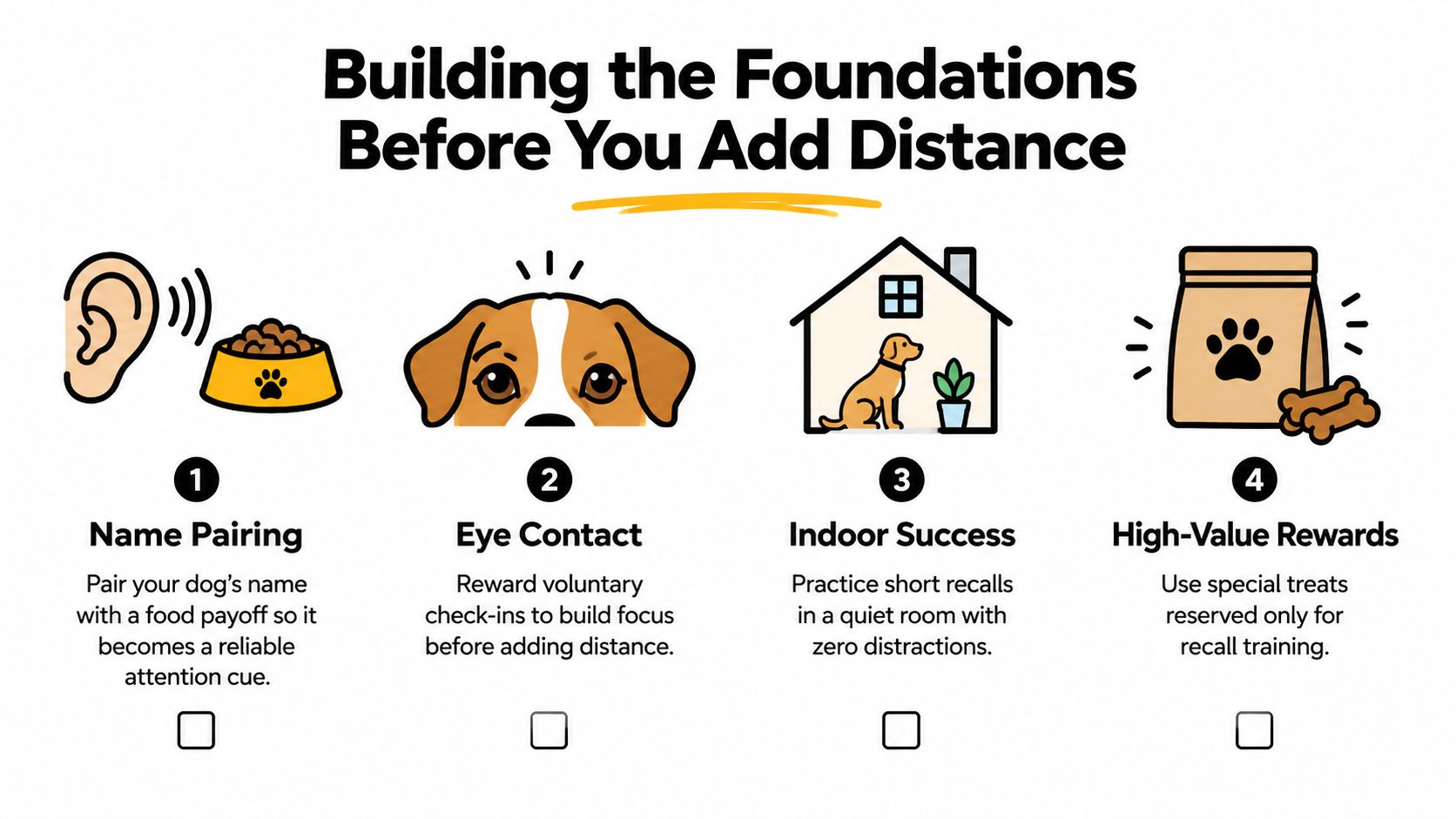
Before you work across a yard or near wildlife, make the response easy and fast at close range. A dog who hesitates indoors won't suddenly become reliable beside a busy trail. Foundation work gives the cue a clear meaning and teaches the dog that orienting toward you pays.
Start with attention, not a dramatic command
Pair your dog's name with something good. Say the name once in a calm, clear tone. The instant your dog turns an ear, head, or eye toward you, mark the response with “yes” or a click, then deliver food near your body. You're teaching the name as an attention signal, not asking for a full recall every time you say it.
Reward voluntary check-ins during ordinary life. When your dog looks at you while you're making coffee, opening a door, or moving around the room, mark and pay that choice. Attention becomes stronger when it's reinforced outside formal sessions, in small bursts that don't feel like a test.
Choose one recall cue and protect it. “Come” works, but so do words such as “here” or “front” if everyone in the home uses the same word. Don't spend that cue casually when you're fairly sure the dog won't respond.
Make the first indoor response easy
Stand only a short distance away in a quiet room. Say the dog's name, pause for orientation, then give the recall cue once while opening your body and moving slightly backward. When your dog commits to you, mark, encourage movement, and reward at your legs.
Use food your dog considers special and reserve some of it for recall. A small piece of cooked meat, soft training food, or another safe favorite can compete better than ordinary kibble when you eventually add distractions. The right reward depends on the individual dog, so watch what produces quick movement rather than what looks impressive in your treat pouch.
Practice in short sessions and stop while the dog is still eager. You can find additional guidance on adapting training to maturity and household context in PawCraft's guide to dog training for adult dogs.
Avoid the preparation mistakes that create slow recalls:
- Repeating the cue: Move closer or lower the difficulty instead of saying it again.
- Raising your voice: A louder cue often adds pressure without adding meaning.
- Skipping name work: Familiarity with the dog's name doesn't guarantee attention under stress.
- Adding distance too soon: Build speed at close range before asking the dog to cross space.
- Paying away from you: Deliver food at your body so the dog learns where arrival happens.
Your goal at this stage isn't a long-distance sprint. It's a dog who hears the cue, turns toward you, and expects something worthwhile at your side.
Teaching the Recall with Lure and Reward Mechanics
The mechanics matter more than the enthusiasm in your voice. Many owners wave a treat in front of the dog, let the dog follow it, and assume they've taught recall. That can create a dog who follows the visible food but has no idea what the verbal cue means once your hand is empty.
Pay the turn, then pay the arrival
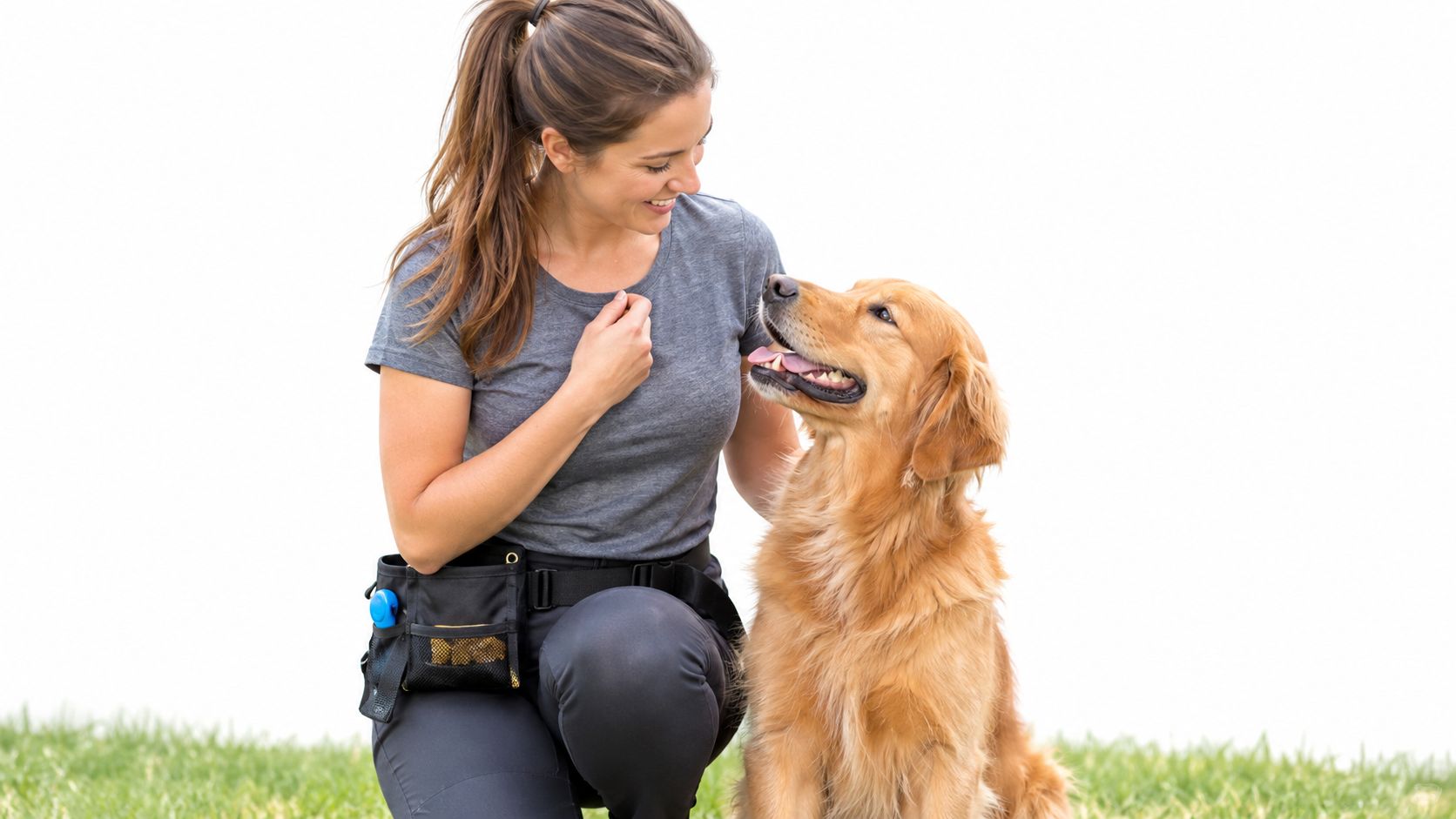
Begin with your dog a few feet away. Say the cue once, use a small backward hand motion if needed, and mark the instant your dog commits to moving toward you. Don't wait until the dog is already at your knees to mark the important decision. The marker tells the dog exactly which part earned reinforcement, while the food completes the payment when the dog arrives.
Keep the reward at your body, not several steps in front of you. Food held away from your legs encourages the dog to grab and leave, while food delivered close to you builds a clean return point. Once the dog is moving quickly, hide the treat in your hand and reduce the hand motion until the verbal cue does the work.
If the dog follows the lure but ignores the word, the lure has become the cue. Test this by presenting an empty hand. If the response collapses, return to an easier distance, say the verbal cue first, add only a subtle motion if necessary, and mark the first commitment. Reward from the other hand so the dog can't predict the food before responding.
Add handling without turning arrival into restraint
When the dog reaches you, gently touch the collar or harness, feed, and release. Many dogs learn to stop just outside reach when every arrival leads to being grabbed. Keep the touch brief and pleasant, then use a release word such as “free” so coming to you doesn't mean the dog loses control of what happens next.
Vary the payoff. Sometimes deliver several small pieces. Sometimes play at your feet. Sometimes reward and let the dog return to the toy or sniffing area. The dog should learn that recall can produce food, movement, contact, or renewed access to the environment.
Watch the timing. A delayed reward after the dog wanders around can reinforce the wandering rather than the return. If your dog arrives slowly, reduce the challenge and make the next repetition easier instead of trying to force speed with a louder voice.
The following demonstration can help you observe the body position, timing, and reward placement involved in a clean return:
A strong recall has a predictable rhythm: cue once, dog commits, marker lands, reward arrives at your body, gentle handling happens, and release follows when appropriate.
Progressing Through Distance and Distraction
Recall training becomes practical when you control the difficulty instead of testing the dog randomly. Think in terms of three variables: distance, duration, and distraction. Changing all three at once makes failure hard to diagnose, while changing one variable lets you see exactly what your dog can handle.
Increase one challenge at a time
Begin close to your dog indoors. Move from a small gap to the other side of the living room, then to a hallway, then to a fenced yard. Add a mild environmental event, such as a toy moving or a leaf rustling, only after the response is quick at the current distance.
The infographic below summarizes the progression, including a simple advancement rule:
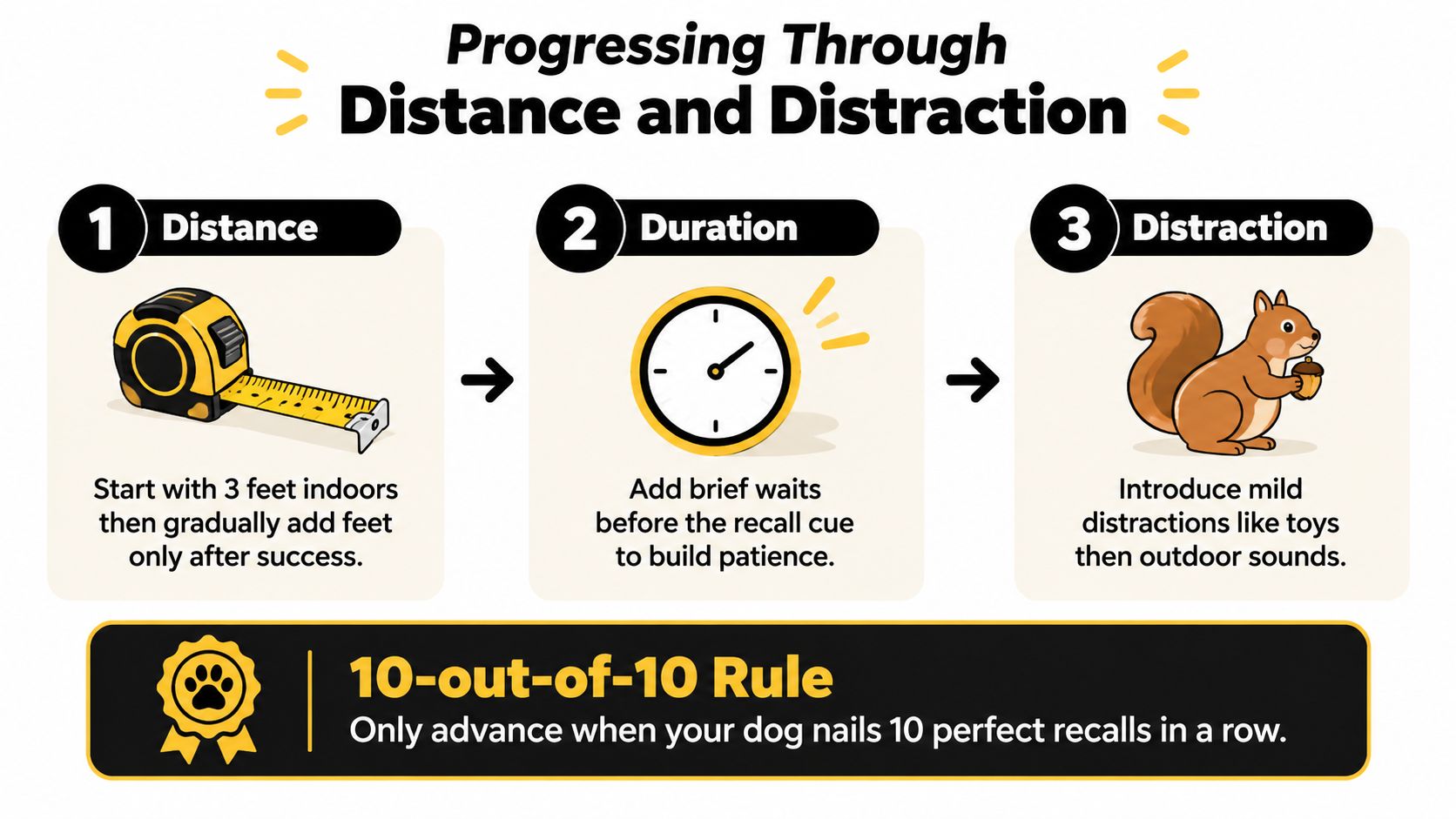
Distance is usually easier to manipulate than distraction. Add space in a controlled location before asking your dog to leave a high-value trigger. When the distraction becomes harder, increase the reward value and reduce the distance so the dog has a realistic chance to succeed.
Use a clear decision rule
The 10-out-of-10 rule gives you a practical checkpoint. If your dog completes ten clean recalls in a row at the current level, add one small increment. If the dog hesitates, needs a repeated cue, or fails, stay at that level or make it easier.
A useful progression might look like this:
- Quiet indoor room: Work at close range with no competing activity.
- Indoor movement: Add a family member walking past, a toy on the floor, or mild household noise.
- Fenced yard: Introduce outdoor smells, breeze, and movement while keeping escape impossible.
- Quiet street or open area on a long line: Practice with manageable sounds and visible distance.
- Busy park: Work far from activity before moving closer to dogs, food, and running people.
- Off-leash environment: Use only after the dog has demonstrated a safe response under comparable distractions.
A long line gives you management without pretending the dog is ready for unrestricted freedom. It isn't a remote control, and it shouldn't be used to drag the dog toward you. Use it to prevent rehearsal of bolting while you continue rewarding voluntary returns.
Keep sessions brief and finish before fatigue appears. Three to five good repetitions in a location can be more useful than drilling until the dog stops responding. If your dog fails, record what changed. The meaningful detail may be the distance from another dog, the presence of food, the wind carrying wildlife scent, or the time of day.
Common Mistakes That Poison Your Recall
A recall can look fine in the kitchen and still be badly trained in daily life. The problem usually appears when owners use the cue as a remote brake for situations they haven't prepared the dog to leave.
Repeating the word teaches delay
Say “come” once. If your dog doesn't respond, don't chant it while walking closer. Change the picture instead. Move away, make yourself interesting, reduce the distance, or use your management line to prevent the dog from reaching the distraction.
Every repeated cue gives the dog more practice ignoring the first signal. If you've already weakened the word, stop using it casually and rebuild it in easy situations. Some owners choose a fresh cue after repeated poisoning, but the new word still needs careful protection.
Don't make arrival predict bad news
Calling your dog only for a bath, confinement, nail care, getting into the car, or leaving the park turns recall into a warning. You don't need to avoid these necessary events forever. You need to separate them from the majority of recalls, reward arrival generously, and add pleasant repetitions before releasing the dog again.
A walk shouldn't end the instant the dog reaches you. Call, reward, touch the harness, then resume walking or allow more sniffing. If you always call at the final moment, your dog can learn that returning means freedom is over.
Stop turning recall into a chase game
Chasing often rewards the dog with movement, attention, and a thrilling interaction. Run away from your dog instead, use an excited but friendly body position, and protect safety with a long line in appropriate settings. Never punish the dog once it reaches you, even if the delay made you angry.
Food also needs timing. Paying only after a slow return can reward the slow return. Mark the first commitment, deliver the payoff when the dog arrives, and make the next repetition easier if the response deteriorates.
Before adding new equipment, review PawCraft's guide to metal dog training collars and make sure your recall plan relies on clear teaching and safe management rather than pain or intimidation.
The historical training literature describes a shift from correction-heavy methods toward welfare-focused, reward-based approaches, with research examining dogs' emotional and behavioral responses during training. This review of pet-dog training research is especially relevant to recall because a dog that expects punishment after approaching has less reason to come closer.
Fixing Recall for Reactive High-Energy and Fearful Dogs
Some dogs fail recall because the environment overwhelms them, not because the reward is too small. A reactive dog may be unable to disengage from another dog at close range. A fearful dog may hear your excited voice as pressure. A high-drive dog may have learned that movement, scent, or pursuit is more valuable than stationary food.
Start with the dog's emotional threshold. A reactive dog should practice turning away from triggers at a distance where it can still eat, orient, and move. Tossing a high-value reward behind you can create the motion needed to escape the trigger, while feeding at your stationary position may leave the dog staring forward. If the dog won't take food, increase distance and lower the intensity.
Match the payoff to the dog
High-energy working breeds often need movement-based reinforcement. A short game with a flirt pole before training can help meet the urge to chase, while a release to a toy, chase game, or Chuckit throw can make the return meaningful. Keep arousal controlled. If the game sends the dog into frantic overdrive, it isn't helping recall.
For a dog who guards food or resources, don't reach toward the dog or crowd the return. Present food on an open, flat palm, keep your body soft, and arrange the exchange so the dog doesn't feel cornered. A qualified behavior professional should help if guarding includes threats or biting risk.
Fearful or noise-sensitive dogs need quieter setups and shorter sessions. Use calm praise, lower your body angle, and avoid rushing toward the dog. Apartment dogs require generalization in the places where recall breaks, such as the hallway, elevator, lobby, sidewalk, and building entrance. A quiet-room recall doesn't automatically transfer to a crowded urban route.
| Dog Profile | Primary Recall Problem | Recommended Fix |
|---|---|---|
| Reactive dog | Locks onto dogs, bicycles, or people | Work below trigger threshold, increase distance, and use tossed high-value rewards to create movement away |
| High-drive working breed | Chooses chase, scent, or motion over food | Use release-to-reward games, controlled flirt-pole work, and movement-based payoffs |
| Food or resource guarder | Feels pressured when approached after returning | Use an open flat palm, avoid grabbing, and get professional behavior support when safety is a concern |
| Fearful or noise-sensitive dog | Hesitates or retreats when the handler sounds intense | Train indoors or in quiet areas with calm praise and gentle body language |
| Apartment or urban dog | Responds at home but fails in shared spaces | Generalize through hallways, elevators, lobbies, sidewalks, and gradually busier streets |
A personalized plan can be useful when the failure pattern is hard to isolate. PawCraft creates a dog training program from the dog's breed, age, environment, and behavior challenges, then delivers daily exercises, progression criteria, and troubleshooting guidance by email. You can also use a local trainer, a group class, or a veterinary behavior professional. The important part is matching the intervention to the reason your dog fails, rather than applying the same food lure to every profile. A practical starting point is a dog behavior modification plan.
The Zoom Room recall training guide describes recall as a common training pain point, with 45% of surveyed respondents reporting recall difficulties and 88% saying interactive elements improved engagement. Those figures support a useful training principle, but they don't replace individual assessment. Your dog's actual distraction, distance, and emotional state should determine the next exercise.
Proofing and Proofing Your Come Command Long Term
Proofing isn't a final exam. It's maintenance across changing places, surfaces, smells, weather, people, and activities. A dog can understand recall and still lose fluency when the environment changes, so rotate locations instead of practicing in one familiar room forever.
Keep a simple log after each session:
- Location: Note the room, yard, sidewalk, or park area.
- Distraction: Record what competed with you.
- Response: Mark whether the dog turned, traveled, and arrived on the first cue.
- Reward: Write down the food, toy, play, or environmental access that worked.
- Next step: Increase one variable, repeat, or make the exercise easier.
Use occasional surprise jackpots so the dog never knows which return will produce an especially valuable payoff. At other times, reward and release the dog back to sniffing or playing. That combination protects the cue from becoming a signal that all good things are finished.
Handle setbacks without drilling failure
When a recall slips, don't repeat the cue until the dog gives in. Drop back one stage, reduce the distraction or distance, and rebuild the response. A bad repetition tells you the setup was too difficult. It doesn't prove that the dog is incapable of learning.
During a 30-day training period, focus first on attention and close-range arrival, then fade the lure, add distance, and introduce one distraction at a time. Later, work directly on the dog's specific gap, whether that's food, wildlife, another dog, or the end of the walk. Keep using a long line and environmental management until the response is safe enough for the location.
The final benchmark is not a perfect performance in a controlled room. It's a dog who can disengage from realistic distractions, arrive within reach, accept gentle handling, and return to normal activity without learning that recall always costs freedom. Continue group classes, supervised proofing sessions, or professional coaching when the response starts to erode.
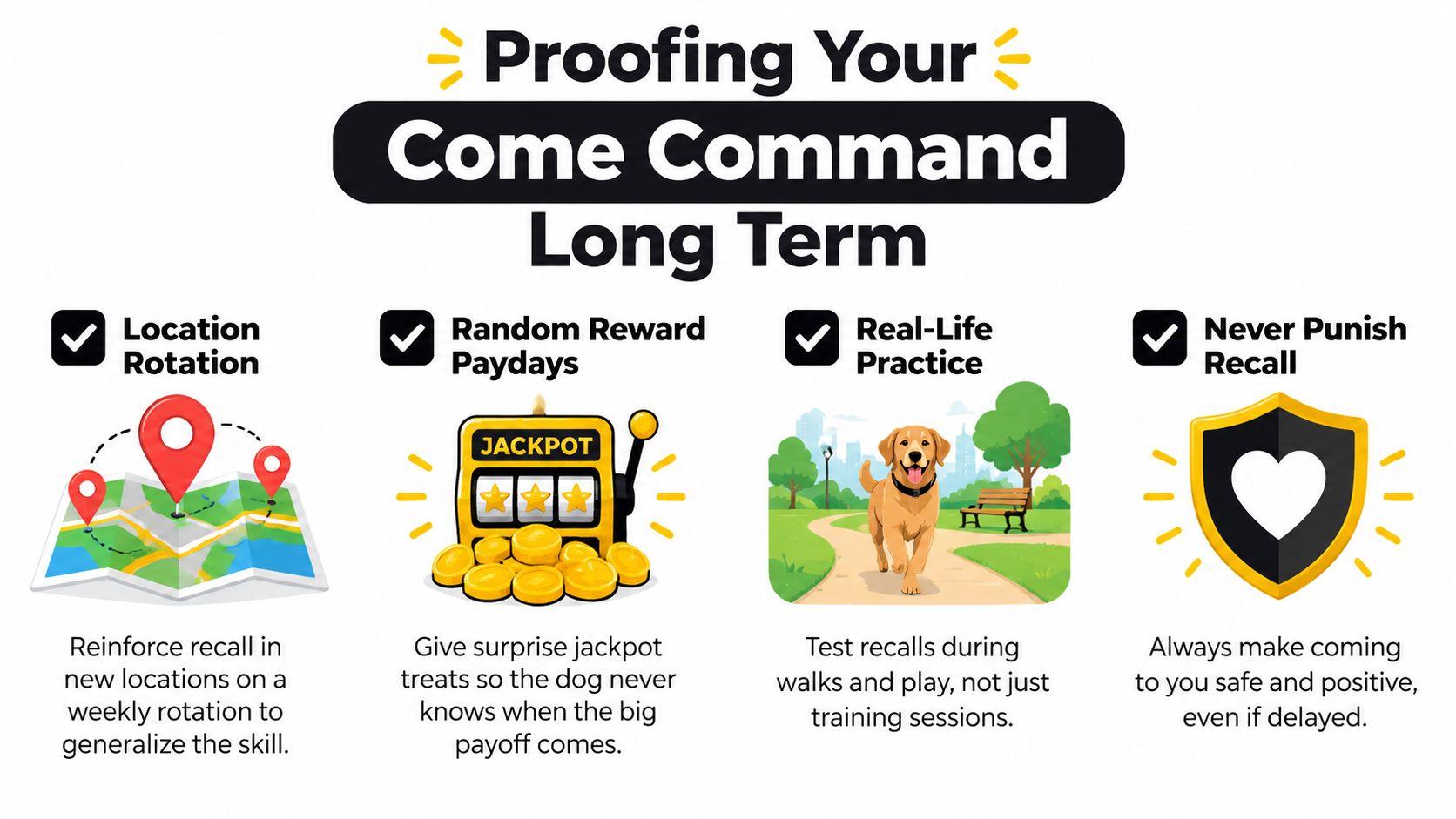
Find the exact failure context, lower the difficulty until your dog can win, reward the decision to return, and protect the cue from unpleasant associations. That's how to make a dog come to you reliably, not by demanding more from a dog who hasn't been prepared for the situation.
If your dog's recall fails around specific distractions, PawCraft can build a personalized 30-day plan around your dog's breed, age, environment, and behavior challenges, including daily exercises and clear progression criteria. Visit PawCraft to create a structured recall plan you can start using today.